Japan’s SoftBank has steadily become one of the most aggressive investors in the world. Led by the flamboyant Masayoshi Son, the company has deployed some $30 billion of its massive $100 billion Vision Fund in startups across the globe, and is set to raise a second fund of equal size.
Japan’s SoftBank has steadily become one of the most aggressive investors in the world. Led by the flamboyant Masayoshi Son, the company has deployed some $30 billion of its massive $100 billion Vision Fund in startups across the globe, and is set to raise a second fund of equal size.
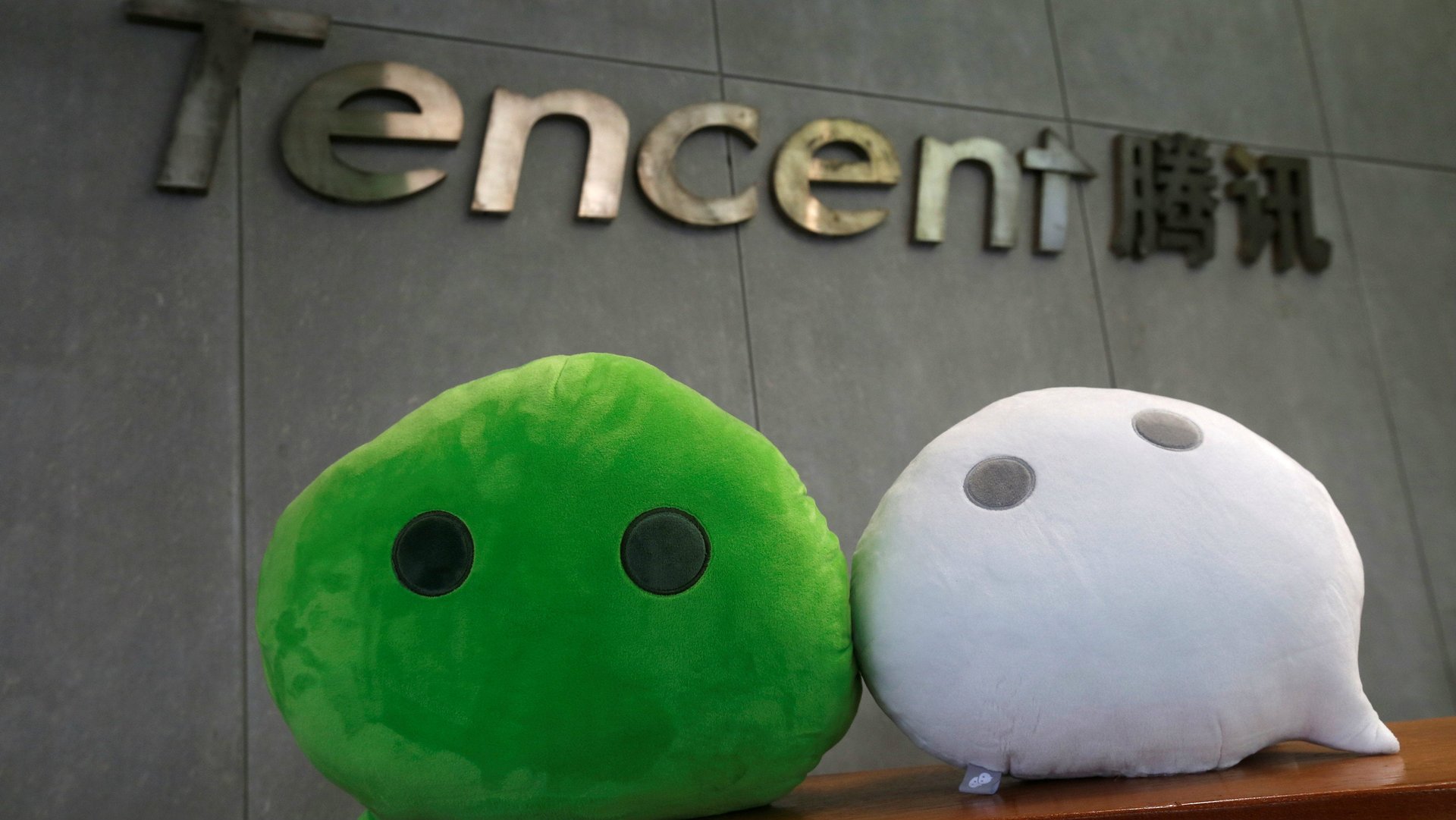
China, less flamboyantly, is home to an equally aggressive investor. Tencent, the social media company best known for its messaging app WeChat, has been funding dozens of Chinese and overseas companies over the past few years at an astonishing rate. Yesterday, the company posted a stellar earnings report for the first quarter, with net profit up 61%. While those earnings were largely driven by gaming, around a quarter of the company’s operating profit also came from gains made on its investments in other companies. Its investing is expansive enough that Bhavtosh Vajpayee, research analyst at Sanford Bernstein, this week dubbed Tencent “” (paywall) in an interview with The Wall Street Journal.
Join 500,000+ readers who start their day with Quartz.
By subscribing, you agree to our Terms of Service and Privacy Policy.
It’s an apt comparison. To date, SoftBank’s $100 billion Vision Fund has invested $29.7 billion in 24 companies, according to SoftBank’s most recent financial report (pdf). Many of these companies have nothing to do with one another, let alone SoftBank’s core telecommunications business; in some cases, it has put money into rivals in the same industry. Its portfolio includes Uber $UBER and Didi, WeWork, chip designer ARM, and GPU maker NVIDIA.
Tencent, meanwhile, is a social media and games company that makes money from virtual goods purchases. Yet it’s also a deep-pocketed venture capital investor. Typically Tencent funds in companies along with several co-investors who only reveal the total size of the round. That makes it difficult to know how much Tencent alone has contributed to each company. Research firms Hurun and GlobeData estimate that Tencent and its affiliates spent $6 billion on overseas investments in 2017. Vajpayee, the Bernstein analyst, tells Quartz he calculates that it spent upwards of $30 billion for its investments between 2015 and 2017.
Many, though not all, of Tencent’s investments are tangential to its core business. The company has invested in ride-hailing, retail, online media, and electric car makers both inside and outside China. During this year and last it picked up a 12% stake in Snap $SNAP, a 7.5% stake in Spotify $SPOT,and a 5% stake in Tesla $TSLA that by now is worth $2.4 billion. Just in the last year, it participated in or led several equity rounds, including the following:
During the year to date, Tencent has participated in 43 investment deals, according to data from Sanford Bernstein and Crunchbase. It participated in 72 investment deals in 2017 and 50 in 2016. At its current rate, it’s outpacing both SoftBank and arch-rival Alibaba in deal volume.
What’s not clear is whether or not Tencent, like SoftBank, has a grand vision that explains its disparate investments. SoftBank founder Son speaks frequently of the “Singularity,” the notion that robots and artificial intelligence will merge with or replace the human species, and more recently has spoken of being guided by Yoda-like gut instinct. Tencent CEO Pony Ma, by contrast, is known for shunning the spotlight and has seldom made any grand pronouncements about Tencent’s future.
