The world’s most important financial benchmark—the London Interbank Offered Rate (LIBOR)—is about to undergo a facelift that could affect everything from the interest rate you pay on your mortgage to the rate at which complex derivatives like interest rate swaps are settled in the market. Over the last few months, regulators have discovered that bankers were attempting to deliberately influence LIBOR for their own benefit, leading to scandals, resignations, and criminal investigations. Today, the UK Financial Services Authority’s head, Martin Wheatley, set forth a series of proposals meant to revise—rather than completely replace—the rate. His suggestions present what is probably the best solution to a tricky problem.
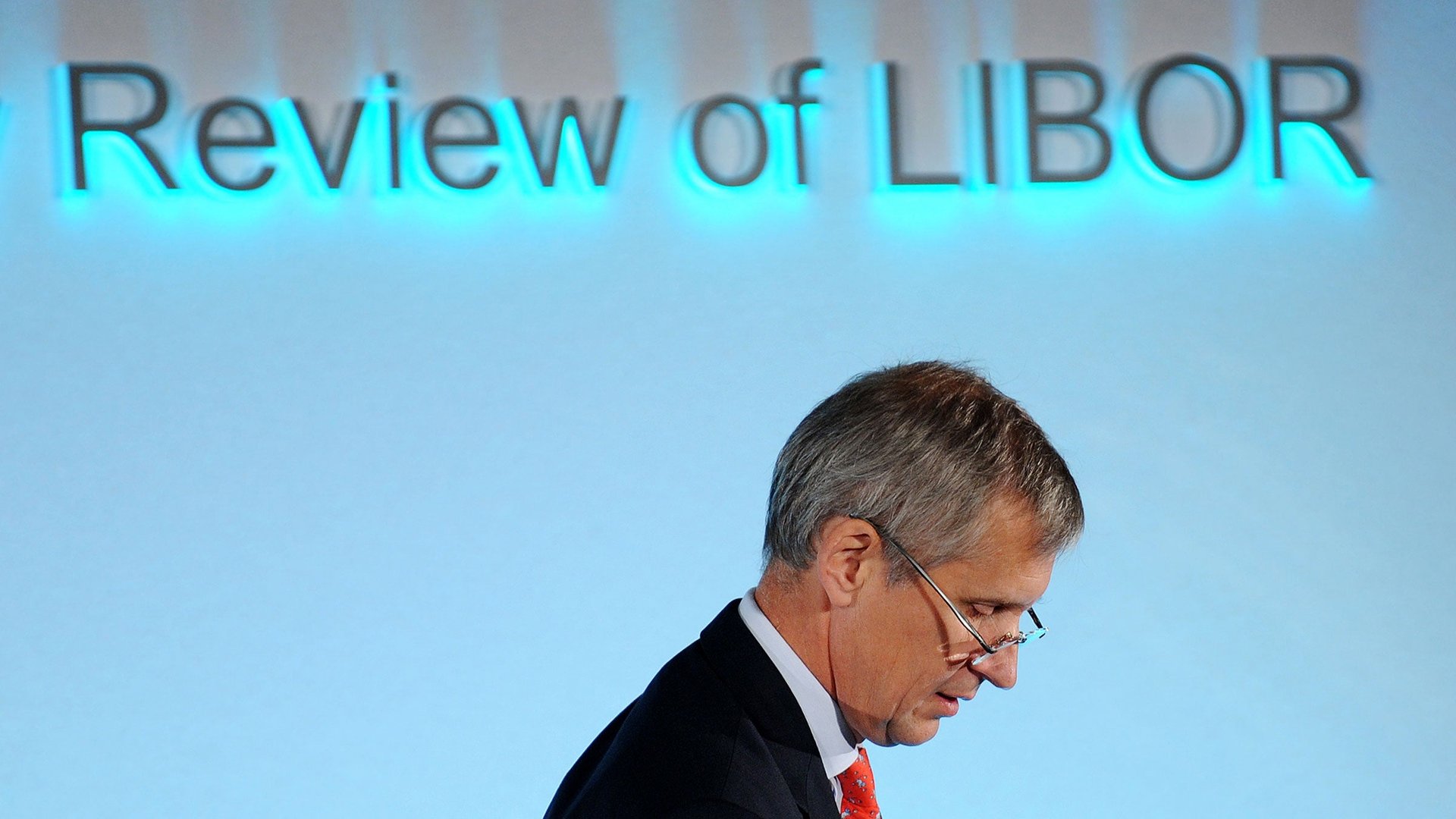
The world’s most important financial benchmark—the London Interbank Offered Rate (LIBOR)—is about to undergo a facelift that could affect everything from the interest rate you pay on your mortgage to the rate at which complex derivatives like interest rate swaps are settled in the market. Over the last few months, regulators have discovered that bankers were attempting to deliberately influence LIBOR for their own benefit, leading to scandals, resignations, and criminal investigations. Today, the UK Financial Services Authority’s head, Martin Wheatley, set forth a series of proposals meant to revise—rather than completely replace—the rate. His suggestions present what is probably the best solution to a tricky problem.
A little background on how LIBOR is calculated: Each day, the world’s most important and highly rated banks submit to Thomson Reuters an estimate of the rate at which they can borrow for a variety of durations in a variety of currencies. In times of financial stability, the rates at which these “prime” banks can borrow are relatively similar. But to control for inaccuracies, the data center eliminates the outliers and takes an average of the remaining submissions to come up with a LIBOR rate. The British Bankers’ Association (BBA) publishes these rates and each bank’s submissions on a daily basis. The reason this went awry was that during the crisis, all the banks had an interest in lying about the rates they were borrowing at, because admitting to higher rates would have exposed how precarious their positions were becoming. And the system was set up in such a way that this lying was easy for them to conceal.
Join 500,000+ readers who start their day with Quartz.
By subscribing, you agree to our Terms of Service and Privacy Policy.
Wheatley and his team came up with a number of recommendations about how to revise the rate and the submission process to eliminate manipulations:
It is important to recognize that there were two distinct pieces of the LIBOR scandal. These recommendations will not completely prevent the most heinous manipulations of the rate, which took place before the financial crisis began. The most stunning of the accusations against Barclay’s come from this period. In moments of financial prosperity, LIBOR varies little from bank to bank, making the rate relatively easy to manipulate. Based on documents released by the FSA in June, a manipulation in the rate by just one basis point (0.01%) would have won Barclays some $2 million on one contract in 2006 (in that case, the traders failed). Most bankers believe that such manipulations were standard practice for bankers at submitting firms.
Even with a cartload of data on bank lending to analyze, it will be difficult for an oversight committee to determine why a bank would have said it could borrow at a rate of 0.91% versus 0.92% for any given day. But such minuscule adjustments in the rate matter little to businesses and individuals, who see little difference between paying a rate of 4.67% and 4.68% on their mortgages. And while they are bad for its reputation, these aren’t the allegations that have truly discredited LIBOR.
Wheatley’s recommendations will prevent far more significant manipulations in the rate, however, like those that occurred during the financial crisis. In 2007 and 2008, banks began submitting artificially low data because their submissions were available to the public, and so became a sign of their individual creditworthiness. That—and the fact that banks simply stopped lending to each other—rendered LIBOR an almost meaningless indicator. Wheatley’s recommendations would probably prevent a repeat of this. LIBOR’s new oversight committee will have the ability to detect significant manipulations of LIBOR meant to disguise funding problems. Submissions will be released on a three-month delay, reducing their usefulness as a signal of a bank’s financial health.
But most importantly, Wheatley attempts to return LIBOR to what it was meant to be—a high-brow measure of interbank lending. He urges firms to rethink their dependence upon the rate and to use different financial benchmarks for most commercial products. At the same time, Wheatley argues that regulators should stay away from directly influencing the rate and becoming part of the oversight committee, leaving the markets to function like markets. It remains to be seen if Wheatley’s recommendations will be adopted or even enforceable, but they certainly seem like a step in the right direction.
