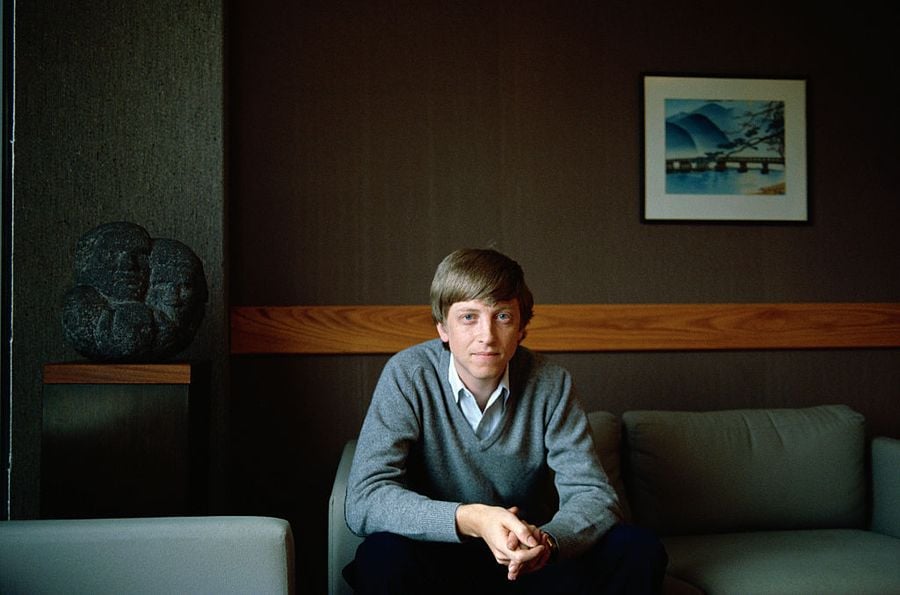
Bill Gates in 1984 (Doug Wilson/CORBIS/Corbis via Getty Images)
A version of this article originally appeared in Quartz’s AI & Tech newsletter. Sign up here to get the latest AI & tech news, analysis and insights straight to your inbox.
Bill Gates turns 70 today. For the last 25 years he's been the Gates Foundation philanthropist, giving away $100 billion to fight disease and poverty. That legacy will reshape global health. But he left another mark during his time at Microsoft $MSFT that's still reshaping Silicon Valley years later: He wrote the playbook for how tech companies dominate markets.
Watch OpenAI's recent moves as it races to capture AI while asking forgiveness rather than permission, and you're watching tactics Gates pioneered in the 1990s when he built Microsoft into a colossus. The Gates doctrine was simple: capture the market first, negotiate with the wreckage later. That approach built Microsoft, and now it's building the AI industry.
Microsoft dominated the PC market through genuine innovation. But then, for good measure, it squeezed.
Gates made Windows the only operating system PC manufacturers could realistically sell, then used that monopoly like a weapon. Computer makers who wanted to install competing browsers or software faced losing Windows entirely, which would be corporate death in the 1990s. Internet Explorer felt impossible to delete from your PC no matter how hard you tried, and Microsoft claimed doing so would break the operating system. When the government finally sued, Gates spent his 1998 deposition playing dumb, pretending not to understand what "compete" meant. But his internal emails told a different story, with executives plotting to "cut off Netscape's air supply."
Breaking news: OpenAI has restructured as a for-profit company
Fast forward to 2025, and OpenAI has perfected Gates' formula for the AI age. First came the great data grab, training its models on the entire internet without asking anyone's permission, turning decades of human creativity into AI fuel. Then came the pattern of overreach and retreat. Earlier this month, OpenAI "paused" Sora's ability to generate videos featuring Martin Luther King Jr.'s likeness after the King estate complained. Last year, it pulled a Scarlett Johansson-esque voice from ChatGPT after Johansson complained.
Last week's launch of ChatGPT Atlas, OpenAI's browser, represents the apotheosis of this approach. Like Microsoft forcing Internet Explorer on every PC user, OpenAI wants Atlas to become the lens through which people experience the internet itself. Why search Google $GOOGL when ChatGPT can summarize? Why visit websites when an AI agent can browse for you? It's the same play Microsoft ran with Explorer, except this time the goal isn't just to control the browser. It's to become the internet's new operating system.
Microsoft's antitrust case hinged on the company forcing users to take products they didn't want, leveraging Windows' dominance to crush competition. The parallels to OpenAI are uncanny. Except this time the bundled product isn't a browser, but rather an entire worldview filtered through large language models trained on data OpenAI grabbed first and licensed maybe never.
Yet history suggests OpenAI might be onto something. Microsoft's Internet Explorer commanded 90% market share at its peak before becoming what one analyst called a "laughing stock" within years of the antitrust ruling. But Microsoft survived, thrived, and Gates walked away to become humanity's favorite billionaire. The fines were pocket change. The breakup never happened. The market moved on.
The difference now is that regulatory intervention is even less likely. The Trump administration sees AI dominance as a national security imperative. It’s more likely to help OpenAI become a behemoth than break it up, all in the name of beating China to artificial general intelligence.
The ultimate irony is that Microsoft is now OpenAI's biggest investor, partner, and future rival. The partnership is already showing cracks. Microsoft has reportedly been frustrated by OpenAI's compute demands and has started building its own AI models. OpenAI, meanwhile, is trying to reduce its dependence on Microsoft's cloud infrastructure.
Microsoft didn't invest $13 billion just to watch OpenAI eat its lunch. Two days after OpenAI announced Atlas, Microsoft unveiled an almost identical "Copilot Mode" for its Edge browser. The company that Gates built still has some bite.
Gates told NPR recently, "It was only as I was turning 70 this year, and Microsoft turning 50, that I decided, OK maybe it is time to look back a bit." But looking back reveals we're actually looking forward.
The question isn't whether OpenAI will face its own antitrust reckoning. It almost certainly will, if not under this administration then later. The question is whether it will matter. Gates proved you could bulldoze your way to dominance, pay the toll, and still end up the hero of your own story.
Happy 70th, Bill. Your legacy isn't just the billions you're giving away. It's the playbook Silicon Valley still can't quit.
