Aadhaar, the world’s largest biometric identity programme, is constitutionally valid, the supreme court of India ruled today (Sept. 26).
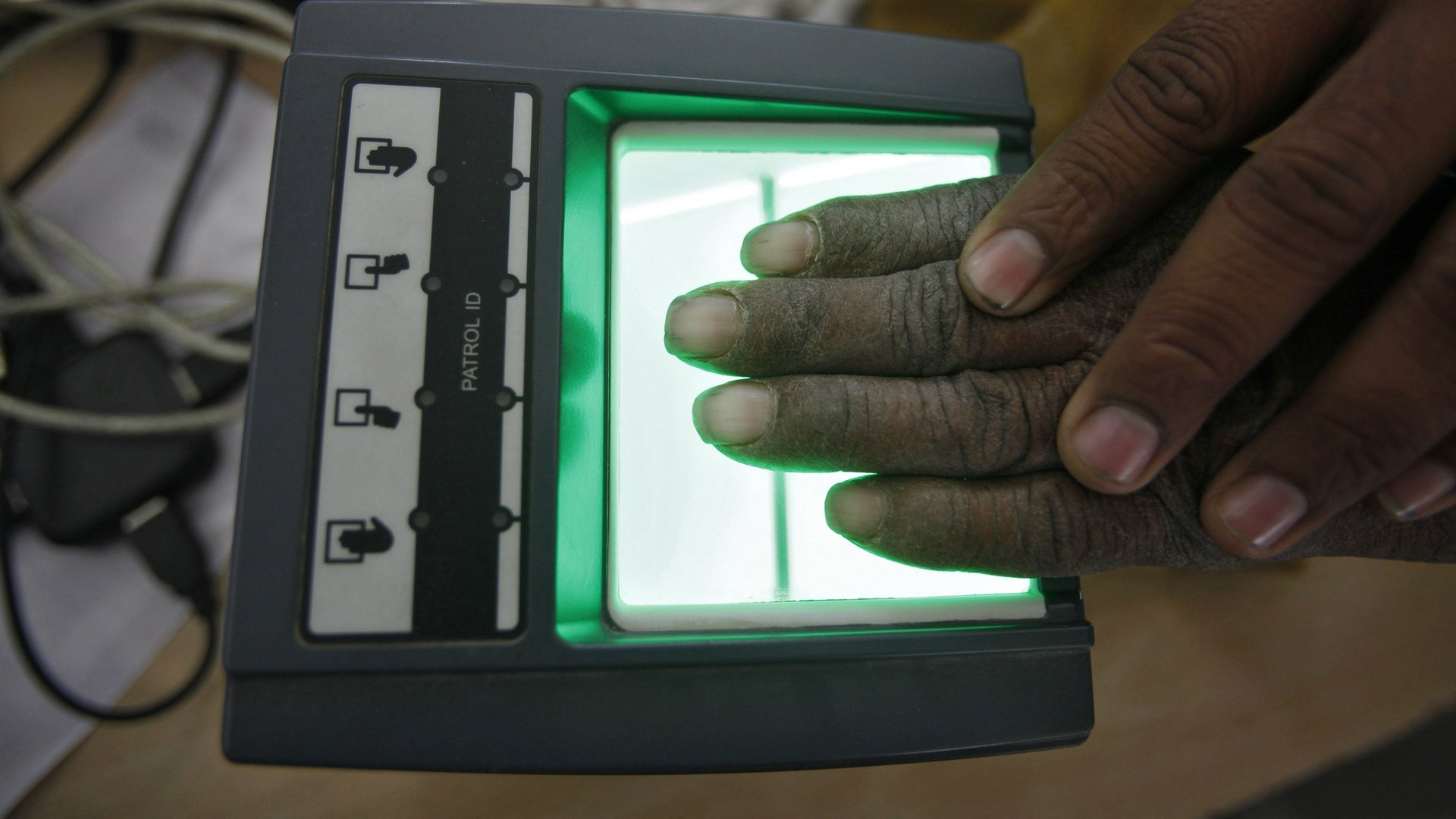
Aadhaar, the world’s largest biometric identity programme, is constitutionally valid, the supreme court of India ruled today (Sept. 26).
However, the court struck down key provisions of the programme. Aadhaar will continue to be required for government welfare schemes, but banks and other private companies can no longer use the platform for their verification requirements.
Join 500,000+ readers who start their day with Quartz.
By subscribing, you agree to our Terms of Service and Privacy Policy.
This verdict comes over a year after the supreme court ruled that Indians have a fundamental right to privacy.
Created in 2009 and administered by the Unique Identification Authority of India (UIDAI), Aadhaar is a biometrics-based identity database that was conceived of as a way to ensure the effective disbursal of public benefits.
Its scope has since widened hugely, with the Narendra Modi government making it mandatory to access many other state schemes, and private entities like telecom companies latching on to the platform. After the court’s judgment, many of these linkages will be rolled back.
Critics claimed the government’s orders that people link their Aadhaar for services were coercive, and are the reason for enrollment in the programme being so high. Over 1.22 billion Indians, nearly India’s entire adult population, have Aadhaar numbers.
Other issues raised about the programme, many of which are addressed in the judgment, have been concerns over privacy, surveillance, security, and various implementation failures, most specifically the denial of services due to failures in the programme’s technical infrastructure.
Here are some of the key points of the judgment:
Justice DY Chandrachud, however, issued a strong dissent to the majority opinion, in which he stated that the passage of the Aadhaar Act, as well as the programme in its entirety, is unconstitutional. Justice Ashok Bhushan also issued a separate judgment, which, although it did not declare Aadhaar unconstitutional, stated that the money-bill classification could be submitted for judicial review.
The supreme court hearing, which lasted 38 working days spread over 4 months, was the second-longest in the history of India’s supreme court.
