Huang, the swaggering high priest of Silicon Valley’s AI chip economy, arrived in Washington to deliver a sermon rewritten for the new regime
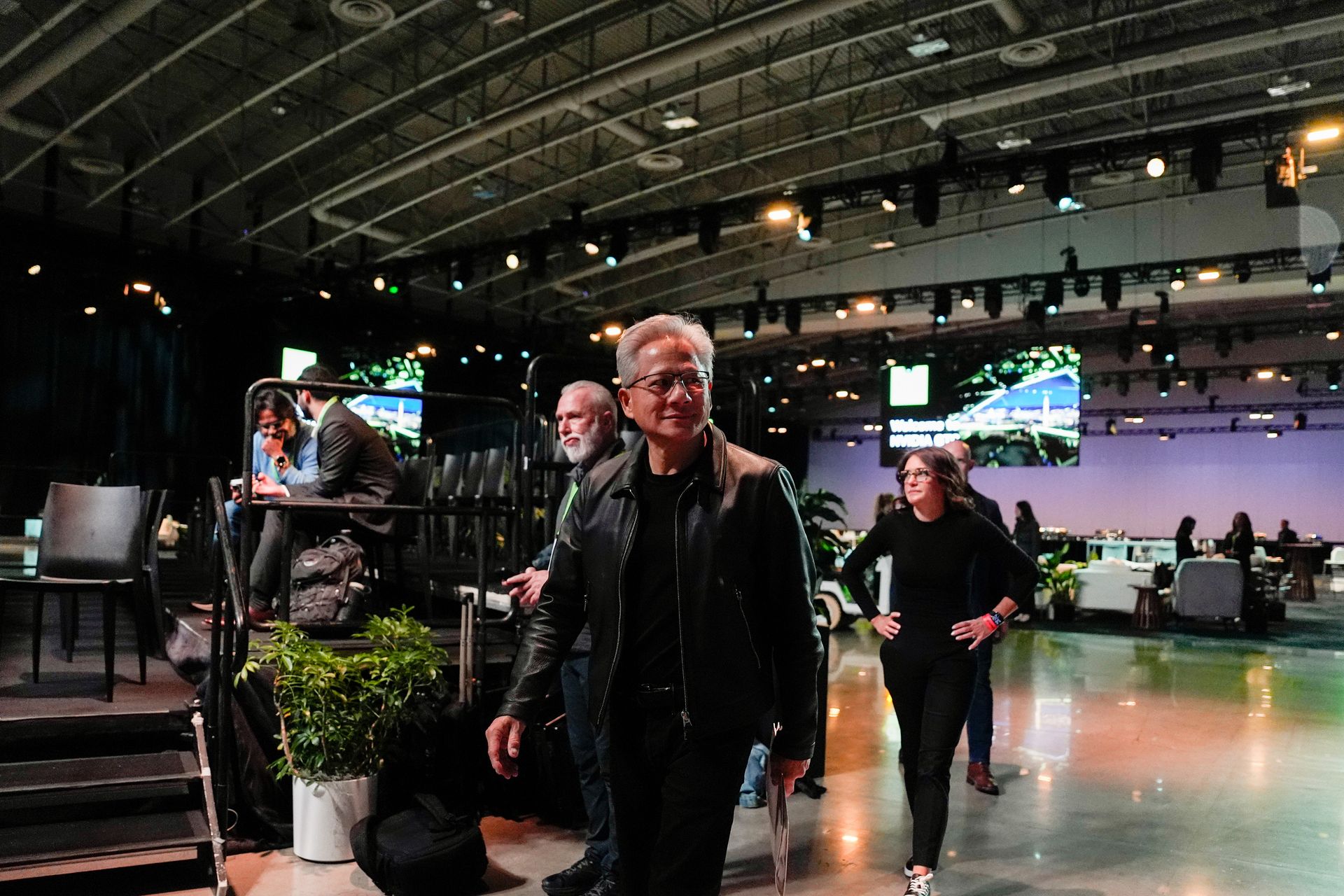
Kent Nishimura/Bloomberg via Getty Images
WASHINGTON — For a moment, Jensen Huang looked like a man waiting for permission to believe his own line.
The Nvidia $NVDA CEO had just told assembled reporters Tuesday that he was “incredibly proud and delighted to help contribute in a small way to what will clearly be a historic and national monument for our country” — his answer to whether Nvidia had helped fund President Donald Trump's construction of a new White House ballroom. He went on about the “majesty” of America's capital, calling it “the best home-court advantage of any country in the world.” Then he turned to the reporters in front of him and asked, “Do you guys agree?”
Join 500,000+ readers who start their day with Quartz.
By subscribing, you agree to our Terms of Service and Privacy Policy.
The silence that followed could have powered a data center. It broke only when Nvidia’s media staff, stationed along the back wall, began to clap — a little too hard, a little too soon, as if applause were part of the deliverables.
Huang hadn’t just answered. He had auditioned.
The exchange was one of the most telling moments from this year’s Nvidia GTC in Washington — and this time, the summit felt a bit less like a developers’ conference than a declaration of fealty. Huang, long the swaggering high priest of Silicon Valley’s AI chip economy, arrived to deliver a sermon rewritten for the new regime. The words “President Trump” punctuated almost every answer as he spoke with reporters on Tuesday. The tone wasn’t defiant or even diplomatic. It was devotional.
When Huang spoke about manufacturing, he echoed Trump’s favorite refrain: “Manufacturing in America brings back jobs, secures our national security, and makes America rich again.” He praised the president’s “leadership” on energy. He thanked Trump for unleashing “the dream of AI leadership,” framing the president not as a disruptor but as a visionary who had “made this dream possible.”
It was a performance calibrated to Washington’s new order — one that has turned Silicon Valley’s titans into supplicants. And the approach has clearly been good for business: Nvidia on Wednesday became the first company to ever hit a $5 trillion market cap.
For nearly an hour Tuesday, Huang extolled Trump’s “leadership” to assembled reporters, tied his company’s growth to national defense, and used every policy question to demonstrate loyalty to the new order. He continued the message later during his conference keynote address. “All of my conversations with the president are about manufacturing in America,” Huang told reporters. “This president works like mad to help America be great and for America to win.”
That phrasing — help America win — came up again and again.
Huang has always spoken in systems: chips, networks, economies. But in Washington, the circuitry was political. The first word of his keynote was “America.” Before he even spoke, the lights dimmed and a slick highlight reel of U.S. industry played behind him: “Every leap, America led,” Huang said via voiceover. “Now, the next era is here.” It was a GTC that opened like a campaign ad.
Huang portrayed Nvidia as part of the backbone of Trump’s new industrial map — an ecosystem of factories, power plants, and “AI supercomputers” that would make America, in his words, “the richest and most secure nation in the world.”
Asked about U.S. chip restrictions on China, he didn’t argue policy: He recited hierarchy.
“We want America to win this AI race. No doubt about that,” Huang said. “We want the world to be built on the American tech stack.” Only later did he insert the pragmatic caveat — that cutting off Chinese developers could “hurt us more” — and even that was wrapped in a pledge of faith. “It’s a fine line,” he said, “but the goal is clear.”
Every technical question turned into an affirmation of Trump’s industrial gospel. Talk of energy shortages became praise for “a president who is pro-energy, pro-growth, pro-America.” A conversation about chip packaging — still dependent on Taiwan — became a story of on-shoring foretold: “Nine months after his administration, here we are manufacturing [Blackwell chips] in America.” He threaded together the language of production and patriotism until they became interchangeable.
What Huang is doing isn’t simple flattery: It’s institutional alignment. Huang was translating Nvidia’s strategy into Trump’s idiom — a public offering not of equity, but allegiance.
Huang said he had scheduled GTC in Washington so the president could attend, and although Trump’s calendar changed, Huang said he plans to meet him this week as the president travels in Asia. Their relationship has already shaped Huang’s image as much as his itinerary. He joked that he owns “one suit and one tie” — both purchased for meetings with Trump. It was the kind of self-effacing aside that doubles as a confession: The man who made the leather jacket his schtick now dresses for Trump.
To the audience of policymakers, the subtext landed clearly: Nvidia would be the compliant engine of Trump’s “AI action plan,” the private sector behemoth that plays inside the government’s new industrial sandbox.
“I come with only one purpose,” Huang said. “To inform and to be in service of the president as he thinks about how to make America great.”
That kind of language would have been unthinkable a year ago, when most of tech’s leadership still clung to post-partisan neutrality. Now it’s currency. Every multibillion-dollar buildout depends on power — literal and political — and Nvidia’s future hinges on federal energy approvals, export regimes, and defense contracts. A company that once evangelized for technological destiny now preaches the virtue of obedience.
This is what deference looks like in the industrial-policy era: A CEO who built the world’s most valuable company offering his achievements as patriotic infrastructure.
He announced that Nvidia would build seven new AI supercomputers for the Department of Energy — part of his argument that the company’s hardware had become national infrastructure. “Because of what you have done,” he told Energy Secretary Chris Wright, “Nvidia is building seven supercomputers here for the DOE labs,” before heaping even more praise on the administration official. “I want to thank you for for everything that you’re doing to accelerate science and putting your will, your force, your your your energy, your spirit behind advancing science for the United States.”
That’s the quiet genius of Huang’s Washington turn. He isn’t capitulating: He’s institutionalizing. By treating Trump’s agenda as Nvidia’s, Huang ensures that Nvidia’s growth remains a national priority. The subtext of every vow — to manufacture in America, to power American science, to secure American energy — is that the country cannot win without him.
But in serving the narrative so completely, he’s also surrendering control of it. Nvidia’s authority has always come from conviction: the physics, the inevitability, the market’s collective faith in his forecasts. In Washington, faith is contingent. You don’t inspire it, you perform it.
The deeper irony is that Huang’s vision and Trump’s rhetoric overlap more than either side admits. Both treat technology as destiny, both believe national might depends on industrial scale, and both see control — of supply chains, of energy, of narrative — as the ultimate proof of sovereignty. What Huang offered this week was the merger: an AI empire recast as patriotic service.
When Huang's briefing with reporters ended, he stepped offstage and said, almost to himself, “Alright, let’s go help America win.”
The line wasn’t applause bait this time. It was punctuation — the end of a speech, the beginning of a submission, and the sound of Silicon Valley learning how to kneel.
