
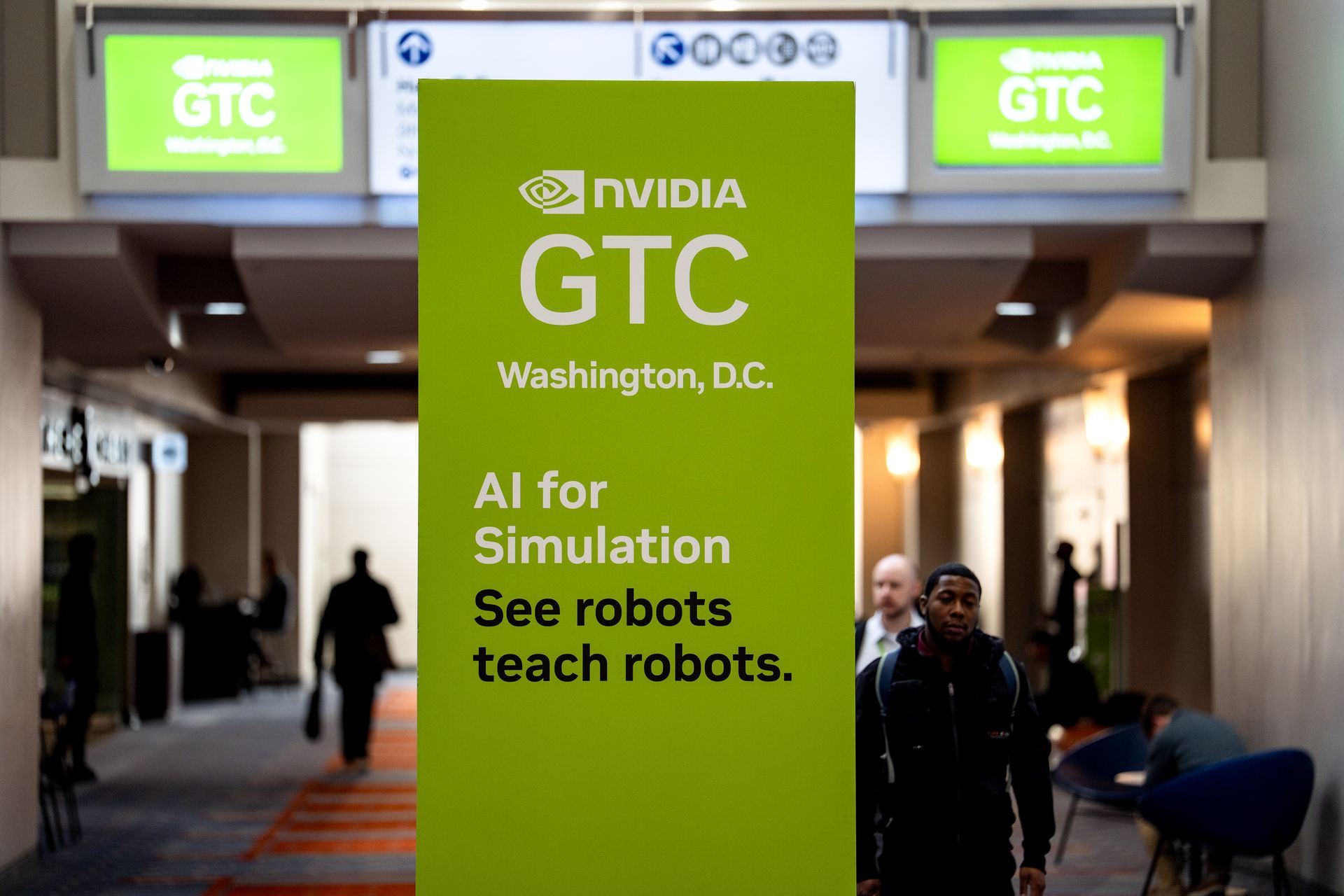
WASHINGTON — Jensen Huang brought his leather jacket — and the company’s new industrial policy — to Washington.
Nvidia’s Washington GTC wasn’t just a product showcase — it was a policy statement, positioning AI as the next pillar of U.S. industry
Kent Nishimura/Bloomberg via Getty Images
WASHINGTON — Jensen Huang brought his leather jacket — and the company’s new industrial policy — to Washington.
At Nvidia $NVDA’s GTC on the banks of the Potomac, the company that built Silicon Valley’s chip economy came to Washington to argue that AI is now part of America’s industrial base. The firm used the main stage to introduce what it calls “physical AI” — intelligence that moves through factories, robots, and vehicles — and to position Nvidia’s stack as the infrastructure that will power it.
GTC has long been the company’s developer showpiece, a blend of performance charts and prophecy where Huang tells engineers what tomorrow will look like. But this audience was different: policymakers, researchers, and executives from industries that still rely on steel, power, and people. The tone matched the setting.
But Washington wasn’t just a backdrop. Nvidia used its capital debut to make an explicit policy play, casting its GPUs as national infrastructure and its software stack as the backbone for everything from industrial automation to federal computing. The company unveiled an “AI Factory for Government,” a secure reference platform developed with partners such as Palantir $PLTR, ServiceNow $NOW, and Lockheed Martin $LMT to power agencies and defense workloads at scale.
The message was clear: If the next era of industry is intelligent, the government should be buying compute by the gigawatt, too. That argument — that compute is the new infrastructure — bled seamlessly into Nvidia’s industrial pitch. If Washington needs AI to govern, industry needs it to build.
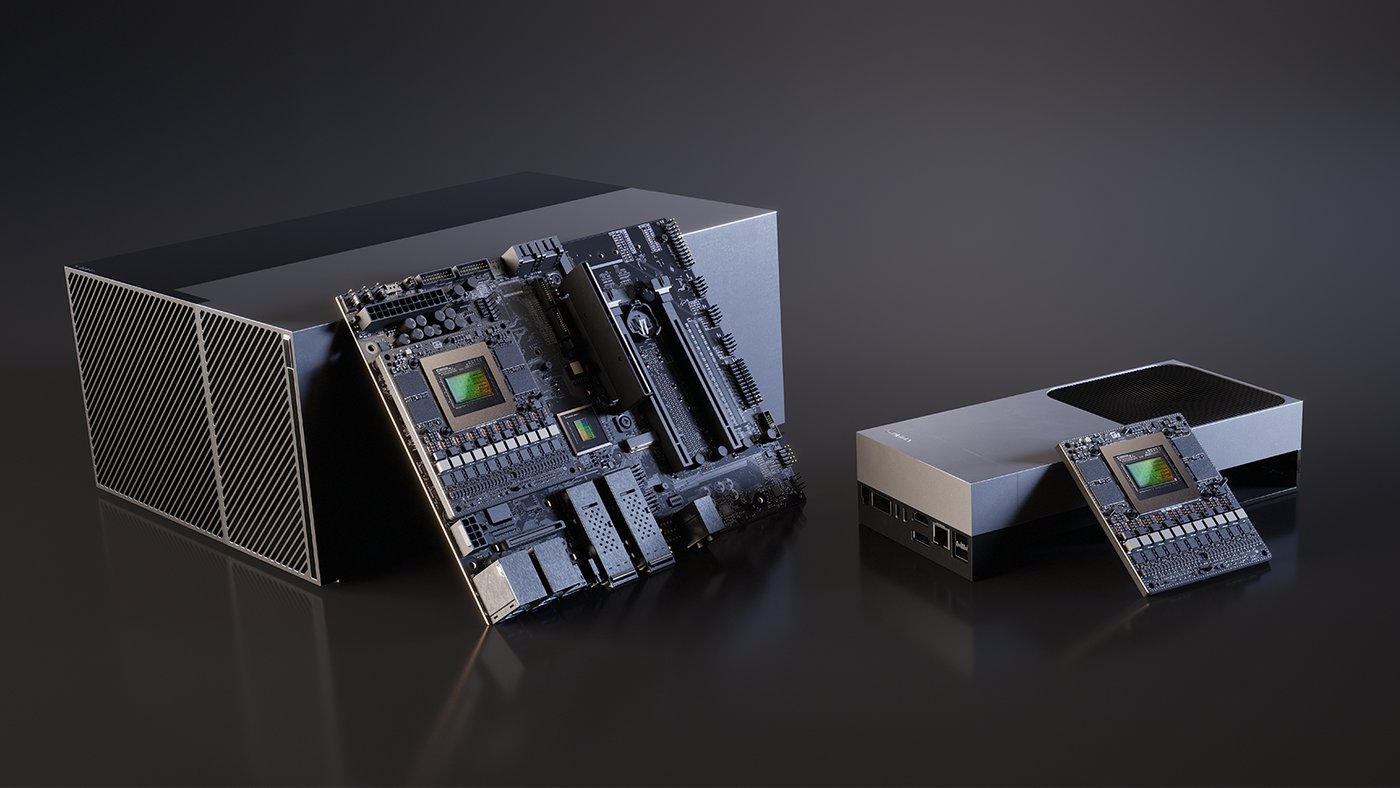
The NVIDIA IGX Thor robotics processor, which Nvidia says will bring real-time physical AI to the industrial and
medical edge.
Nvidia’s case in Washington wasn’t about invention so much as assembly: a synthesis of chips, partners, and policy. Its newest platform, Omniverse DSX, is a digital blueprint for what it calls AI factories — gigawatt-scale data centers designed like industrial plants. Engineers can co-design construction, power, and cooling inside a shared simulation, then run the same twin as the facility’s control system once it’s live.
Nvidia says that approach can make deployment up to 500 times faster, boost efficiency by 30%, and increase throughput by 14%. The method is already in use at the company’s AI Factory Research Center in Manassas, Virginia.
The foundation for those digital twins is a new layer of AI physics. Nvidia says its accelerated computing can now speed up traditional solvers by as much as 80 times, while new AI-based physics models simulate complex fluid dynamics in real time. Working with partners such as Synopsys $SNPS and Ansys Fluent, those models have achieved performance gains of up to 500 times, shrinking design cycles from weeks to minutes.
Those blueprints sit atop new plumbing. The BlueField-4 DPU and ConnectX-9 SuperNIC (1.6 terabits per second) form the fabric of Nvidia’s so-called operating system for AI factories, tying thousands of GPUs together over its Spectrum-X $TWTR Ethernet network. They’re the silent infrastructure behind a new class of industrial supercomputers — from Stargate (1.2 gigawatts) in Abilene, Texas to Switch’s 2-gigawatt build in Georgia — each built to feed the same appetite for compute that once powered cloud software.
At the edge, IGX Thor turns that architecture into something physical. The industrial-grade Blackwell computer delivers 5,581 FP4 teraflops of performance and 400-gigabit Ethernet connectivity, with a 10-year lifecycle meant for factory floors and surgical rooms rather than data halls. Two models, the T5000 and T7000, are expected to arrive in December; early adopters include Diligent Robotics, EndoQuest Robotics, Hitachi Rail, and Joby Aviation, with CMR Surgical also evaluating the platform.
Nvidia describes IGX as the “industrial runtime” in a three-computer robotics stack — DGX for training, RTX for simulation, and IGX for real-world inference — built for industrial and medical environments with functional-safety integration for the kind of safety and reliability that are demanded in medical and manufacturing settings.
That hardware runs the same “three-computer” pipeline Nvidia now applies everywhere: train on DGX systems, simulate on RTX servers and Omniverse, deploy on Jetson or IGX. Diligent Robotics trains hospital couriers in Isaac Sim; Johnson & Johnson $JNJ refines surgical arms; Figure AI tests humanoids in Isaac Lab before installing their brains on Jetson Thor. In Nvidia’s taxonomy, these are no longer robots but the first employees of a computational workforce.
The next step is building the places where those machines will build everything else. In Houston, Texas, Foxconn is using Omniverse to model and operate a 242,000-square-foot plant that will assemble Nvidia’s AI systems. Siemens is releasing a new Omniverse-based app that lets manufacturers design and test entire facilities in 3D; FANUC and Foxconn Fii are supplying OpenUSD robot twins that drop directly into those digital models.
To keep production lines from colliding, Nvidia introduced Mega, a simulation framework that lets engineers test fleets of robots and factory controllers in virtual sync. Safety comes from Halos, an overhead vision-AI system that watches the floor and automatically slows or stops machines when people cross their paths. The company has created an ANSI-accredited Halos Inspection Lab to certify functional safety for physical AI.
The ecosystem now reads like a who’s who of heavy industry. Caterpillar $CAT is using digital twins to train autonomous equipment; TSMC $TSM and Toyota $TM are simulating production lines; Belden and Accenture $ACN built a “physical AI orchestrator” for industrial optimization; and Lilly is running a 1,016-GPU Blackwell SuperPOD using Nvidia’s BioNeMo platform to model drug-discovery processes before they reach the lab.
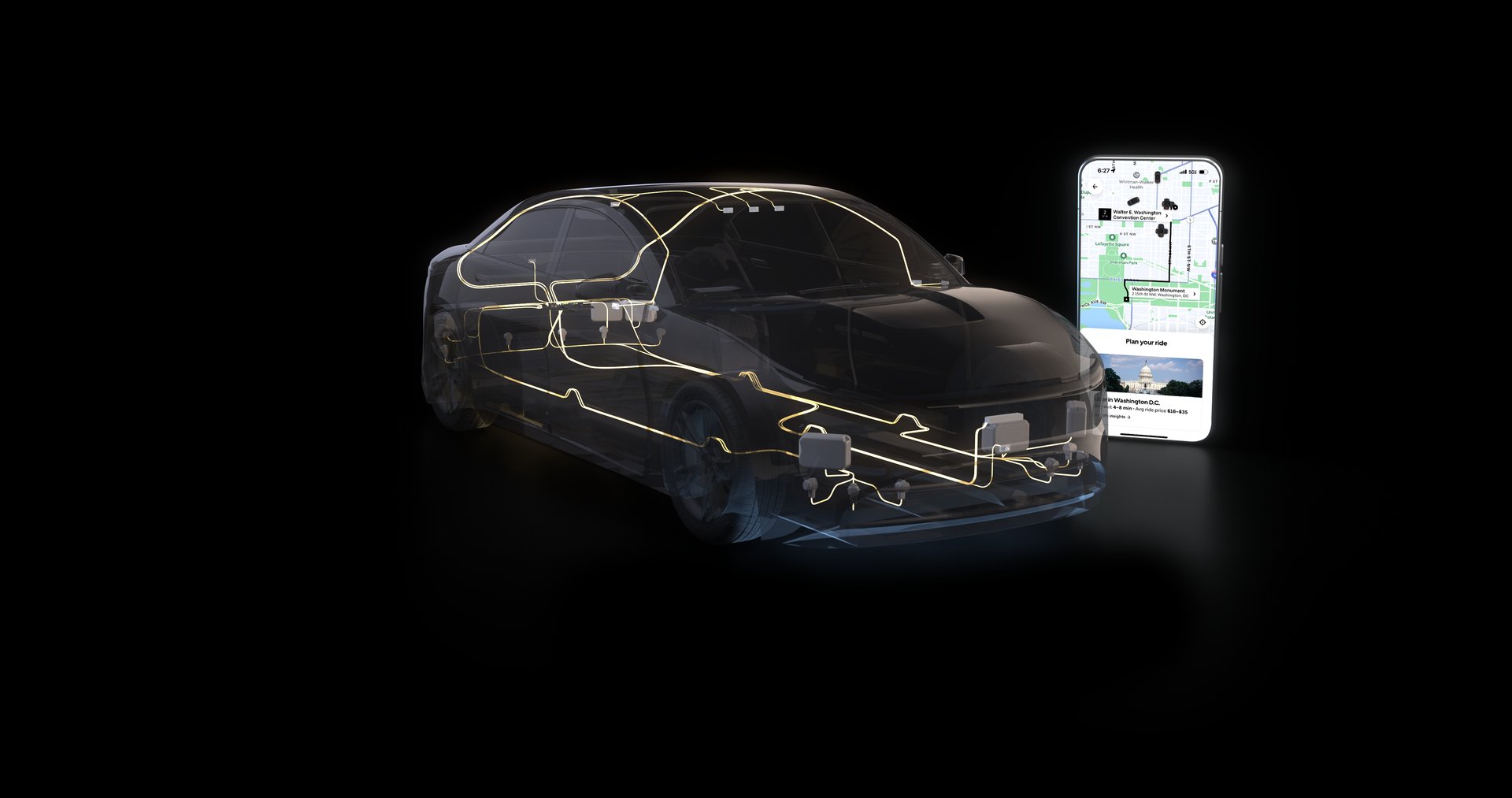
NVIDIA DRIVE AGX Hyperion 10, which Nvidia says is a reference computer and sensor architecture that enables automakers to build level 4-ready, software-defined vehicles on a validated, scalable foundation.
At the Nvidia-hosted pregame event for the keynote address, Huang popped on screen briefly on his way to deliver his big speech and joked, “Every time I say ‘quantum,’ the stock price goes up. Quantum, quantum, quantum.” He had more to say on the topic. When he took to the stage, he announced Nvidia’s next step in the quantum realm: NV and NVQlink, Nvidia’s bid to fuse quantum and classical computing into a single architecture, something the company has been hinting at for months.
“We now have an architecture that can do control, co-simulation, quantum error correction, and scale into the future,” he said during his keynote. The goal is sweeping: to link quantum processing units (QPUs) with Nvidia’s GPUs through a new interconnect that handles everything from calibration and control to error correction and hybrid simulation — the plumbing of post-classical science.
The scale of support is staggering — 17 quantum computing companies and eight Department of Energy labs are already collaborating on NVQ, including Berkeley, Brookhaven, Fermilab, Los Alamos, Oak Ridge, and Pacific Northwest. “Just about every single DOE lab has engaged us,” Huang said, positioning Nvidia as the connective tissue of U.S. research.
The Department of Energy will also partner with Nvidia to build seven AI supercomputers — a direct fusion of the quantum, AI, and robotics pipelines Huang described as “the fundamental instruments of science.” He called it both a “surge of energy” and a “surge of passion” under DOE Secretary Chris Wright, describing a convergence of accelerated computing, AI, quantum modeling, and robotic experimentation.
From there, the story moves from plants to pavement. “There’s one robot that is clearly at an inflection point, and it is basically here,” Huang said in his keynote, “and that is a robot on wheels.” And Nvidia wants in on the game. “I’m expecting this [new computing platform] to be quite successful,” the CEO said.
Drive Hyperion 10, Nvidia’s new Level-4-ready platform, pairs two Thor processors (about 2,000 FP4 TFLOPS each) with a sensor suite of 14 cameras, nine radars, one lidar, and a dozen ultrasonics. The platform underpins coming vehicles from Lucid $LCID, Stellantis $STLA and Foxconn, and Mercedes-Benz, which plans to integrate Thor into the S-Class around 2028.
The biggest deployment will come from Uber $UBER, which plans to roll out 100,000 Level-4-ready vehicles starting in 2027 — cars and trucks from Lucid, Stellantis, Mercedes-Benz, and Volvo Autonomous Solutions — trained inside a joint AI data factory built on Nvidia’s Cosmos engine. Nvidia describes this as the world’s largest Level-4-ready ride-hailing network. To accelerate testing, Nvidia released a 1,700-hour multimodal dataset spanning 25 countries, plus tools such as NuRec (neural rendering), Cosmos Transfer, and Lidar Gen for autonomous-driving simulation.
The company’s reach now extends to airwaves and agencies. Aerial 6G, its software-defined-networking platform, is being open-sourced under Apache 2.0, with Nokia’s ARC-Pro hardware and T-Mobile $TMUS running field trials in 2026. The open-sourcing itself — along with Nokia’s first commercial collaboration and T-Mobile’s pilot — marks Nvidia’s push to make 6G networks part of its AI ecosystem.
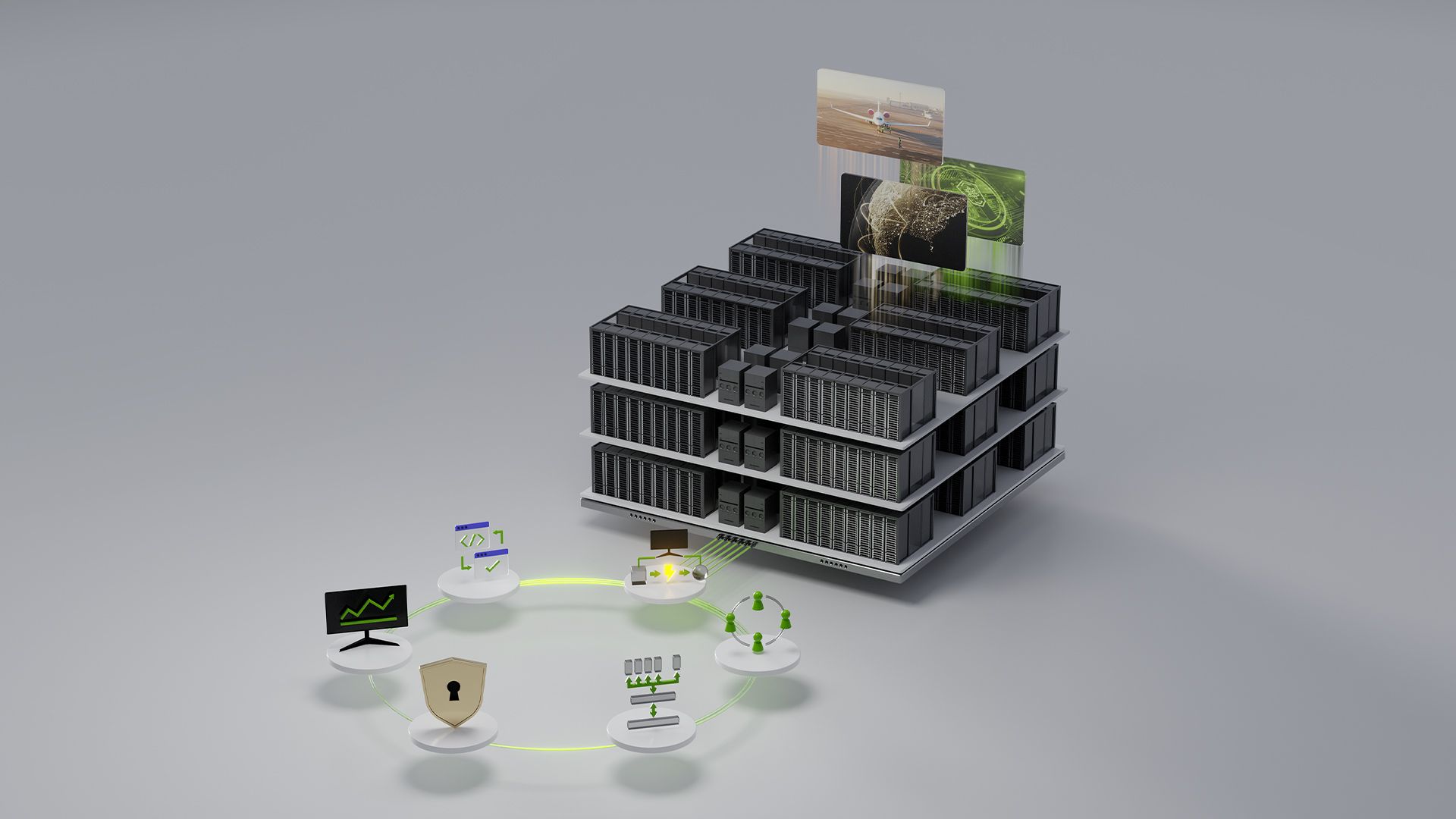
The NVIDIA AI Factory for Government reference design, which Nvidia says will equip federal agencies and regulated industries to build and deploy full-stack AI solutions that meet rigorous security standards.
For public-sector buyers, Nvidia unveiled an AI Factory for Government — a FedRAMP-aligned reference stack combining Nvidia AI Enterprise with partners such as Palantir, CrowdStrike $CRWD, ServiceNow, Lockheed Martin, and Northrop Grumman $NOC. The same template supports the Department of Energy’s Equinox and Solstice systems, as well as Los Alamos’ Vera Rubin supercomputer. Even the enterprise layer got its version. Palantir is embedding Nvidia’s CUDA-X and Nemotron models into its Ontology platform; Lowe’s is using the stack to run a live digital twin of its global supply chain — retail as another form of AI factory.
GTC has always been part product launch, part persuasion campaign. In San Jose, Huang sells imagination. In Washington, he sold inevitability — the idea that intelligence itself has become infrastructure, and that whoever builds it fastest will own the next supply chain. What he pitched wasn’t just faster chips or smarter robots, but an operating plan for how intelligence itself gets manufactured — in factories, on roads, and at grid scale.
The venue made the subtext plain. This wasn’t just a conference; it was a policy pitch in a leather jacket — one that turned industrial strategy into a software problem that only Nvidia can solve.
Join 500,000+ readers who start their day with Quartz.
By subscribing, you agree to our Terms of Service and Privacy Policy.