Stephen Lam/San Francisco Chronicle via Getty Images
WASHINGTON — At Nvidia $NVDA’s first-ever Washington GTC, the dress code will skew fewer hoodies, more Hill badges. With more than 70 sessions on “responsible AI,” quantum computing, digital infrastructure, and beyond, the company is staging the quiet sequel to Silicon Valley’s biggest export: persuasion.
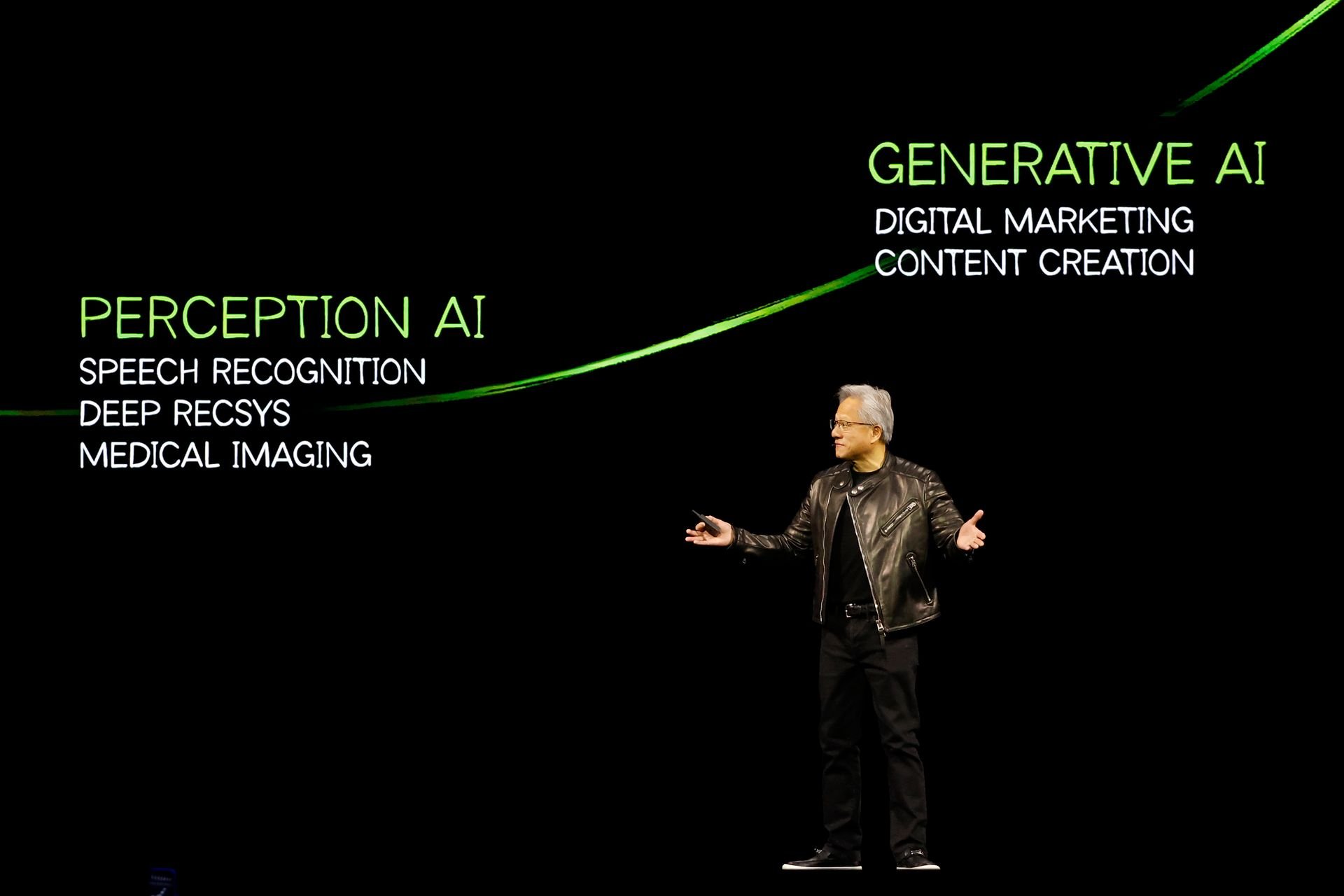
The company’s annual GPU Technology Conference has long been a Silicon Valley ritual — a glossy pageant of chips, demos, and developer swagger. CEO Jensen Huang’s leather jacket has become as recognizable as his chip diagrams, and every March, he fills arenas in San Jose, California, with developers eager to see what’s next. But this week’s three-day summit (Oct. 27–29) at the Walter E. Washington Convention Center swaps out the coders for contractors.
The shift to Washington will likely say as much about the company’s ambitions as much as its timing. AI infrastructure is quickly becoming a matter of statecraft — the kind of national-interest project that invites regulation, subsidies, and oversight in equal measure. (There’s a labeled Government Affairs track on the agenda.) As federal AI guidance continues to take shape, Nvidia is positioning itself as the vendor that can make Washington’s digital dreams real without rewriting its bureaucracy. Nvidia is courting a market that buys at scale and rarely switches vendors.
Monday was the conference’s quieter on-ramp — think check-ins, workshops, and campus activations — but it sets the tone for an event built for buyers as much as builders. The show really kicks off Tuesday, with Huang’s keynote address; he’ll take to the main stage at 12 p.m. ET, with an expanded pregame beforehand — and a livestream for anyone who isn’t within badge-scanning range.
Huang’s keynote is expected to double as a civics lesson: a reminder that in an age of tariffs, export bans, and trillion-dollar compute budgets, AI supremacy is as much about influence as innovation. The Nvidia CEO is likely to emphasize power efficiency, secure supply chains, and “AI factories” — talking points that translate easily into Washington shorthand for jobs, infrastructure, and national competitiveness. Expect nods to “agentic” or “physical” AI and to quantum/HPC — the themes Nvidia is spotlighting for Washington — and expect them framed in the language of deployment rather than demos.
Expectations are calibrated toward execution: reiterating the spring roadmap (Blackwell Ultra now, Rubin/Vera Rubin on the horizon) and translating it for a Washington audience that cares about supply, reliability, and the total cost of inference almost as much as raw TOPS. If March’s GTC was about unveiling, October will likely be about deployment — how to get these systems into data centers with megawatt budgets and agencies with RFP checklists.
Investors will listen for near-term signals on networking and power constraints, public-sector demand, and any color on delivery timing. And if Huang’s keynote threads the needle — performance per watt, time-to-value, and a story about connecting millions of accelerators without melting the substation — the week will have done its job.
On the ground, the conference is set to play out like a hybrid between a tech showcase and a trade mission. By Tuesday, the expo floor will transform into a Beltway science fair — booths lined with robotics, quantum systems, and networking solutions, all speaking the language of compliance and cost-benefit. Everything will be geared around answering the two questions federal buyers always ask: Does it work, and who else uses it?
Nvidia’s “Connect with the Experts” stations — drop-in consults on accelerated computing, agentic AI, CUDA tuning, vision stacks, Omniverse twins, and even quantum via CUDA-Q — are a triage desk for teams trying to harden a pilot into a program. Certifications are running on-site, too, including new generative-AI credentials, slotted to make “we have certified staff” a slide you can show your contracting officer.
Nvidia is preaching stability, resilience, and domestic sourcing. Federal customers want less about what’s possible and more about what’s allowed. The same photonics, interconnects, and inference optimizations that wow investors in San Jose will likely be framed as power-management and energy-security solutions. Set against that pitch are the usual Washington cautions — vendor lock-in, export-control exposure, and simple energy availability — which are likely to surface in Q&As and side-room briefings.
Startups get their moment once the keynote glow fades. Nvidia’s Inception program is staging a startup pavilion on the floor and a Wednesday morning pitch hour where founders have five minutes each to win over investors, integrators, and the odd colonel who wandered in from a JADC2 meeting. This is the “receipts” part of the story: edge robotics, security, synthetic data, and healthcare triage — the applied demos that show what a federal checkbook might actually buy. Nvidia is betting that the agencies walking out of the Walter E. Washington Convention Center will see AI as an asset to commission, not as a risk to manage.
This version of GTC is about showing that the next wave of innovation will need as many signatures as it does transistors — and that Nvidia already speaks both languages. The near-term tells will be prosaic: who books follow-ups, which pilots get named, and whether any agencies telegraph budget intent coming out of the show.
Nvidia seems to insist that GTC — even in the nation’s capital — remains a technical conference, not a trade show. But everything about the Washington edition suggests a company learning to speak another dialect of power. The real breakthroughs here aren’t measured in gigahertz; they’re measured in how convincingly Nvidia can describe AI as a civic necessity. This week is really about whether the company can translate its spring roadmap into procurement-ready language for a Washington buyer.
If San Jose is the birthplace of hype, Washington is its proving ground. This is where Nvidia will work to show that its machines can coexist with the bureaucracy they’re meant to modernize — that AI can fit inside the rulebook without losing its edge. Whether anyone in the federal government actually buys that argument might not matter right away. In Washington, ideas tend to take hold long before the contracts do.
By the time the lights go down on Wednesday, the takeaway won’t be about what Nvidia revealed, but whom it impressed. The company that turned chips into symbols of ambition is now trying to turn them into policy. And in Washington, that might be the most powerful upgrade of all.
