As Trump reorders global trade in his “America First” image, Republicans are stuck in an uncomfortable dance
Chip Somodevilla/Getty Images
A version of this article originally appeared in Quartz’s Washington newsletter. Sign up here to get the latest business and economic news and insights straight to your inbox.
In April, Republican Sen. Thom Tillis of North Carolina asked the chief White House trade negotiator whose throat he could choke if sweeping tariffs caused America’s economy to go haywire. Months later, it doesn’t look like he will rough anyone up anytime soon.
Join 500,000+ readers who start their day with Quartz.
By subscribing, you agree to our Terms of Service and Privacy Policy.
“I don't know how any free market conservative can rationalize this,” Tillis told me in an interview about the tariffs. “Obviously there has to be a consequence for bad actors, but I think that we're manipulating markets that we shouldn't.”
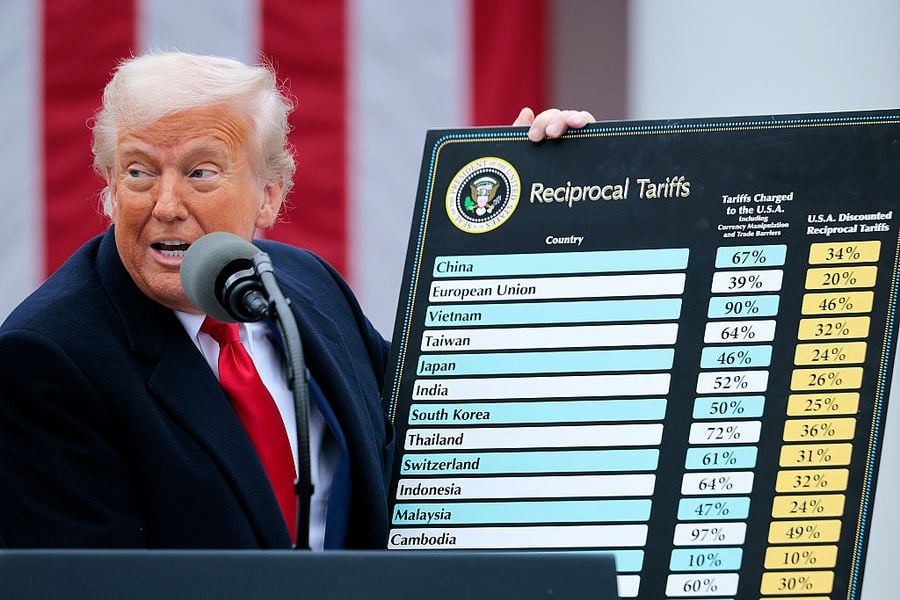
Tillis’ criticism amounts to shrugging and then putting his hands into his pockets. He was one of seven Republicans who signed onto legislation to reassert congressional authority over tariffs shortly after President Donald Trump unilaterally issued his “Liberation Day” import taxes that rattled financial markets in the spring.
But early nerves didn’t turn into a Republican rebellion. Instead, the party of free trade gave in.
As Trump reorders global trade in his “America First” image, Republicans are stuck in an uncomfortable dance around his double-digit tariffs. GOP lawmakers in the spring gave Trump leeway in his blunt use of tariffs to negotiate trade deals. Five months later, the lightswitch approach has yielded an economy increasingly saddled with business and consumer uncertainty, rising prices, and a stalling job market.
Most Republican tariff skeptics, though, reluctantly accept there’s not much they can change about a president who loves wielding them like a swordsman eager to swing his blade in every direction. “I prefer tariffs that get an outcome specifically to a trade deal,” Sen. Mike Rounds of South Dakota told me.
“This is a hugely disappointing development for me, that Congress has chosen to be a non-participating bystander,” former GOP Sen. Pat Toomey said during an American Action Forum webinar.
The fate of Trump’s tariffs hinge on a Supreme Court case that could strike them down. That isn’t quelling tariffmania in the West Wing.
A piece of gold-framed artwork was hung up last month in the White House depicting Trump alongside four prominent U.S. political figures known for tightly embracing tariffs. It debuted as “The Tariff Men” with a roster that included Abraham Lincoln and William McKinley. Trump has frequently invoked McKinley as a model leader for presiding over a manufacturing heyday in the late 19th century with a government financed mostly by tariffs.
Trump and his emissaries have drawn up preliminary trade agreements with the European Union, Japan, South Korea, and the United Kingdom. Those early accords left double-digit tariffs in place. But the administration has conceded the U.S. won’t be self-sufficient. It released earlier this month a long list of exemptions for products like avocados, bananas, and coffee that can’t be grown or produced in sufficient quantities in the U.S. The catch: Foreign governments can receive duty-free treatment for those goods only if they strike a deal with the U.S.
But don’t expect final accords to reach lawmakers for their thumbs-up. “There isn’t something here for Congress to ‘ratify,’” a White House official told me on condition of anonymity. Since the administration has relied on an emergency law broadening Trump’s executive authority to impose country-specific tariffs, the official said, the president isn’t obligated to send those agreements to Congress.
Capitol Hill is still kept in the loop in smaller ways. A Senate Finance Committee aide said the U.S. Trade Representative’s office provides weekly briefings to committee staff about ongoing trade negotiations. Democrats including Sen. Ron Wyden of Oregon remain critical of White House trade chief Jamieson Greer for refusing to commit to sending trade agreements through Congress.
Lawmakers last took up a major trade deal in Trump’s first term. The United States-Mexico-Canada Agreement passed both chambers by wide bipartisan margins in 2020, and the Trump administration is eyeing another renegotiation of that deal starting this fall.
With tariffmania becoming part of the landscape, companies are strapping in for an economic landscape where the fog isn’t going to lift anytime soon. Luxury furniture seller RH warned of the effect of possible furniture import taxes not just on it, but on its competition as well.
“God forbid they throw another tariff on furniture. I mean, like someone has got to come talk to us,” RH CEO Gary Friedman said on a Sep. 12 earnings call. “I don't want to win because 50% of our competitors who are really good, hard-working people get wiped out. … I really don't think anybody is thinking about the math."
Joseph Maher, a partner and trade specialist at the law firm Nixon Peabody, said he sought guidance over the summer from U.S. Customs and Border Protection on the valuation of steel and aluminum. The agency said it didn’t have an answer for him.
As Maher, a former official at the Department of Homeland Security, put it to me: “That’s when you get these situations where it's impossible to see ahead of time.”
