President Donald Trump said he was abruptly ending trade talks with Canada on Thursday night, citing an anti-tariff ad that appeared to irritate him and reviving a dispute with the major U.S. trading partner.

The president revived the spat with Canada after a provincial government aired an ad featuring Ronald Reagan bashing sweeping tariffs
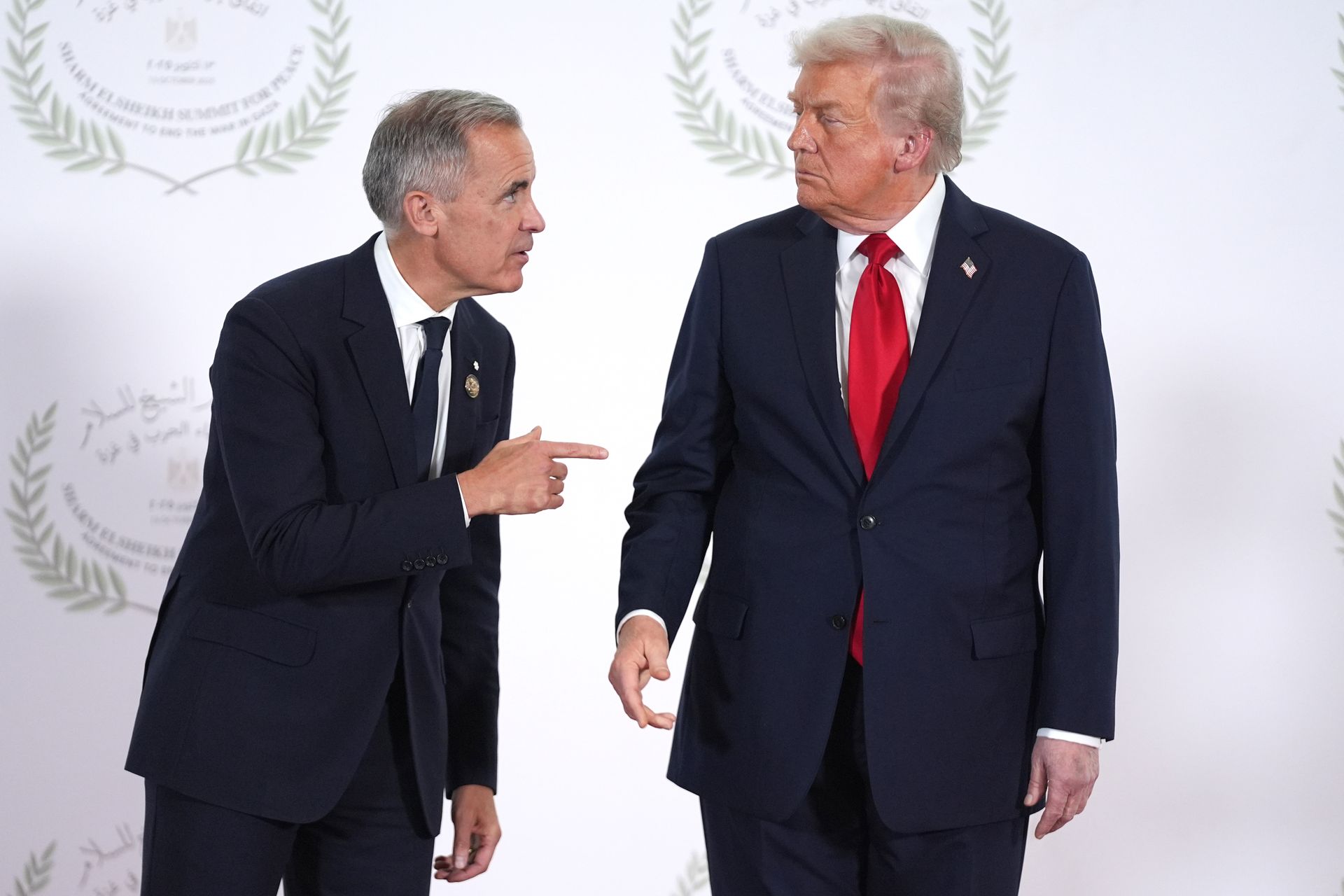
President Donald Trump greets Canada's Prime Minister Mark Carney during a world leaders' summit in Egypt. (Evan Vucci - Pool / Getty Images)
President Donald Trump said he was abruptly ending trade talks with Canada on Thursday night, citing an anti-tariff ad that appeared to irritate him and reviving a dispute with the major U.S. trading partner.
The president claimed that Canada was "fraudulently using an advertisement" featuring a radio address from former President Ronald Reagan, bashing tariffs as a policy that jeopardizes U.S. jobs. The Ontario provincial government introduced the television ad in U.S. markets a week ago to argue against U.S. tariffs on Canada, which it quickly took down less than a day later.
"Based on their egregious behavior, ALL TRADE NEGOTIATIONS WITH CANADA ARE HEREBY TERMINATED," Trump wrote in a social media post. He followed that up on Friday morning with a fresh attack that accused Canada of attempting to interfere with a pending Supreme Court decision that will determine the legality of his global tariffs.
The White House doubled down on its aggressive posture against Canada and said it had tried diminishing trade barriers between the two countries.
"These good-faith efforts with Canadian officials have not led to any constructive progress," White House spokesperson Kush Desai said in a statement provided to Quartz. It cited the Reagan ad as "the latest example of how Canadian officials would rather play games than engage with the Administration."
White House economic advisor Kevin Hassett said on Friday morning that the Trump administration was "frustrated" with the Canadian government's trade positions in ongoing negotiations.
"The president I'm sure has his reasons," Hassett said in a Fox Business interview. "Sometimes when you're frustrated a timeout is the right call. It's probably a good time to take a break for a little while."
Hassett didn't provide a specific timeline when he thought trade talks would get back on track. He said he expected Trump would reopen discussions with the Canadian government sometime before the end of his second term.
Trump's sudden move injects fresh uncertainty with Canada, one of the top U.S. trading partners. It was the second time this year that the president pulled the plug on trade negotiations that veer between fits of belligerence and cordial statements of progress. In May, Trump cancelled discussions with Canada over a 3% tax on digital services that it was about to impose on U.S. tech giants. He labeled it a "direct" attack on the U.S. Three days later, Canada shelved the tax.
Trade negotiations with Canada have sputtered on without a final accord, much less a preliminary agreement like those with the European Union and South Korea. The U.S. has levied 50% tariffs on Canadian steel and aluminum in conjunction with a 25% tariff on other Canadian imports.
Canadian Prime Minister Mark Carney on Friday said that progress had been made towards clinching a trade agreement that both sides can accept.
"We can't control the trade policy of the United States," Carney told reporters before departing for an international summit with Southeast Asian nations. He added that the Canadian government had been in "detailed, constructive" talks with U.S. officials on steel, aluminum, and energy tariffs.
Trade between Canada and the U.S. totaled $900 billion in 2024, according to the Office of the U.S. Trade Representative. Canada's main exports to the U.S. consist of energy products and vehicles.
As for the ad, Reagan delivered the clipped radio address in 1987. He did so shortly after he imposed limited tariffs on Japan, viewed throughout the 1980s as an economic rival to the U.S. The import taxes hit Japanese electronics, a relatively tiny slice of U.S. imports at the time.
While the Canadian ad spliced together different parts of the speech, it did not alter Reagan's overall argument laying out the drawbacks of sweeping protectionism.
"High tariffs inevitably lead to retaliation by foreign countries and the triggering of fierce trade wars," Reagan said in the five-minute address. "Then the worst happens: Markets shrink and collapse; businesses and industries shut down; and millions of people lose their jobs."
Ontario Premier Rob Ford $F later announced that the ad would be taken down to help restart trade negotiations. Still, the ad will air for the final time this weekend during the first two games of the World Series.
“Our intention was always to initiate a conversation about the kind of economy that Americans want to build and the impact of tariffs on workers and businesses,” Ford said. “We’ve achieved our goal, having reached U.S. audiences at the highest levels.”
Join 500,000+ readers who start their day with Quartz.
By subscribing, you agree to our Terms of Service and Privacy Policy.