Trump has turned corporate strategy into tribute, with CEOs betting that gifts, praise, and silence are the safest hedge against retaliation
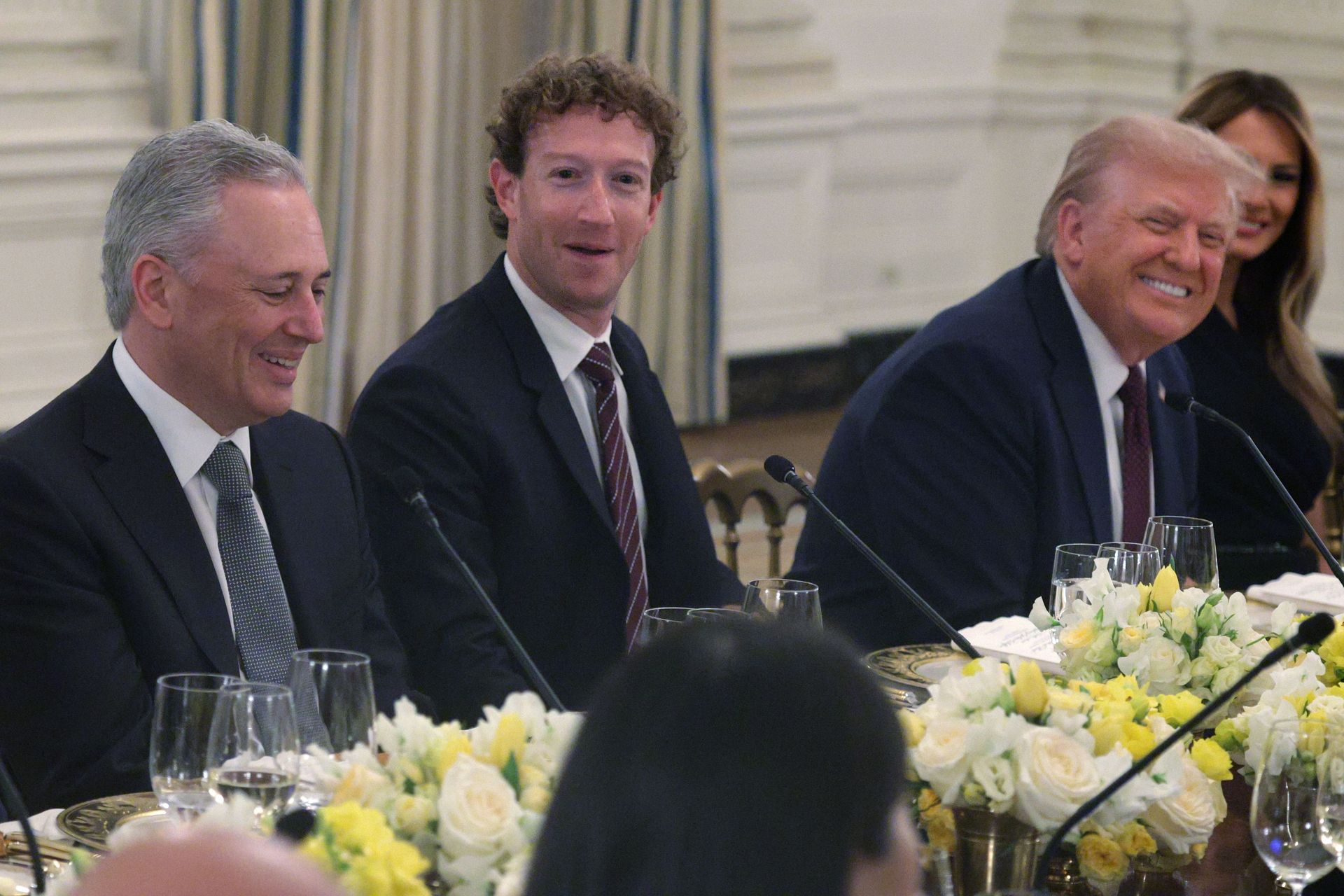
Alex Wong/Getty Images
The biggest and most powerful companies in the world may now live and die by a report card. Not a balance sheet, not a quarterly earnings call — but a loyalty score, reportedly tallied inside President Donald Trump’s White House. Each press release, each social media post, each appearance at a Rose Garden ceremony goes into the file folder. And when it’s time to ask for a tariff carve-out, a merger approval, or a regulatory break, loyalty is what matters.
This is the new corporate cage in Trump’s America: gilded, transactional, and carefully measured. The gift changes shape, but the logic doesn’t.
Join 500,000+ readers who start their day with Quartz.
By subscribing, you agree to our Terms of Service and Privacy Policy.
Apple $AAPL CEO Tim Cook arrives at the White House amid iPhone tariff threats with a gold-plated, engraved silicon disk. Nvidia $NVDA brings compliments that are as carefully calibrated as its chip design. Oracle $ORCL brings itself as TikTok’s U.S. chaperone. Intel $INTC brings something rarer still — a multi-billion dollar stake for Uncle Sam. And just this week, Google $GOOGL cut a $24.5 million check to settle Trump’s lawsuit over his YouTube suspension after the January 6, 2021, insurrection at the U.S. Capitol — with most of the money earmarked for a $200 million Washington ballroom project on the president’s wish list. Google made no admission of wrongdoing, no change in policy. It just paid the price of moving on and staying on the president’s good side.
During Trump’s first term in 2017, CEOs quit the president’s business advisory councils over his remarks following the “Unite the Right” rally in Charlottesville, Virginia. In 2021, after the pro-Trump mob stormed the Capitol, CEOs issued statements about democracy and justice.
But in 2025, they flatter, they settle, they stay quiet. They’re publicly deferential, privately uneasy, performers in a loyalty economy where flattery is cheap, dissent is costly — and silence is safest.
“They are afraid of him going after their companies,” said Jeffrey Sonnenfeld, the president of Yale University’s Chief Executive Leadership Institute, who organized a September gathering of top CEOs in Washington.
“Nobody thinks things have gotten better,” Sonnenfeld said in an interview. “They’re very concerned about global diplomacy and the degradation of our national security.”
This is the exchange rate in Trump’s second term: A little praise buys a little access. A little equity buys a little certainty. A check buys silence and a way off the stage.
The Trump-loyalty corporate report card was first reported by Axios in August: a 553-entity list that grades companies and trade groups on how visibly they backed the administration’s sweeping domestic policy bill. Aides said the report cards would be consulted when those same companies called for help.
It doesn’t take a constitutional scholar to understand why the smartest strategy for CEOs might be to keep public remarks about Trump warm and undramatic, to route objections through associations, and to buy time while lawyers and supply-chain teams model the next swing.
The optics for today’s CEOs are airtight, and the choreography travels well on cable. Inside boardrooms, the soundtrack is different. CEOs have expressed skepticism verging on alarm at Sonnenfeld’s off-the-record CEO summits, where phones are parked outside and reputations aren’t.
“Behind closed doors, CEOs say Trump is bad for business,” he wrote last week, distilling months of private polling into a sentence most executives won’t say on camera or within a mile of a reporter’s microphone.
Tariffs are hitting revenue margins. Rules announced by proclamation feel, in Sonnenfeld’s phrase, “legally shaky.” Investment plans stall when a policy can appear at 10 p.m. and vanish by morning. Sonnenfeld’s reports from the private consensus suggest that CEOs think Trump’s policies are hurting business: 71% of CEOs said tariffs are harmful, about three-quarters thought parts of the tariff regime were illegally executed, 62% of CEOs said they won’t increase U.S. manufacturing investment under current conditions, and 80% said pressuring the Federal Reserve isn’t in America’s long-term interest.
Influential business groups such as the Business Roundtable (BRT) and the Chamber of Commerce haven’t offered overt criticism of Trump’s policies — even of the tariffs, which many business leaders quietly say are casting a fog of uncertainty over the U.S. economy. By contrast, the BRT spent eight figures to advance its tax priorities in the GOP megabill that passed earlier this summer.
Some are even suggesting that groups such as the BRT should be adopting a higher public profile in pushing back against Trump.
“That’s why they are hoping for collective action from the Business Roundtable… that the whole purpose of the Business Roundtable is for that collective action,” Sonnenfeld said, describing the group’s status as “missing in action.”
The Business Roundtable issued statements against Trump’s tariff blitz in April and August, usually balancing soft criticism with praise for the president’s ability to negotiate trade agreements and his promise to rev domestic manufacturing. The group does most of its work behind the scenes, and a person familiar with BRT’s strategy said that the group thinks direct, private advocacy is the most effective way to advance the interests of its members. But some people want concrete action.
“[CEOs are] looking for the trade groups, especially the Business Roundtable, to give them air cover through collective action,” Sonnenfeld said. “That’s the way you take on a bully.”
The dissonance between the public praise and the silent alarm isn’t new, but it’s bigger now.
“Trump does everything so publicly, and he does it in a way that is so transactional that it raises concerns about whether this is appropriate for the president of the United States,” said David Primo, a political economist and professor at the University of Rochester who studies corporate strategy.
Presidents have long tried to shape the economy. Franklin Delano Roosevelt folded industry captains into alphabet agencies and treated CEOs as instruments of national strategy. Ronald Reagan turned CEOs into recurring characters in a growth story and showed, in firing striking air traffic controllers, how presidential muscle could set the tone for business. Barack Obama, facing a collapsing auto sector, paired a government rescue with demands — new boards, tougher fuel economy standards — while auto chiefs stood behind him at the lectern. And just about every president has wielded merger review as leverage.
But what’s different now, Primo said, is how Trump is approaching the business sector. The Trump administration doesn’t just want policy wins. It wants visible affirmation — the ceremony, the quote, the big check that becomes a talking point.
In Trump’s second term, CEOs are running the same calculation they’d apply to a balance sheet: What matters is the long-run interest of the company and its bottom line. If you’re Nvidia CEO Jensen Huang, for example, and you’re told that you can keep access to a critical market by giving the U.S. government a 15% cut of your China sales, that might look like a relatively cheap solution. The equation is simple: lose billions in revenue under a blanket ban, or trade a slice of it to keep the channel open.
But “once you’ve revealed your type,” as Primo put it, there’s “no guarantee the president won’t keep going back to the well.” Each concession sets a precedent, and the risk compounds over time. For most executives, the bet is that this posture is unique to Trump, and that once he leaves office, the old, quieter rules of engagement in Washington will snap back into place.
“It’s, without a doubt, a risky strategy,” Primo said. Quiet tribute might solve today’s problem — but it could signal tomorrow’s vulnerability.
There’s also the psychology of insurance. “If there are symbolic things you can do to flatter the president that don’t cost you anything except maybe some face, it seems like an attractive thing to do from a business perspective,” Primo said. A gift on camera. A line about a “great start.” A cameo at a bill signing. Relative to the price of becoming the target of a 1 a.m. social media tweetstorm, such gestures are rounding errors.
But what might look like good policy on a balance sheet might become a ransom if the rules blur too far into favors. Stanford professor Anat Admati, an economist and leading scholar of corporate governance, said that “if anyone speaks up, there are many tools” Trump can weaponize at will: tariffs declared by tweet, H-1B visa programs throttled overnight, subsidies steered toward frequent Mar-a-Lago visitors, or even “tell[ing] the board to fire somebody” — like what happened at Intel before the government took a stake in the company.
Admati’s concern is partially what these tactics reveal about the system itself. She said CEOs today “wouldn’t dare” to “speak up for democracy and speak up for racial justice and other things like that.” Now, the safer bet is silence.
“I think that in a democracy, the public needs to be heard, and there have to be limits on the abuse of power, whether it’s in violence or in policy,” she said. “And it’s very worrying that these CEOs seem to be going along with what appears to be both bad policies and abuse of power by the administration.”
That silence, Admati warned, has a price. “Markets really depend on kind of a legal infrastructure,” she said. Once the world stops trusting the U.S., she said, the consequences show up — in capital markets and strategy decks alike. Long-term projects shrink. Foreign partners hedge against American instability. And the scaffolding that once gave U.S. firms their global edge starts to weaken.
Silence might feel like a solid strategy, but if it’s repeated enough, it could become the system itself.
“[Trump is] showing that … he will give [CEOs] stuff that they want, as long as they don’t criticize him, the more so if they help him,” Admati said. “And that is very dangerous.”
