
While Trump’s new semiconductor tariffs threaten global supply chains, years of U.S. buildout plans have left AI’s biggest firms largely insulated
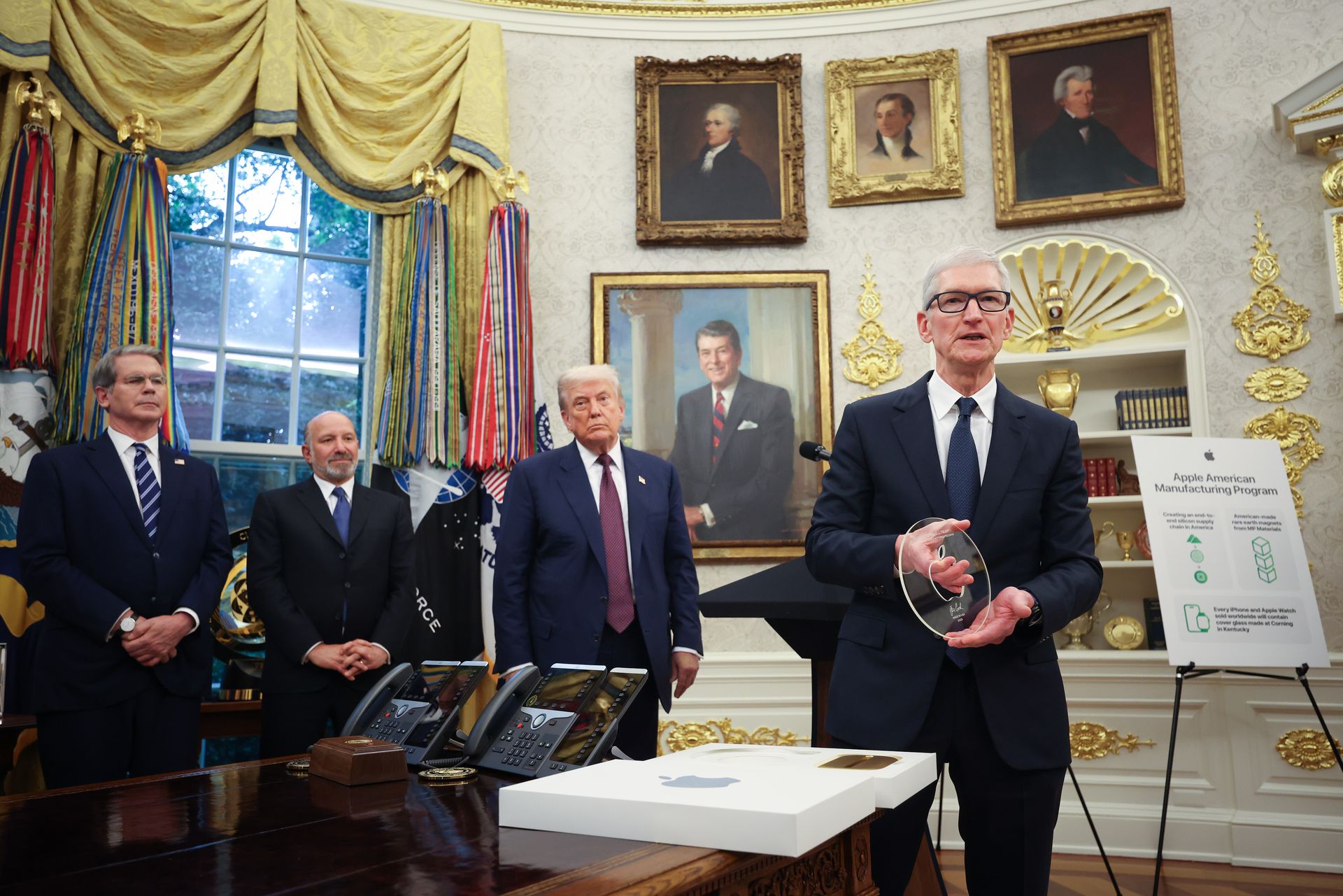
Win McNamee/Getty Images
President Donald Trump’s just-announced 100% tariffs on semiconductors may have sent shockwaves through manufacturing and legacy tech industries, but the AI firms at the center of this decade’s economic realignment aren’t scrambling. They’re insulated. They’re not sweating the headlines. And that isn’t an accident. It’s structural. And it’s the product of years of preparation for exactly this kind of political volatility.
The policy, part of Trump’s “America First” agenda, aims to bolster domestic manufacturing by penalizing companies that rely on overseas chip production. For AI companies, the stakes are particularly high. Semiconductors are the backbone of AI infrastructure, powering everything from data centers to autonomous vehicles. The tariff threatens to increase the cost of these critical components, potentially derailing ambitious AI projects that rely on affordable and timely access to advanced chips.
Join 500,000+ readers who start their day with Quartz.
By subscribing, you agree to our Terms of Service and Privacy Policy.
But buried in the president’s announcement was a crucial carve-out: Companies that are building — or, perhaps more politically convenient and press-release-ready, that have committed to building — chipmaking capacity in the U.S. will qualify for an exemption. A loophole? Maybe. A golden ticket for companies with U.S. buildout plans? Absolutely. And lucky for Big AI, they’ve been collecting those tickets for years. Right now, almost all of the big players already have their bases covered. Nvidia $NVDA’s plans to build AI infrastructure in the U.S.? TSMC $TSM’s U.S. buildout? SK Hynix’s U.S. investment? All in motion. All part of the AI industry’s push for domestic capacity. And all vague enough to likely qualify for exemption.
The White House hasn’t yet given exact timelines for enforcement or clarified whether tariffs would apply to raw silicon, finished components, or entire systems. But the signal was unmistakable: You want to avoid a 100% surcharge? Better build your chips inside the U.S.
The thing is: Most of the big AI firms have already said they will — or that they are. So companies are saying yes. Loudly. Or they’re waving past press releases wildly in the Trump administration’s general direction. Wall Street got the message: The exemptions provide a clear path for these companies to continue their operations without substantial disruptions. Nvidia, Apple $AAPL, TSMC, and Broadcom $AVGO all saw their stock prices tick up during the day, a slightly counterintuitive rally in the face of what looked, on paper, like punitive policy.
Apple CEO Tim Cook seized the opportunity by heading to the president’s side to unveil a $100 billion investment in U.S. manufacturing, adding to its previous $500 billion commitment. Cook was part of the tariff announcement on Wednesday — staging a photo-op with Trump in the Oval Office, flanked by Vice President J.D. Vance, Commerce Secretary Howard Lutnick, and Treasury Secretary Scott Bessent — where Cook presented the president with a 24-karat gold-engraved gift, promising that the company is dedicated to domestic production (and demonstrating Apple’s vigorous and continued intent to sidestep looming tariffs).
Now, TSMC’s Arizona fab project — once considered slow-moving — is suddenly a strategic centerpiece, and the company has said it intends to expand its U.S. investment to $165 billion. Nvidia is pushing forward with its U.S. Stargate buildout plan, aiming to produce $500 billion worth of AI infrastructure domestically over four years. GlobalFoundries and Samsung have committed to multibillion-dollar U.S. fabs and R&D centers. Even Amazon $AMZN and Microsoft $MSFT are pouring billions into domestic chip design and custom silicon roadmaps — moves that now read less like strategy and more like insurance.
None of these moves from AI companies are knee-jerk reactions to Trump’s tariff threat. These aren’t last-minute attempts to shield themselves from policy shifts. These companies have been laying the groundwork to shore up any looming weaknesses long before the president’s announcement — years of inventory stockpiling, multiyear supply deals, and domestic footprint planning. The AI industry has quietly built an entire playbook around the idea that disruption was the default.
In Seoul, officials moved quickly to calm markets. South Korea’s trade envoy insisted that Samsung and SK Hynix were out of harm’s way thanks to their hefty U.S. footprints — from Samsung’s $17 billion fab rising in Taylor, Texas, to SK Hynix’s planned AI memory-packaging plant in Indiana. But the reassurance comes with an asterisk. The Trump administration hasn’t actually spelled out what “production” means in the context of the exemption. Does packaging count? Testing? Or does it require full end-to-end fabrication? Trade lawyers suggest the ambiguity is big enough to drive a fully loaded container ship through — and until the White House draws a line, companies are left guessing how much domestic presence is enough to dodge the 100% duty.
That uncertainty has a way of bending global supply chains in unintended directions. Protectionist policies might not just push manufacturing back to U.S. soil — they could just as easily divert it toward China’s still-maturing chip corridors. Analysts warn that if exemptions are narrow and rules remain vague, South Korea and Japan could lose share not to America, but to lower-cost, less-regulated Chinese fabs eager to soak up displaced orders.
And it’s not just Korean giants navigating the tariff maze. U.S. trade-agreement allies are cashing in on their positioning, too. Nvidia’s GPU assembly in Mexico and Canada is protected under USMCA, effectively bypassing the new 100% duty. Morgan Stanley $MS still has Nvidia’s stock as a top pick, pointing to unrelenting AI demand and a supply chain nimble enough to route around tariff risks. Citi has lifted its forecasts for AI-driven chip and equipment spending, citing robust data-center buildouts, while Mizuho has raised its Nvidia price target on expectations of accelerating AI accelerator shipments. The consensus: The industry’s core hardware will keep flowing — at least for now.
Those key protections, however, stop at the giants’ gates. Dozens of smaller chipmakers without American soil remain squarely in the line of fire and could see millions wiped from their annual revenue. Large chip-equipment makers such as Applied Materials $AMAT, Lam Research $LRCX, and KLA may be able to cushion the blow, but mid-tier and niche players such as Onto Innovation have far less room to maneuver. As The Wall Street Journal put it, Trump’s tariff policy “favors the deep-pocketed,” leaving manufacturers that depend on imported components from Asia with little protection and no easy workaround.
Even outside the fab lines, smaller electronics companies are feeling the strain. Adafruit, a modest U.S. manufacturer that relies on parts from Taiwan and the Philippines, is still waiting for official guidance on whether its shipments will be slapped with the new duties — a silence that leaves production schedules, pricing, and future orders in limbo.
Even for AI, where GPUs dominate the narrative, the picture isn’t perfectly insulated. Memory — the high-bandwidth fuel that keeps AI accelerators fed — is already getting pricier. TrendForce projects HBM costs will climb 15–20% by year-end, while older formats such as DDR4 and GDDR6 could jump as much as 45%. Add on 25% U.S. tariffs on memory imports from Japan and South Korea, and the market faces a one-two punch: tighter supply and higher costs. The sting could arrive at the worst possible moment — late 2025 — just as hyperscalers scale up the next wave of AI infrastructure. A GPU that skirts tariffs doesn’t mean much if the rest of the server stack costs more and takes longer to build.
And then there’s the quiet ripple effect. Beyond fabs and freight lanes, AI-first software companies are already adjusting for higher hardware costs they might never directly pay. Some have started adding “tariff surcharges” into enterprise contracts, a subtle move that spreads uncertainty across the ecosystem. For now, the industry’s biggest players can wave their U.S. buildout plans like a hall pass. But for everyone else — the suppliers, the smaller chipmakers, the startups building on rented compute — the umbrella may keep them dry, but the streets are already starting to flood.
Even before Trump’s proposed semiconductor tariffs, the U.S. was already trying to bend the industry’s center of gravity back toward domestic production. The CHIPS and Science Act — signed in 2022 — earmarked $52.7 billion for domestic semiconductor manufacturing and R&D, with a 25% tax credit to sweeten the pot. The rollout was slow, but the money was real. And it pulled capital toward U.S. soil. Trump’s tariffs now add a second force — a push to match the pull. Together, they’re redrawing the industrial map.
The trouble is, redrawing takes time. Building a fab isn’t like spinning up a warehouse — it’s a multiyear, multibillion-dollar exercise in logistics, engineering, and patience. In Taiwan, average construction timelines run about 19 months; in the U.S., they can stretch beyond 36. Costs often top $20 billion once you factor in labor, tooling, and operational readiness. TSMC’s Arizona facility, once slated for 2026, is now looking at 2028. For now, companies can get cover by saying something “is in the works.”
Trump hasn’t set a formal implementation date, and enforcing the 100% levy on chips — which move in and out of the U.S. in dozens of SKUs and assembly stages — will come with regulatory lag. Even if enforcement ramps quickly, many domestic buildouts will still be unfinished when his second term ends. Politics moves faster than construction crews.
That’s why the AI industry isn’t just betting on geography — it’s betting on PR. Apple’s latest announcement was made hand-in-hand with the White House. Nvidia (via CEO Jensen Huang) is aligning its rhetoric with national priorities. Sam Altman, meanwhile, has pushed for U.S.-based chip independence in his pitch for OpenAI’s long-term survival. And tech leaders from Microsoft to Google $GOOGL and Meta $META have all doubled down on U.S. supply security in recent months. Historically, getting the person who makes the rules on your side is a winning strategy — especially when Washington changes the rules mid-game.
The AI industry may be standing on solid strategy, but the terrain beneath it keeps shifting. Tariffs are just one front. Export controls, antitrust scrutiny, and talent wars are all reshaping how global AI firms operate. And in an arms race that depends on chips, capital, and credibility, even the best-positioned firms are still playing a game they don’t fully control. But they're trying. And they know: In Washington, good policy can be protection. Great PR can be immunity.