
As 2024 came to a close, the Federal Reserve had appeared to pull off a rare feat: quelling an inflation spike after the pandemic without causing a recession, otherwise known as "a soft landing."
The central bank is grappling with Trump's ongoing attempt to recast the 12-member Federal Open Market Committee in his image as a key policy meeting begins
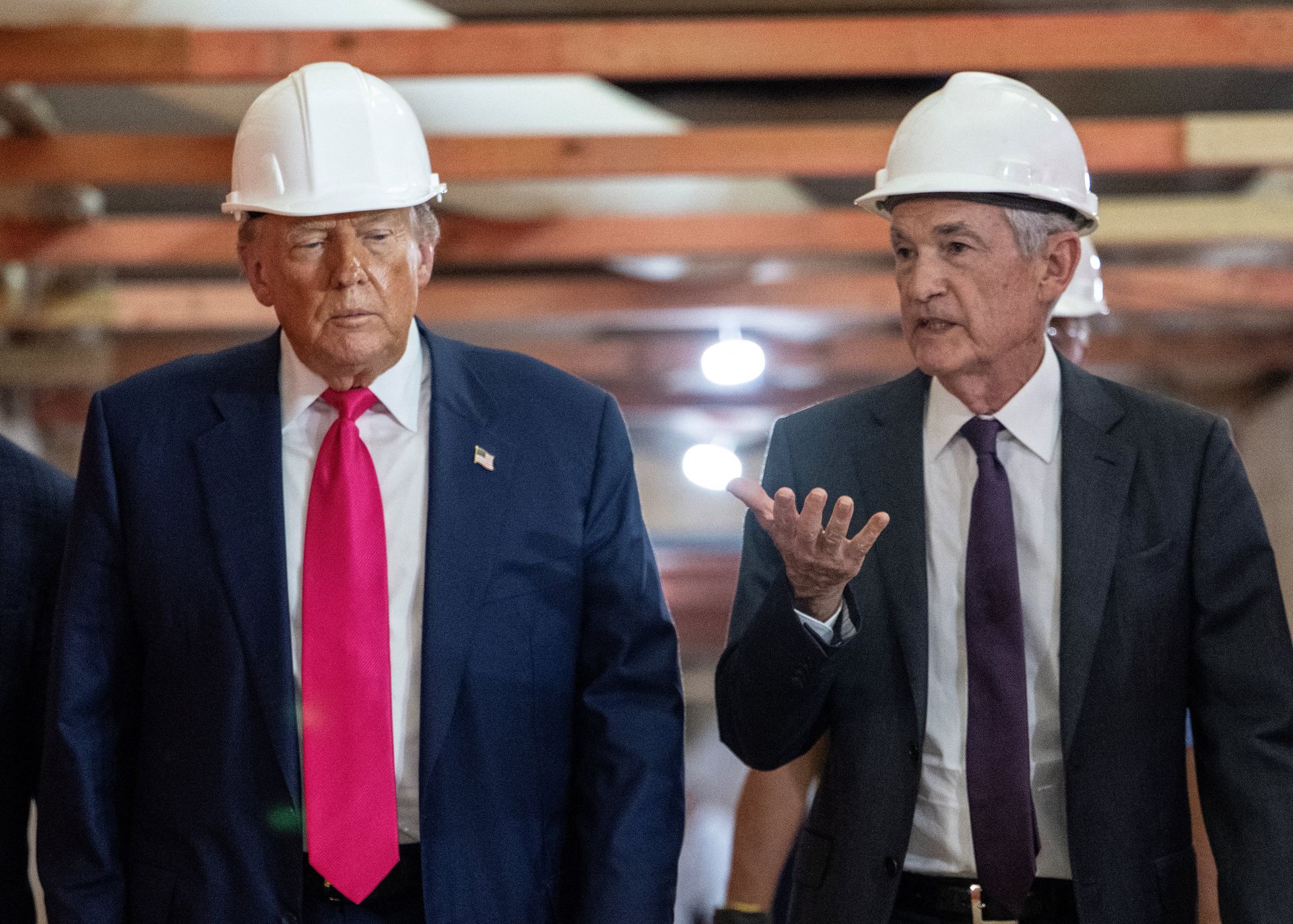
US President Donald Trump speaks with Federal Reserve chair Jerome Powell (R) as he visits the Federal Reserve in Washington, DC, on July 24, 2025. (Photo by ANDREW CABALLERO-REYNOLDS/AFP via Getty Images)
As 2024 came to a close, the Federal Reserve had appeared to pull off a rare feat: quelling an inflation spike after the pandemic without causing a recession, otherwise known as "a soft landing."
It soon collided with President Donald Trump and his determination to remake the central bank. Once financial markets settled in April after the rocky rollout of his global tariffs, he renewed attacks on the central bank that were a defining feature of his first term.
"Powell’s termination cannot come fast enough!" Trump said in a social media post at the time, adding he was "TOO LATE" on lowering interest rates.
What followed was a summer of unprecedented public crusade against the Fed from Trump, who appears intent on gaining control over monetary policy to secure lower interest rates. From badgering Powell over costly renovations of the Fed's headquarters to seeking Federal Reserve Governor Lisa Cook's ouster over allegations of mortgage fraud, the president has kept up a near-daily pace of broadsides. On Monday, Trump said Powell's Fed should slash interest rates even "BIGGER THAN HE HAD IN MIND" in another social media post.
The president has chipped away at the Fed's traditional separation from the executive branch. Powell is still helming the U.S. central bank and has made clear he will not step aside. One of Trump's top economic advisors, though, is close to landing a seat on the Fed's Board of Governors without resigning from his White House role in an unprecedented arrangement. Whether Cook will cast a vote this week is still unclear pending legal proceedings.
"This takes us into new territory. We simply haven't seen it," David Wilcox, senior fellow at the Peterson Institute for International Economics and director of U.S. economic research at Bloomberg Economics, told Quartz. "In my mind, it represents, if not the end of central bank independence, it represents the closing of a chapter.
The Fed has a major challenge ahead that would be tricky even in better circumstances. Last week, revisions to monthly job reports show employment growth through most of last year was dramatically lower than previously thought. That usually calls for slashing borrowing costs to stimulate economic activity.
However, prices for everyday goods are climbing as a result of Trump's tariffs, which typically demands increasing those same borrowing costs to limit demand. Financial analysts believe the Fed will slash interest rates by a quarter point, opting to shore up a weakening labor market. Up to now, the central bank has stood still on interest rates while measuring the effect of Trump's tariffs on prices.
The Fed is grappling with Trump's ongoing attempt to recast the 12-member Federal Open Market Committee in his image. In August, the president attempted to fire Cook, sparking a legal battle that's ping-ponging through federal court.
Many observers believe that Trump's rationale for seeking Cook's ouster is flimsy. "The Supreme Court has ruled that President Trump can only fire Federal Reserve officials for 'just cause,' said Kenneth Rogoff, an economics professor at Harvard University on X $TWTR. "Does 'just cause I want to' count?"
Federal District Court Judge Jia Cobb last week backed up Cook, who has not been charged with a crime or any wrongdoing. She issued a ruling that said that the president had not displayed "cause" for Cook's removal and sought to limit that mechanism to instances of gross misconduct or neglect while serving in office. The Trump administration has since appealed the decision and another could be issued before the two-day September meeting.
Trump shows no signs of easing up on the Fed. Former Trump economic advisor Larry Kudlow argued it's only a matter of time before the president succeeds in gaining control. “It’s sort of a sad tale,” Kudlow said in a podcast interview earlier this month. “But look, the bottom line is: President Trump’s going to take the Fed over, as he should.”
Powell and the Fed have focused on their primary mission of maximizing employment and ensuring stable prices while not picking anything resembling a fight with the executive branch. At a closely-watched speech in Jackson Hole last month, Powell did not mention the string of Trump-led attacks on the Fed.
"That's a really hard political judgment you have to make," David Wessel, a senior fellow at the Economic Studies Program at the Brookings Institution, told Quartz. "I think Jay Powell's view was, 'I'm not going to fight him on anything except monetary policy' because that's the core of the Fed."
Still, that approach has prompted some economists to push the central bank to explore ways to reconnect with a public that might not fully understand its responsibilities.
"I think the Fed needs to be out there [and] seen more visibly listening [to] all parts of the U.S. economy," Sameera Fazili, a former staffer at the Federal Reserve Bank of Atlanta, told Quartz. "They should be having more visits with farmers, more visible roundtables with consumers, more visible roundtables with workers, so that they can push against the narrative that the Fed is anti-democratic."
Join 500,000+ readers who start their day with Quartz.
By subscribing, you agree to our Terms of Service and Privacy Policy.