
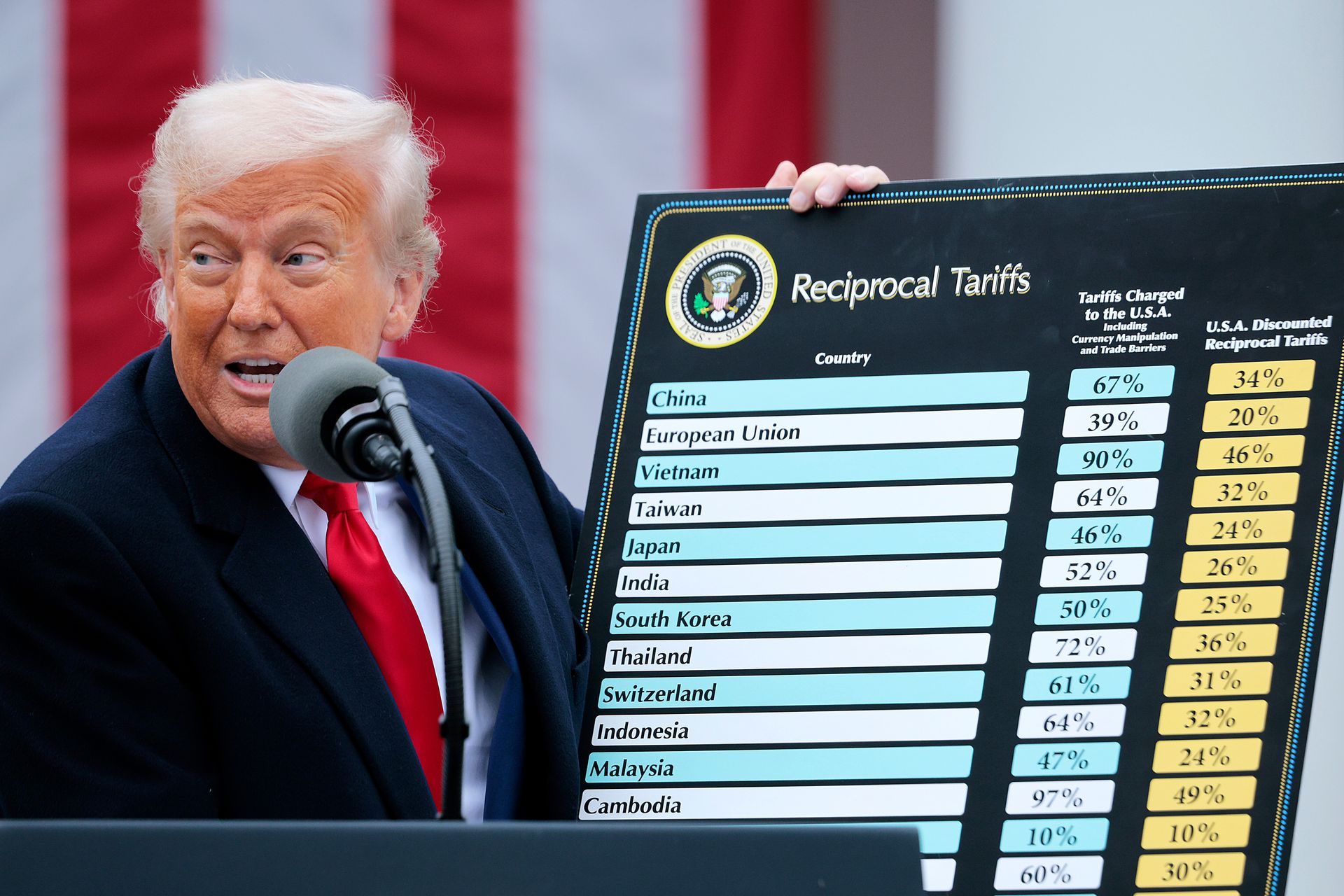
President Donald Trump said he will not attend the Supreme Court hearing this week over whether his tariff regime is legal, despite calling it a historically important decision.
“I don’t want to call a lot of attention to me. It’s not about me, it’s about our country,” he told reporters on Air Force One on Sunday.
Trump’s tariff blitz faces perhaps its most serious test yet this week when arguments against it will be heard by the high court. Many are brought by small businesses and U.S. states that say the levies are illegal. A lower court has already ruled that many of the tariffs go beyond his emergency power to regulate imports.
If the court sides with them, Trump’s entire strategy would be upended, though it could take months before a decision is issued. Trump said the eventual ruling will be “one of the most important decisions in the history of the country.”
“If we don’t have tariffs, we don’t have national security, and the rest of the world would laugh at us because they’ve used tariffs against us for years and took advantage of us,” he said Sunday.
He also wrote on Truth Social: “If a President was not able to quickly and nimbly use the power of Tariffs, we would be defenseless, leading perhaps even to the ruination of our Nation.”
Read more: Trump's trade war backup plan
For many small businesses in the U.S. and beyond, the stakes are high. The U.S. Chamber of Commerce has said that “the irreparable harms already suffered by American businesses large and small underscore the vast economic consequences of the President’s tariffs.”
Treasury Secretary Scott Bessent has pushed a different view, saying that if the Supreme Court strikes down the tariffs, the administration will simply enact them under different authorities. One of those is the Trade Act of 1974, which allows 15% tariffs for 150 days to address trade imbalances.
“You should assume that they’re here to stay and that you should honor your agreements," he said of the tariffs in a September interview.
The administration has also issued later tariffs under other legal authorities. Last month, it announced a Section 301 investigation into Chinese compliance with a 2020 trade accord that Trump signed.
“You can see the administration potentially hedging some of their bets,” Colin Wilhelm, a policy analyst at the Grant Thornton advisory firm, told the Quartz Washington newsletter last week.
—Joseph Zeballos-Roig contributed to this article.