It’s a bus. It’s a train. It’s both.
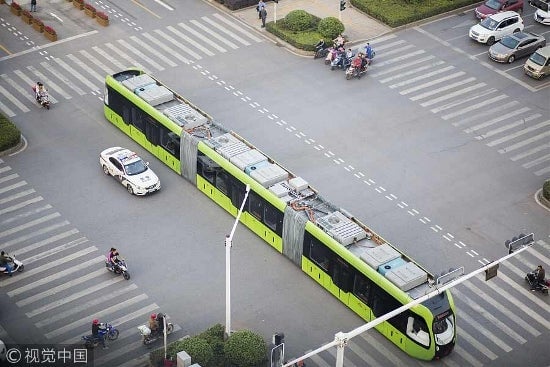
It’s a bus. It’s a train. It’s both.
Chinese firm CRRC Zhuzhou Locomotive has built what it says is the world’s first self-driving “rail bus.” After test runs earlier this summer, the CRRC began tests of the rail bus in China’s Hunan province on Oct. 30.
The 30-meter (98 foot) electric train uses white paint markings on the pavement, as well as on-board sensors, to gauge the dimensions of the road and navigate its route. Instead of rails embedded in the pavement, it runs on rubber tires with visual lines to define its dedicated lanes.
Join 500,000+ readers who start their day with Quartz.
By subscribing, you agree to our Terms of Service and Privacy Policy.
The company says the vehicle can whisk several hundred passengers along at 70 km/h (43 mph). A fast-charging system gives it about 25 kilometers (15.5 miles) range after about just 10 minutes.
The vehicle is currently traveling a 3.1-km route between four stations, with a 9 km loop planned, according to the state news agency Xinhua. Operations on the full route are slated to begin in 2018. CRRC says the system costs just one-fifth of the $23 million to $30 million that traditional tram systems cost per kilometer.
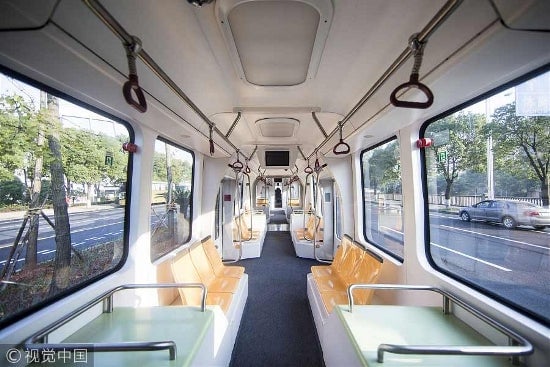
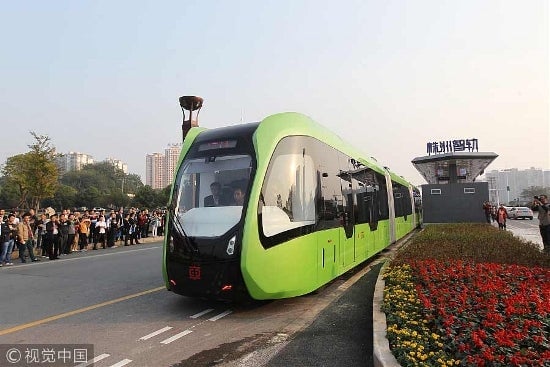
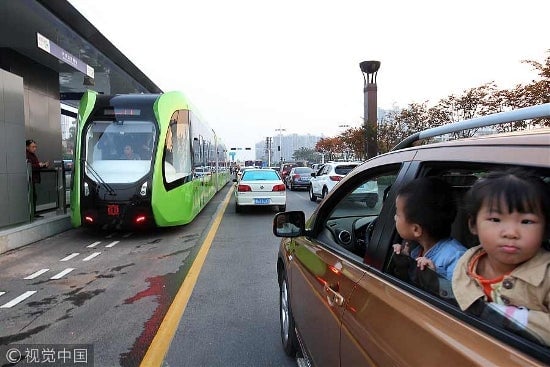

This will probably be the first of many self-driving trains and buses to enter major cities. CRRC says it has signed an agreement with Malaysia to supply 42 self-driving light rail vehicles of its transit projects. US mayors are intrigued as well. City Lab reports that Carlos Gimenez, mayor of Miami-Dade County, is planning to fly to china to see Zhuzhou’s system in person. “It’s a solution we can implement now,” Gimenez said last week. “Not one that will take decades to complete.”
While they have a bad reputation, buses can work nearly as well as trains when designed well with a dedicated, high-speed lane and other amenities, and promoted as extension of rail lines. CityLab says the rapid bus Orange Line in Los Angeles has tripled its original ridership projections with “spacious cars, frequent service, dedicated lanes, and smooth connections to bus and rail.”
