From Romanticism to Neo-Expressionism, each of these 15 movements was born from a specific historical crisis — here is what created them
Credit: www.gustav-klimt.com
Art doesn't emerge from a vacuum. Every painting, sculpture, or installation is made by a person living in a specific time and place — shaped by wars being fought, economies collapsing, cities being rebuilt, and ideas circulating in cafés, pamphlets, and public squares. The history of art is, in significant part, a history of crisis and response.
The conventional story frames art movements as aesthetic revolutions — bold artists breaking from academic tradition, visionaries seeing color or form in new ways. That story is accurate but incomplete. Impressionism wasn't only about capturing fleeting light; it emerged from a Paris being demolished and rebuilt under Baron Haussmann, a city losing its medieval neighborhoods to broad new boulevards and train stations. Cubism wasn't only about fractured perspective; it appeared in the same years that Einstein's theory of relativity was reshaping physics, and the movement's formal logic was partly influenced by encounters with African and Oceanic sculpture in colonial-era Paris. Dada wasn't merely absurdist theater; it was the logical response of artists who had watched a supposedly civilized continent send an entire generation into industrial-scale slaughter and call it progress.
Understanding art through its historical context changes how you encounter it. A canvas becomes a document. A brushstroke carries the anxiety, grief, or defiance of a particular moment in history. The subjects artists chose, the techniques they developed, and the institutions they rejected all hold meaning that extends beyond the gallery.
This list covers 15 major movements from the early 19th century to the late 20th century, pairing each with the specific historical conditions that called it into being. The selections are weighted toward Western and European-American traditions — a scope limitation, not a value judgment. Art movements rooted in other cultural contexts carry equally powerful historical weight, and deserve their own treatment.
What reading these movements alongside their historical moments reveals is a consistent pattern: the greater the social or political disruption, the more radical the artistic response tends to be. Art is not decoration. It is argument. And the argument is always with something.
Credit: Wikipedia
Romanticism rose in the late 18th and early 19th centuries as a direct repudiation of the Enlightenment's faith in reason, order, and scientific progress. The movement took hold in Germany, England, and France during a period of convulsive change: the French Revolution had upended the old social order, the Napoleonic Wars had redrawn the map of Europe, and the early industrial revolution was transforming rural landscapes into mill towns and factory floors.
The Enlightenment had argued that human beings, through reason, could master nature and build better societies. By the early 19th century, that confidence had absorbed significant damage. The Revolution promised liberty and delivered the Terror. Napoleon promised order and delivered nearly two decades of war across Europe and its colonies. The industrial transformation promised prosperity and delivered child labor, mass displacement, and the erasure of artisan traditions that had defined communities for generations.
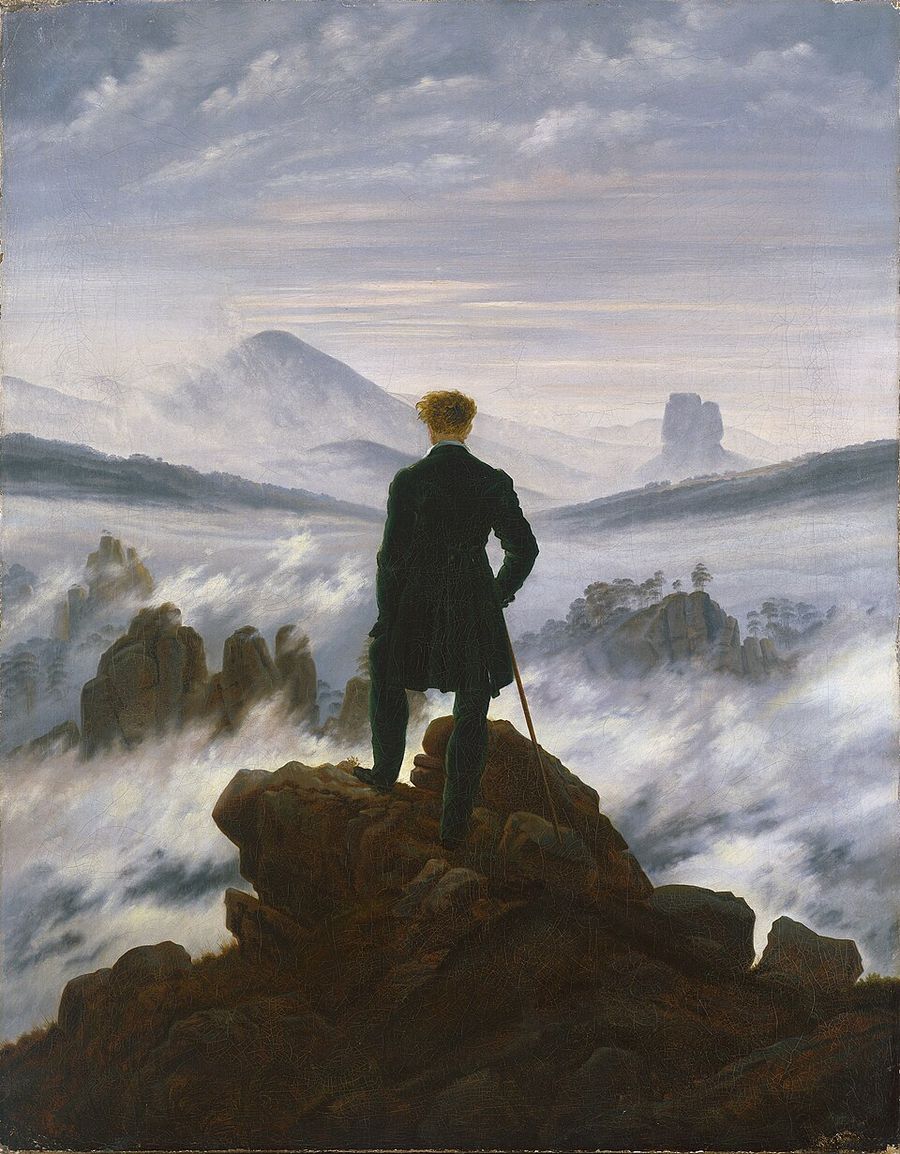
Romantic artists responded by valorizing precisely what the Enlightenment had dismissed: emotion, intuition, nature in its most untamed forms, the premodern past, and the inner life of the individual. Caspar David Friedrich's landscapes place tiny human figures before vast, mist-covered mountains and ruined medieval abbeys — a compositional choice that is also an argument. The individual is small. Nature is overwhelming. The proper response to existence is not mastery but awe.
Francisco Goya, who lived through the Napoleonic occupation of Spain, captured the movement's darkest register. His series "Disasters of War," etched between 1810 and 1820, and the "Black Paintings" he made in his final years reflect a mind shaped by witnessing war's actual texture — not the heroic battle scenes of academic painting, but atrocity, madness, and the failure of reason to prevent either.
In England, poets such as Wordsworth and Coleridge championed the natural landscape as a moral corrective to industrial ugliness. J.M.W. Turner pushed landscape painting toward abstraction, dissolving form into light and atmosphere in ways that anticipate developments a century later. Eugène Delacroix in France brought emotional intensity and chromatic boldness to historical and literary subjects that the academic tradition treated with cooler formality.
Romanticism also fueled nationalist politics across Europe. The idealization of folk culture, local language, and medieval heritage powered independence movements in Greece, Poland, and the German states. Artists and political activists drew on the same sources — folk epics, landscape mythology, idealized visions of peasant life — and the entanglement of art with national liberation would recur in every generation that followed.
Steven Zucker / Smart History
Realism emerged in France in the 1840s as a frontal challenge to both Romanticism and the academic tradition that dominated French painting. Where Romanticism glorified emotion, nature, and the distant past, Realism turned its attention to the present — specifically to the lives of working-class people, peasants, and the rural poor, subjects that the Salon system had long treated as beneath serious artistic attention.
The historical moment that produced Realism was decisive. The revolutions of 1848 swept across Europe — France, the German states, the Austrian Empire, the Italian peninsula — as workers and middle-class reformers challenged aristocratic and monarchical rule. The Communist Manifesto appeared that same year. Class conflict was not an abstraction; it was visible in the streets of Paris, in coal mines, and in the conditions of agricultural labor that most of the population still depended on.
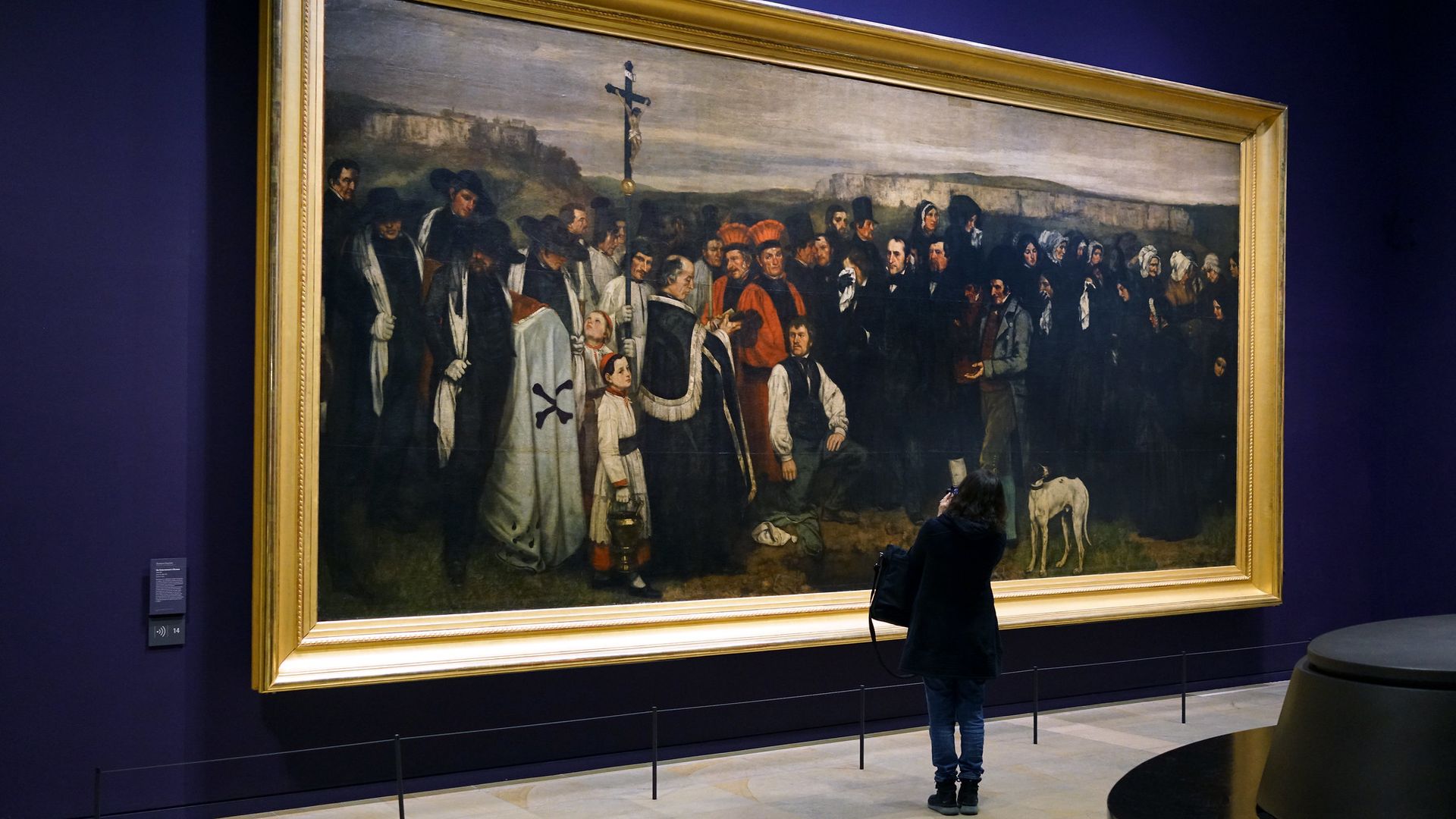
Gustave Courbet, the movement's central figure, was explicit about the political stakes of his art. His enormous canvases — "A Burial at Ornans" (1849–1850), "The Stone Breakers" (1849) — placed ordinary laborers and provincial villagers at the same monumental scale previously reserved for biblical scenes and aristocratic subjects. This was a deliberate provocation. The size of a painting in the academic tradition signaled the importance of its subject. Courbet was arguing, in the most visible way available to a painter, that working people mattered.
Jean-François Millet painted peasants in the fields — "The Gleaners" (1857), "The Sower" (1850) — with a gravity and dignity that critics found unsettling precisely because it was political without being programmatic. Honoré Daumier brought Realist sensibility to printmaking and caricature, producing images of lawyers, judges, and legislators that read as an indictment of bourgeois self-satisfaction.
Realism's insistence on depicting the world as it actually was — without mythological elevation or sentimental prettification — became a foundational premise for almost every movement that followed. Photography, which was developing rapidly at the same moment, sharpened the question of what painting was for if machines could record appearances with increasing fidelity. Realism answered that painting was for truth-telling, and truth required looking at what polite culture preferred to ignore.
Credit: Wikipedia
Impressionism is perhaps the most recognizable art movement of the 19th century, but its origins are as much sociological as aesthetic. The movement developed in Paris in the 1860s and 1870s against a backdrop of rapid and often traumatic modernization — specifically the transformation of the city under the urban renewal program of Baron Haussmann, who, at the direction of Napoleon III, demolished much of medieval Paris and replaced it with wide boulevards, grand apartment buildings, parks, and department stores.
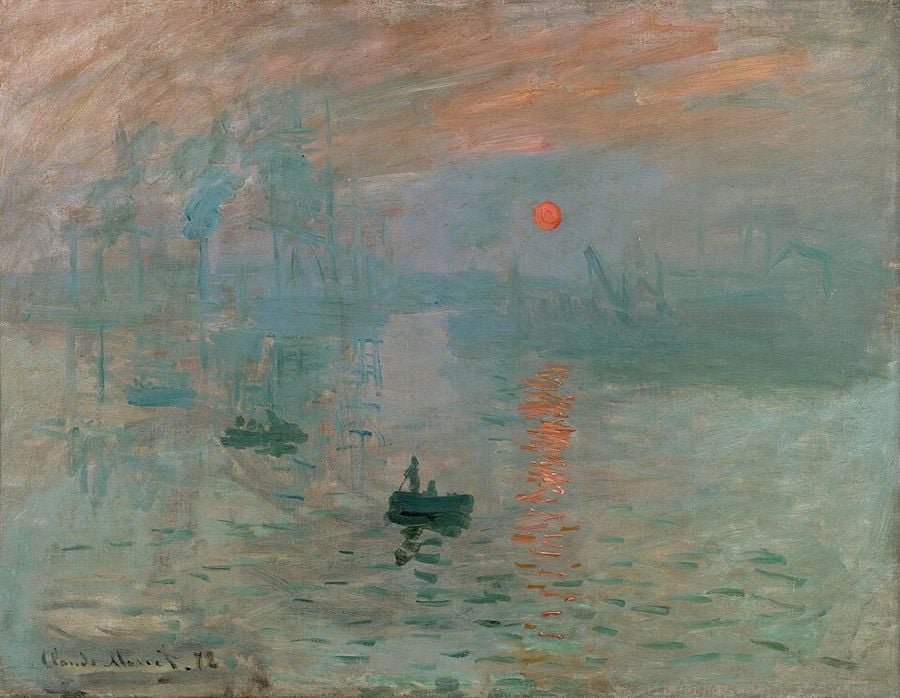
The new Paris was a city of spectacle, leisure, and consumption. Cafés, theaters, racetracks, boating on the Seine, Sunday strolls in the Bois de Boulogne, day trips to the suburbs by the newly expanded rail network — these became the subjects of Impressionist painting. Claude Monet, Pierre-Auguste Renoir, Edgar Degas, Berthe Morisot, and their colleagues were painting the experience of modernity as it was actually lived by the middle classes who were its primary beneficiaries.
Photography was becoming commercially viable at the same moment. The Impressionists' insistence on capturing the transient quality of light — the way a garden path looks at a specific hour, the way water reflects a particular sky — was partly a response to photography's expanding reach. Where the camera could record, painting could interpret. The soft edges and broken brushwork that made the Impressionists controversial were, in part, a claim about what painting alone could do.
The Franco-Prussian War of 1870–1871 and the Paris Commune that followed were also formative. Several of the Impressionists were in Paris during the Commune and its violent suppression, which killed thousands of people in the streets of the city. The movement's emphasis on private experience and sensory pleasure, rather than historical narrative or political allegory, reflects an implicit turn away from public trauma toward individual perception.
The Impressionists were rejected by the official Salon in 1863 and in subsequent years, leading them to organize independent exhibitions beginning in 1874. This institutional break — artists organizing their own shows outside the state-sanctioned system — was as historically significant as their technique. It established the model of the independent avant-garde that would define Western art for the entire 20th century.
Buyenlarge / Getty Images
Art Nouveau flourished from roughly 1890 to 1910, a period often called the Belle Époque in France — a stretch of relative peace in Western Europe, economic expansion, and widespread confidence in technological progress. It was also a period of deepening anxiety about what industrial production was doing to human skill, craft, and the quality of the built environment.
The mass-produced consumer goods filling the new department stores of Paris, Vienna, and Brussels were cheap and standardized — made by machines, with the irregularities of handcraft engineered out. Art Nouveau was, in significant part, a reaction against this. The movement's characteristic vocabulary — sinuous plant forms, flowing figures, natural curves derived from flowers, vines, and insects — was a deliberate counter-program to the rigid geometry of industrial manufacturing.
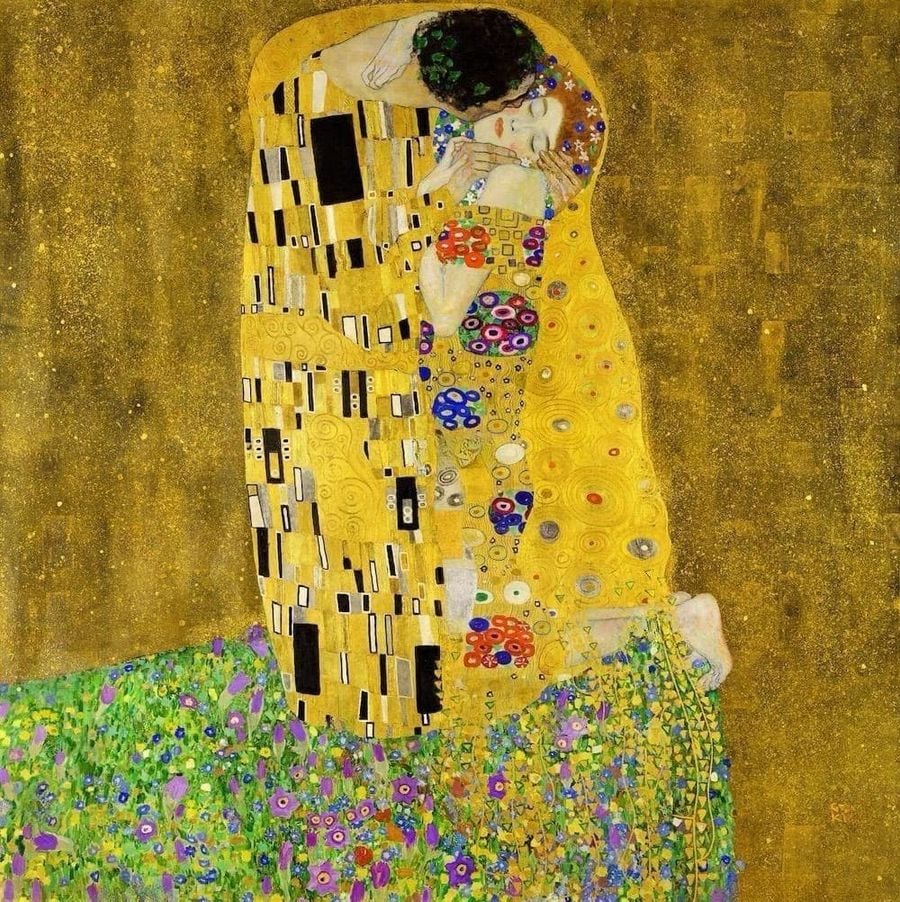
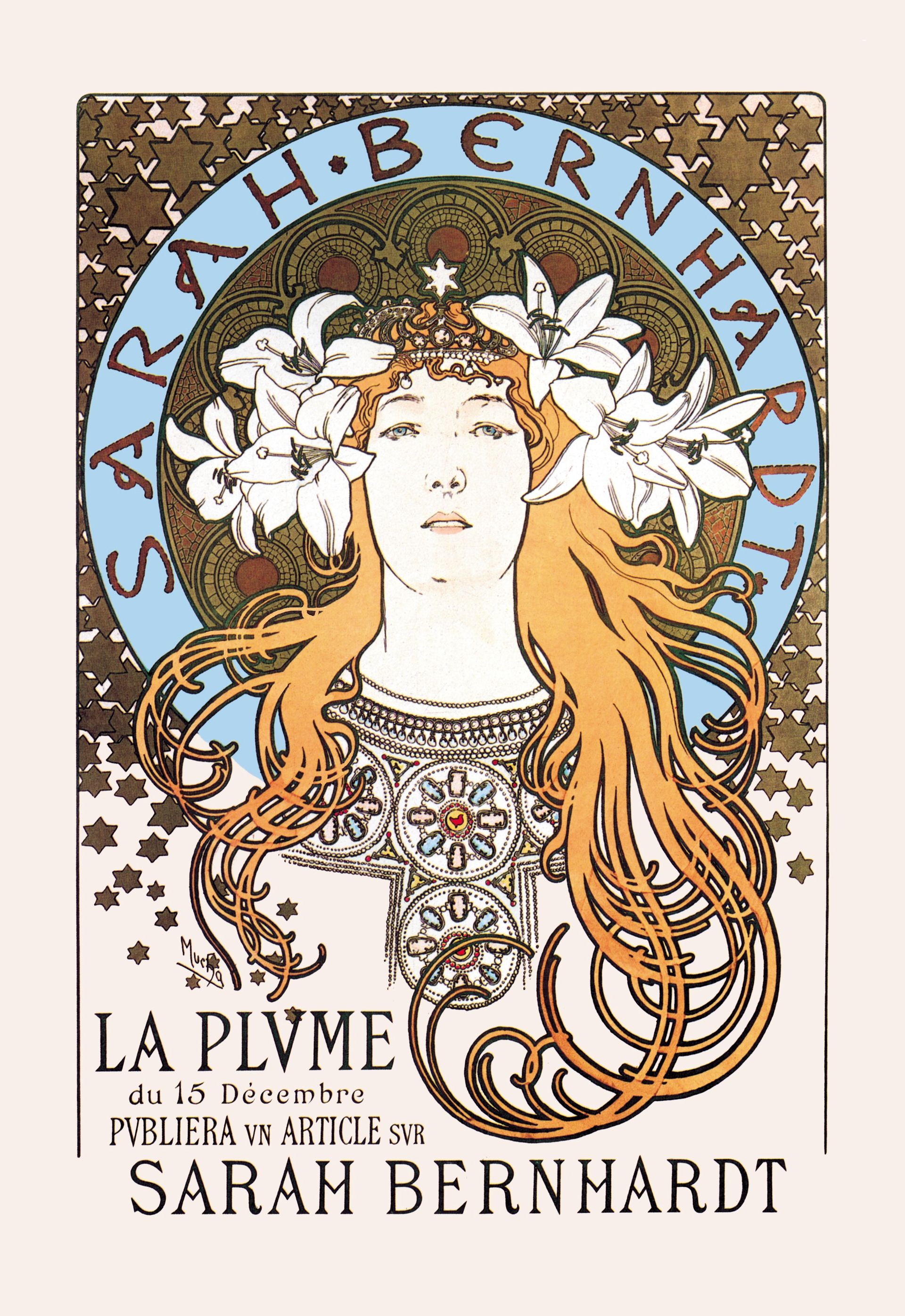
The movement expressed itself across every medium and at every scale. Alphonse Mucha's posters for Sarah Bernhardt's theatrical productions turned commercial advertising into art objects. Victor Horta's buildings in Brussels wrapped iron structural elements in organic ornament, making the city's infrastructure itself a form of decoration. In Vienna, Gustav Klimt and the Secession movement reimagined the relationship between fine art and applied design, insisting that no hierarchy should separate a painting from a piece of furniture or a textile.
In Barcelona, Antoni Gaudí pushed the Art Nouveau vocabulary to an extreme, designing buildings — the Sagrada Família, the Casa Batlló — that look less like constructed architecture than like living organisms shaped by forces outside human intention. In Glasgow, Charles Rennie Mackintosh developed a cooler, more geometric variant that would influence the modernist design movements that came after.
Art Nouveau was also shaped by the influence of Japanese art, which had been entering European collections since the forced opening of Japan to Western trade in the 1850s. Japanese woodblock prints — particularly the work of Hiroshige and Hokusai — introduced European designers to asymmetrical composition, flat areas of color, and the decorative treatment of natural forms.
The movement effectively ended with the First World War. The war destroyed both the Belle Époque's optimism and its material conditions. The sinuous ornament of Art Nouveau looked, after 1918, like the indulgence of a world that no longer existed. Modernist design — stripped of ornament, functional, openly machine-embracing — replaced it almost immediately.
TIMOTHY A. CLARY / Getty Images
Expressionism developed primarily in Germany between roughly 1905 and the late 1920s, in a society undergoing extraordinarily rapid industrialization, urbanization, and political stress. Germany had unified only in 1871, and the empire that Bismarck built was trying to compress into a single generation the social transformations that Britain and France had experienced over a century. Cities grew at a pace that overwhelmed infrastructure and social institutions. Traditional rural communities fractured. The modern city became both a central subject and a central anxiety in German culture.
The two main Expressionist groups — Die Brücke (The Bridge), founded in Dresden in 1905, and Der Blaue Reiter (The Blue Rider), formed in Munich in 1911 — shared a conviction that conventional academic art, with its smooth surfaces and commitment to depicting the visible world accurately, had become a kind of lie. The world, as these artists experienced it, was not smooth. It was distorted by social pressure, psychological distress, and the grinding pace of industrial modernity.
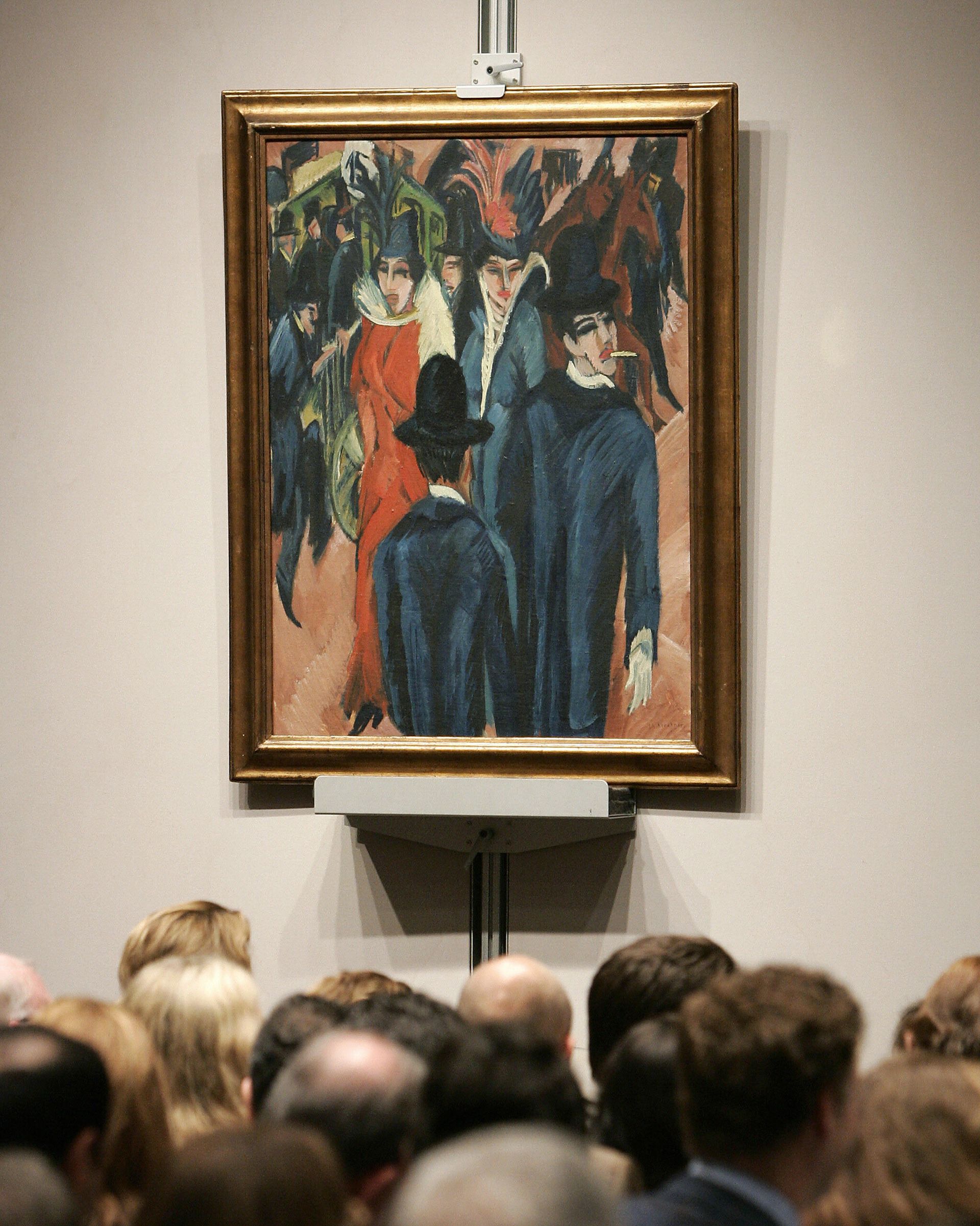
Ernst Ludwig Kirchner's street scenes of Berlin show elongated, angular figures moving through garish, menacing urban spaces — a vision of city life as a form of psychic assault. Egon Schiele, working in Vienna, took the body as his primary subject and rendered it with an angular, raw tension that made comfortable viewing difficult. His figures are not idealized; they are exposed, contracted, and stripped of the flattery that academic portraiture took for granted.
Wassily Kandinsky, a key figure in Der Blaue Reiter, moved toward abstraction entirely, arguing that pure color and form could communicate emotional states without needing to represent anything recognizable. This was a philosophical as much as a painterly claim — that art's responsibility was to inner truth, not outer appearance.
Edvard Munch, a Norwegian painter whose work was foundational to the movement, had already made the essential Expressionist argument with "The Scream" (1893): that the subjective experience of modern anxiety was a legitimate — perhaps the only fully honest — subject for serious art.
The First World War devastated the movement's first generation. August Macke was killed in combat in September 1914, less than two months after the war began. Franz Marc died at Verdun in 1916. Ernst Ludwig Kirchner suffered a breakdown. The works these artists had made in anticipation of catastrophe arrived at their full meaning only as the catastrophe unfolded.

Credit: Wikipedia
Cubism, developed by Pablo Picasso and Georges Braque in Paris between roughly 1907 and 1914, is frequently described in purely formal terms — its fracturing of objects into multiple simultaneous viewpoints, its rejection of single-point perspective, its flattening of pictorial space. The formal account is accurate, but it leaves out the historical pressures that made such a radical break conceivable.
Two forces were particularly significant. The first was the presence of African and Oceanic art objects in Paris during the first decade of the 20th century. The Trocadéro ethnographic museum held extensive collections, and African masks and sculptures were also appearing in private collections and dealers' shops. Picasso visited the Trocadéro in 1907 and later described the encounter as transformative — he found in African sculptural approaches to the face and figure a set of formal solutions that did not depend on European naturalism. The proto-Cubist work completed that same year, "Les Demoiselles d'Avignon," bears direct evidence of this influence in its right-hand figures.
The second force was the broader intellectual environment of early-20th-century Europe, in which the certainties of Newtonian physics were being systematically revised. Einstein published his special theory of relativity in 1905, establishing that space and time were relative to the observer's position rather than fixed absolutes. Henri Bergson's philosophy challenged the idea of time as a uniform, measurable flow. Cubism's representation of an object from multiple viewpoints simultaneously is not a direct illustration of relativity — the connection is more atmospheric than programmatic — but both emerged from a culture that had stopped believing a single fixed perspective could adequately capture reality.
The First World War effectively ended the collaboration between Picasso and Braque that had produced analytical Cubism. Braque enlisted in the French army and was severely wounded, sustaining a head injury that required a long recovery. When he returned to painting, the daily practice of working through formal problems together was over.
Cubism's legacy extended far beyond the two men who invented it. It gave subsequent movements — Constructivism, Futurism, De Stijl, Bauhaus design — a shared vocabulary of fractured form and multiple perspective from which each developed its own program. The break from single-point perspective that Picasso and Braque made in a Paris studio over a few intense years proved to be one of the most consequential formal decisions in the history of Western art.
Sepia Times / Getty Images
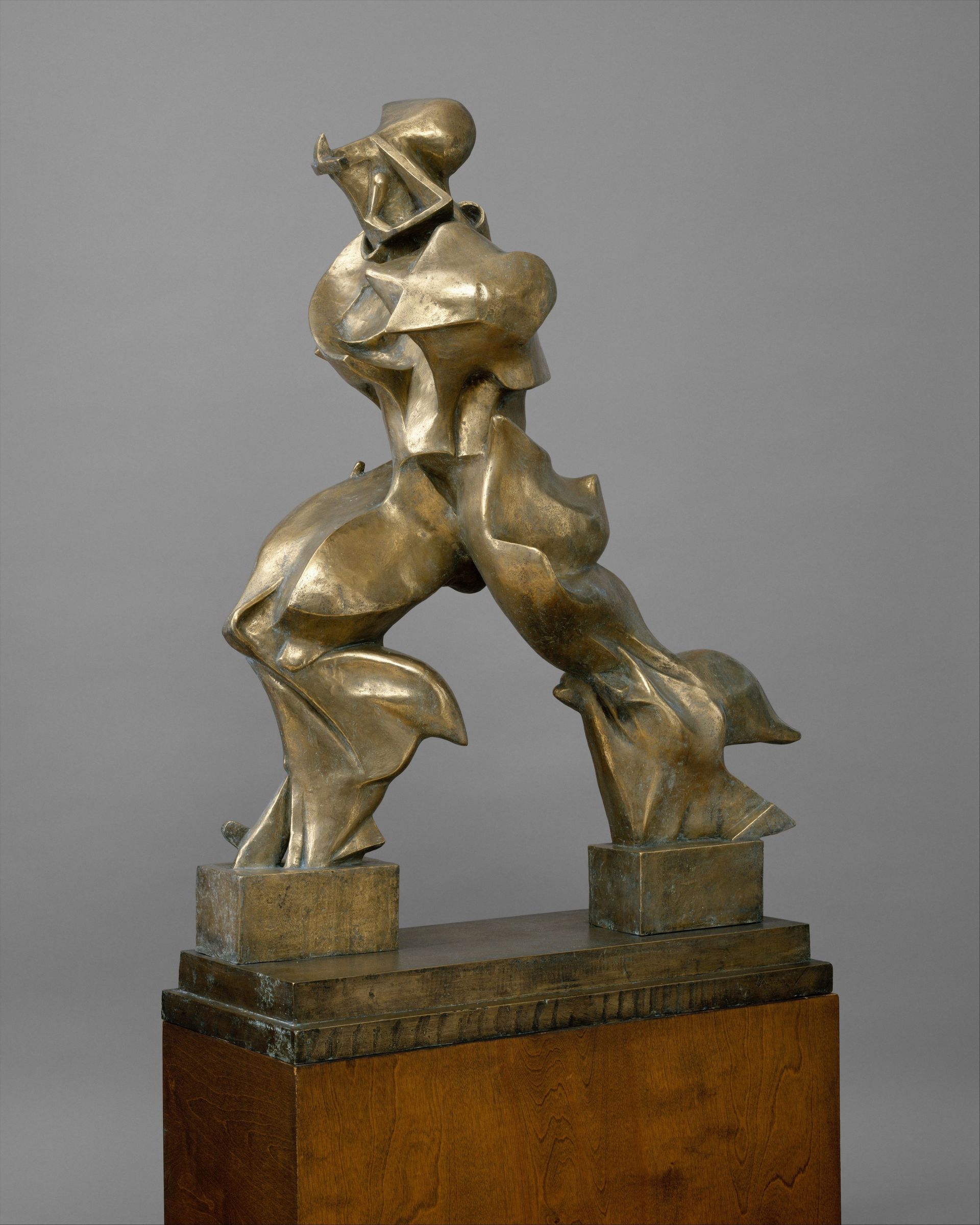
Futurism was launched in 1909 with the publication of Filippo Tommaso Marinetti's "Futurist Manifesto" on the front page of Le Figaro. The text was belligerent, theatrical, and precise about what it despised: libraries, museums, feminism, moralism, and anything that carried the smell of the past. What it celebrated was speed, machines, crowds, violence, and war — which Marinetti famously declared to be the world's only true form of purification.
The historical context is essential for understanding why this posture found an audience. Italy in 1909 was a unified nation of only 40 years, still economically underdeveloped compared to Britain, France, and Germany, still heavily rural in its south, still carrying the weight of a classical heritage that European culture simultaneously celebrated and used to condescend to contemporary Italians. The Futurists' rage at museums and the cult of antiquity was partly a rage at the way Italy's past was being used to diminish its present — a way of insisting that Italy's future, not its ruins, deserved attention.
The movement also drew on a broader European absorption with industrialism and the machine. Umberto Boccioni, Giacomo Balla, and Carlo Carrà developed a visual language for depicting speed, motion, and energy — dynamic diagonal compositions, overlapping forms suggesting a figure or vehicle in successive positions, the city rendered as a field of simultaneous forces rather than a stable backdrop. Balla's "Dynamism of a Dog on a Leash" (1912) broke a single moment of movement into multiple overlapping images with a logic similar to stop-motion photography.
Futurism's relationship with Italian nationalism and, eventually, fascism is not incidental to the movement. Marinetti was an enthusiastic supporter of Mussolini, and several Futurists were directly involved in the early fascist movement. The celebration of violence, the contempt for democratic process, and the glorification of youth and energy as values in themselves fed directly into fascist ideology. This does not reduce Futurism to a fascist art program — its formal experiments influenced Constructivism, Bauhaus design, and graphic design across the political spectrum — but it does require acknowledging that aesthetic radicalism and political reaction can coexist in the same body of work.
The First World War killed Boccioni in a training accident in 1916 and diminished the movement's naive enthusiasm for combat. The postwar Futurism that continued into the fascist period carried the movement's name into a context its founding energy had not anticipated and could not survive intact.
Credit: Wikipedia
Dada was born in Zurich in 1916 at the Cabaret Voltaire, in neutral Switzerland, surrounded by a war that had been killing people by the millions for two years. Hugo Ball, Emmy Hennings, Jean Arp, Tristan Tzara, and Richard Huelsenbeck — artists, poets, and performers who had fled the carnage of the Western Front or the political upheaval of their home countries — gathered in a small venue and began making art that tried to match the irrationality of the war itself.
The internal logic of Dada follows directly from its historical moment. If the educated elites of Europe — the philosophers, the scientists, the generals, the politicians — had produced a war with millions of dead, then reason, logic, and the European cultural tradition those elites had built were not to be trusted. The appropriate response was nonsense: sound poems with no semantic content, collages assembled from newspaper fragments that meant nothing, performances designed to alienate rather than seduce, art that declared itself anti-art.
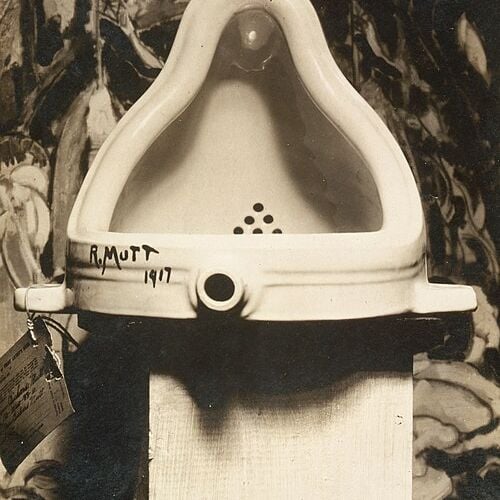
Marcel Duchamp, working in New York — which developed its own parallel Dada scene — took the critique to its furthest point with his readymades: ordinary manufactured objects submitted to exhibitions as artworks. A bicycle wheel mounted on a stool. A commercial bottle rack. Most famously, a porcelain urinal submitted to the Society of Independent Artists exhibition in 1917 under the title "Fountain" and signed with the invented name "R. Mutt." The institutional definition of art — what counted as art because an artist had made it and placed it in an art context — was exposed as purely circular and therefore empty.
Dada spread from Zurich to Berlin, where the stakes became explicitly political. Berlin Dada — George Grosz, John Heartfield, Hannah Höch — made photomontages attacking the German military, the Weimar political establishment, and bourgeois culture with a ferocity that reflected the chaos and violence of postwar Germany. Höch's "Cut with the Kitchen Knife Dada" (1919–1920) assembled fragments of mass media imagery into a portrait of a society in violent transition.
Dada's legacy is vast and contradictory. It gave the art world a set of conceptual tools for questioning what art itself is — tools that every subsequent movement drew on, often against Dada's own nihilistic intentions. In wanting to destroy art, Dada made more art possible.
Credit: Wikipedia
Surrealism emerged in Paris in 1924, when André Breton published the first "Surrealist Manifesto." The movement grew directly from Dada — many Surrealists had been Dadaists — but where Dada aimed at negation, Surrealism aimed at construction. It wanted to build a new way of seeing, grounded in the unconscious mind and in the logic of dreams.
The historical context that made this project legible was the recently concluded world war and the psychological wreckage it had produced. Shell $SHEL shock — post-traumatic stress disorder in contemporary terminology — had demonstrated, in undeniable numbers, that the mind under extreme duress behaved in ways that rational psychology could not fully account for. Sigmund Freud's work on dreams, repression, and the unconscious, which had been developing since the 1890s, now had a vast and visible body of evidence behind it. The war had cracked open the European psyche, and the crack let the unconscious through.
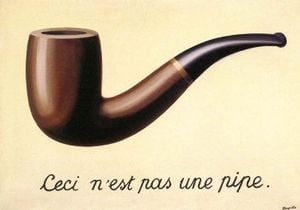
Surrealism's visual program was direct: access the unconscious through automatic processes, through dreams, through the states between sleep and waking, and make that material visible in art. Salvador Dalí's melting watches and hallucinatory desert landscapes, René Magritte's quietly unsettling combinations of ordinary objects — a bowler hat, a pipe, a window, a cloud where a face should be — Giorgio de Chirico's empty, shadow-drenched piazzas: all were attempting to represent a psychic reality that rational, daylit consciousness suppressed.
The movement also had an explicitly political dimension. Breton aligned Surrealism with communism, arguing that the liberation of the unconscious and the liberation of the working class were parallel projects. This alliance was tense, productive, and ultimately broke down — the Communist Party demanded political utility from art, and the Surrealists refused to subordinate the imagination to any program, including their own.
Women Surrealists — Meret Oppenheim, Leonora Carrington, Remedios Varo, Dorothea Tanning — produced work that engaged the movement's vocabulary on different terms, often turning its logic of irrational transformation onto the experience of being female in a culture that already treated women as objects of fantasy rather than as agents. Their contributions were systematically undervalued during the movement's peak years, and have been substantially recovered by art history since.
Robert Nickelsberg / Getty Images
Abstract Expressionism was the first major art movement to emerge from the United States rather than Europe, and its rise in New York in the 1940s and early 1950s was shaped by two world historical events: the Second World War and the onset of the Cold War.
The war brought a significant number of European artists to New York as refugees — Piet Mondrian, Marcel Duchamp, Fernand Léger, Max Ernst, André Breton, and others fled Nazi-occupied Europe and settled, at least temporarily, in the city. This influx, concentrated in a place already developing its own galleries, critics, and collectors, accelerated the maturation of the New York art world. American artists absorbed European modernism in real time through direct contact rather than through photographs in magazines.
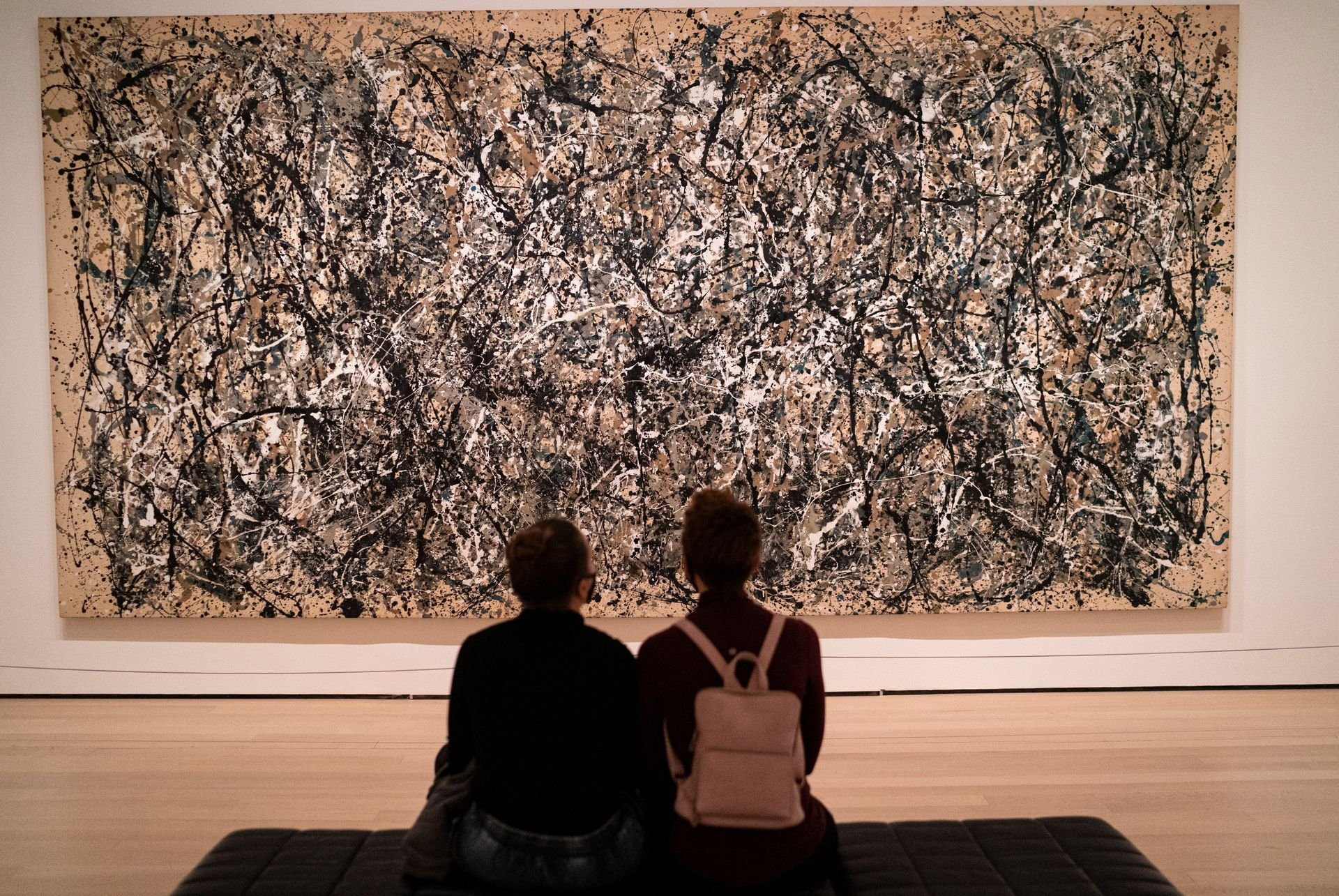
The existential weight of the war itself — the Holocaust, the atomic bombings of Hiroshima and Nagasaki, the demonstrated capacity of industrial civilization to destroy on a scale previously unimaginable — created the conditions for an art that treated gesture, emotion, and the raw physical act of making as sufficient subjects in themselves. Jackson Pollock dripping paint onto canvas laid flat on the floor, Mark Rothko dissolving color into large atmospheric fields, Franz Kline making monumental black brushstrokes against white grounds: these were forms of art in which the evidence of the artist's physical and emotional presence was the content. No narrative, no symbol, no representation — only the record of a body at work.
The Cold War added another dimension to the movement's history. The U.S. government and associated cultural organizations took an active interest in promoting Abstract Expressionism internationally as evidence of American cultural vitality and freedom, specifically as a contrast with the figurative Socialist Realism required of Soviet artists. The Congress for Cultural Freedom, funded in part by the CIA, organized exhibitions of American abstract art in Europe. Most of the artists themselves were unaware of this institutional support and held leftist political views. The appropriation of their work for Cold War purposes remains one of the more ironic episodes in 20th-century cultural history.
Willem de Kooning, Lee Krasner, Helen Frankenthaler, and Robert Motherwell each developed distinct approaches within the movement — there was no single Abstract Expressionist style or method. What the group shared was a conviction that painting was a serious, morally weighted act in a world that had recently provided very serious reasons for doubt.
JUSTIN TALLIS / Getty Images
Pop Art emerged in Britain and the United States in the late 1950s and reached its cultural peak in the early to mid-1960s, in the context of postwar consumer prosperity, the expansion of mass media, and the development of a visual culture saturated with advertising, celebrity imagery, and commercial design.
The movement arose partly as a response to Abstract Expressionism's seriousness and its insistence on originality, depth, and emotional authenticity. Andy Warhol, Roy Lichtenstein, Jasper Johns, Robert Rauschenberg, and Claes Oldenburg in the U.S., and Richard Hamilton and Peter Blake in Britain, looked at the commercial images flooding American and British visual culture — soup cans, comic strips, movie stars, soft drink bottles, newspaper photographs — and argued that these images constituted the actual visual environment that people lived in. Ignoring them in favor of pure abstraction was its own kind of mystification.
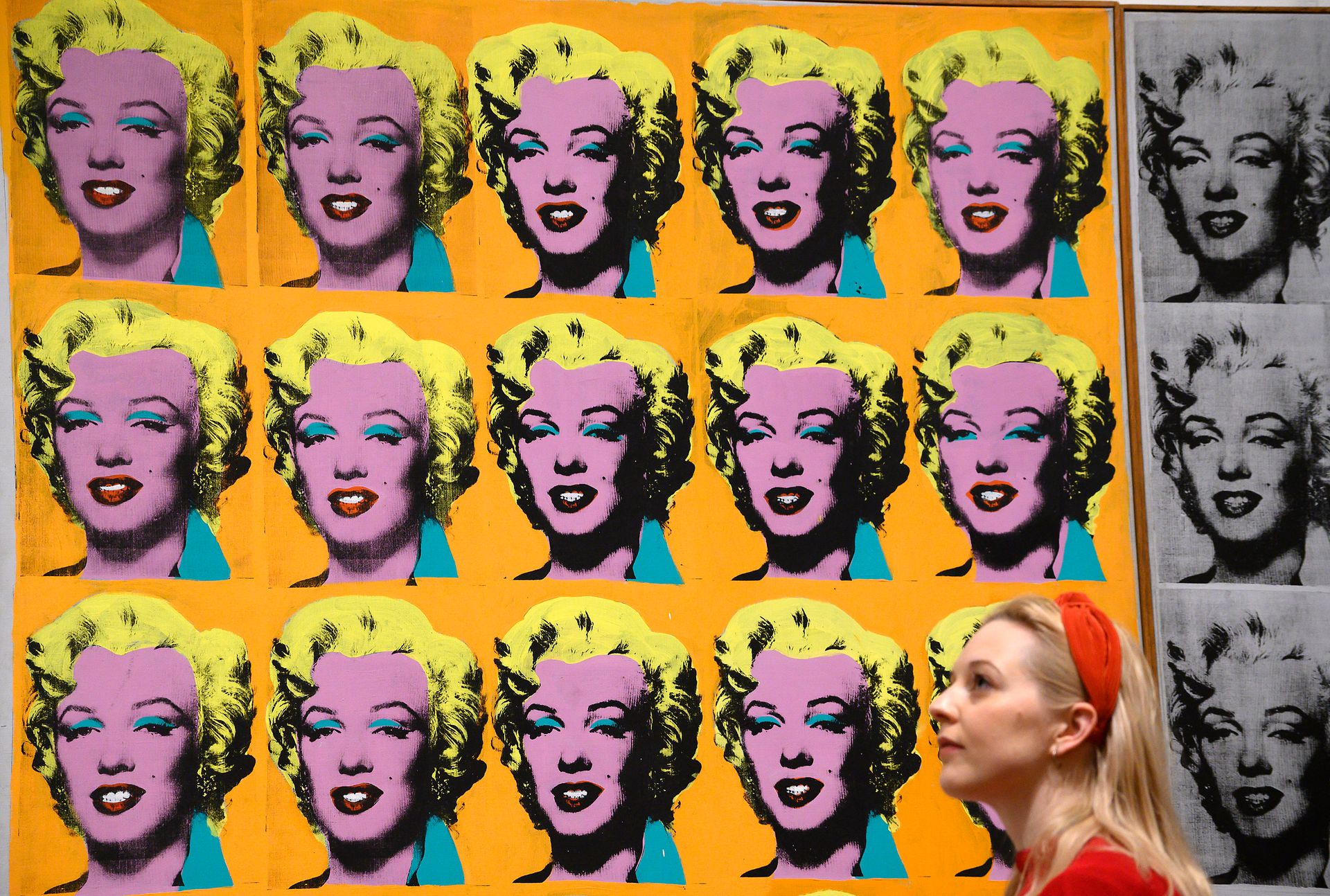
Warhol's screenprints of Marilyn Monroe, Elvis Presley, and Mao Zedong used the techniques of commercial reproduction to flatten the distinction between art and commodity, between the unique object and the mass-produced one. This was not simply a critique of consumer culture; it was also a demonstration of how consumer culture actually operated — how repetition created familiarity, how familiarity created desire, and how desire drove both commercial exchange and political life. The portrait of a celebrity produced in 50 identical silkscreens did not diminish the celebrity; it multiplied and reinforced her.
The Cold War context was embedded in the movement's material. The consumer abundance of 1950s and early 1960s America was itself a political argument — that liberal capitalism delivered prosperity and freedom — and Pop Art's treatment of consumer goods oscillated between celebration and irony in ways that were never fully resolved. Warhol consistently refused to specify whether he was celebrating or critiquing the culture he depicted, and this refusal was its own form of argument.
The British Pop Art scene, centered on the Independent Group at the Institute of Contemporary Arts in London, was working from a different material base. Britain still had rationing until 1954, and the American consumer imagery flowing through magazines and films carried an aspirational charge for British artists that was absent for their American counterparts. The British relationship to Pop culture was more explicitly analytical — more aware of the power dynamics involved in the flow of images from west to east across the Atlantic.
Credit: smarthistory.org
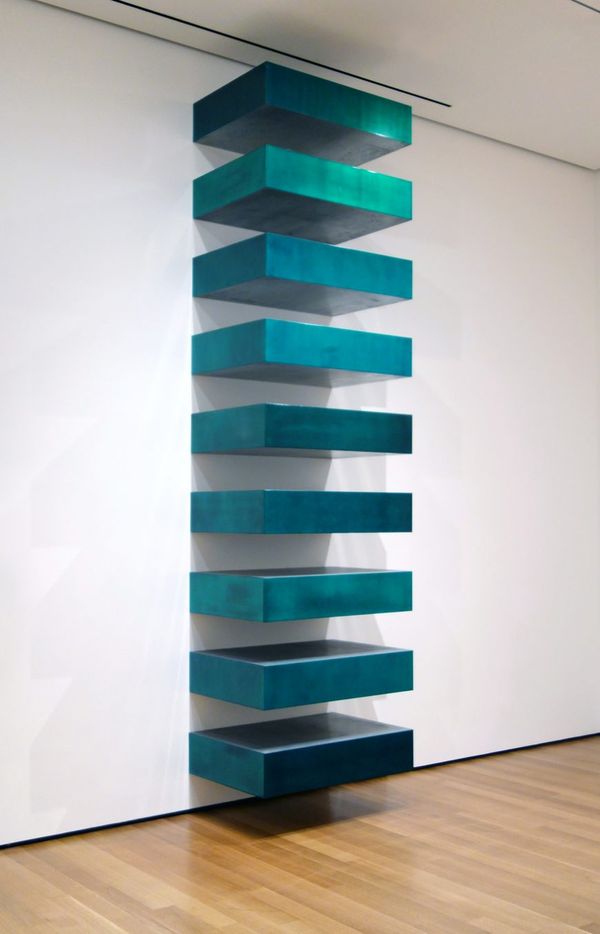
Minimalism developed in New York in the early 1960s, largely as a reaction against Abstract Expressionism. Where Abstract Expressionism placed the artist's emotional and psychological life at the center of the work, Minimalism removed it entirely. The object was the object — a painted steel cube, a row of fluorescent light tubes, a series of identical aluminum boxes — and it did not represent, symbolize, or express anything beyond its own physical presence in space.
The artists associated with the movement — Donald Judd, Dan Flavin, Carl Andre, Robert Morris, Anne Truitt — rejected not only Abstract Expressionism's emotional claims but also its handmade quality. Judd had his sculptures fabricated by industrial manufacturers to specifications he provided, rather than making them by hand in a studio. The work of art as a unique object bearing the distinctive marks of a unique maker — one of the foundational premises of Western art since the Renaissance — was deliberately eliminated.
The historical context was Cold War America at the start of the Vietnam War. The philosophical orientation of the movement drew on phenomenology — an interest in the actual perceptual experience of encountering an object — rather than on symbolic meaning or biographical reference. There was also a political dimension to the rejection of Abstract Expressionism's heroic posture. The rhetoric of grandiose individualism that had surrounded the Abstract Expressionists — and that the U.S. government had co-opted for Cold War cultural diplomacy — looked, by the early 1960s, like exactly the kind of inflated self-importance a serious artist should be suspicious of.
Minimalism also reflected the conditions of industrial production in postwar America. The interchangeable unit, the module, the standardized component manufactured in series — these were the basic units of American manufacturing, and Minimalist artists made them visible as the basic units of a new aesthetic experience as well. Carl Andre's floor pieces, made of identical metal tiles arranged in grids directly on the gallery floor, asked viewers to pay attention to how their feet and eyes encountered material at full scale — an experience entirely different from standing before a framed painting on a wall.
The movement's legacy includes a direct line to Conceptual Art, which retained Minimalism's anti-expressive orientation while removing the physical object from the equation almost entirely. In stripping art down to its essential conditions, Minimalism raised the question of which conditions were actually essential — a question Conceptual Art then answered in ways the Minimalists had not intended.
Credit: WikiArt.org
Conceptual Art developed in the late 1960s from a simple but consequential proposition: the idea behind a work of art is the work of art. The physical object — the painting, the sculpture, the carved stone — was not the irreducible core of artistic practice. It was a convention. And like all conventions, it could be examined, questioned, and set aside.
The historical moment that gave this proposition urgency was one of institutional crisis across multiple domains simultaneously. The civil rights movement in the U.S. had exposed the moral failures of liberal institutions that had presented themselves as essentially just. The Vietnam War had exposed the dishonesty of government communication and the complicity of cultural institutions in sustaining public support for the conflict. The student uprisings of 1968 — in Paris, Mexico City, Chicago, Prague, and dozens of other cities — had called into question the authority of established structures in education, politics, and culture.
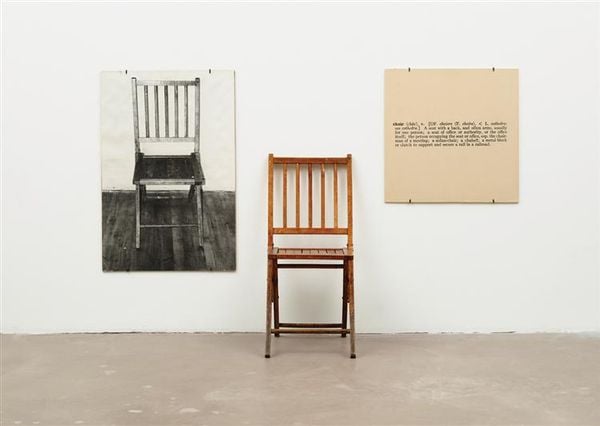
Art institutions were part of the target. The gallery system, the museum, the auction house — these were mechanisms for converting art into commodity and attaching it to wealth and power. Conceptual artists attacked the institution directly and from within. Hans Haacke produced sociological surveys of the real estate holdings and financial interests of museum trustees and displayed them as gallery works, making the economic infrastructure of the art world itself the subject. Joseph Kosuth's "One and Three Chairs" (1965) — a physical chair, a photograph of that chair, and a dictionary definition of the word "chair" — asked which of the three was the real thing and whether the question had a stable answer.
Lawrence Weiner, Sol LeWitt, and others established that a work of art could exist as a set of instructions to be executed by anyone, anywhere — the artist's hand was not required. LeWitt's wall drawings were described in language; the physical execution at any given location was incidental to the work itself. This distributed the artwork in a way that bypassed the gallery and market system.
The movement's engagement with language, systems, and institutional critique opened the door to the identity-based art of the 1970s and 1980s, in which artists used Conceptualism's tools to address race, gender, and sexuality — subjects that the movement's first generation, which skewed heavily white and male, had largely left unaddressed.

Saatchi Collection / www.independent.co.uk
Neo-Expressionism appeared in West Germany, Italy, and the United States in the late 1970s and early 1980s, returning large-scale, emotionally raw, figurative painting to the center of the art world after a decade in which Conceptual Art and its variants had dominated critical attention. The return was not simply aesthetic nostalgia. It was a response to a specific political and cultural climate on both sides of the Atlantic.
In West Germany, the movement known as Neue Wilde (New Fauves) and the work of artists such as Georg Baselitz, Anselm Kiefer, and Sigmar Polke engaged directly with the weight of German history — the Third Reich, the Holocaust, the division of the country — at a moment when German society was being asked to reckon with that history more explicitly than it had in the postwar decades. Kiefer's paintings, with their heavy surfaces of straw, lead, and ash, their references to Nazi mythology and Jewish mysticism, their scorched and desolate German landscapes, made the failure to process historical guilt both the subject of the work and its physical material. These were not comfortable pictures. They were not meant to be.
In the United States, the Neo-Expressionist moment coincided with the Reagan years: the withdrawal of public investment in cities, rising inequality, the early AIDS crisis, and the culture wars that accompanied the political shift to the right. Jean-Michel Basquiat, whose career moved from spray-painted walls on the Lower East Side to international gallery exhibitions in a few years, brought Black American history, police violence, and the economics of race into a Neo-Expressionist vocabulary. His paintings — dense with text, imagery, crossed-out figures, anatomical diagrams, and references to jazz musicians and athletes — were both formally bold and historically specific. They were also records of an artist navigating, with considerable awareness, the art world's commercial appetite for his work.
Julian Schnabel, David Salle, and Francesco Clemente were leading figures of an American Neo-Expressionism that attracted significant commercial success and critical ambivalence in equal measure. The return to painting was also a return to a market-friendly object at a moment when the art market was expanding rapidly, driven by the wealth concentration of the early Reagan era. The coincidence between aesthetic return and market enthusiasm was not lost on critics, and the question of whether Neo-Expressionism represented a genuine historical moment or a commercial cycle has followed the movement ever since.
What Neo-Expressionism demonstrates, regardless of how that question is answered, is that aesthetic cycles have material causes. The turn back to painting was not simply a generational preference or a spontaneous shift in taste. It was shaped by what the political and economic conditions of a specific decade made both necessary and profitable to express.

Social Realism
Credit: Wikipedia
Social Realism was not a unified movement with a single manifesto or founding moment, but rather a shared orientation among artists across several countries in the 1920s and 1930s who believed that art had a responsibility to represent the conditions of working-class and peasant life with political intent. Its high-water mark came during the Great Depression, when mass unemployment and the rise of fascism in Europe made the aesthetics of individual expression seem, to many artists, like a luxury the moment could not support.
In the United States, the New Deal's Federal Art Project — part of the Works Progress Administration established in 1935 — put thousands of unemployed artists to work, producing murals, prints, and paintings for post offices, schools, hospitals, and public buildings. The program's scale was unprecedented. The imagery was deliberately populist — American workers, farmers, regional history, ordinary civic life — and its willingness to fund art for public buildings helped define what public art in a democracy could look like.
The Mexican Muralists were a direct influence on this American project. Diego Rivera, José Clemente Orozco, and David Alfaro Siqueiros had been developing monumental public muralism in Mexico since the early 1920s, following the Mexican Revolution of 1910–1920 and under the cultural program of Education Minister José Vasconcelos, who commissioned murals for public buildings as a way of constructing a post-revolutionary national identity. Rivera's murals at the Detroit Institute of Arts (1932–1933) and his controversial, subsequently destroyed mural at Rockefeller Center (1933) brought the Mexican tradition directly into U.S. public discourse and made visible the political stakes of art in public spaces.
The Soviet Union developed its own parallel version of Social Realism during this period, though under state direction rather than critical intent. Socialist Realism became official Soviet cultural policy in 1934, requiring art to depict working-class and Soviet life in an optimistic, heroic register that served the ideological needs of the state. This state-controlled version was something quite different from the critical Social Realism of American and Mexican artists — one was a form of dissent, the other a form of compliance — but both drew from the same foundational premise that art should depict the real conditions of real people rather than abstract formal problems.