The central bank for Central Banks just sent out a warning that markets have gotten excessively euphoric in spite of some worrying fundamentals.

The central bank for Central Banks just sent out a warning that markets have gotten excessively euphoric in spite of some worrying fundamentals.
The red flag comes from the Bank of International Settlements annual report on the state of the world’s economy. The report, which was released today, acknowledges that the global economy is broadly improving, with most of the world returning to solid growth. But is also includes (PDF) an analysis of which countries and regions have the most worrisome early warning indicators for a domestic banking crisis. The indicators aren’t a surefire way to predict a crisis, but have been fairly reliable in the past.
Join 500,000+ readers who start their day with Quartz.
By subscribing, you agree to our Terms of Service and Privacy Policy.
History shows that when the difference between a country or region’s credit-to-GDP ratio and the long-term trends of that ratio exceeds 10%, it indicates a pretty rapid accumulation of debt and is usually followed by serious strain on a banking system within 3 years. When residential property prices start rising above their long term trends, that often points to a credit boom and comes two to three years ahead of a crisis. And all it would take is a 250 basis points increase in short term money market rates to push debt servicing ratios in many booming economies upward. These ratios tend to rise rapidly a year or two before a crisis.
A red cell indicates a a more worrisome level for any given indicator. According to the report, Asia is the region that seems to be at most risk, with China in particular creating cause for concern. Switzerland, Turkey, and Brazil are also sending serious warning signals:
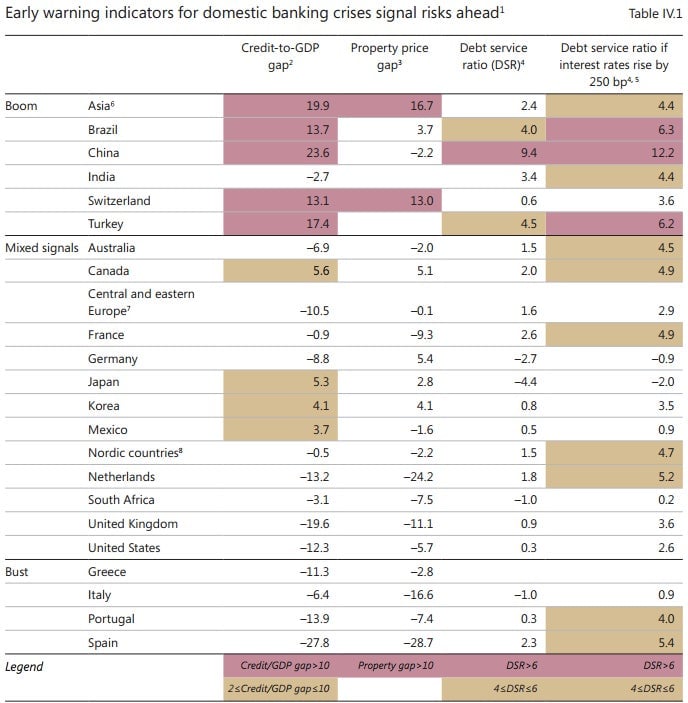
This isn’t to say that crisis is imminent wherever there’s a red cell. But should markets grow a bit less euphoric, rates start to rise, or China slow down substantially, there are quite a few countries that could end up scrambling.
