Russia, Iran and Venezuela have reason to be nervous about the abrupt 25% plunge in global oil prices. But what of those whose spirits should be up? We are hearing less from them.
To quantify all this silence, Quartz looked at the top 25 petroleum-importing countries and emerged with what we’re calling the ”$80 Index.” The name references a reasonable average for Brent oil over the coming year or so, given the global petroleum glut, dearth of demand, and nonchalance toward geopolitical disruption. (Brent traded as low as $82.93 last week.) If the index is accurate, these are the countries with the most reason to breaking out the champagne as their economies get a jolt from a better trade balance—and as their drivers get more cash in their pockets.
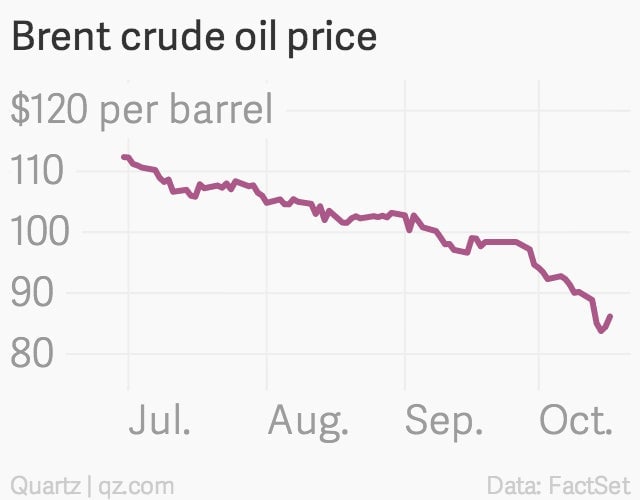
The index mechanics are explained below. What they yield makes sense: Ukraine and Poland, for example, will be spending much less on imports and, given their entanglement with a resurgent Russia, will be much more at ease in an $80-a-barrel world than at $115, the price last June.
Even though its shale oil is a big reason for the price plunge, and that sector will be earning less at lower prices, the US makes the top 10 due to its trade deficit (about a third of which is comprised of oil imports) and the energy intensity of its economy. In addition, at lower prices, the US derives contentment from imagining Russian president Vladimir Putin’s discomfort with $80 oil and the prospect of squeezing Iran, with which the West is in tense nuclear negotiations.
Each country’s score is based on a weighted index that takes four factors into account:
Countries are given a score of 1 to 5 for the first three factors, based on which quintile they occupy in the sample. After the geopolitical bonus is awarded, the weighted sub-scores are added together to get a final score, which is also expressed on a 1-to-5 scale.
