Spanish and Arabic are two of the most widely-spoken languages on Earth. The former language originated on the Iberian peninsula and is still spoken by more than 400 million people—primarily in the Western Hemisphere and on the Iberian Peninsula, but also in parts of North and West Africa and the Philippines. Arabic is spoken throughout the Middle East and North Africa and as the canonical language of Islam, can be found throughout the world—from western China to Senegal.
Spanish and Arabic are two of the most widely-spoken languages on Earth. The former language originated on the Iberian peninsula and is still spoken by more than 400 million people—primarily in the Western Hemisphere and on the Iberian Peninsula, but also in parts of North and West Africa and the Philippines. Arabic is spoken throughout the Middle East and North Africa and as the canonical language of Islam, can be found throughout the world—from western China to Senegal.
Most historians know these two languages share substantial history. The Arabic-speaking Moors conquered and ruled the Iberian Peninsula, including modern-day Spain and Portugal, for nearly eight centuries. Their control began in 711 and didn’t end until the fall of the Emirate of Granada in 1492 (the end of the “Reconquista”).
Join 500,000+ readers who start their day with Quartz.
By subscribing, you agree to our Terms of Service and Privacy Policy.
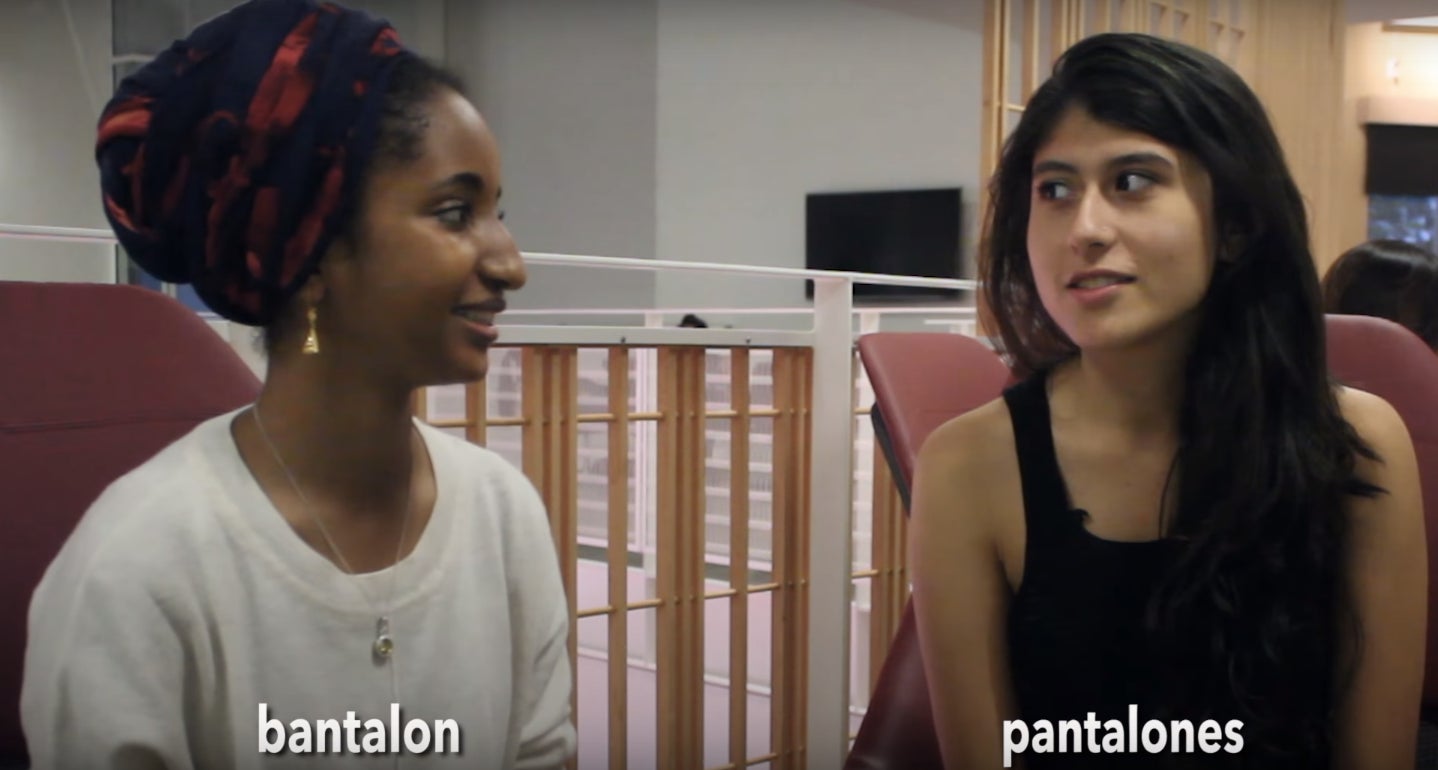
Over the course of those centuries, Arabic heavily influenced the Spanish language—but many of us are unaware of the extent of that influence today. In order to highlight this fascinating linguistic overlap, two students at the University of Southern California’s Annenberg School of Communication and Journalism produced a short video proving just how similar the languages remain, even in 2015:
The video features two students—one of Colombian descent, the other of Ethiopian heritage—simultaneously translating English words into Spanish and Arabic. It’s a delightful reminder of just how interrelated two seemingly disparate languages and cultures can be.
“I just wanted to open people’s minds to help them realize that the two cultures aren’t that different,” one of the video’s creators, Taylor Villanueva, told Fusion.
Villanueva, who is of mixed Mexican and Lebanese descent, said that she considers herself an American but is disheartened by the sometimes stereotypical and ignorant ways that minorities are represented by public figures and the media. “I’ve grown up seeing the similarities between the two cultures and I wanted other people to see it, too,” she said.
