
Here’s the thing: while getting paid to bring ideas to life day in, day out has its challenges, it ain’t rocket science. You wouldn’t worry if your surgeon is feeling inspired enough to operate, or ask your mechanic if he’s in the right headspace to fix your car, right?

Here’s the thing: while getting paid to bring ideas to life day in, day out has its challenges, it ain’t rocket science. You wouldn’t worry if your surgeon is feeling inspired enough to operate, or ask your mechanic if he’s in the right headspace to fix your car, right?
It’s the same with creatives. When the hours are slipping away and your deadline is hurtling towards you, there’s no time to wait for some sweet flower of genius to flutter down from the heavens.
Join 500,000+ readers who start their day with Quartz.
By subscribing, you agree to our Terms of Service and Privacy Policy.
So, how does that work? How can you, even on your most blah day, still find ways to reach into your reserves of creative juices and craft something your clients will love—on time, and every time? It all ties into your habits.
Inspiration is all around you, all the time. Absolutely everything you love, admire, hate, makes you think, makes you mad, grosses you out, changes your mind, or makes you act, etc… needs to be part of your “swipe file.”
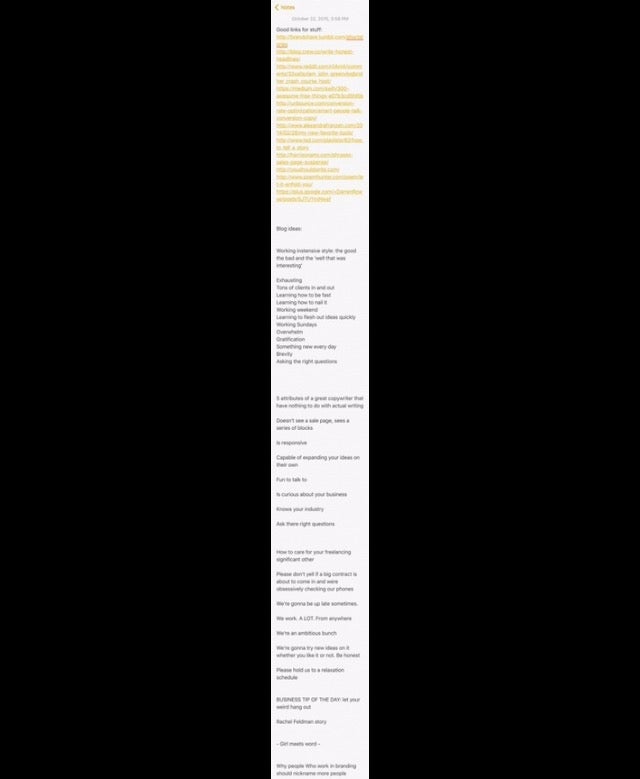
Swipe files can take many forms. I have a note on my iPhone that goes on for pages, filled with blog post and project ideas that hit me at any moment of the day, and links to other posts I think are great.
I also keep a running word doc with random blurbs and websites that resonate with me, and a file on my desktop packed with screenshots of what I consider to be great ads, graphics, press kits, books, songs, and videos.
Your swipe file is the perfect resource for those moments when ideas just aren’t coming and those moments when that perfect project comes around, when you’ll have just the thing tucked away and ready to build on.
For example, a one-liner I used in a headline for a client (which I have since seen repeated and imitated tenfold) was something I noticed in a reddit comment thread about motivation two years earlier.
Another example: the inspiration for the overall vibe and colors of my own website came from a popular “edgy” fashion brand.
The bottom line: Always keep your eyes open. Write down, save, and take photos of the things that speak to you. But whatever you do, save it all. You’re going to need it.
Impactful creative statements don’t follow a single pattern. In fact, work that doesn’t follow a common formula is often the stuff that’s most worth paying attention to.
Here’s what I mean: Earlier this year, a NYC real estate search engine called StreetEasy launched an awesome campaign that has stuck with me since I first saw it.
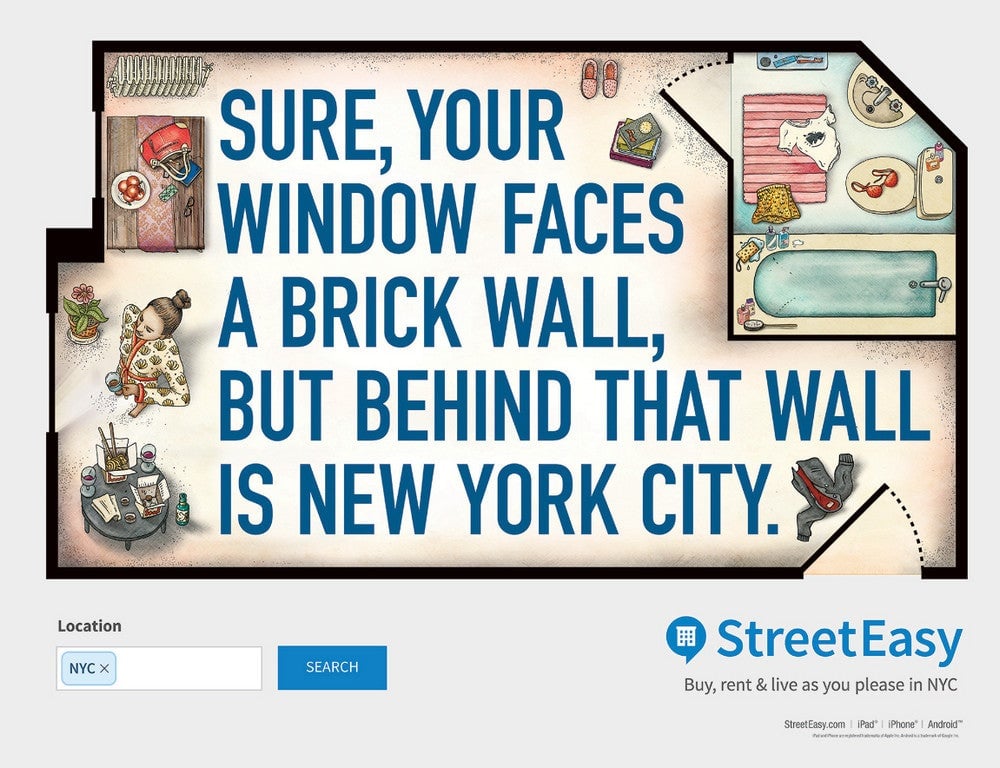
While most real estate company ads include images of properties or happy couples sitting in their new homes, this campaign does two things:
See how that works? Just two simple sentences evoke an emotional response that makes me feel like StreetEasy gets me. Bravo.
This honest humor and brevity is something I always try to channel when working on ad content: how can I grab people in a similar way, whether I’m talking about real estate or tech or wellness or something else? How can I tap into their private jokes and frustrations like that?
On a longer-form note, the website for the insurance company Oscar was groundbreaking for different reasons.

Oscar chose simplicity, jargon-free terminology, and human interest in an industry that often lacks all three of those things. There’s no stock photography of laughing model families, or well-rested, honest-looking doctors, or elderly folks looking confident they’ll get their medications on time.
And you know what? It’s refreshing!
So when I’m working on content for more complex or ‘unfeeling’ industries, I always start with a quick visit to the Oscar site to see what ideas fall into place.
Just make sure of one thing: when you catch that disruption, pop it right into your swipe file, stat.
When it comes to creative work, the questions you ask are everything.
Questions like:
Write down the answers with as much detail as you can. Then, keep asking follow-up questions until you feel completely confident you’ve got a grip on what’s going on.
A good way to make sure you’re digging as deep as you possibly can is by using the Five Whys technique. Ask “Why” up to five times to determine the route cause of the statement that precedes them. Each question leads into the “Why” that follows. For example, here’s how StreetEasy could have come to their campaign idea by asking “why”:
See how that works?
Keep asking those whys. They’ll help you tune in to your target market’s sensibilities, goals, and desires, as well as provide ample opportunity for those eureka moments of creativity.
Often a lack of inspiration in a dire moment means you’re not connected deeply enough to the work you’re doing. And if you’re not utterly stoked, chances are your audience isn’t going to be either.
So if you’re hitting a rut, go back to the basics (and those questions you asked earlier).
Getting excited about the work you’re doing will make the focusing process a whole lot easier and help you create work that captivates every member of the target audience that comes across it.
When you find ways to have fun with your work, you keep your mind active and entertained enough to keep pushing for that out-of-the-box concept or grand slam hook.
It also helps you stay on the alert for great ideas as they flow by, because instead of stressing yourself out with “why didn’t I make that?” thinking, you appreciate brilliance when you see it, and give yourself the mental space to build on it in your own way.
Creatives ‘carry our work with us’ wherever we go. Let’s make it a blessing instead of a curse.
Crew publishes regular articles on creativity, productivity, and the future of work. Enter your email here to get their weekly newsletter. You can also follow Crew on Twitter $TWTR and Facebook $META.