It’s official: your data will outlive you by a few billion years.
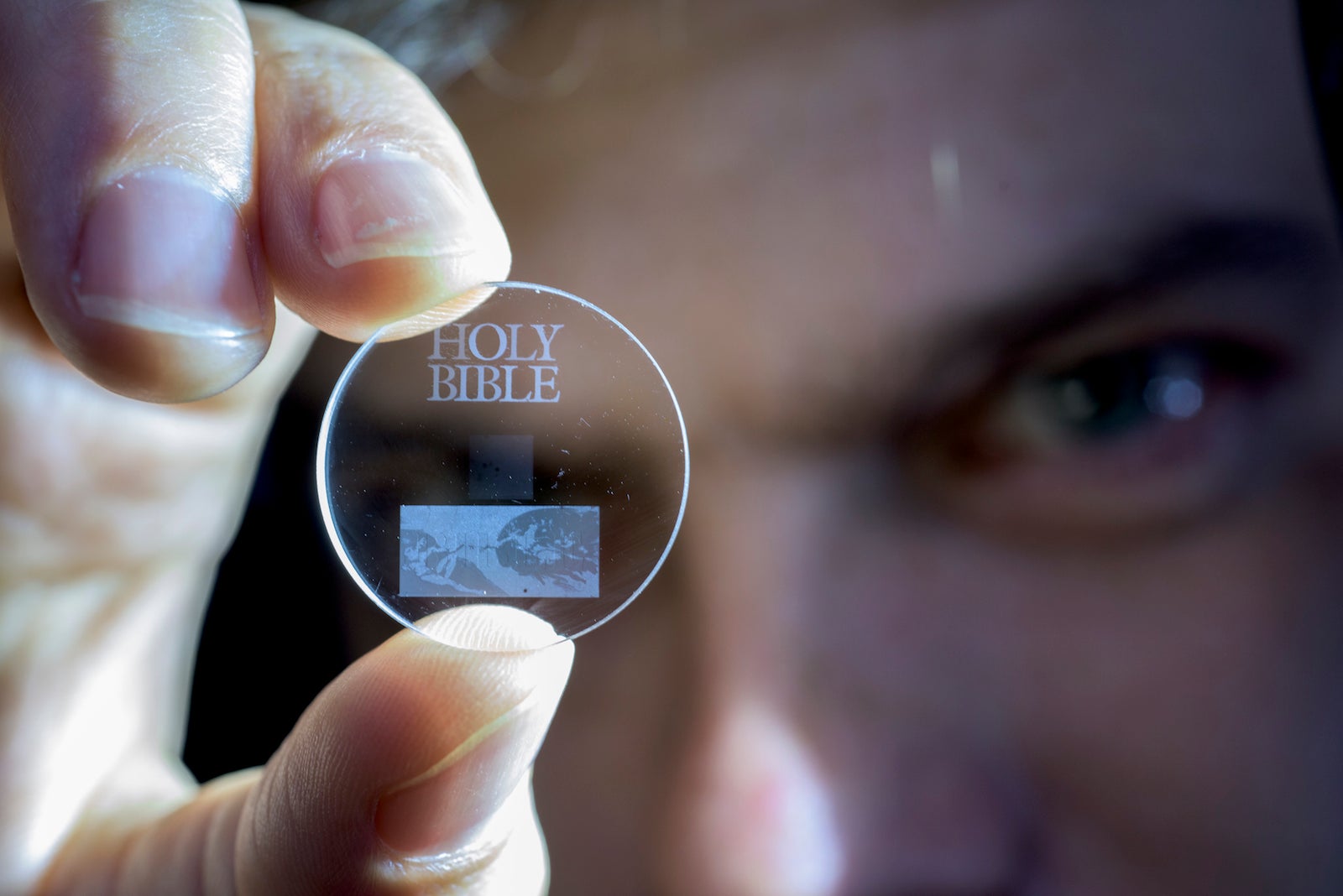
It’s official: your data will outlive you by a few billion years.
On Tuesday (Feb. 17), a group of researchers from the University of Southampton’s Optical Research Center announced they have developed a new way to store data that can keep your digital information safe for an estimated 13.8 billion years.
Join 500,000+ readers who start their day with Quartz.
By subscribing, you agree to our Terms of Service and Privacy Policy.
The new method, called five-dimensional (5D) data storage, can store 360 terabytes of data in the nanostructures in glass. The researchers have been working on this since 2013, when they released a paper outlining the procedure, but perfected it only recently. They recently stored digital versions of the Magna Carta, the King James Bible, Opticks by Isaac Newton, and the United Nations’ Universal Declaration of Human Rights.
As The Verge explains, 5D discs can store more data because the information can be packed into the tiny spaces inside of a glass disc, which is made up of fused quartz. Normal CDs store data by encoding them onto the surface of the glass, not inside of it. So, while a Blu-Ray disc can store 128 gigabytes of data, a 5D disc can store 3,000 times that amount.
With that kind of storage capability, the opportunity to commercialize 5D storage is clear. It could be useful for large corporations with lots of record-keeping, big data storage for tech giants, as well as preserving historical documents. The University of Southampton says commercializing 5D storage is on the roadmap, and the group is currently looking for industry partners.
