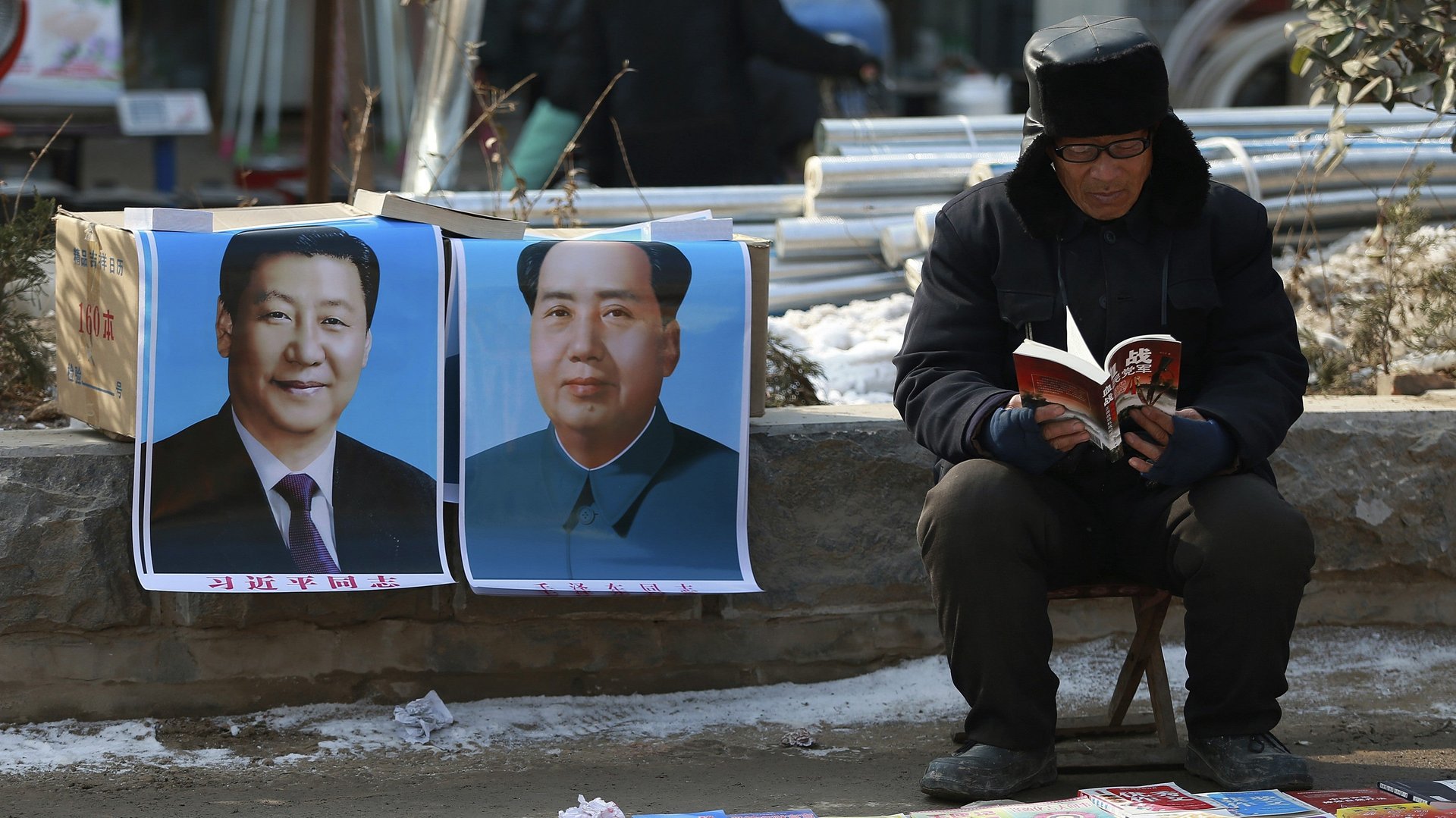
The latest directive from China’s top leader, Xi Jinping, highlights the strength of his obsession with Mao-era ideology.
On Thursday (Feb. 25), Xi ordered all Communist Party officials to read an essay by Mao Zedong, and to learn “the art of leadership” (link in Chinese) described in it. The order was issued to Party committees in the army, state-owned enterprises, universities, and government bureaus, and was widely reported by state media including Xinhua news agency and People’s Daily.
It is not common for a top Chinese leader to give a public order to his party members to learn from Mao. Chairman Mao, the founding father of the People’s Republic China, ruled China for more than 30 years, and is still revered by many citizens. But his last decade was marked by chaos, thanks to a revolutionary campaign that spread violence and persecution nationwide, and he has rarely been held up as an example of great leadership since his death.
Xi’s revival of Mao’s ideologies has already raised concerns from many China watchers, and the descendants of former Party leaders.
Mao’s essay, titled Methods of work of Party committee (pdf, page 377), was written in March of 1949, on the eve of the founding of Communist China. In it, Mao uses a colloquial tone to describe 12 points about forming a sound Party leadership.
The most important of these 12 points today is the very first, that discusses how party leaders should be coordinated, and work together, according to one veteran journalist who now studies the Party’s statements. Here it is in full:
The secretary of a Party committee must be good at being a “squad leader.”A Party committee has ten to twenty members; it is like a squad in the army, and the secretary is like the “squad leader.”
It is indeed not easy to lead this squad well. Each bureau or sub-bureau of the Central Committee now leads a vast area and shoulders very heavy responsibilities. To lead means not only to decide general and specific policies but also to devise correct methods of work. Even with correct general and specific policies, troubles may still arise if methods of work are neglected. To fulfill its task of exercising leadership, a Party committee must rely on its “squad members” and enable them to play their parts to the full. To be a good “squad leader”, the secretary should study hard and investigate thoroughly.
A secretary or deputy secretary will find it difficult to direct his “squad” well if he does not take care to do propaganda and organizational work among his own “squad members”, is not good at handling his relations with committee members or does not study how to run meetings successfully. If the “squad members” do not march in step, they can never expect to lead tens of millions of people in fighting and construction.
Of course, the relation between the secretary and the committee members is one in which the minority must obey the majority, so it is different from the relation between a squad leader and his men. Here we speak only by way of analogy.
Mao’s remaining 11 points are:
Echoing Mao, Xi initiated a sweeping anti-graft campaign since he took control in November of 2012, and even made a landmark speech encouraging socialist artwork. He has also paid tribute to Mao by raising terms used only in the Mao era, and summoning the army’s loyalty to him at the same place where Mao did.
Some of Mao’s points seem very topical today—he could be describing the Chinese government’s sketchy “official” data and failure to control the image of China. But if the “squad leader,” point is, in fact, the most important, then Xi’s main goal with this reading assignment may be further promotion of a one-man dictatorship. The last point, about drawing a line “between revolution and counter-revolution,” could also be interpreted as his willingness to clamp down on dissidents and those who challenge the Party today.
