We are inundated with stories about robots taking our jobs. Machines can learn new skills, refuse orders that seem dangerous, and excel in white-collar professions.
We are inundated with stories about robots taking our jobs. Machines can learn new skills, refuse orders that seem dangerous, and excel in white-collar professions.
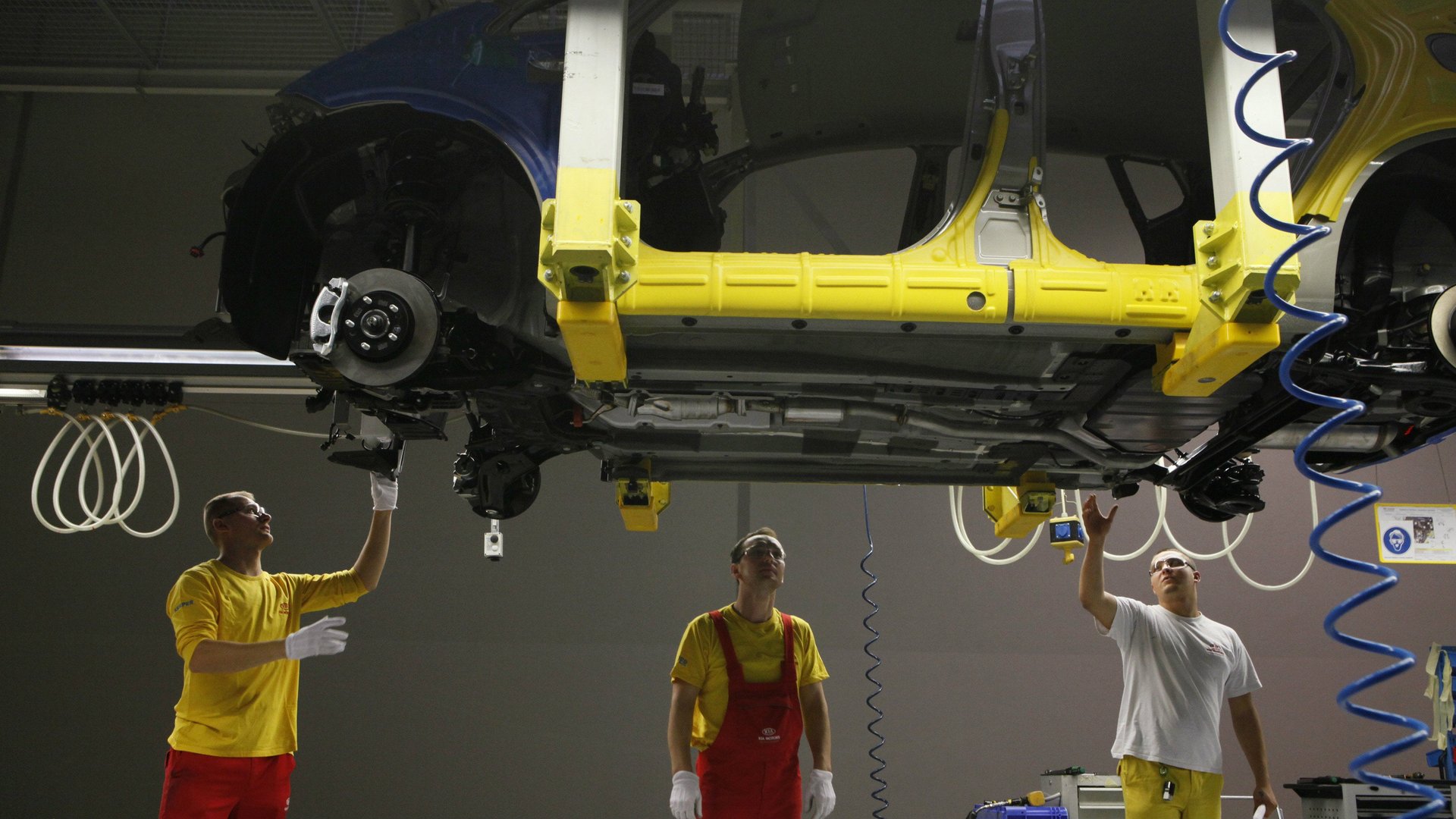
But Mercedes-Benz is bucking the trend: The carmaker is phasing out some robots on its production line, and will replace them with humans.
Join 500,000+ readers who start their day with Quartz.
By subscribing, you agree to our Terms of Service and Privacy Policy.
Markus Schaefer, Mercedes’ head of production, told Bloomberg that humans are better suited for the customization their cars require.
“Robots can’t deal with the degree of individualization and the many variants that we have today,” he said. “We’re saving money and safeguarding our future by employing more people.”
Whereas robots make a cheap workforce for repetitive tasks, Schaefer explains that they’re less useful for adapting the process to the specifications of each car. So the plan is for Mercedes to manufacture cars using smaller robots that work alongside humans. Other car manufacturers, including BMW and Audi, have similar plans to allow humans and robots to work together, according to Bloomberg.
Though robots are continually becoming more advanced, there are still plenty of reasons for a human-based approach to manufacturing. Peter McOwan, computer science professor at Queen Mary University of London, tells Quartz that humans still often have superior skills, even on the production line.
Humans generally have better vision, for example, as robots can struggle to adjust with changes in lighting, shadows, or recognizing objects from a variety of directions and distances.
We also have the advantage of sophisticated smell and hearing senses, McOwan adds. Humans can smell burning and recognize when it is a warning sign. And we can make deductions; for example, that a scraping sound means an object isn’t fitting correctly.
Humans also have flexible hands to get into small spaces, and can adapt to the various pressures needed to hold an egg or lift a brick, while robots don’t yet have such a variety of skills integrated in one system.
But just because humans have certain advantages now, does not mean we will forever. McOwan points out that the new generation of robots under development is far better equipped to mimic human behavior.
That said, it will take time before such robots are put to work.
“They are still a while away from being deployed in the rough and tumble world of the manufacturing floor, and clearly need a great deal of real world testing both for quality and consistency of performance in complex and flexible real world situations,” says McOwan. “There are issues of ensuring proper levels of safety too, and such robots will be more expensive than humans in the beginning.”
So, humans can hold onto their production line jobs for a few more years—though it’s unlikely such roles will sustain a lifelong career.
