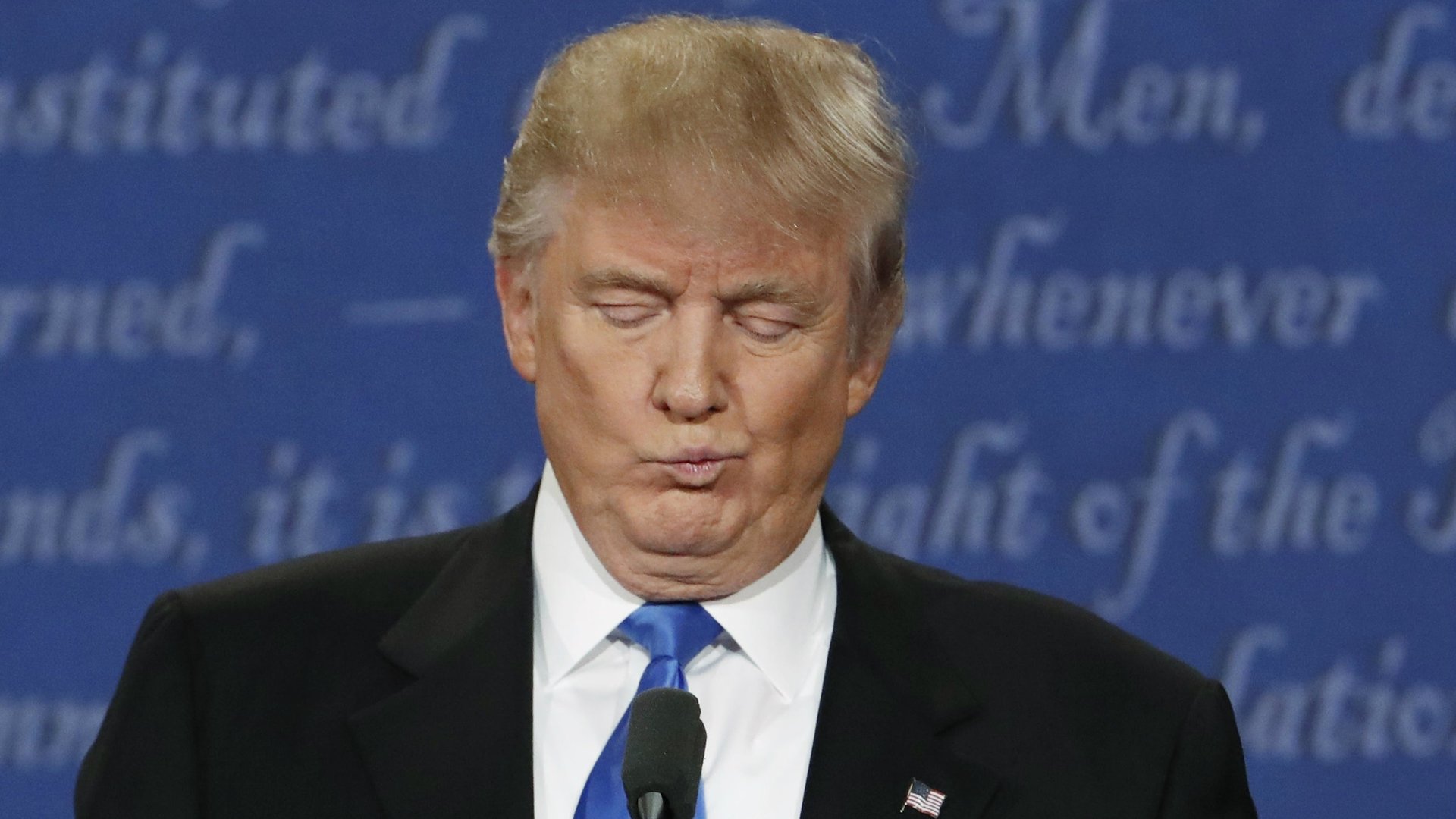
For a guy whose whole persona is based on speaking his mind, taking requests via comment card is a pretty weird move.
But that’s exactly what Donald Trump has been doing to swot up for the presidential debates.
“I need your immediate feedback from the first debate in order to win the second one,” read an email from Trump’s campaign sent out on Wednesday, linking to a 30-question “Second Debate Preparation Survey” (we’ve reprinted all 30 questions below).
A different 30-question survey—”TRUMP Debate Preparation Survey“—went out on Sep. 21. via an email whose subject line read: ”Help me prepare for the big debate.”
Taking debate tactic tips from the masses is a strategy whose wisdom seems best left to Team Trump to explain. (They haven’t responded to our request for comment at time of publishing). Amassing emails for their get-out-the-vote efforts is almost certainly part of it (you have to enter your email to submit your responses). So, probably, is drumming up campaign contributions.
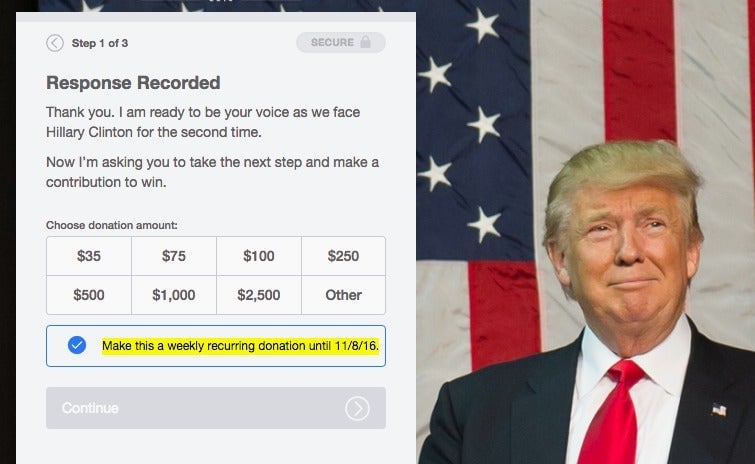
The surveys are also an easy way to rile Trump’s base up about issues without blanketing them with long emails. That’s maybe why some questions read more like reminders than contentious policy disputes (e.g. ”Should Trump bring up the importance of not only the Supreme Court, but also the next president’s ability to appoint many federal judges?”)
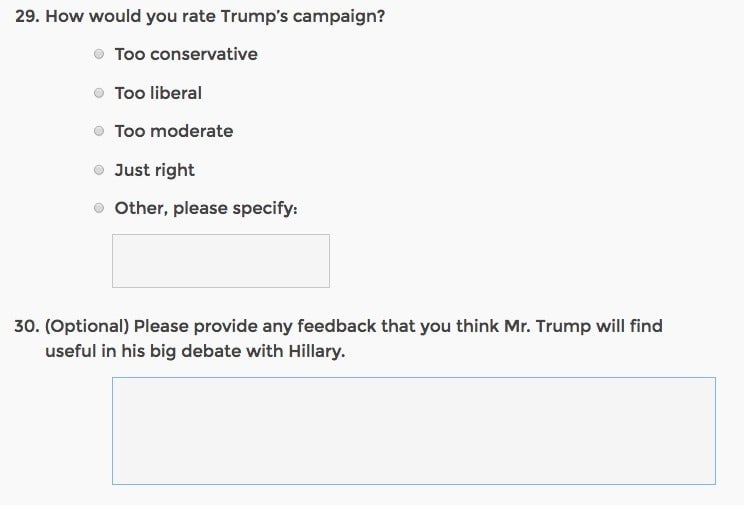
Still, the surveys are curiously thorough, soliciting advice on everything which Hillary Clinton scandal to hammer on to “personal advice for Donald Trump for the next debate.” While many questions rephrase campaign slogans, others seem written genuinely to extract information.
Also intriguing is the conspicuous shift in focus between the first and the second survey. Immigration is the case in point. Given that it’s Trump’s signature issue, it’s unsurprising that, on the pre-debate survey, “Illegal immigration” is the first option for the first question, and the issue appears in another question later on. It also appears prominently on a “Debate Survey” sent to Trump’s mobile-phone mailing list.
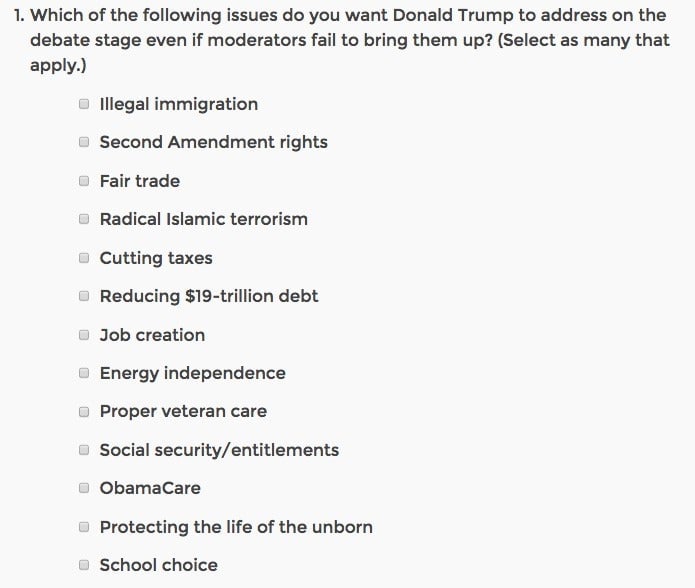
However, the second survey, sent after the debate, mentions immigration not once, subbing in “Law and order” in its place. Other issues like “Social security/entitlements,” “Obamacare,” and “Protecting the life of the unborn,” are scrapped too.
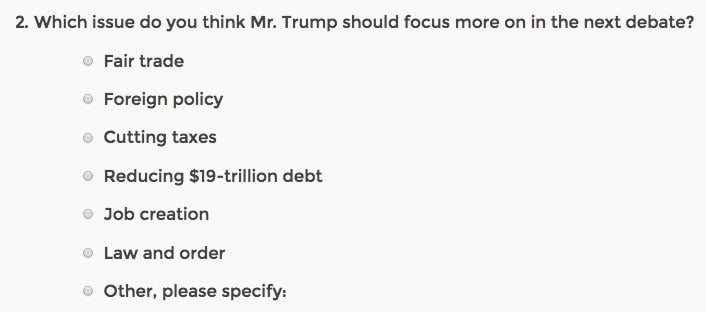
Then again, the second survey explores some themes neglected in the first—for instance: “Should Trump attack Hillary for referring to tens of millions of American men and women as ‘deplorables’?”
There’s also a change in tone. When talking about Clinton’s strategy, the questions in the first survey use muscular verbs like “force” and “attack.” The survey posted after the debate—at which Trump seemed roundly ill-prepared—has more of a evaluation vibe: four questions ask “should Trump have brought up” or “called out” Clinton on a certain issue.
A few questions are just plain baffling—for instance, the first survey’s request for topics to “address on the debate stage even if moderators fail to bring them up.” Even stranger, the second survey asks respondents, “Should Trump speak directly to the American voters at home and defend our positive message for America?”
It sounds faintly like the debate version of the “rigged election” theme—an insinuation that the moderators are all conspiring to muffle Trump’s message. Thanks to these surveys, at least Trump should now know what that message is.
