For a few hours on Jan. 31, McDonald’s will give Boston its first ”Big Mac ATM,” which is exactly what it sounds like. McDonald’s franchisee Vince Spadea called it a “really just a fun way to be modern and progressive.”
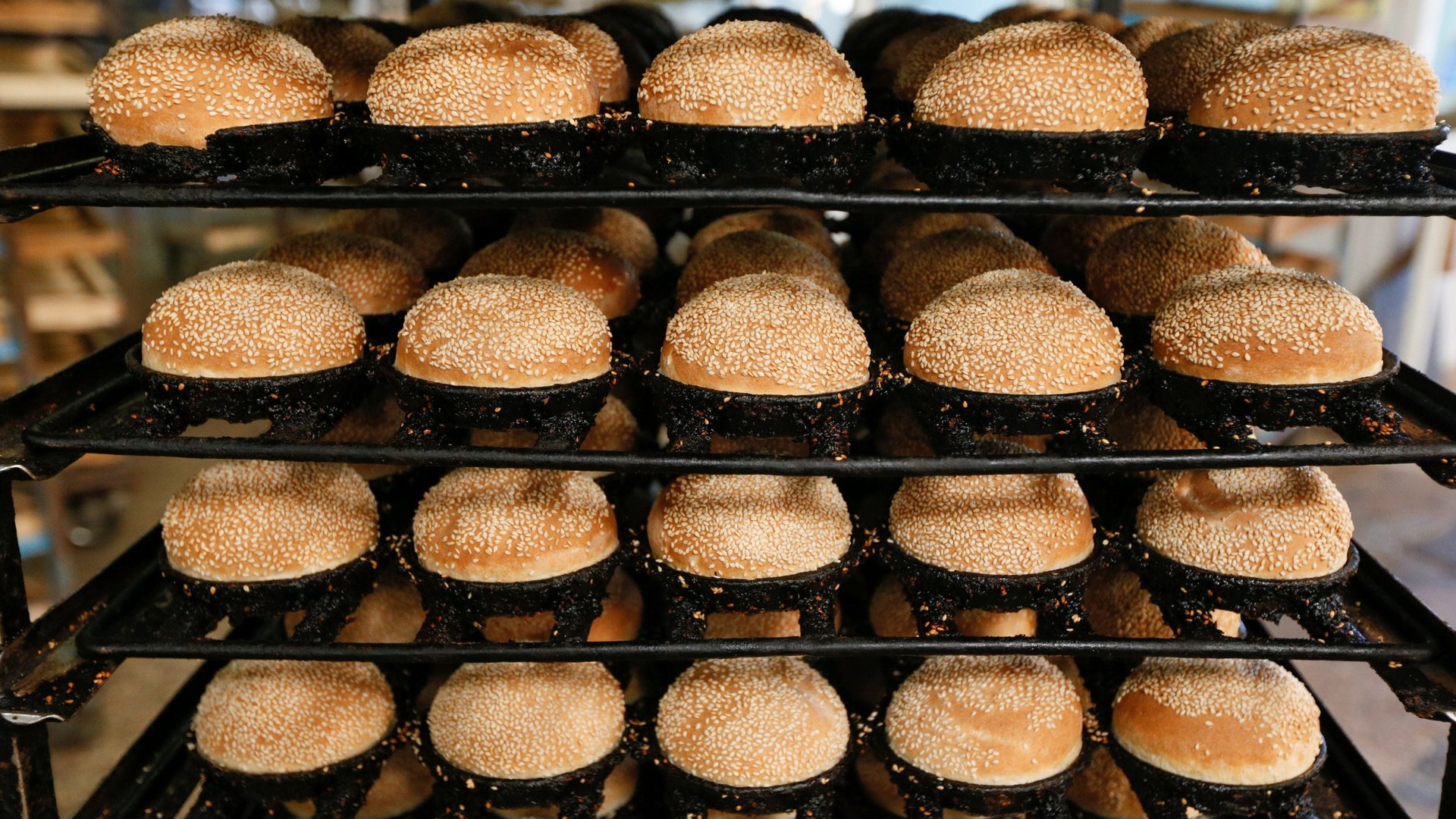
For a few hours on Jan. 31, McDonald’s will give Boston its first ”Big Mac ATM,” which is exactly what it sounds like. McDonald’s franchisee Vince Spadea called it a “really just a fun way to be modern and progressive.”
But restaurants have been attempting to automate the fast-food business for more than 50 years—and not just the part where a cashier hands over your cheeseburger.
Join 500,000+ readers who start their day with Quartz.
By subscribing, you agree to our Terms of Service and Privacy Policy.
With a “whirring of precision thingamajigs” and an “occasional poketa-pocketa-pocketa,” the AMFare automated kitchen system for drive-in restaurants, unveiled in 1964, could produce 16 different menu items. It stamped patties of ground beef onto a conveyor belt that ran through a hot grill, topped them with cheese singles when a cheeseburger had been ordered, and shoveled them onto buns, which it had sliced and toasted itself. It weighed servings of fries and dropped them into a fryer, mixed four varieties of sodas, and squirted milkshakes into cups before sending them down a slide to the single “tray-assembly counter.”
At the time, executives at the American Machine & Foundry Company (AMF) bragged that the cluster of six connected machines (which required the labor of one person with “no more mechanical aptitude than we need in bowling alley to fix our pin-spotter machines”) could completely prepare and serve a meal in four minutes. In 1966, Popular Mechanics writer Clifford B. Hicks tested out one of the automatically prepared burgers, concluding that it was “the best meal I’ve ever had at a drive-in.”
AMFare looked poised to replace most kitchen workers. Its creator spent at least $10 million and four years developing a automated dine-in restaurant concept, and AMF hired a consultant to ”determine the practicability and economic feasibility of the system.” Carter L. Burgess, AMF’s chairman at the time, said he expected AMFare to “accelerate the drive-in restaurant industry’s expansion by easing limitations imposed by a shortage of qualified labor.”
More than 50 years later, the system has been mostly forgotten, and AMF is best-known as a bowling company. At least one restaurant actually installed the AMFare system, and the company briefly operated a test kitchen in New Jersey as a regular restaurant, but the technology never became widespread.
The hopes and fears surrounding automated kitchens, however, are still going strong. As the US’ 12.5 million fast-food workers advocate for expanded overtime protections and a $15-per-hour federal minimum wage, restaurant automation is increasingly appealing to executives. US labor secretary nominee Andy Puzder, who is CEO of the company that owns Carl’s Jr. and Hardee’s, has said that robots are “always polite, they always upsell, they never take a vacation, they never show up late, there’s never a slip-and-fall, or an age, sex, or race discrimination case.”
As in 1964, automated restaurants also seem to be on the brink of feasibility. In addition to McDonald’s burger machine, a robot-made hamburger shop is launching in San Francisco; a Mountain View, California-based robot-made pizza startup delivers 200 pies per day; and a restaurant called Eatsa, which allows customers to order their food and pick it up without human interaction, has six locations.
To assess whether these strides will be different than those in the 1960s, it makes sense to look at why the AMFare failed. Here are a few theories:
To be used in a meaningful way, automation technologies need to be both adaptable enough to replace humans and affordable enough to make it profitable. So far, automated kitchen machines have missed that mark. But that’s unlikely to be the case forever.
One current attempt at machine-made burgers comes from a San Francisco startup called Momentum Machines, whose founders have estimated that their burger-making robot will save the average restaurant $135,000 a year in wages. Momentum says their machine can also customize burgers to include different blends of meat and special cheeses, neither of which the AMFare could handle. “Our device isn’t meant to make employees more efficient,” co-founder Alexandros Vardakostas has said. “It’s meant to completely obviate them.”
