Cities aren’t chasing flying pods. They’re racing to wire permits, safety, and services into systems that can keep up with the pressures of modern life
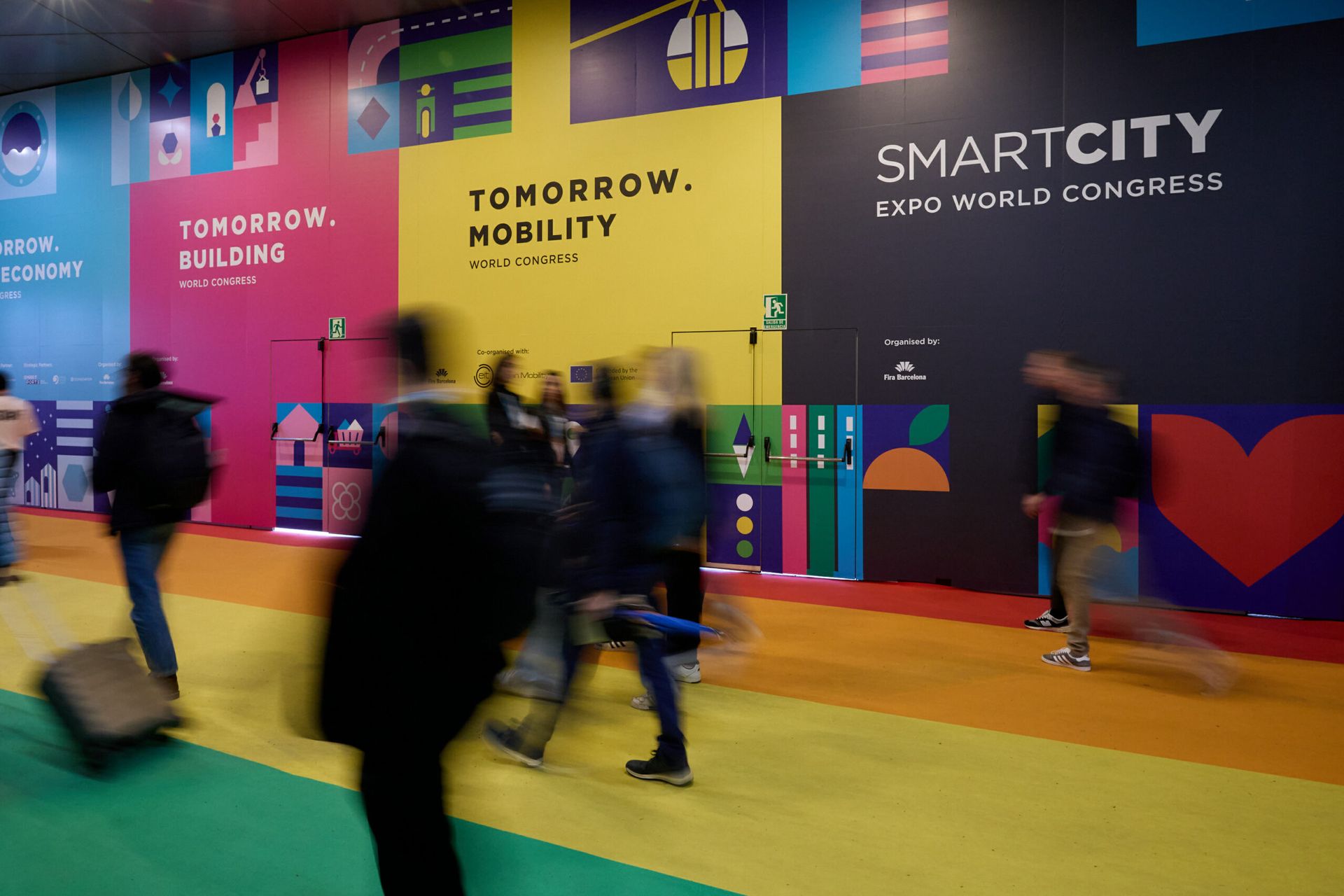
Image Courtesy: Smart City Expo World Congress
BARCELONA — In 1962, “The Jetsons” showed a city perched on stilts above the clouds, where morning commutes unfolded in neat aerial lanes and chores evaporated at the push of a button. George drifted to work in a flying capsule that behaved more like a moving armchair than a vehicle. Jane glided through a home so automated it practically anticipated her next thought (or five). The dog, Astro, got his exercise on a moving sidewalk that did most of the walking for him. Everything in Orbit City looked effortless because the city itself was the machinery, humming in the background, coordinating every light, door, meal, and movement.
We don’t live in that world just yet, but the idea that a city might run a little more like an intelligent system — one that smooths out frictions, anticipates needs, and connects its moving parts — is suddenly looking a lot less like vintage sci-fi television and a lot more like a low-glamour version of the future arriving through the administrative back door. What makes this moment different is that AI has caught up to the workload, processing the volume that once buried city staff every single day.
Join 500,000+ readers who start their day with Quartz.
By subscribing, you agree to our Terms of Service and Privacy Policy.
“The Jetsons” fantasy sat on the clouds. Today’s version sits on cloud platforms: permitting platforms that read, sort, and route documents in minutes instead of weeks, quietly untangling the bureaucracy that once dictated the pace of construction. Today’s version looks like traffic models learning the city’s habits — the Friday bottlenecks, the surprise surges when school lets out early — and adjusting signals before the slowdown turns into a snarl. It looks like a 911 operator hearing immediate translations of a caller who is frightened, breathless, and speaking a language that the dispatch center never prepared for.
In 1962, television imagined a skyline full of spectacle. The real future is quieter. It’ll be made up of city-scale models and digital twins (the grown-up version of a SimCity map), of software tucked behind municipal counters and models running under the hood of bus routes and emergency systems — small algorithms making a city feel faster, clearer, and more responsive. The pieces don’t soar, but they work. And in their own unglamorous way, they’re edging the modern city closer to something the cartoon drew six decades ago — just without the altitude or the audience applause.
In Barcelona this year, the Smart City Expo World Congress sketched out something more believable than Orbit City. You couldn’t see as far out as 2062, the year “The Jetsons” was set in, but you could see the outlines of the next decade taking shape.
Inside the halls of Fira de Barcelona, the future has a sponsor. And no surprise, it’s the biggest company in the world: Nvidia $NVDA. After the check-in line spits visitors into the main concourse, the building funnels everyone toward the main hall, where a joint Dell $DELL–Nvidia pavilion sits as the first booth on the right, planted squarely in the path like a gatehouse. Beyond it, the next hall stretches into a grid of booths showing off traffic systems, camera rigs, venue dashboards, and energy-management screens. And many of those stands carry the same neon green logo on their signs — Nvidia’s partner mark — stamped on the hardware that promises to keep streets, buses, factories, and stadiums running.
The show calls itself Smart City Expo World Congress, but the branding this year spells out a heavier assignment. The theme — “The Time for Cities” — is printed across walls, brochures, and stage backdrops, and it lands a bit like a deadline. The implicit message is that whatever “the future” looks like, it will be negotiated here, not in imaginary skylines.
Onstage, the definition of a “smart city” sounds more grounded than the branding. Barcelona’s deputy mayor, Jaume Collboni, warns that technology without purpose “can become a nightmare,” but paired with social values and real constraints, it can “make dreams come true.” Other speakers return to the same idea, that a smart city is a city that helps people live better under pressure, not a city with more screens. And not a real-estate ad in disguise.
Cities now house more than half of the world’s population, generate about 80% of global GDP, and account for roughly 70% of global greenhouse-gas emissions. They also consume close to two-thirds of the world’s energy. When something goes wrong with climate, infrastructure, or growth, it usually goes wrong in a city first. That’s the reason mayors, technologists, and envoys from around the world have flown in: If the world is going to hold together, cities have to function — and they have to function faster than they are right now.
Speakers described cities as “the main protagonists of the 21st century” and said “cities are where technology meets humanity.” They argued that “the time for cities is today, not tomorrow,” pointing to heatwaves, floods, and infrastructure failures that are arriving faster than local governments can reinforce roads, pipes, and grids. Climate shocks are now a competitiveness problem, the kind investors and residents factor into decisions about where to build and where to stay. In today’s world, “smart” has become a survival strategy for places asked to deliver more services with fewer staff, tighter budgets, older infrastructure, and more volatile weather.
AI makes this all possible, scanning feeds, logs, and building plans at machine speed. If the early “smart city” era was about sensors, kiosks, and dashboards, 2025’s version is about what happens when those feeds are handed to real models in real hands that can sort, predict, rank, and route in real time.
For the U.S. mayors who flew to this year’s expo — from Tampa, Florida; Rochester Hills, Michigan; and Montgomery, Alabama — the phrase “smart city” translated into something rather narrow, not cinematic. When they talked about AI, they kept circling the same pressure points: the license counter, the patrol car, the streetlight grid, the public meeting where half the room can’t follow along because the conversation is in a language they don't fully understand. In the U.S., the future that people in Barcelona kept pointing to is hiding in the paperwork.
Montgomery mayor Steven Reed didn’t pretend his city was chasing anything futuristic. He wasn’t in Spain to talk about drones or holograms. He came to talk about business licenses.
“We’ve just started using AI as it relates to our business licenses and how we can better process those and be a lot more efficient,” he said. “We have an outdated system of doing things.” On paper, Montgomery’s pitch might look modest — a model that reads applications, checks them against the rulebook, and hands a cleaner stack to actual humans for review — but for a small business owner who doesn’t have an entire compliance team on retainer, the stakes are plenty big. Either the city keeps automating the dull work or the backlog keeps swallowing time and everyone keeps drowning in paper. “We’re kind of at the breaking point,” he said. “We’re saying, listen, we’ve got [to use AI to innovate] with or without you, but we’ve got to do it.”
Vendors have started to mirror that logic back to cities. Jumbi Edulbehram, who leads Nvidia’s work with cities, framed the current wave of deployments as a set of agents that learn local laws and habits instead of free-floating in the cloud. A licensing agent can live inside a city website, answer natural-language questions, and fill in the right forms using the city’s own ordinances as its source of truth. A permitting agent can perform the first pass on building plans so no engineer spends their morning hunting for missing signatures. A translation agent can sit inside a call center or council chamber and operate in the 50 or 60 languages needed to keep up in a diverse city.
AI listens, recognizes the language, and throws an English transcription onto the screen so council members can follow. When they respond in English, the system reverses the flow and displays the answer back in the speaker’s language. For a city whose politics have always been multilingual but whose meetings have not, that change is small and radical at the same time. Participation no longer depends on who can bring a human interpreter to a town hall meeting at 3 p.m. on a Tuesday.
Out on the street, the same logic has started to seep into safety. In Tampa, Mayor Jane Castor has layered AI on top of the camera systems in the city’s entertainment districts, where the stakes rise with the weekend crowd. “We currently use it mostly in our law enforcement, our camera system, Genetec, and that’s in our entertainment districts,” she said. (Reed, a couple of seats away, scribbled the company’s name in a notebook.) The city has “implemented a layer of AI where it can recognize activity that is out of the ordinary.” Officers’ body-worn cameras feed into Axon’s system, where AI helps with report writing. The goal is more eyes on the street without adding more officers, and more time on actual policy instead of wrestling with forms — which comes with its own set of hefty concerns.
Castor knows that every new layer of data raises the same old fear: that the city is watching its residents more closely than they ever asked it to — a concern echoed throughout sessions, panels, and conversations in Barcelona. “Honestly, there’s fear with AI,” she said.
For now, Tampa’s nightlife runs on a mix of software, lenses, and human judgment, but every new layer has to survive a tougher audience than any product keynote: residents, defense lawyers, and a press corps that remembers every past overreach sold as innovation. “We have to ask our teams to innovate and to be creative, but they have to have the latitude to fail,” she said.
Access to basic services is shifting in quieter ways. In Amarillo, Texas, the city stood up an AI assistant named Emma and dropped her at the front door of local government, where a tangle of web menus and PDF links used to live. Emma can answer questions in multiple languages and walk residents through everyday tasks such as paying parking tickets or figuring out which department handles a particular complaint. For residents with limited English or limited patience for bureaucracy, the innovation is a conversation that finally produces an answer.
In Austin and Los Angeles, AI-driven pre-check tools now read building plans against zoning codes and flag obvious problems before a human ever opens the file. AI-driven traffic systems, including Google $GOOGL’s Project Green Light, report early results of up to 30% fewer stops and roughly 10% lower emissions at optimized intersections. San Jose and Columbus, Ohio, have begun rolling out next-gen 911 capabilities that include AI-powered text translation in dozens of languages and video-sharing from callers’ phones, widening access to emergency services for residents who were once shut out by language or tech gaps.
Today’s stories are less about glossy “smart city” branding and more about a slow rewiring of the civic baseline. A city where a business license moves because an AI handled the box-checking. A city where a camera in an entertainment district quietly flags the one fight in a sea of motion. A city where the streetlight grid doubles as an early warning system. A city where someone who speaks Spanish or Vietnamese or Amharic can walk into council chambers, or tap on a browser window, and have the institution answer back in a language they understand.
This is the smart-city future the U.S. mayors brought to Barcelona. The fantasy of flying pods stays on the television. But the machinery that really matters is already running in the background.
The smartest city in the world this year? Rome. It won this year’s City Award — not for a single glittering megaproject but for a strategy literally titled “Rome: The City Is Transforming,” a yearslong effort to wire traffic, tourism, and public services into a common digital backbone. Judges cited a new traffic control center that pulls real-time feeds from around the capital and uses data, 5G, and digital twins to orchestrate flows during crunch moments — including an influx of more than a million visitors this summer — so staff can reroute buses, redirect police, or shift cleaning crews as the city moves.
The quiet star of that project is the digital twin itself: a live, three-dimensional model of Rome’s streets and infrastructure that lets planners and operators run “what if” scenarios on a screen before they play out in real life. By the end of the expo, “digital twin” had become the default sales pitch — a gamelike experience running behind the scenes of very real streets.
South Korea has been treating entire districts this way for years. National pilot smart cities in Sejong and Busan use city-scale twins to test flood responses, traffic plans, and land-use changes, backed by a government push to standardize how building and transport data plug into those systems so models can be shared and reused instead of rebuilt from scratch.
Microsoft $MSFT hosted a panel dedicated to the innovation in Tampere, Finland (population: 260,000), where the smart-city pitch comes with a science-fiction name — the “cityverse.” Nvidia officials used the city as a reference in sessions and conversations. “I think we have always been the one that has been very bold,” said Teppo Rantanen, the city’s executive director for growth, competitiveness, and innovation, Teppo Rantanen.
The city has built a platform that ties together traffic, outdoor lighting, maintenance, telecom security, and heating systems, feeding data into a common layer that can be used for both operations and experiments. On top of that infrastructure, Tampere has tested everything from AI-assisted “people flow” analysis around its Nokia Arena to artist-driven AI light installations.
“AI is making everything absolutely better,” he said. “AI is now so rapidly developing that we see that all the things that we took so much time can be done in a millisecond.”
The Liverpool region, meanwhile, has been treating its transit network as a kind of living laboratory. Researchers there built a “Meta $META Liverpool” digital twin of mass transit, using it to simulate new routes, test 5G rollouts, and stress-test emergency plans before real people ever feel the changes. The same university network is piloting building-scale twins to monitor energy use and HVAC upgrades in real time, both as a climate play and as a way to prove that promised efficiencies actually materialize once contractors leave.
Sure, none of these projects seem futuristic — or particularly sexy. But together they sketch out a different way to run a city, and a version of a newly possible future.
By the time the Expo lights dimmed, the through-line had become clear. The future won’t look like Orbit City any more than it will look like the PowerPoint renderings scattered across the exhibition floor. It will look like fewer surprise bottlenecks on a Friday, a bus that actually shows up when the app says it will, a streetlight network that flags potential outages before a block goes dark, and a permit that arrives in days or weeks instead of months. The real gamble sits in cement, fiber, and software, not in Elon Musk’s sketches of a flying car. What matters today is the decision to treat the city as software that can be refactored while people are still living inside it.
That’s the scaffolding of a smart city — not the skyline, but the systems underneath it, stitched together by the same neon green logo that kept appearing across Hall 3.
Barcelona delivered a consensus: Cities don’t need flying pods or domestic robots to feel futuristic. They need models that can read, translate, forecast, and coordinate at the speed of real life. In 1962, that looked like the Jetsons floating above the clouds. In 2025, it looks like cities finally starting to function the way people always needed them to — not magical, not airborne, but quietly, relentlessly intelligent.
