
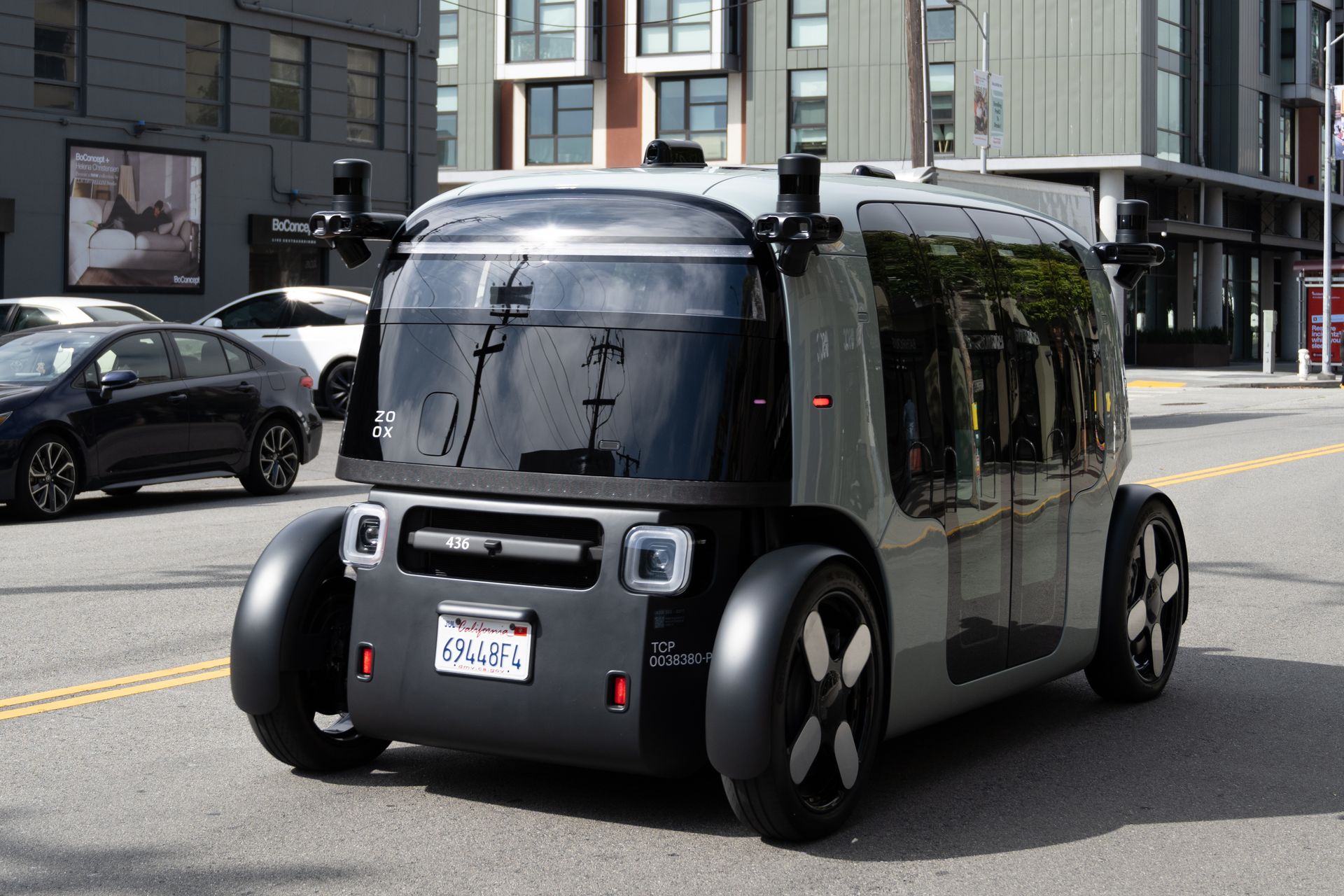
Zoox, the Amazon $AMZN-owned autonomous vehicle company, received a temporary exemption Thursday from the National Highway Traffic Safety Administration, clearing the way for the company to charge customers for rides in its custom-built robotaxis.
The exemption spans eight federal motor vehicle safety standards — among them windshield defrosting and light vehicle braking systems — and enables Zoox to put vehicles on the road without steering wheels or pedals, the driver-operated controls that existing federal law has long mandated. Under the terms NHTSA announced, Zoox may field as many as 2,500 vehicles per year over a two-year period, with the company remaining under a regulatory oversight framework the agency said is designed to evolve alongside its technology.
Zoox CEO Aicha Evans called the approval an important milestone. "We are honored to receive the first-ever commercial exemption for a purpose-built robotaxi from NHTSA, enabling us to begin charging for our service and take another step toward bringing autonomous ride-hailing to more communities," Evans said in a statement.
A Zoox spokesperson said the company will begin charging for rides in Las Vegas next month, according to CNBC. Additional markets will follow as Zoox satisfies state-level commercialization requirements, according to TechCrunch. In California, where the company is headquartered and currently offers free rides, Zoox still needs driverless deployment permits from the state Public Utilities Commission and the Department of Motor Vehicles.
Zoox had been operating under an earlier NHTSA exemption, granted in August 2025, that permitted public-road demonstrations and complimentary passenger trips in markets such as San Francisco and Las Vegas, but stopped short of allowing the company to collect fares. Thursday's decision authorizes the company to charge fares for the first time.
The Zoox vehicle is a steering-wheel-free, pedal-free design capable of traveling in either direction, with an interior configured to carry as many as four riders in a face-to-face arrangement, according to Bloomberg. Because Waymo's commercial fleet consists of conventionally controlled cars, the Alphabet $GOOGL subsidiary has not needed to seek comparable federal exemptions, putting the two companies on divergent regulatory tracks.
The Zoox approval came as part of a broader set of AV policy announcements from NHTSA on Thursday. The agency said it is partnering with SAE Industry Technologies Consortia on a three-year, $5 million consortium to develop the first national AV performance standards. NHTSA also published an updated rule modernizing how exemptions are applied to vehicles manufactured before an exemption's effective date, and said it is reviewing a separate exemption application from Los Angeles-based delivery startup Robomart.
The federal clearance arrives weeks after Zoox recalled the software on its entire 105-vehicle fleet after one of its robotaxis drove into an active fire scene in Las Vegas in June, unable to detect heavy smoke in its path. That recall followed a warning from NHTSA Administrator Jonathan Morrison that the agency had identified a pattern of driverless vehicles interfering with first responders. The Zoox software update enhanced the vehicles' ability to detect and respond to heavy smoke, the company said.