
Cupertino’s fall ritual delivered a slimmed-down iPhone, AI-infused AirPods, and fresh Watches, all in a bid to prove Apple can still set the pace
Justin Sullivan/Getty Images
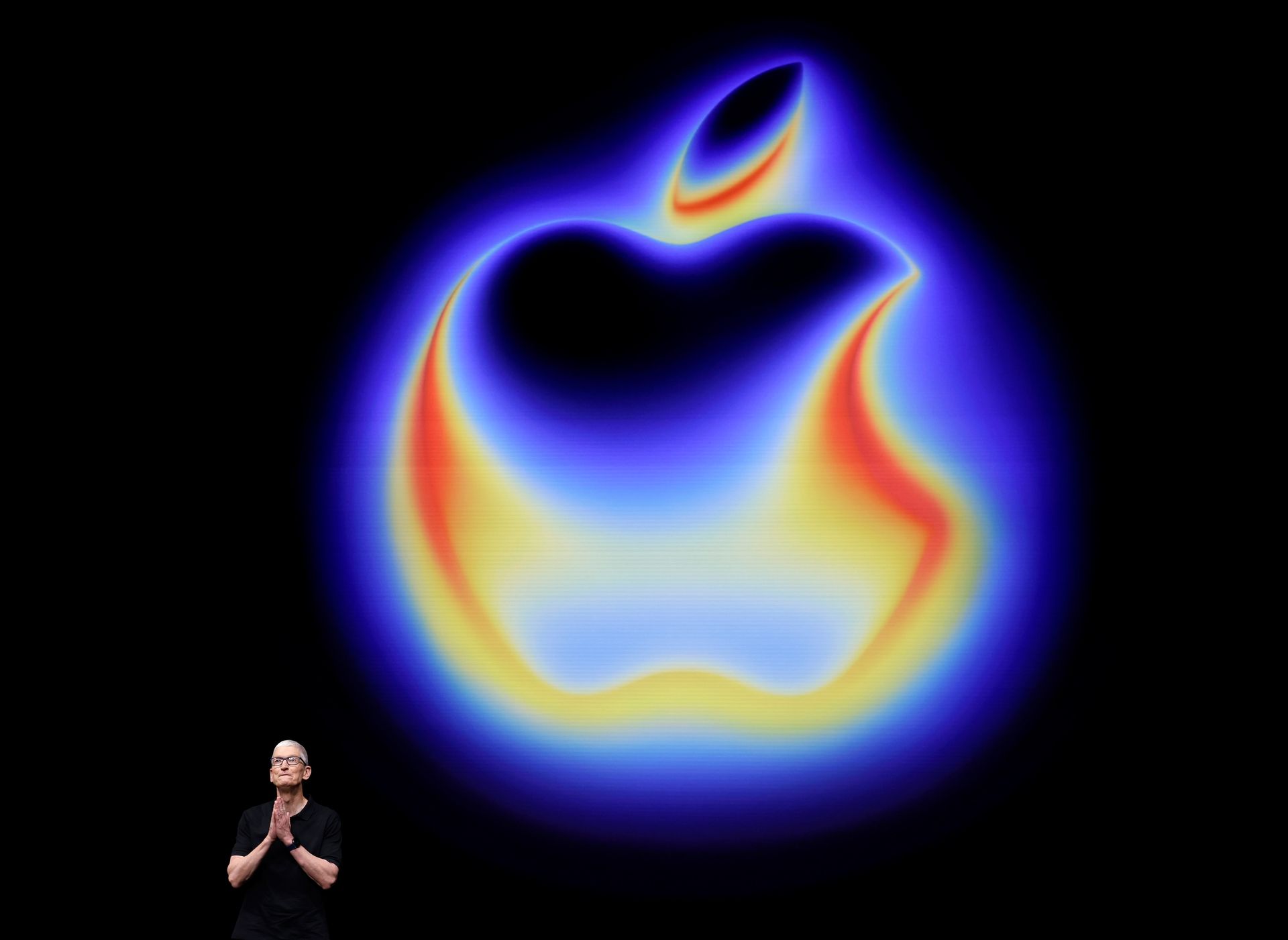
Another September, another attempt to convince the world that a rectangle can still surprise. At its “Awe Dropping” event, Apple $AAPL rolled out a familiar script: the iPhone 17 lineup — with an “Air” model so thin it’s practically begging to slide into a pair of skinny jeans — alongside smarter watches, AirPods that might just know more about you than your doctor, and the usual sermon about how Cupertino has redefined the rectangle yet again. The only real mystery is whether investors and consumers will buy the hype along with the hardware.
For Apple, the stakes are higher than the stagecraft. While the iPhone is still a hit, the company’s AI play is still more teaser than takeover, and regulators from Washington to Brussels are circling its walled garden. A design refresh — thinner here, a brighter screen there, along with dashes of AI — may thrill the diehards, but the broader market wants evidence that
Join 500,000+ readers who start their day with Quartz.
By subscribing, you agree to our Terms of Service and Privacy Policy.
Before getting to the hardware, though, Cook set the tone with a familiar Apple refrain: design. “Design goes beyond just how something looks or feels. Design is also how it works,” he told the event’s live-streaming audience from Cupertino’s Apple Park, pointing to everything from the “magical listening experience with AirPods” to the new “Liquid Glass” software that he described as “absolutely gorgeous” and more intuitive. The subtext is that Apple wants this event read as a manifesto on how design still drives the company’s biggest leaps.
Apple’s reveals landed right where the rumor mill had placed them: a lighter “Air” edition replacing the Plus, new camera arrays that look more GoPro than phone, and the obligatory chip upgrade designed to make last year’s model feel like a brick. Plus, the software is glossier. iOS 26 promises more AI sprinkles on top of the familiar sundae. Siri made a brief return, with faster on-device responses and phrasing that’s supposed to sound more natural, though the demo stopped well short of the reinvention investors keep waiting for. Apple Intelligence slipped in at the margins — and just there.
The updates make the rectangle shinier and smoother to use, but not fundamentally different. That’s the double-edged sword of Apple’s September show expectations: Nail the reveal and Apple gets credit for another reinvention; miss the moment and the event becomes just another live-streamed costume change. And that’s the subtext humming under Tuesday’s show — not whether Apple can unveil something exciting (it always does) but whether the world will see enough “awe” to justify the “drop.”
“This is by far the most powerful iPhone lineup we’ve ever created,” Cook told the audience as he unveiled the slate. Investors weren’t quite as sold. Apple shares popped ahead of the keynote but slipped as the event wrapped, down about 1.7% an hour after the event ended — a reminder that no amount of stagecraft guarantees Wall Street buy-in.

Apple drops promotional images for its iPhone 17. Image: Apple
The headliner, as always, was the iPhone — Apple’s latest attempt to convince the world that a rectangle can still surprise. The iPhone 17 arrives in five shades (lavender, mist, blue, black, white, and sage) and stretches its screen to 6.3 inches with slimmer borders. Apple finally handed the base model its long-denied glow-up: ProMotion for a buttery 120Hz refresh rate that dials down to 1Hz when idle, plus an always-on display that the company hopes will actually feel useful. Outdoor brightness now peaks at 3,000 nits, meaning you’ll be able to check your texts in direct sun without squinting like you’ve just stared straight into an eclipse.
Apple framed it as the “best display ever on iPhone.”
Durability got its own sermon. The company introduced Ceramic Shield 2, which it says is three times more scratch-resistant, thanks to a coating bonded “at the atomic level.” Throw in a seven-layer anti-reflective finish, and Apple wants you to believe shattered screens and scuffed glass are relics of the past — though history suggests Genius Bar appointments aren’t going anywhere.
Inside, the new A19 chip powers everything from smoother gameplay to faster on-device AI. Apple Intelligence is supposed to run leaner and meaner on this bit of silicon, while the extra GPU and neural engine upgrades give the company a fresh excuse to show off console-style graphics. Battery life reportedly stretches further, too: up to eight more hours of video playback than iPhone 16, with a top-up that nets you a 50% charge in 20 minutes.
And then there’s the camera parade. The 48-megapixel dual-fusion system brings a main and 2x telephoto, a new 48-megapixel ultrawide quadruples resolution, and selfies get their own glow-up with the Center Stage front camera. The camera’s sensor nearly doubles in size, auto-frames friends into your shots, and finally lets you take landscape selfies without doing the wrist-twist shuffle. It’s the kind of tweak that will make for slicker TikToks — and could sell a lot of storage upgrades.
The iPhone 17 now starts at 256GB and $799 and ships with iOS 26. Brighter, tougher, faster — yet another “reinvention” of the rectangle. The question, as always, is whether that’s enough to make people actually buy a new one.

Apple's iPhone Air may be thin, but its pitch is blunt — just as it was with the original MacBook Air. Image: Apple
Apple’s “one more thing” wasn’t another incremental rectangle — it was the iPhone Air, the company’s first real spin on the lineup in years. At just 5.6 millimeters, it’s the thinnest iPhone ever, built from "spacecraft"-grade titanium and clad in Ceramic Shield front and back. Cook called it “a total game changer.” Investors will decide later if it’s really that, but in the room, the pitch was simple: This is the paradox phone, impossibly thin without (supposedly) cutting corners.
The company’s pitch was less about megapixels or nits and more about the sheer impossibility of fitting a full-fledged iPhone into something this slight. To pull the Air off, Apple ditched the SIM tray worldwide, reengineered the internal “plateau” to stack key components at the top, and poured the rest into a high-density battery. The result is a phone that seems closer to a sliver of metal than a slab of glass. Like the iPhone 17, the Air offers ProMotion up to 120Hz, an always-on display, and a 3,000-nit peak brightness, but here those features come wrapped in a body so light it seems more concept than product.
Performance gets the Pro treatment. The Air runs on the A19 Pro chip, which Apple claims delivers MacBook-level GPU performance and on-device AI horsepower three times faster than last year’s silicon. The Air is also the first iPhone with Apple’s in-house modem and wireless chip, bringing Wi-Fi 7, Bluetooth 6, and Thread. Apple’s message is that this isn’t a watered-down “thin phone” — it’s the whole shebang just in a slimmed-down body.
The camera setup had to be rethought to fit. What looks like a single lens is actually a 48-megapixel "fusion" system that doubles as a 2x telephoto. At least, that's how Apple's selling it. On the front, the Center Stage camera uses a square sensor nearly twice the size of the old one, making it easier to, just like with the iPhone 17, take landscape selfies without the wrist gymnastics. A dual capture mode records front and rear video at once.
Apple insists all this doesn’t meaningfully compromise battery life; it boasts that the Air can sustain “all-day use” and up to 40 hours of video playback with help from iOS 26’s adaptive Power Mode. The iPhone Air starts at $999 for 256GB of storage, with 512GB and 1TB tiers climbing to a rumored $1,299 and $1,499. Preorders open this week, and the phone starts shipping on Sept. 19. It'll hit shelves in four colors: space black, cloud white, light gold, and sky blue.
The Air is the thinnest iPhone yet, but the real weight it carries is symbolic — an attempt to prove that Cupertino can still chase audacity, not just iteration. After years of September updates that felt more like wardrobe changes than overhauls, the Air stands out as a genuine swing: risky, eye-catching, and designed to remind investors and consumers alike that Apple hasn’t run out of tricks. Whether that thinness translates into a new wave of upgrades is another matter, but for a moment, Apple made the iPhone feel at least a little bit new again.
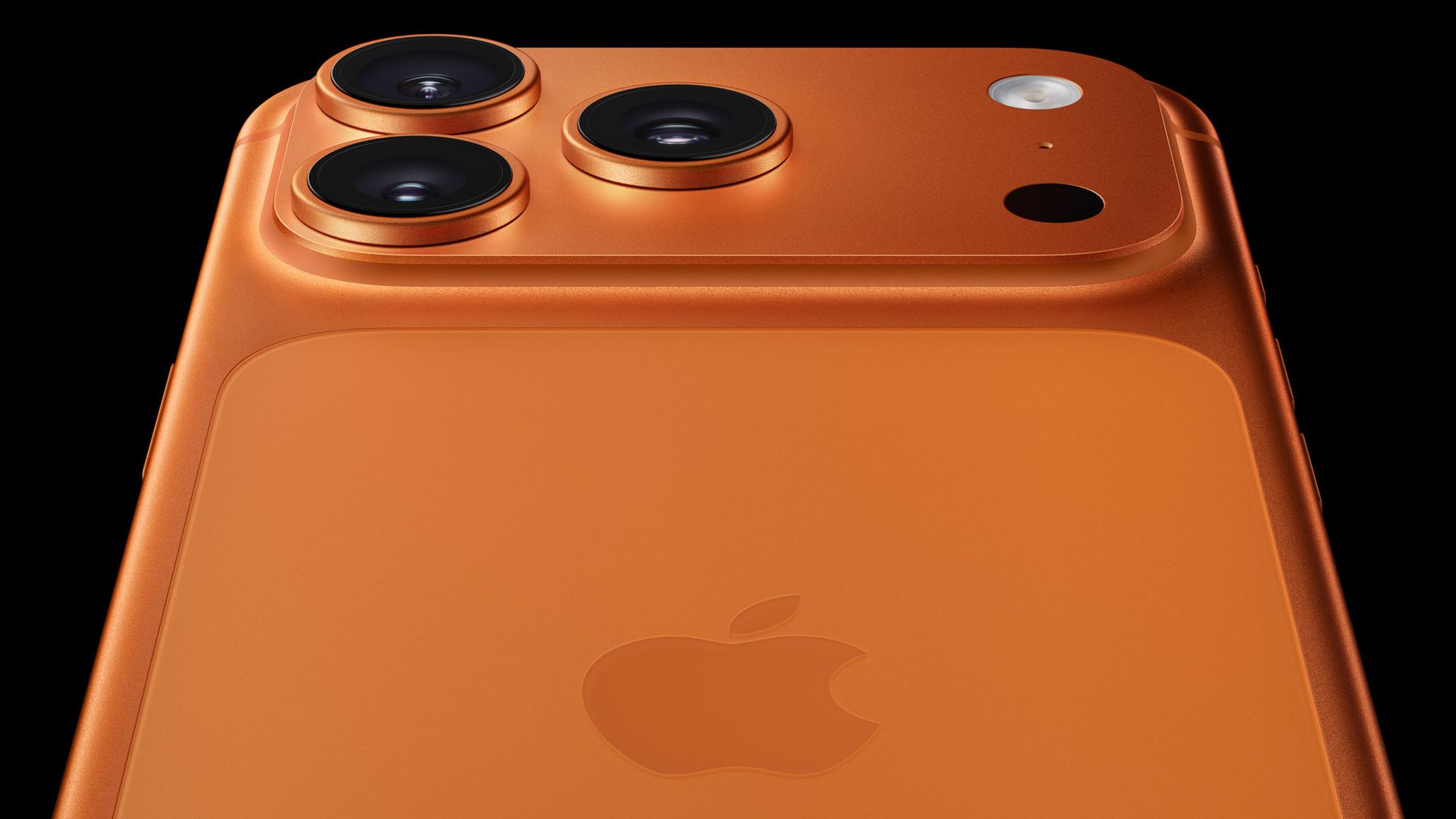
Apple's iPhone 17 pro in vivid "cosmic orange." Image: Apple
If the Air is Apple’s show pony, the iPhone 17 Pro and Pro Max are its workhorses — phones pitched less as gadgets than as portable workstations. Apple doubled down on performance, starting with a custom aluminum alloy that serves as a heat sink. A new vapor chamber cooling system runs through the chassis, Cupertino’s tacit admission that these chips now run hot enough to need laptop-style thermal management.
At the center is the A19 Pro: a six-core CPU, six-core GPU, and neural accelerators baked into every GPU core. Apple says the result is 40% better sustained performance than last year’s Pro — enough for hardware-level ray tracing in console-class games or on-device AI without throttling.
Cameras got the “Pro” treatment, too. All three rear lenses are now 48 megapixels, paired with a new fusion telephoto that stretches to 8x optical-quality zoom at 200mm on the Pro Max — Apple’s longest reach yet. The front 18MP Center Stage camera caters to creators, while a new dual-capture mode films front and back at the same time. ProRes RAW and genlock — staples of studio rigs — are now supported on a device you can hold one-handed. Apple even filmed parts of the keynote on the 17 Pro to prove the point.
The excess shows up in the battery and storage. The Pro Max pushes to 39 hours of video playback and unlocks a new 2TB storage ceiling, while both Pro models start at 256GB for $1,099, holding last year’s price. Shipping starts Sept. 19; the Pro lineup ditches the minimal palette with three bold finishes that read like sports-car paint jobs: Deep blue, cosmic orange, and silver.
For all the breathless talk of AI everywhere else in tech, Apple barely said the two letters. Apple Intelligence really just showed up in passing — a translator tucked into AirPods, a generative “Workout Buddy” in the Watch, some on-device smarts sprinkled through iOS 26. But there was no ChatGPT cameo, no Siri reinvention, no “Wow!” marquee demo meant to reset the narrative. The pitch was a deliberate understatement, framing AI as another hidden layer rather than the star of the show.
The emphasis was less on what AI does today than on the hardware that might make it matter tomorrow. Apple spent more time showing off its A19 chips than it did demoing AI features: neural accelerators embedded in every GPU core, swollen caches for faster throughput, even a vapor-chamber cooling system in the Pro line so the phones can churn through local large-language models without throttling. An in-house N1 wireless chip and C1x modem were framed as just as important, handling connectivity and power efficiency that Apple says will make its AI “leaner” and less battery-hungry.
Product by product, the company tried to show AI as utility, not spectacle. That restraint may be the point. Cook leaned again on his mantra that “design is how it works,” implicitly tying AI to Apple’s obsession with seamlessness. In this telling, “Apple Intelligence” isn’t a platform or an app — it’s plumbing. You’ll know it works not when it dazzles, but when you forget it’s there.
But it also highlights the gap between Apple and the rest of the industry. Google $GOOGL, Microsoft $MSFT, and Meta $META are making AI the show — and pushing ahead to a point where they’re almost out of Apple’s reach. Apple’s decision to bury AI in features feels almost defensive, as though the company is still building the foundation while its rivals are already erecting the skyscraper. Investors won’t see a Siri reboot or a headline partnership with OpenAI; they’ll see a lot of promises about silicon and a handful of incremental perks.
Which is the subtext humming beneath the “Awe Dropping” stagecraft: AI is everywhere in Apple’s slides… but nowhere in its story. Whether that’s discipline — an insistence on waiting until the features feel indispensable — or drift will be the debate that lingers long after the confetti is cleared. Apple wants credit for making AI invisible, private, and seamlessly built into the products people already own. But invisible also means forgettable — and while Cupertino whispers about design, rivals are shouting about breakthroughs.
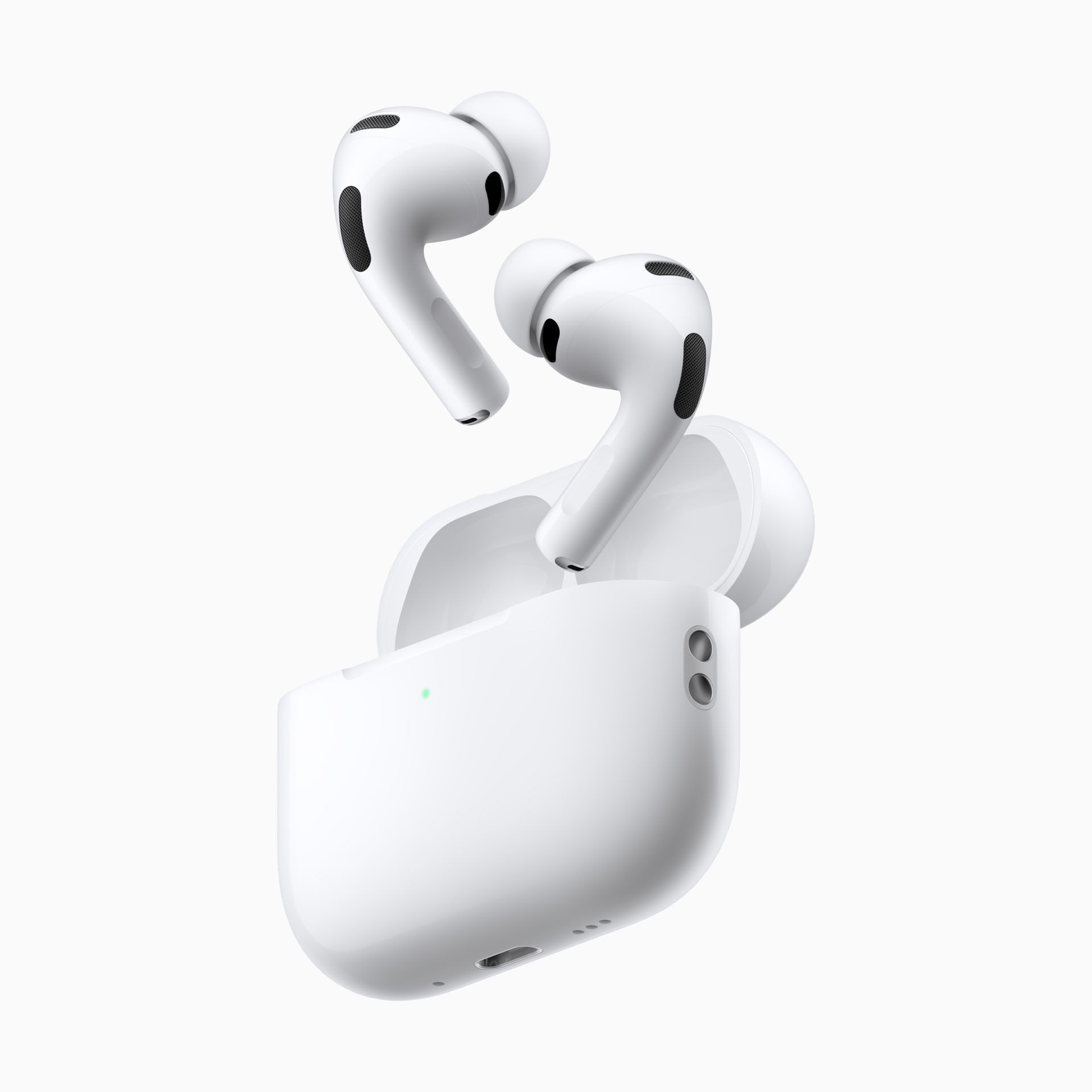
Apple debuts its AirPods Pro 3. Image: Apple
Apple opened the show by reminding the world that AirPods aren’t just the company’s most popular accessory; they’re the most popular headphones — period. Cook framed the update as proof that Apple’s design philosophy is as much about how products work as how they look, pointing to AirPods’ seamless setup and ecosystem glue.
“AirPods are the best and most popular headphones in the world, with an iconic design and groundbreaking sound quality,” Cook said, reminding everyone that the tiny white stems have long since outgrown their accessory status.
Then came the headline: the AirPods Pro 3.
Kate Bergeron, Apple’s vice president of audio hardware engineering, called them her “favorite AirPods ever,” and the spec sheet seems to back her up. Apple says the third-gen Pros pack a custom multiport acoustic system that reshapes airflow inside the ear, unlocking deeper bass and a wider soundstage. Vocals pop, instruments separate cleanly, and Apple claims noise cancellation is now twice as powerful as before — or “night and day” compared with the originals. The foam-infused ear tips improve noise isolation, promising over-ear performance from buds still small enough to (easily) lose between your couch cushions.
The upgrade goes beyond sound. Building on what Apple billed last year as the first “end-to-end hearing health experience,” AirPods now double as health monitors — tracking, measuring, and surfacing improved alerts if your listening habits could damage your ears. With a photoplethysmography sensor shining invisible infrared pulses 256 times per second, AirPods Pro 3 can now track heart rate in real time — syncing with the Fitness app, powering up to 50 workout types, and even delivering a “Workout Buddy” experience driven by on-device AI. There’s also an ear-canal temperature sensor, giving you instant body-heat readings more accurate than what your wrist can deliver.
Apple’s new wellness pitch seems to position AirPods as much as a medical device as a musical one. The new AirPods Pro 3 land at $249 in the U.S., the same price as the previous generation. Preorders open this week, with availability beginning Sept. 19.
But the flashiest trick isn’t the bass, the silence, or even the health perks — it’s the chatter. AirPods Pro 3 debut live translation, powered by Apple Intelligence. Picture wandering a street market in Mexico City: a vendor rattles off prices in Spanish, noise cancellation dips, and your AirPods quietly feed you the English in real time. At the same time, your iPhone lights up with captions — live subtitles that mirror what you’re hearing — turning the buds into a translator for your ears and the phone into a translator for your eyes. Apple says even your own voice sounds more natural in transparency mode, making conversations less muffled and more, well, human. If the pitch sounds familiar, that's probably because Google and Samsung have been singing this tune for a while now.
Altogether, AirPods have become more than earbuds. They’re turning into a more sophisticated communication device, a health monitor, and a personal interpreter — the kind of incremental magic that keeps Apple’s smallest product line one of its biggest flexes.
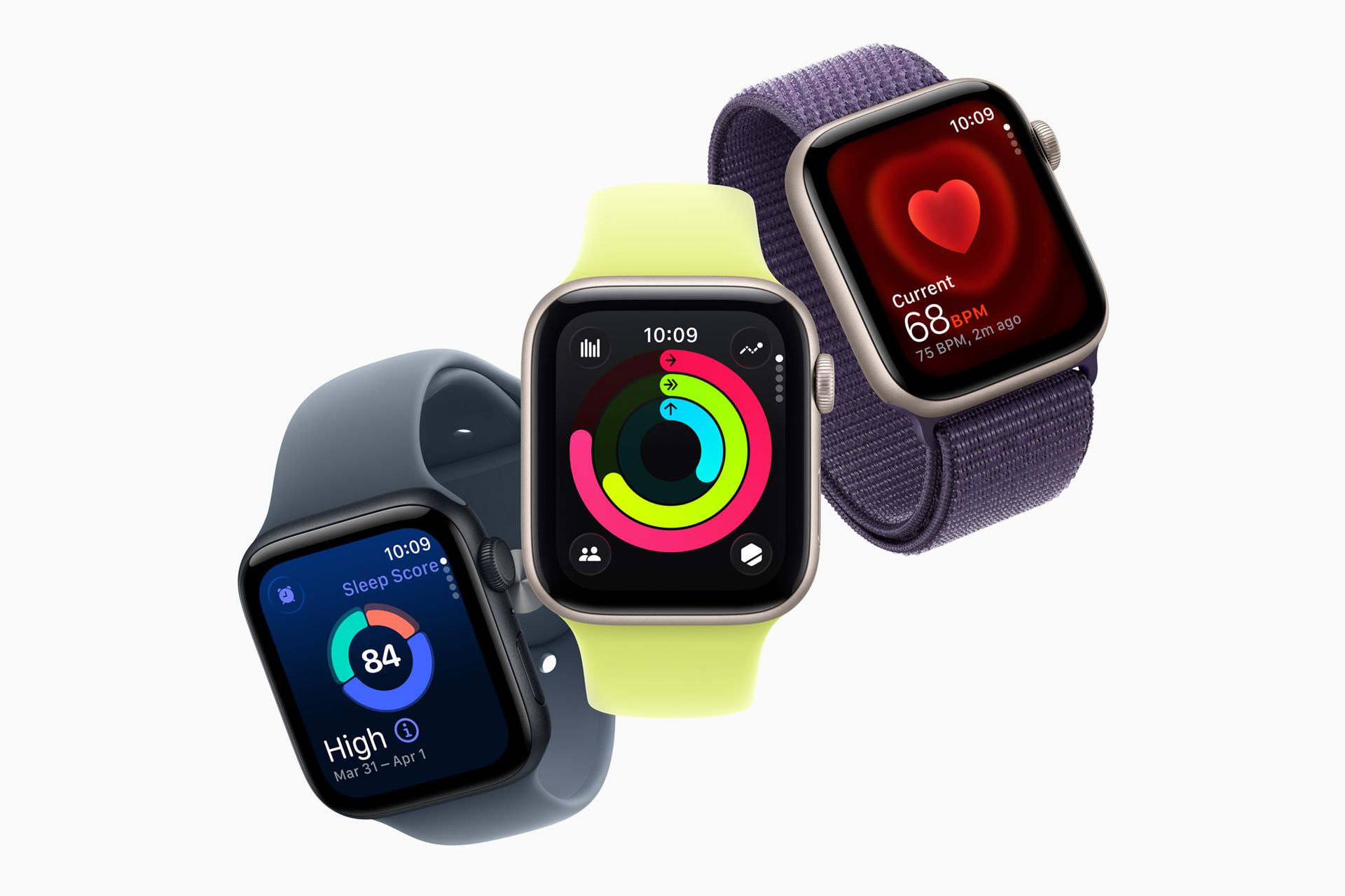
Apple debuts its Watch SE 3. Image: Apple
Apple set the stage with a string of stories that made the Watch feel less like a gadget and more like a guardian: a collapsed lung caught by a blood-oxygen alert, a stroke flagged mid-jump-rope session, hikers rescued from a snowstorm in Japan, even a car crash survivor hearing a faint “help is on the way” through the tiny speaker on their wrist. “What I really love about Apple Watch is how it alerts millions of people to potentially serious health issues and helps save so many lives,” Tim Cook said, as the company provided testimonials to underscore the point.
Then came the lineup. Apple Watch Series 11 is Apple’s thinnest and reportedly most comfortable watch yet, made with ion-X $TWTR glass fused to a ceramic coating that supposedly makes it twice as scratch-resistant. It also adds 5G connectivity for stronger coverage, plus watchOS 26 with a fresh set of faces — including Flow, which refracts color through Apple’s new Liquid Glass aesthetic.
On the health front, Series 11 will debut hypertension notifications, a machine-learning system that analyzes heart-sensor data over 30 days to flag possible high blood pressure — what Apple called a “silent killer” that affects 1.3 billion people worldwide. Backed by studies of more than 100,000 participants, Apple expects to notify over a million people in its first year. Sleep tracking also levels up with Sleep Score, a nightly readout that factors in duration, consistency, and time in each stage, offering clear guidance to make rest more restorative — when you're not up late basking in your screen's glow.
“The capabilities introduced today will not only help users stay connected, they’ll deliver even more health and fitness benefits seamlessly and automatically,” Cook said.
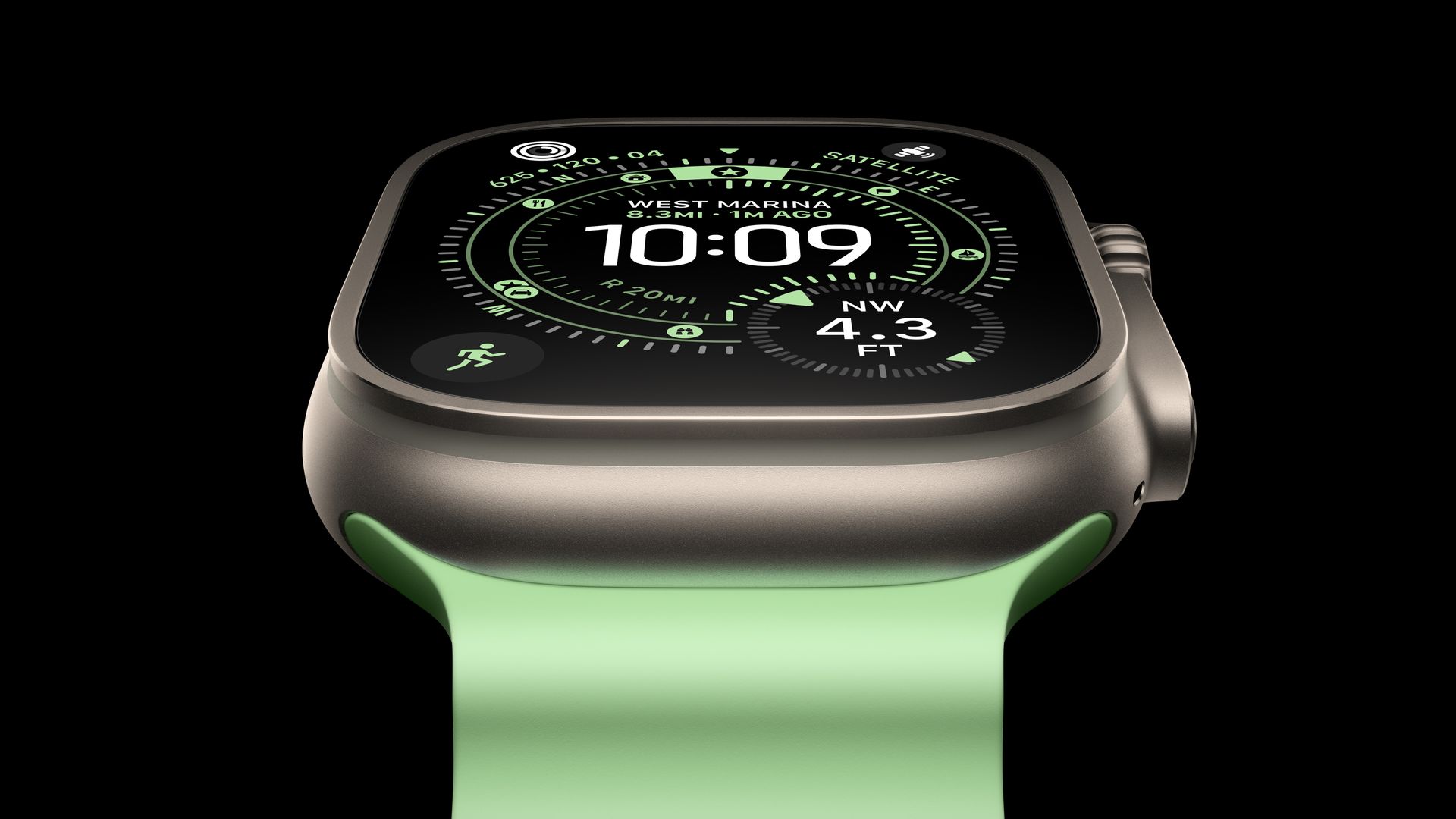
Apple debuts its Watch Ultra 3. Image: Apple
For athletes and adventurers, there’s the Apple Watch Ultra 3. It gets a larger, brighter display within a familiar chassis, plus a bigger battery for up to 42 hours of life. A “Workout Buddy” voice powered by Apple Intelligence pipes real-time coaching into your ear, while new satellite connectivity means you can send messages or trigger an emergency SOS even when you’re off-grid. Apple says it redesigned the antenna system to double signal strength and connect with satellites 800 miles overhead — all squeezed into a titanium case now made from 100% recycled material via 3D printing.
The entry-level SE 3 also got a performance bump, keeping Apple’s Watch family spread wide: $249 for the SE, $399 for Series 11, and $799 for Ultra 3. All ship starting Sept. 19. Cook said the Watch is “indispensable” — and this year’s updates push it further into the territory of coach, doctor, and safety net, all strapped to your wrist.
Apple’s software story was polish, not pageantry. The company kept returning to Liquid Glass, its latest design language meant to make interfaces shimmer and glide across devices. In practice, the Flow watch face bends color like a prism, while iOS 26’s lock screen picks up Live Activities and widgets that finally make the always-on display feel useful. The demonstration wasn’t built on reinvention; it was a fresh coat of lacquer — an effort to make familiar features look less tired without changing how people actually use them.
On iOS 26, Apple stacked small upgrades where people largely live. The lock screen becomes a more functional dashboard with Live Activities and widgets that benefit from the always-on display. Visual Intelligence lets you search, act on, or ask about whatever’s on your screen. And live translation now reaches deeper into Phone, FaceTime, and Messages. Siri, notably, didn’t get a reboot. Apple barely said the name, opting to park Apple Intelligence under the hood instead. And Vision Pro was conspicuously absent — beyond borrowed design cues. Last year’s “next platform” didn’t even get a cameo, a quiet sign of how quickly Apple has shifted away from its almost-was headset revolution.
The event’s through line was silicon, not showmanship. And the net effect is a lot of small changes — everywhere.
Liquid Glass gives the OS a fresh coat. iOS 26 tucks intelligence into places you already tap. And the company’s most consistent message wasn’t about a new app or assistant; it was that the hardware you’re buying today is built to make those quiet AI tricks feel instantaneous tomorrow. Whether that restraint reads as confidence or caution will depend on how quickly those background wins add up in real life.
Apple’s event ended with a contradiction only it could stage: the Air straining physics on one end, the Pro flexing brute performance on the other, and a through-line of design polish meant to convince the world that rectangles can still dazzle. For the fans in Cupertino’s glass ring, the choreography worked. For the rest of the market, the verdict will take longer to land.
What lingers isn’t whether Apple can still make slick hardware — it clearly can — but whether the combination of “thinnest ever,” “brightest yet,” and “most powerful to date” adds up to something more than the next turn of the spec-sheet crank. That’s the problem with ritual: The lines get bigger, the demos sharper, but the element of surprise harder to stage.
The company that can still shape glass and metal into improbable forms, but it now has to prove it can still shape consumer behavior. The iPhone Air shows audacity isn’t gone, the Pro proves horsepower isn’t lacking, and the base 17 feels worthy of its slot. But the stakes stretch beyond the keynote stage — whether those rectangles are enough to break through upgrade fatigue, AI hype cycles, and regulatory heat closing in on the walled garden. Cupertino pulled off the show. The harder trick is proving the world still needs a new iPhone.