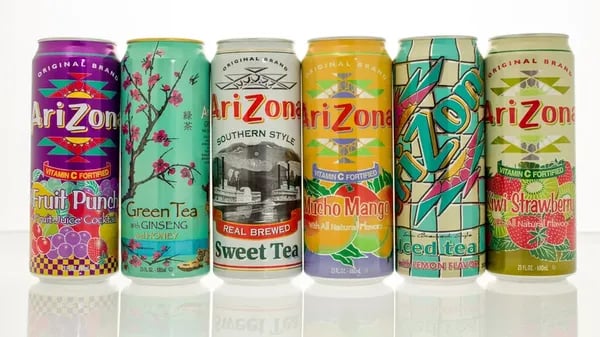
The past three decades have seen financial crises, war, a heating planet, technological revolutions, and a global pandemic. But one truism prevailed: an AriZona Iced Tea costs 99-cents.

The Trump administration’s 50% tariff on aluminum imports has left AriZona CEO Don Vultaggio contemplating the unthinkable – a price hike.
Getty Images / Memoriesarecaptured
The past three decades have seen financial crises, war, a heating planet, technological revolutions, and a global pandemic. But one truism prevailed: an AriZona Iced Tea costs 99-cents.
Then came the Trump administration’s 50% tariff on aluminum imports. It has left AriZona CEO Don Vultaggio contemplating the unthinkable – a price hike.
“I hate even the thought of it,” Vultaggio told The New York Times last week, adding, “It would be a hell of a shame after 30-plus years.”
U.S. inflation has increased by roughly 100% since 1997, when the iconic cans first appeared on shelves. If the company had adjusted prices accordingly, one drink would be selling for $1.99 today. AriZona’s commitment to shield consumers from macroeconomic woes has become a signature feature of its brand: each can is designed with “99¢” printed boldly on the front.
But manufacturing those cans requires more than 100 million pounds of aluminum a year, of which about 20% comes from Canada, according to the Times.
“At some point the consumer is going to have to pay the price,” said Vultaggio, although he’s hopeful that Trump will reverse the tariff.
AriZona is not the only brand to have an unspoken agreement with the public to never change its price.
Costco $COST president W. Craig Jelinek famously once complained to then-CEO Jim Sinegal that the company was losing money on its $1.50 hotdogs. “If you raise [the price of] the effing hot dog, I will kill you,” Sinegal replied. “Figure it out.” Holding up its end of the bargain, Costco even began producing its own Kirkland Signature hot dogs during the 2008 financial crisis to avoid increasing the price.
Similarly, when Dollar Tree $DLTR backtracked on its motto that “Everything’s $1” back in 2021, raising the base price to $1.25 for most items, there was outcry.
“It will be a shock to a loyal customer base,” Scott Mushkin, a founder and analyst at R5 Capital, a retail research and consulting firm, told CNN at the time. “It could end up being one the worst decisions in retail history if it is not dialed back.”
Should AriZona be forced to hike prices, it may not be the only beverage company to do so. Coca-Cola $KO CEO James Quincey said on an earnings call in February that tariffs will increase the costs of their soda cans, and the company will adapt accordingly. This could mean changes to the sourcing and weight of cans, price increases, and potentially a switch to more plastic bottles.
“It is a cost. It will have to be managed,” he said. “It would be better not to have it relative to the U.S. business, but we are going to manage our way through.”
But Quincey was speaking back when steel and aluminum tariffs were just 25%. The administration doubled the proposed rate in May.
“Doubling steel tariffs will inflate domestic canned food prices, and it plays into the hands of China and other foreign canned food producers, which are more than happy to undercut American farmers and food producers,” The Can Manufacturers Institute, the trade association of the metal can manufacturing industry, said in a statement shortly after. The new rate would “further increase the cost of canned goods at the grocery store.” The can manufacturing industry relies on foreign imports for nearly 80% of its tin-mill steel.
Join 500,000+ readers who start their day with Quartz.
By subscribing, you agree to our Terms of Service and Privacy Policy.