
20 artistic collaborations that produced something neither artist could have made alone
From Lennon and McCartney to Warhol and Basquiat, these creative partnerships show how two artists working together can produce work neither could achieve alone

Credit: Canva Images
The lone genius is one of the most durable myths in art history, and one of the least accurate. Look closely at the paintings, songs, films and performances that define the past century and you keep finding two names instead of one. Cubism was invented by a pair of painters who visited each other's studios almost daily. The most valuable songwriting catalog in pop music carries a joint credit. The piece that dragged opera into the modern era was built by a composer and a director who barely discussed what the other was doing.
Collaboration in art is not the same as cooperation. Two people can divide labor and still produce something predictable. The partnerships on this list did something different. Each one generated work that sits outside both artists' solo output — a third voice that belonged to the pairing itself. Brian Eno never wrote a song like "Heroes" on his own, and neither did David Bowie. Elton John cannot write lyrics and Bernie Taupin cannot write melodies, yet together they have produced more than 50 years of hits. Christo and Jeanne-Claude signed their monumental wrapped buildings as a single artist because neither could point to where one person's contribution ended.
The mechanics vary widely. Some of these pairs worked in the same room, arguing over every bar and brushstroke. Others deliberately stayed apart, mailing lyrics across an ocean or composing music and choreography in separate studios so the two would meet for the first time on stage. Some partnerships lasted five decades. Others burned out in two years and left behind a handful of works that neither artist ever matched again.
What unites them is friction. Every collaboration here paired people with different skills, different temperaments or different ideas about what art should do. The results were not compromises between two visions. They were new things entirely — proof that in creative work, one plus one can equal something no arithmetic predicts.
John Lennon and Paul McCartney
Credit: Tony Barnard / Wikimedia Commons ( CC BY 4.0)
Credit: Nationaal Archief, Den Haag, Rijksfotoarchief: Fotocollectie Algemeen Nederlands Fotopersbureau (ANEFO) / Wikimedia Commons (CC BY-SA 3.0 nl)
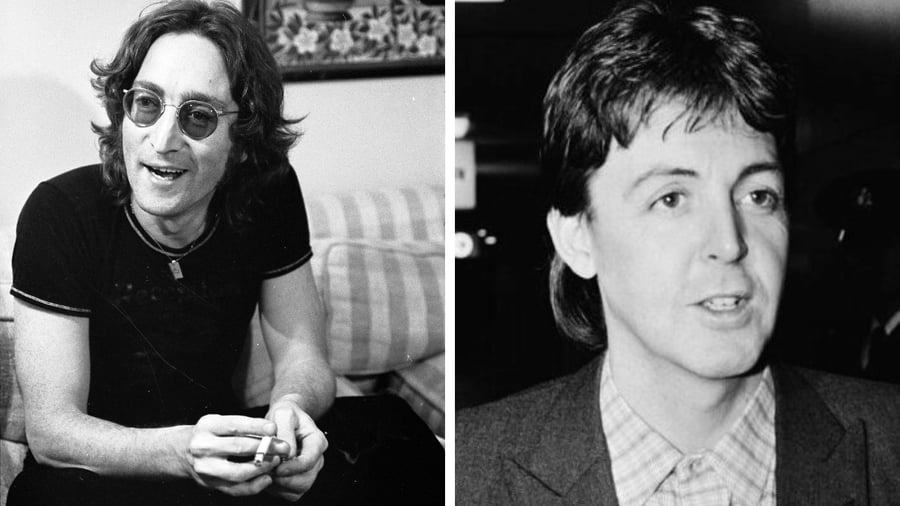
Lennon and McCartney agreed as teenagers in Liverpool that every song either of them wrote would be credited to both. The handshake deal held from the Beatles' first single in 1962 to the band's breakup in 1970, and it turned two competing songwriters into a single legal and creative entity. The joint credit covered roughly 180 songs, including nearly every original the Beatles recorded.
In the early years they genuinely wrote together, sitting face to face with guitars, as McCartney has described it, "eyeball to eyeball." Songs such as "She Loves You" and "I Want to Hold Your Hand" came out of those sessions. As the partnership matured, each man increasingly wrote alone and brought drafts to the other for editing, completion or sabotage. The credit stayed shared either way.
The most famous example of the method is "A Day in the Life," which closes the 1967 album Sgt. Pepper's Lonely Hearts Club Band. Lennon had written haunted verses drawn from newspaper stories but had no middle. McCartney had an unrelated fragment about waking up and catching a bus. Joined by an orchestral crescendo, the two pieces became one song that neither writer could have finished alone. "We Can Work It Out" worked the same way in reverse — McCartney's hopeful verses answered by Lennon's impatient middle section.
The partnership functioned as mutual quality control. Lennon pushed McCartney away from sentimentality. McCartney pushed Lennon toward melody and structure. Each man knew the other would hear a weak line within seconds, and the anticipation of that judgment shaped what they wrote before a note was played.
Their solo careers after 1970 proved the point. Both men produced hits, and both produced albums that a sharp-eared partner would have trimmed. The catalog they built together remains the standard against which songwriting partnerships are measured, and the joint credit remains on every song.
Pablo Picasso and Georges Braque
Between 1908 and 1914, Picasso and Braque invented Cubism in something close to a two-person laboratory. They visited each other's Paris studios almost daily, examined each other's canvases and pushed each idea one step further before handing it back. Braque later compared the arrangement to two mountaineers roped together on the same climb.
The dialogue was so tight that the two painters' work from the height of Analytic Cubism can be difficult to tell apart. Both fractured objects into shifting planes, flattened space and restricted their palettes to browns, grays and muted greens. For a period they stopped signing the fronts of their canvases, a deliberate move to submerge individual authorship in the shared project. The name of the movement itself came from outside: the critic Louis Vauxcelles mocked the small cubes he saw in Braque's 1908 landscapes, and the label stuck.
Each man contributed things the other lacked. Braque, trained as a house painter and decorator, brought craft techniques such as combed faux wood grain and stenciled lettering into fine art. Picasso brought speed, nerve and a willingness to break whatever rule remained standing. In 1912 Picasso glued a piece of printed oilcloth onto a canvas and made "Still Life with Chair Caning," often called the first modern collage. Braque answered within months by inventing papier collé, building compositions from cut and pasted paper in works such as "Fruit Dish and Glass."
The partnership ended abruptly in 1914, when Braque was mobilized for the First World War and suffered a serious head wound at the front. The two men never worked closely again, and Picasso later spoke of the collaboration in the past tense, as a marriage that had ended. What survived was the visual grammar of the 20th century. Abstraction, collage and constructed sculpture all trace back to six years of conversation between two studios in Montmartre.
W.S. Gilbert and Arthur Sullivan
Credit: Wikimedia Commons / PICRYL
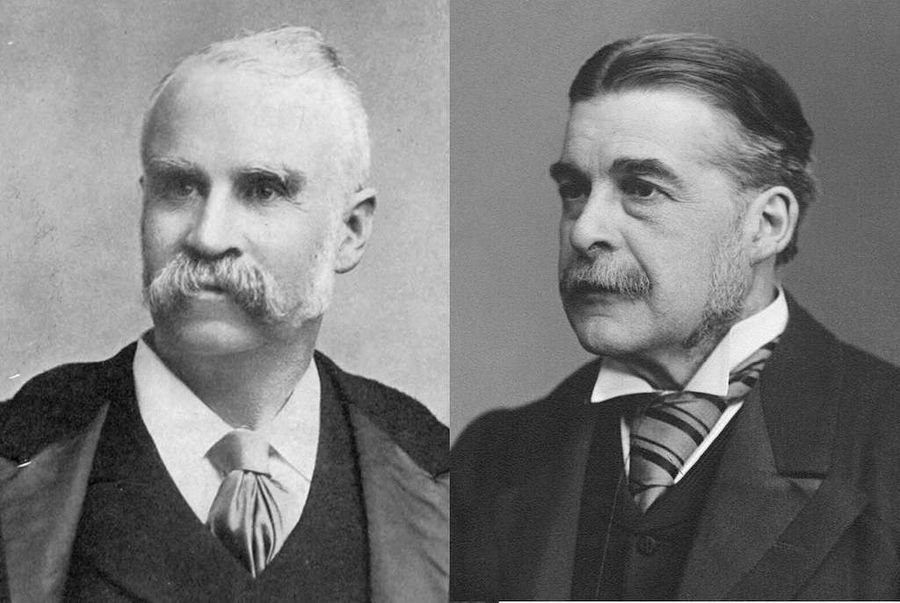
Gilbert and Sullivan wrote 14 comic operas together between 1871 and 1896, and in the process invented much of what became modern musical theater. The two men were opposites who never became close friends. William Schwenck Gilbert was a barbed satirist who drilled his casts like a stage sergeant. Arthur Sullivan was a celebrated composer who considered comic opera beneath his gifts and kept threatening to quit for serious music.
The friction produced a distinct product. Gilbert wrote absurd plots and precise, patter-heavy lyrics that skewered the British establishment — the navy in "H.M.S. Pinafore," the House of Lords in "Iolanthe," the legal system in "Trial by Jury." Sullivan set the satire to music of genuine elegance, and the contrast between silly words and graceful melody became the partnership's signature. Neither man's work outside the pairing achieved anything like the same effect.
The impresario Richard D'Oyly Carte held the partnership together as a commercial machine. He commissioned the operas, managed the touring companies and built the Savoy Theatre in London in 1881 specifically to house their work. The Savoy was the first theater in the world lit entirely by electric light, and the works premiered there — including "The Mikado" in 1885 and "The Gondoliers" in 1889 — are still known as the Savoy operas.
The pair's most famous rupture, the so-called carpet quarrel of 1890, began when Gilbert objected to Carte charging the cost of new lobby carpet to the partnership. The lawsuit that followed split the two men for years, and the reconciliation that eventually came never fully restored the old working rhythm.
Their influence outlasted the feuds. The patter song became a template for rapid-fire comic lyrics from Broadway to hip-hop parody, and companies around the world still perform the operas continuously more than 125 years after the partnership ended.
Richard Rodgers and Oscar Hammerstein II
Rodgers and Hammerstein were both established Broadway veterans when they teamed up in the early 1940s, and both were arguably past their commercial peak. Richard Rodgers had spent two decades writing sophisticated songs with the lyricist Lorenz Hart, whose alcoholism had made him unreliable. Oscar Hammerstein II had written the landmark "Show Boat" in 1927 but had endured a long string of flops since.
Their first show together changed the shape of the American musical. "Oklahoma!," which opened in 1943, integrated songs, story and dance so that every number advanced the plot or revealed character. It ran for a then-record 2,212 performances on Broadway. The formula was not an accident of chemistry alone. It came from a reversal of method: with Hart, Rodgers had written music first, but Hammerstein preferred to finish a complete lyric before Rodgers composed a note. Words led, and the songs grew directly out of the drama.
The run that followed has no real parallel. "Carousel" in 1945, "South Pacific" in 1949, "The King and I" in 1951 and "The Sound of Music" in 1959 all became standards of the repertoire. "South Pacific" won the Pulitzer Prize for Drama in 1950, a rare honor for a musical, while confronting racial prejudice directly in the song "You've Got to Be Carefully Taught."
Neither man reached the same level apart. Rodgers's post-Hammerstein shows drew respectful notices and modest runs. Hammerstein's earlier solo-era work, "Show Boat" aside, is rarely revived. Together they built a catalog that still anchors school auditoriums, opera houses and film revivals, and their production company shaped Broadway business practice for decades.
Hammerstein died in 1960, months after "The Sound of Music" opened. His final lyric, written for that show, was "Edelweiss" — a quiet song that sounds like a folk tune and exists only because two mismatched veterans decided to start over together.
Igor Stravinsky and Vaslav Nijinsky
Credit: Photo by Auguste Bert, Paris (1911) / Featured in the Ballets Russes program book by Comoedia Illustre / GetArchive / PICRYL
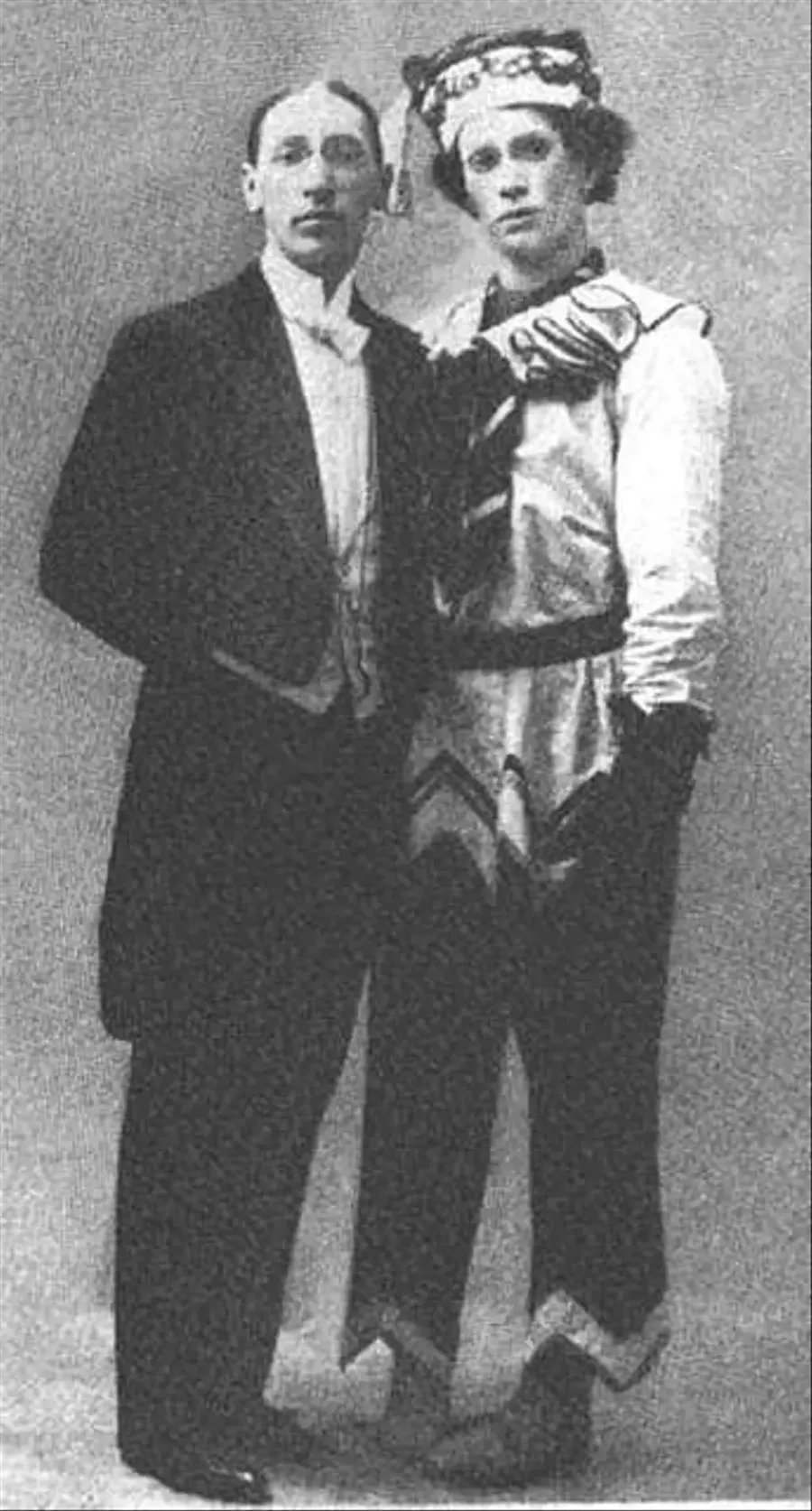
"The Rite of Spring" caused one of the most famous opening-night uproars in the history of performance, and it took three artists and one impresario to detonate it. Serge Diaghilev, director of the Ballets Russes, commissioned the young composer Igor Stravinsky to write a ballet about a pagan ritual in ancient Russia. The painter and mystic Nicholas Roerich shaped the scenario and designed the sets and costumes. Vaslav Nijinsky, the company's star dancer, created the choreography.
Stravinsky's score broke the rules of concert music. It stacked dissonant chords, shifted meters bar by bar and treated the orchestra as a percussion machine. Nijinsky's choreography broke the rules of ballet just as thoroughly. He turned the dancers' feet inward, bent their bodies into heavy, stamping shapes and replaced classical grace with the jerking movements of a trance. Neither element alone explains what happened at the Théâtre des Champs-Élysées in Paris on May 29, 1913. The combination did. The audience began shouting during the opening bassoon solo, fights broke out between supporters and detractors, and the dancers finished the premiere barely able to hear the orchestra.
The collaboration was brief and strained. Stravinsky privately doubted Nijinsky's musical training, and rehearsals required a system for counting the score's irregular rhythms that pushed the dancers to their limits. Nijinsky's choreography was performed only a handful of times before being dropped, and it was considered lost for decades until the Joffrey Ballet staged a reconstruction in 1987 based on research by the dance historian Millicent Hodson.
The score went on to a life of its own as a concert work and a foundation stone of 20th-century music. But the scandal that made "The Rite" a legend belonged to the pairing — a composer and a choreographer, both in their 20s, each amplifying the other's break with the past until the audience could no longer sit still.
Salvador Dalí and Luis Buñuel
"Un Chien Andalou," the 17-minute silent film that opens with a razor slicing a woman's eye, came out of a writing method built on refusal. Luis Buñuel, an aspiring filmmaker from Aragon, and Salvador Dalí, a painter not yet famous, had met as students in Madrid. In early 1929 they spent several days at Dalí's family home in Figueres trading images for a screenplay. They set one rule: any idea that could be rationally explained, or that carried an obvious symbolic meaning, was thrown out.
The result was a film assembled from dream logic. Ants crawl out of a hole in a man's palm. A man drags two grand pianos loaded with dead donkeys and live priests across a parlor. Title cards announce times and dates that mean nothing. The eye-slitting shot, achieved with a calf's eye, remains one of the most cited images in cinema.
Buñuel directed and edited the film in Paris, financed largely by money from his mother, while Dalí contributed to the scenario and appears briefly on screen. Buñuel later claimed he attended the 1929 premiere with stones in his pockets in case the audience rioted. The opposite happened. The Paris avant-garde embraced the film, and both men were welcomed into the Surrealist movement that André Breton led.
The partnership barely survived its success. The two collaborated again on "L'Age d'Or" in 1930, but Dalí's involvement shrank as Buñuel took control, and the friendship collapsed amid political and personal disputes. Dalí went on to become the most famous Surrealist painter in the world. Buñuel built a five-decade directing career in Mexico, France and Spain.
Neither man ever made anything else like their first film. Dalí's later cinema projects leaned on spectacle, and Buñuel's mature films wrapped their subversion in narrative. "Un Chien Andalou" stands apart — the product of a few days when two young Spaniards agreed to reject every reasonable idea they had.
John Cage and Merce Cunningham
The composer John Cage and the choreographer Merce Cunningham built a 50-year partnership on a paradox: they collaborated by staying out of each other's way. Beginning with a joint recital in New York in 1944, and continuing through the Merce Cunningham Dance Company that formed in 1953, the two men made music and dance for the same performances while composing them separately. Often the dancers heard the score for the first time at the premiere.
The method rested on a shared principle. Cage and Cunningham agreed that music and dance did not need to depend on each other, only to coexist in the same span of time. Duration was the single element they coordinated in advance. Everything else — rhythm, mood, structure — was left to collide on stage. The collisions produced relationships between sound and movement that neither man could have planned, which was exactly the point.
Chance ran through both halves of the work. Cage famously used the I Ching, the Chinese divination text, to make compositional decisions, removing his own taste from the process. Cunningham applied similar chance operations to choreography, tossing coins to determine sequences of movement and even the placement of dancers on stage. At Black Mountain College in 1952, the two staged an unscripted multimedia event now regarded as a forerunner of the happenings of the 1960s.
The partnership extended to life. Cage and Cunningham were romantic partners for decades, though the working relationship remained deliberately impersonal in its rules. Collaborators drawn into their orbit included Robert Rauschenberg and Jasper Johns, who designed sets and costumes under the same independence principle.
Cage died in 1992, Cunningham in 2009. Their refusal to let music illustrate dance, or dance interpret music, changed both fields. Choreographers who set movement against unrelated sound, and composers who treat performance as coexistence rather than accompaniment, are working inside a frame the two of them built.
Ella Fitzgerald and Louis Armstrong
Ella Fitzgerald and Louis Armstrong recorded three albums together for the Verve label in the late 1950s, and the pairing worked because of the distance between their voices. Fitzgerald's instrument was pure, precise and seemingly effortless across its range. Armstrong's was gravel — a rasp that turned every phrase into speech. Set side by side on the same melody, the contrast made both singers sound more like themselves.
The producer Norman Granz engineered the collaboration. He signed both artists, booked the sessions and kept the settings deliberately spare. The first album, "Ella and Louis," released in 1956, backed the two singers with the Oscar Peterson quartet: Peterson on piano, Herb Ellis on guitar, Ray Brown on bass and Buddy Rich on drums. The material came from the Great American Songbook — "Cheek to Cheek," "They Can't Take That Away from Me," "April in Paris" — taken at relaxed tempos that left room for conversation between the voices.
The formula carried through "Ella and Louis Again" in 1957, a double album that added solo turns for each singer, and "Porgy and Bess" in 1958, a full reading of the Gershwin opera's songs. Armstrong's trumpet appears throughout the sessions, adding a third voice that answers both singers.
Neither artist needed the other commercially. Fitzgerald was in the middle of her celebrated songbook series, and Armstrong remained one of the most famous entertainers alive. What the duets added was a quality absent from their solo catalogs: audible pleasure in company. Armstrong's asides and improvised interjections pull Fitzgerald toward playfulness, and her rhythmic security gives his phrasing a frame to push against.
The albums have never left print. They remain a standard introduction to jazz singing, and a document of two performers from different generations — Armstrong born in 1901, Fitzgerald in 1917 — meeting on equal terms in front of a rhythm section content to stay out of the way.
Miles Davis and Gil Evans
Miles Davis made his name leading small combos, but some of his most lasting records came from a partnership with a self-taught Canadian arranger who worked slowly, obsessively and mostly out of sight. Gil Evans first collaborated with Davis on the 1949 and 1950 nonet sessions later collected as "Birth of the Cool," writing arrangements that wrapped the trumpeter's spare lines in unusual instrumental colors, including French horn and tuba.
The full partnership arrived at Columbia Records in the late 1950s, when producers gave Evans an orchestra and Davis the role of lone soloist in front of it. "Miles Ahead" in 1957 cast Davis on flugelhorn against a 19-piece ensemble. "Porgy and Bess" in 1958 rebuilt Gershwin's opera as a concerto for trumpet. "Sketches of Spain" in 1960 went further, adapting the adagio of Joaquín Rodrigo's "Concierto de Aranjuez" and drawing on flamenco and Spanish folk sources.
The division of labor was clear and complementary. Evans supplied harmonic settings of unusual density and patience, voiced for woodwinds, brass and muted colors that no working jazz band carried. Davis supplied the single human voice those settings existed to frame — a sound so exposed that every note carried weight. Davis's small-group records of the same period, including "Kind of Blue," show what he did without Evans. The orchestral albums show a different artist: lyrical, theatrical and unhurried.
Evans, for his part, never achieved comparable results with another soloist, and his own albums as a leader, though admired, reached a fraction of the audience. The two men remained close for three decades, with Evans contributing quietly to later Davis projects and serving as a trusted ear until his death in 1988.
The collaborations stand as a category of their own — neither big-band jazz nor classical music, but a hybrid that required one particular arranger and one particular trumpet player to exist at all.
Elton John and Bernie Taupin
Elton John and Bernie Taupin have written songs together for more than half a century, and they have almost never been in the same room while doing it. The two met in 1967 after separately answering the same talent advertisement placed by Liberty Records in a British music paper. An executive handed the young pianist, then still named Reg Dwight, an envelope of lyrics from a teenager in Lincolnshire. The method they stumbled into then has barely changed since.
Taupin writes complete lyrics first, with no melody in mind, and sends them off. John sets them to music alone at a keyboard, typically working fast — often finishing a song in well under an hour and discarding any lyric that does not yield a melody quickly. There are no writing sessions, no arguments over a bridge, no shared drafts. The lyric arrives as a finished text, and the music arrives as a response to it.
The output of this long-distance system includes "Your Song," "Rocket Man," "Tiny Dancer," "Goodbye Yellow Brick Road," "Candle in the Wind" and dozens of other standards of the pop era. In 1975 their autobiographical album "Captain Fantastic and the Brown Dirt Cowboy" became the first album to debut at No. 1 on the Billboard 200, a chart feat that reflected how completely the partnership had conquered American radio.
The division of labor is total. John has said repeatedly that he cannot write lyrics; Taupin does not write music. Each career depends on the other, yet the two men have led separate lives on separate continents for most of the partnership, with Taupin settled in California ranch country and John touring the world.
The pairing won the Academy Award for best original song in 2020 for "(I'm Gonna) Love Me Again" from the film "Rocketman." More than 50 years in, the envelope of lyrics still arrives, and the melodies still come back.
David Bowie and Brian Eno
Credit: Elmar J. Lordemann / Jo Atmon / Photography by Jo Atmon / Wikimedia Commons ( CC BY-SA 2.0 de)
Credit: osciansky / Flickr as Life of Brian) / Wikimedia Commons (CC BY 2.0)
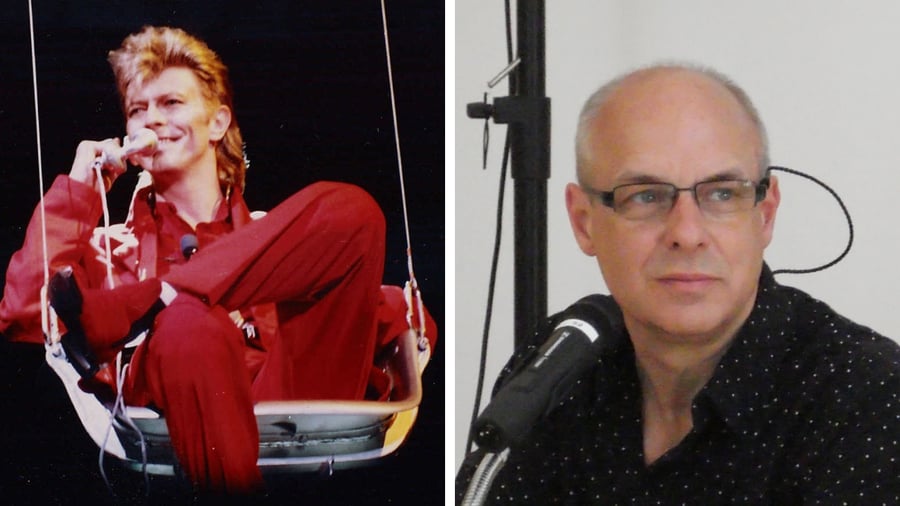
In 1976 David Bowie left Los Angeles, cocaine and superstardom behind and moved to Europe to rebuild his music from the ground up. The collaborator he chose was Brian Eno, the former Roxy Music synthesist who had begun releasing ambient records and treating the studio as a compositional instrument. Working with the producer Tony Visconti, the two made three albums — "Low" and "Heroes" in 1977 and "Lodger" in 1979 — that became known as the Berlin Trilogy.
Eno's contribution was less a sound than a set of procedures. He brought his Oblique Strategies cards, a deck of cryptic instructions such as "Honor thy error as a hidden intention," and used them to force decisions when sessions stalled. He layered synthesizers and treatments over the rhythm tracks and pushed Bowie toward structures pop music did not use. The second side of "Low," recorded mostly at the Château d'Hérouville studio in France, abandoned songs altogether for brooding instrumentals.
"Heroes" was cut entirely at Hansa Studios in West Berlin, close enough to the Berlin Wall that guards in the watchtowers were visible from the control room. The title track grew from a churning two-chord jam, Robert Fripp's sustained guitar lines and a lyric Bowie improvised at the microphone about two lovers meeting by the Wall. It became one of the defining recordings of his career.
Neither man made records like these on his own. Bowie's previous albums, whatever their invention, were built on songcraft and personae. Eno's solo work drifted toward stillness. Together they produced music that was both experimental and emotionally direct, and its influence spread through post-punk, electronic pop and every artist who has since treated a career reinvention as an artistic method.
The two reunited in 1995 for the album "Outside." But the Berlin records remain the core of the partnership — three albums in three years that redrew the map of what a mainstream rock star could release.
David Byrne and Brian Eno
Brian Eno appears twice on this list because he built two entirely different machines with two different partners. While producing Talking Heads in the late 1970s, Eno and the band's frontman David Byrne began a side project with a premise that barely existed in pop music at the time: an album with no lead singer. "My Life in the Bush of Ghosts," recorded in 1979 and 1980 and released in 1981, replaced conventional vocals with found voices lifted from radio broadcasts and records.
The two men built dense, funk-driven rhythm tracks, then threaded in the voices of an unidentified exorcist, radio call-in hosts, a Lebanese mountain singer and American preachers. The sampled voices were treated as lead instruments, their cadences setting the melodic shape of each track. "The Jezebel Spirit" turned an exorcism recording into a groove. Nothing on the album was sung by its makers.
The technical process was laborious. Working before digital sampling was practical, Byrne and Eno synchronized tape recordings by hand, a method that made every alignment of voice and rhythm a physical act. Rights issues forced changes too — one track was replaced after objections from the estate of a sampled radio evangelist, an early preview of the legal fights that would follow sampling into the mainstream.
The album's influence outran its sales. Hip-hop producers, electronic musicians and pop acts spent the following decades building tracks from recorded fragments of other voices, and "Bush of Ghosts" is regularly cited as a forerunner of that entire practice. For its 25th anniversary in 2006, Byrne and Eno released the multitrack stems of two songs online and invited the public to make remixes.
Byrne's day job with Talking Heads absorbed the same ideas — Eno produced the band's "Remain in Light" in 1980 — but the duo album remains the purest statement of the experiment: two art-school minds asking what a song is when nobody in the room sings it.
Queen and David Bowie
"Under Pressure" was never planned. In July 1981 Queen were recording at Mountain Studios in Montreux, Switzerland, a facility the band owned, when David Bowie, who lived nearby, dropped in. What began as a night of jamming on covers turned into an attempt to write something from scratch. By the end of the session the five musicians had the skeleton of a song, built around a seven-note bassline that became one of the most recognizable figures in rock.
Accounts of who invented the bassline differ even among the participants, with band members giving conflicting versions over the years — a fitting origin for a track with no single author. The finished record was genuinely collective. Freddie Mercury and Bowie traded and overlapped vocal lines, with Mercury's wordless high improvisations set against Bowie's declamatory verses. The lyric, assembled partly through a studio game in which participants improvised vocals without hearing what the others had sung, ended in an open plea about love under the strain of modern life.
Released in October 1981, "Under Pressure" went to No. 1 in the U.K. It was Queen's second British chart-topper, after "Bohemian Rhapsody," and it entered both acts' concert repertoires permanently, though the two never performed it together on stage.
The song's afterlife extended its reach. Vanilla Ice built his 1990 hit "Ice Ice Baby" on the bassline, initially without credit, and the resulting dispute was settled out of court with songwriting credit added — a case still cited in arguments about sampling and ownership.
Neither Queen nor Bowie sounded quite like this anywhere else. Queen's records were architectural, built from layered overdubs; Bowie's were conceptual, built from personae and procedures. One unplanned night in Switzerland produced a track leaner than the former and warmer than the latter, and neither party ever repeated the experiment.
Run-DMC and Aerosmith
The 1986 remake of "Walk This Way" is one of the few recordings that measurably changed the course of two genres at once. Run-DMC, the Queens trio then at the front of hip-hop, had been rapping over the song's drum break for years without knowing much about its source. Their producer Rick Rubin proposed covering the entire 1975 Aerosmith track — rapping Steven Tyler's verses — and bringing in Tyler and the guitarist Joe Perry to play and sing on the record.
The two camps recorded together at Magic Venture Studios in New York, and the pairing was awkward by every account. Run and DMC initially resisted the idea, regarding the song as outdated rock. Aerosmith were commercially adrift, their 1970s peak long past and the band newly emerged from years of drug problems. The finished track split the difference between the two acts: Perry's riff and Tyler's shrieked hook intact, the verses traded between rappers, the arrangement stripped to drums, guitar and voices.
The single reached No. 4 on the Billboard Hot 100, higher than Aerosmith's original had climbed, and its video — the two bands breaking through a literal wall between adjoining rehearsal rooms — put rap into heavy rotation on MTV at a time when the channel played little of it. The album it anchored, Run-DMC's "Raising Hell," became one of hip-hop's first multi-platinum records.
Both parties were transformed. Aerosmith's career restarted almost immediately, leading to a run of hit albums that lasted through the 1990s. Run-DMC became the act that carried hip-hop to rock audiences, arenas and suburban record collections.
The collaboration's larger legacy is the rap-rock crossover itself. Every subsequent pairing of rappers and rock bands, from one-off singles to entire genres, descends from a producer's suggestion that two acts who barely knew each other's music should share one song.
Andy Warhol and Jean-Michel Basquiat
In the mid-1980s the most famous artist of the previous generation and the most talked-about painter of the new one shared canvases for roughly two years. Andy Warhol was in his 50s, wealthy and widely considered past his creative peak. Jean-Michel Basquiat was in his early 20s, a former street artist whose paintings were selling as fast as he could make them. The Swiss dealer Bruno Bischofberger brought them together, initially in three-way collaborations with the Italian painter Francesco Clemente, before the two continued as a pair.
The working method was sequential. Warhol, who had largely abandoned hand-painting for silkscreen, returned to the brush and typically began the canvases with enlarged corporate logos, newspaper headlines and product imagery — General Electric $GE, Paramount $PARA, banana brands. Basquiat then painted over and around them, adding his skulls, crowned figures and fields of scrawled text, sometimes obliterating Warhol's contribution. Each man pushed the other off his settled ground: Warhol painted by hand again, and Basquiat worked at a scale and speed even he had not attempted. The pair produced a large body of joint canvases, with counts commonly put well above 100.
A 1985 exhibition of the collaborations at the Tony Shafrazi Gallery in New York, promoted with a poster of the two artists in boxing gloves, was received badly. Critics treated the show as a stunt, and a New York Times review suggested Basquiat had become Warhol's mascot. The friendship cooled sharply afterward, and the two produced little together again.
Warhol died in February 1987 after gallbladder surgery. Basquiat, deeply shaken by the loss, died of a heroin overdose in August 1988 at 27. The joint paintings, dismissed on arrival, have since been re-evaluated in museum retrospectives and now sell for sums that would have startled even their makers — the record for a collaboration stands in the tens of millions of dollars.
Christo and Jeanne-Claude
Christo Vladimirov Javacheff and Jeanne-Claude Denat de Guillebon were born on the same day — June 13, 1935 — in Bulgaria and Morocco respectively, met in Paris in 1958 and spent the next five decades wrapping, draping and fencing the physical world. Their projects included "Running Fence," a 24.5-mile fabric fence across California ranchland in 1976; the wrapped Pont Neuf bridge in Paris in 1985; the wrapped Reichstag in Berlin in 1995, which drew millions of visitors in two weeks; and "The Gates," 7,503 saffron-colored fabric panels installed along 23 miles of Central Park walkways in 2005.
For years the works were credited to Christo alone, and in 1994 the couple retroactively attributed the large outdoor projects to both names. The division of labor resisted simple description. Christo made the preparatory drawings and collages; Jeanne-Claude managed logistics, negotiations and the public arguments. Both insisted the ideas and decisions were joint, and they famously flew on separate planes so that if one crashed, the other could finish the work in progress.
The financing model was itself part of the art. The pair refused sponsorship, grants and donations, funding every project through the sale of Christo's preparatory studies. The wrapped Reichstag alone required roughly a quarter-century of lobbying, ending in a debate and vote on the floor of the German parliament in 1994. The temporary nature of the works was deliberate: each installation lasted days or weeks, then vanished, leaving photographs, drawings and memory.
Jeanne-Claude died in 2009. Christo continued executing projects the two had conceived together, including "The Floating Piers" on Italy's Lake Iseo in 2016. He died in May 2020, and their long-planned wrapping of the Arc de Triomphe in Paris was completed posthumously in September 2021, carried out by their team exactly as designed — a final work by an artist that was always, by its makers' own insistence, two people.
Marina Abramović and Ulay
Marina Abramović and the German artist Ulay, born Frank Uwe Laysiepen, met in Amsterdam in 1976 and spent 12 years making performance art as a single unit. They called their joint pieces Relation Works, lived for a period in a van and signed statements describing themselves as a "two-headed body." The works tested what two people could do to and with each other in front of witnesses.
The pieces were physically severe. In "Relation in Time" they sat back to back for hours, tied together by their hair. In "Breathing In/Breathing Out" they sealed their mouths together and exchanged the same air until both neared collapse. In "Imponderabilia," first performed in 1977, they stood naked and facing each other in a museum doorway, forcing visitors to squeeze between them. "Rest Energy," performed in 1980, distilled the partnership into roughly four minutes: Abramović held a bow, Ulay held the drawn string with an arrow aimed at her heart, and microphones broadcast their accelerating heartbeats as they leaned apart.
None of these works could exist as a solo. Their subject was the relationship itself — trust, dependency, endurance and the possibility of harm between two specific people.
The ending was staged as art. In 1988, with the romantic relationship failing, the two walked toward each other from opposite ends of the Great Wall of China, each covering roughly 2,500 kilometers over about three months. They met in the middle, embraced and separated, ending both the partnership and the relationship in a piece known as "The Lovers."
The coda came in 2010, during Abramović's retrospective "The Artist Is Present" at the Museum of Modern Art in New York, where she sat silently across from thousands of strangers. Ulay took the visitor's chair on opening night. She broke her own protocol, reached across the table and took his hands. Ulay died in 2020.
Damon Albarn and Jamie Hewlett
Gorillaz began as a joke between flatmates about the emptiness of music television and became one of the most commercially durable art projects in pop. Damon Albarn, frontman of Blur, and Jamie Hewlett, the comic artist who co-created "Tank Girl," were sharing a London flat in the late 1990s when they conceived a band with no visible humans: four animated members — 2-D, Murdoc Niccals, Noodle and Russel Hobbs — with their own biographies, feuds and fictional discography.
The division of labor made the project genuinely joint. Albarn wrote and produced the music, a genre-blending mix of hip-hop, dub, electronic pop and melancholy songcraft, recorded with a rotating cast of guest artists. Hewlett created everything visible: the characters, the videos, the album art and the stage projections behind which the real musicians performed. Neither half worked without the other. The songs needed the fiction to escape comparison with Blur, and the drawings needed the music to be anything more than illustration.
The self-titled debut arrived in 2001 and sold in the millions, and Guinness World Records recognized Gorillaz as the most successful virtual band. The 2005 album "Demon Days," led by the single "Feel Good Inc." with De La Soul, expanded the project's reach, and the track won a Grammy Award in 2006 for best pop collaboration with vocals.
Guest collaboration became the format's engine. Because the band's public face was drawn, anyone could join without disturbing the brand, and over two decades the credits have included Lou Reed, Bobby Womack, Grace Jones, Elton John and dozens of rappers and singers across generations.
Albarn has said the anonymity was liberating after years fronting Blur, and Hewlett's characters have aged, argued and evolved across album cycles like a long-running comic. The partnership has survived its own creative disputes and continues to release albums and tour, its cartoon members now older than many of their fans.
Robert Plant and Alison Krauss
On paper the pairing made little sense. Robert Plant was the former Led Zeppelin singer, the most imitated hard-rock voice of the 1970s. Alison Krauss was a bluegrass fiddler and singer from Illinois who had been winning Grammy Awards since her 20s for precise, quiet, tradition-rooted records. The two met when both were invited to perform at a 2004 tribute to the blues and folk musician Lead Belly, and they found their voices blended in ways neither expected.
The album that followed, "Raising Sand," released in 2007, was shaped by a third collaborator: the producer T Bone Burnett, who selected most of the material from obscure corners of country, blues, rockabilly and folk. Burnett's arrangements were slow, spacious and shadowed, built on tremolo guitars and brushed drums. Within them, Plant abandoned his trademark wail and sang low, restrained harmony. Krauss, in turn, sang darker and more sensual material than her bluegrass catalog contained. Each singer moved toward the other, and the meeting point resembled neither career.
The record became a commercial and critical event. At the 2009 Grammy Awards it won five categories, including album of the year and record of the year for "Please Read the Letter" — a song Plant had originally recorded with his former bandmate Jimmy Page, remade here as a hushed duet.
The success carried a pointed subtext. It arrived just after Led Zeppelin's celebrated 2007 reunion concert in London, and Plant declined a full reunion tour, choosing instead to continue with Krauss — a decision that ranks among the more expensive artistic choices in rock history.
The two returned in 2021 with "Raise the Roof," a second album made with Burnett under the same method, and toured internationally behind it. The partnership remains a standing argument that a singer's second act can be quieter than the first and still matter.
Philip Glass and Robert Wilson
"Einstein on the Beach" has no plot, no intermission and no conventional characters, runs around four and a half hours, and is widely treated as the work that redefined what opera could be. It was made by two artists working in parallel. Philip Glass was a downtown New York composer developing a style of repetitive, slowly changing patterns later labeled minimalism. Robert Wilson was a Texas-born director making silent theater pieces of extreme length and glacial movement.
The two built the opera from Wilson's storyboard drawings, agreeing on a subject — Albert Einstein — treated through recurring images rather than story: a train, a trial, a spaceship, a field. Glass composed to the timings of the drawings. The libretto consists largely of numbers and solfège syllables sung by the chorus, with spoken texts by collaborators including Christopher Knowles woven through. Short connecting scenes called knee plays join the acts, and the audience was invited to leave and return at will during performances.
The opera premiered at the Avignon Festival in France in July 1976 and toured Europe before two sold-out performances at the Metropolitan Opera House in New York that fall — rented by the artists themselves, since no company would produce it. The performances left Glass and Wilson deeply in debt, and Glass went back to driving a New York taxi while the music world argued about what it had seen.
The influence arrived anyway. Staged revivals in 1984, 1992 and 2012 to 2014 introduced new generations to the work, and its fingerprints appear across contemporary opera, theater and electronic music. Glass and Wilson each became defining figures in their fields, and they collaborated again on later projects. But neither man's separate catalog contains anything like "Einstein" — a piece that required one artist who thought in images, one who thought in patterns and a shared refusal to explain.