When Facebook founder Mark Zuckerberg was asked to give this year’s commencement address at Harvard, he asked for advice from Bill Gates.

When Facebook founder Mark Zuckerberg was asked to give this year’s commencement address at Harvard, he asked for advice from Bill Gates.

Despite being significantly underrepresented among the wealthy and business elite, more females are making it to the top.

In 1983, the National Commission on Excellence in Education published A Nation At Risk: The Imperative for Educational Reform, which documented widespread academic underachievement at every level, concluding:

We know that intelligence matters at the level of the individual, impacting performance in school, work, and life. Decades of research supports that point. But what if your personal intelligence level doesn’t matter as much as the average level of intelligence of the country in which you live? This is what economist Garett Jones of George Mason University calls the “paradox of IQ” in his new book Hive Mind: How Your Nation’s IQ Matters So Much More Than Your Own.

There’s been much discussion about the needless complexity of academic writing.

Today, the very best athletes compete in the Olympics. The most dramatically talented people compete for our attention in theaters and on Netflix. And the smartest people—the Taylor Wilsons, the Albert Einsteins, and the Elon Musks—compete to invent something that will change the world. These remarkable few strive for the pinnacles of excellence.

Best-selling author Malcolm Gladwell says that it takes a decade of intense practice—roughly 10,000 hours—to achieve mastery in any field.

This item has been corrected.

Peter Thiel famously said of the future: “We wanted flying cars, instead we got 140 characters.” As innovative as Twitter might be, it pales in comparison to engineering feats that could truly transform our future. Think, for example, of the things Elon Musk has been dreaming about: the Hyperloop, a Mars colony, or a new energy source.

Frank Bruni’s new book, Where You Go Is Not Who You’ll Be, argues that the college you attend doesn’t really matter so much. The coveted Ivy League—and the wider range of elite schools—have more applications than ever before, but Bruni recommends that anxious students and their status-obsessed parents caught up in the admissions madness should calm down and relax—the school you go to cannot define you.

It doesn’t matter if you have money, or just wish you did, people have always been fascinated with wealth. And ranking it. The annual Forbes billionaires list—released this month—hits this sweet spot, providing intimate and sometimes silly details about the lives of people with enough money to last most of us many lifetimes.

Do students who choose to major in different fields have different academic aptitudes? This question is worth investigating for many reasons, including an understanding of what fields top students choose to pursue, the diversity of talent across various fields, and how this might reflect upon the majors and occupations a culture values.

Soon we will celebrate my son’s first birthday. It has been a year of sleepless nights and frustrations, but also a year of many special moments, including a smile meant for me that I will never forget. I had no idea how much time, literally face-to-face, I would end up spending with my son, and how that would change me, psychologically and physically. When he was born, Susan Pinker, author of The Village Effect, sent me an excerpt from her book that she hoped would motivate me as a new father. The passage was on how face-to-face contact is critical to the formation of the brain circuitry of a developing baby, and that the “give-and-take of face-to-face interaction in infancy affects how a child’s genetic programming will play out.” Little did I know that this contact would not only alter the brain circuitry of my son, but perhaps also my own:

The Facebook like button was first released in 2009. As of September of 2013, a total of 1.13 trillion likes had been registered across the earth, according to OkCupid co-founder Christian Rudder in his new book Dataclysm. Much has been written about how “likes” limit our social interaction or increase our engagement with brands. But these likes have another function, they’re becoming a source of data that will eventually tell social scientists more about who we are than what we share.

Recently, several colleges and universities in the US have declared that applicants no longer need to submit their SAT or ACT scores to be considered for admission. Numerous schools have gone test optional; in fact, Bowdoin College has been test optional since 1969. However, when available, standardized test scores have been used almost uniformly in making admission decisions at most schools, with the SAT being used since 1926 and the ACT since 1959. Testing has come under intense scrutiny, and an ongoing discussion over its usefulness in college admissions has followed them to this day. The debate over the use of tests is really a debate over what criteria should be used for admissions. Ultimately, the objective and subjective criteria used for selecting students will determine the kinds of people who end up getting coveted spots in incoming classes.

The US appears focused on math education, especially when it comes to curing American innumeracy. Yet we are in an age when enormous new data sources are now available in academia, business, and government. Elliot Schrage, vice president of communications at Facebook, argued that our kids should study “statistics, because the ability to understand data [will] be the most powerful skill in the twenty-first century.” Hal Varian, chief economist at Google, noted “I keep saying that the sexy job in the next 10 years will be statisticians. And I’m not kidding.” The National Science Foundation reported that the employment rate was highest (at 99%) for PhD mathematicians and statisticians compared to other scientific fields. Therefore, in addition to math education, shouldn’t we be focused on statistics education?

The standard narrative today is that science, technology, mathematics, and engineering (STEM) education is important because we need more data scientists, engineers, and STEM professionals. But promoting STEM education is critical for another reason: it teaches creative problem solving, which is widely applicable and more necessary than ever today. STEM education is linked to success not only in STEM fields, but in many other disciplines and even among many of the world’s most wealthy and powerful people.

Even Andrew Carnegie understood the power of making a list. In an anecdote detailed in the book, Good Strategy Bad Strategy, management guru Richard Rumelt writes:

Since 1954, the GMAT exam has been used to aid admissions decisions for MBA programs. Research by academics as well as GMAC, the organization responsible for the test, has shown the GMAT has high validity for predicting performance in MBA programs. Last year, I conducted a study published in Intelligence (pdf) and found that even within a highly select group of Fortune 500 CEOs, individuals who attended MBA programs with higher average GMAT scores were significantly more likely to have higher compensation.

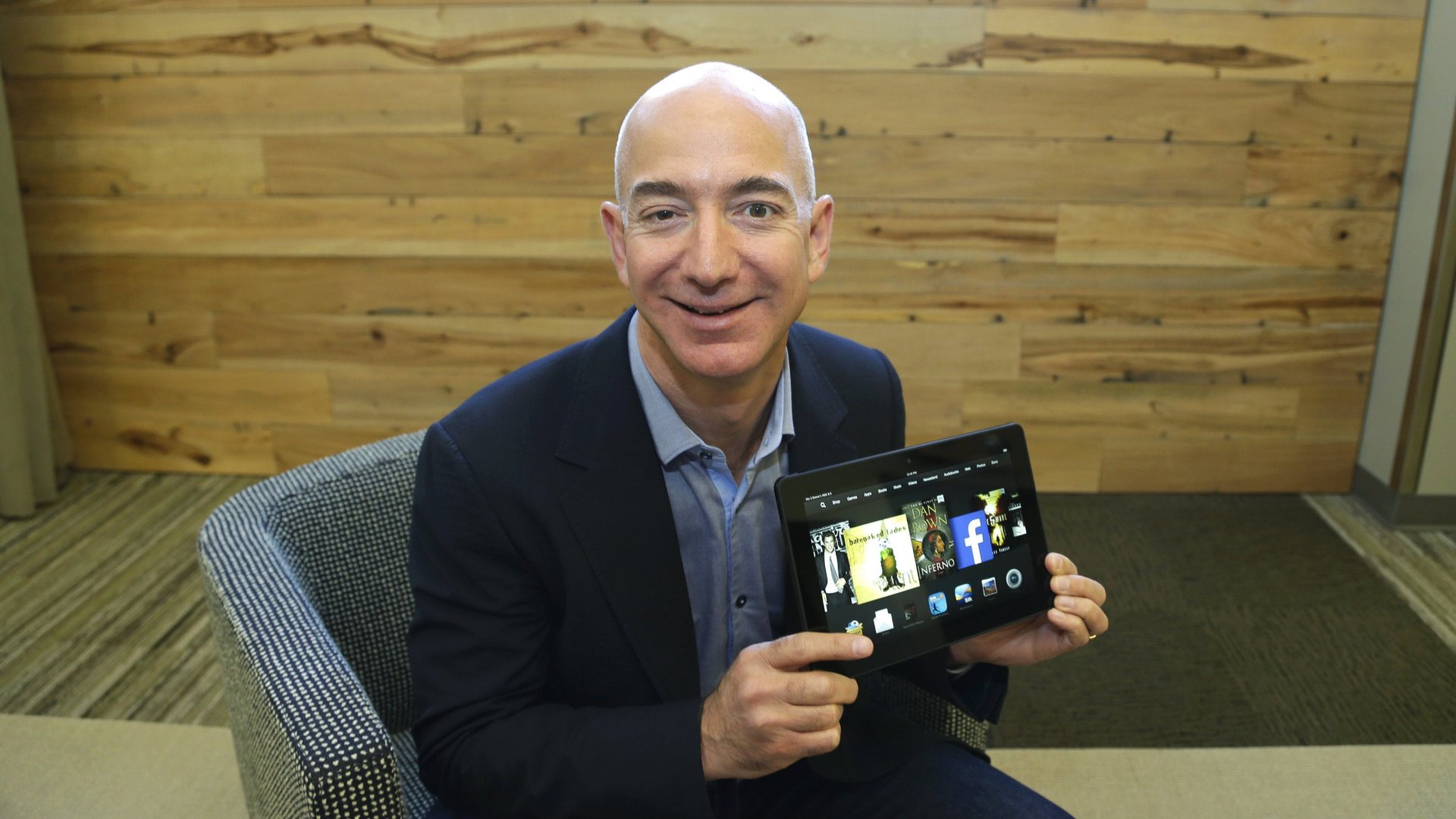
Brad Stone’s The Everything Store tells the story of Jeff Bezos and the rise of Amazon. It also illuminates how childhood personality and ambitions would drive his adult accomplishments, giving us a window into what might be our future. The following string of anecdotes connect the life stories of the boy who would become the man: a spatially-talented inventor, an ambitious space explorer with dreams of saving humanity, and a focused and disciplined workaholic who always believed his work was central to his life.

At 16, Albert Einstein wrote his first scientific paper titled “The Investigation of the State of Aether in Magnetic Fields.” This was the result of his famous gedanken experiment in which he visually imagined chasing after a light beam. The insights he gained from this thought experiment led to the development of his theory of special relativity.