From a lottery-access museum in Nintendo's original factory to Donkey Kong Country at Universal's newest U.S. theme park
Credit: Nintendo Museum
Video game franchises have inspired merchandise and licensing deals for decades, but Nintendo has done something more ambitious: it has built a physical world. The company’s most beloved characters now inhabit theme parks, flagship stores, and a museum housed in the factory where Nintendo made its earliest products. These are not pop-up experiences or temporary installations. They are permanent, purpose-built destinations designed around the specific pleasure of encountering Mario, Donkey Kong, and the rest of the Nintendo universe in three dimensions.
The appeal extends well beyond children. Nintendo’s catalog spans generations in the most literal sense: adults who grew up with the original Game Boy now bring their own children to these destinations, and the franchise’s staying power means that the cultural references land across age groups in a way that more recent entertainment properties cannot match. A parent who spent childhood hours on Super Mario Bros. and a teenager who plays Nintendo Switch today share enough common ground that a Nintendo destination works as a family experience in both directions simultaneously.
The destinations below appear in Travel + Leisure, ranging from a museum accessible only by lottery to theme park lands that rank among the most technically ambitious attractions built in recent years. The selection covers Japan and the United States, reflecting where Nintendo has concentrated its physical presence. Each destination offers something distinct: the museum tells the company’s history, the stores carry exclusive merchandise unavailable elsewhere, and the theme park worlds put visitors inside the games themselves.
Credit: Nintendo Museum
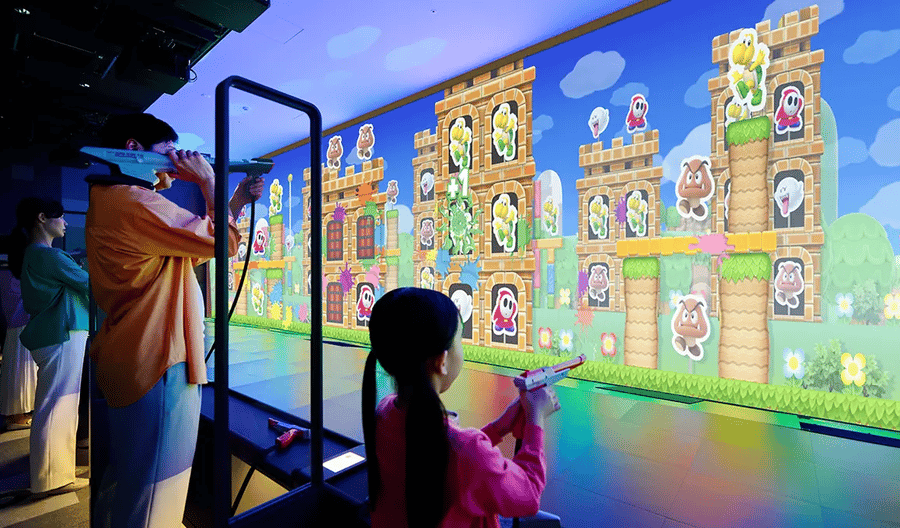
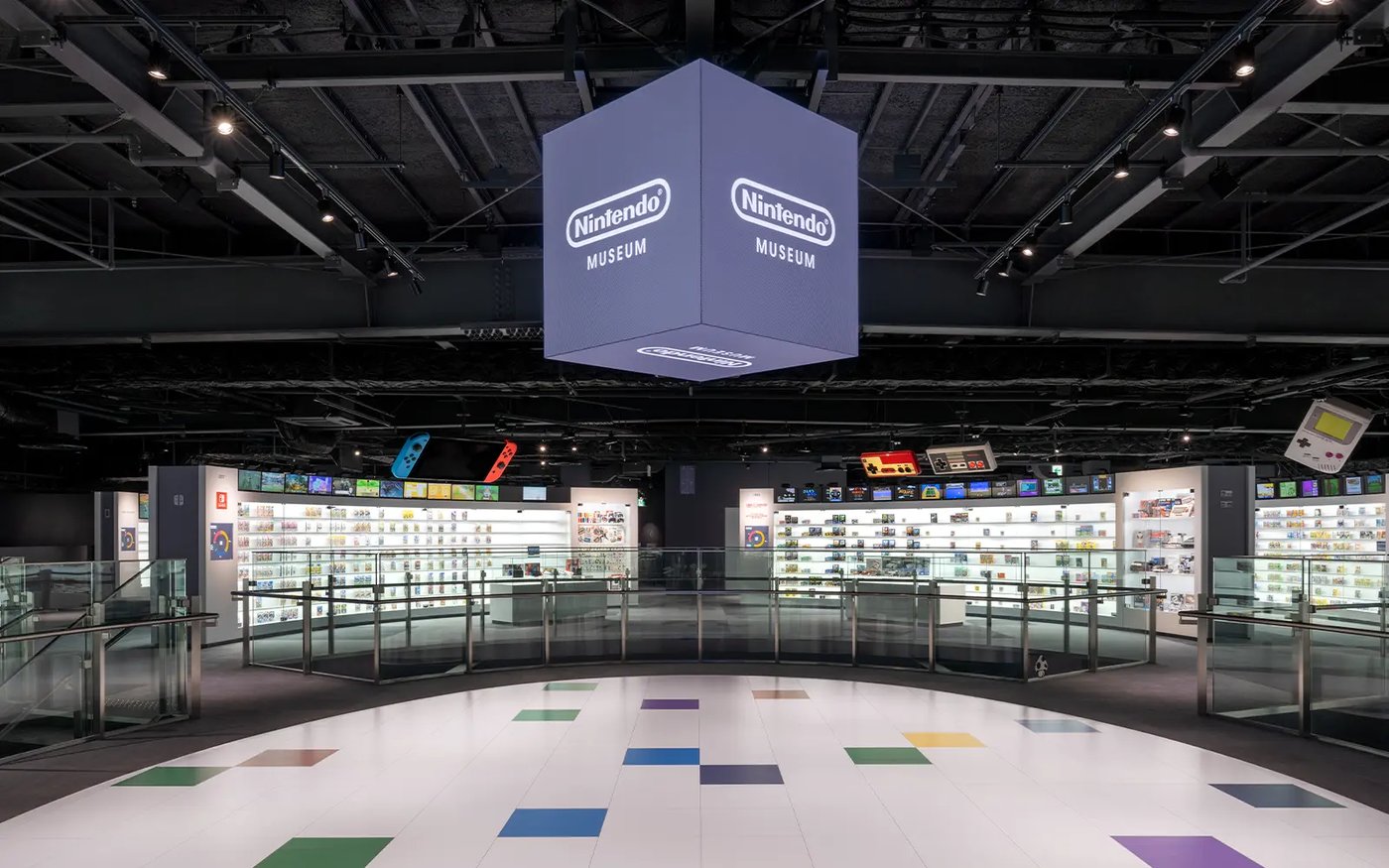
The Nintendo Museum opened in October 2024 inside the company’s former Uji Ogura Plant, a facility located roughly 13 miles south of Kyoto City that Nintendo used before the company shifted its manufacturing operations. The building’s history predates the video game era entirely: Nintendo was founded in 1889 as a maker of hanafuda, traditional Japanese flower playing cards, and the museum traces that origin before moving through the decades of game hardware and software that brought the company to its current global position. Three buildings contain the exhibits, giving the museum a physical scope that matches the breadth of the history it covers.
The Craft & Play exhibit lets visitors make their own hanafuda cards, connecting the contemporary audience to the product that Nintendo produced for its first several decades of existence. The gesture is specific enough to feel meaningful rather than decorative: making the cards by hand gives the company’s origin story a tactile reality that display cases alone cannot provide. The Discover $DFS area, which displays every Nintendo release across the company’s history, functions as the centerpiece for visitors whose connection to Nintendo begins with the video game era rather than the playing card period.
Demand for tickets has made access the primary challenge the museum presents. The lottery system for purchasing tickets reflects visitor interest at a level the physical space cannot accommodate through open sales, and the process requires advance planning that international visitors need to factor into trip timelines. The museum is currently accepting entries for July 2026 tickets, and its official website provides the most current information on the lottery schedule. The difficulty of obtaining tickets has not diminished the museum’s reputation as the definitive Nintendo destination for serious fans, and the Uji location, accessible from Kyoto, fits naturally into a Japan itinerary built around the Kyoto-Osaka corridor.
The factory setting gives the museum a specificity that a purpose-built institution would lack. Visiting the building where Nintendo actually made things, now converted into a space that explains what those things were and how they led to what followed, provides a connection between the company’s physical history and its cultural legacy that no other Nintendo destination offers.
Credit: Nintendo
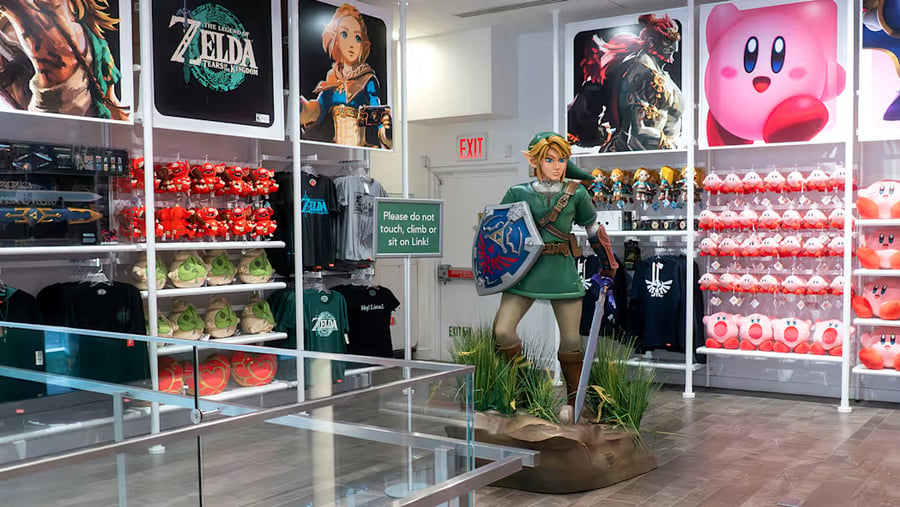
Nintendo New York occupies 10,000 square feet across two floors in Rockefeller Center, a location that places one of gaming’s most recognized brands in the middle of one of Manhattan’s most visited commercial districts. The store opened originally as the Pokémon Center New York in 2001 before evolving into its current form, giving it a history within New York’s retail landscape that the more recently opened U.S. locations do not yet have. The two-floor layout gives the store enough space to stock hundreds of themed products alongside dedicated areas for game demonstrations and staff interaction.
The exclusive merchandise available at Nintendo New York represents the primary draw for collectors and serious fans. Products sold here and not through standard retail channels give the store a reason to visit beyond convenience, and the rotating collections tied to game releases, anniversaries, and seasonal events mean that the inventory changes often enough to reward repeat visits. The store’s staff, described on the Nintendo website as enthusiastic fans rather than standard retail employees, bring product knowledge and game history context to the floor in a way that distinguishes the experience from ordinary merchandise shopping.
Game demonstrations using current Nintendo Switch titles give visitors direct access to hardware and software in a context where trying before buying is the explicit purpose rather than an afterthought. The ambassadors who staff these demo areas assist with gameplay and explain the history of the displays, connecting contemporary releases to the broader Nintendo catalog in conversations that reward visitors who arrive with questions.
Official events at the store, including the recent Mario Day programming, extend Nintendo New York’s function beyond retail into a community gathering. These events bring fans together around shared enthusiasm in a physical space, which the digital distribution model that now dominates game sales cannot replicate. The Rockefeller Center location gives these events a Manhattan address accessible to the city’s resident population as well as the tourist visitors who make up a significant portion of the store’s daily traffic.
Credit: Nintendo
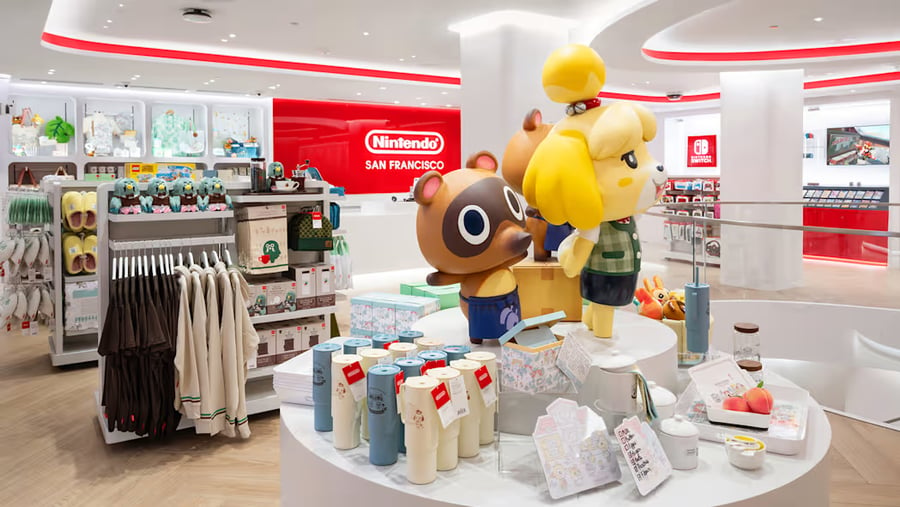
Nintendo San Francisco opened in Union Square $SQ in May 2025, establishing the brand’s second official U.S. store location and giving West Coast fans a domestic destination that previously required a trip to New York or Japan to access. Mario cut the ribbon at the opening, a detail that reflects how Nintendo handles the boundary between brand character and institutional representative. The Powell Street location in Union Square places the store within one of San Francisco’s primary retail and tourist districts, accessible to the city’s resident population and to visitors whose San Francisco itinerary already includes the surrounding area.
The store carries exclusive branded merchandise alongside products featuring characters from across Nintendo’s catalog, including Legend of Zelda, Splatoon, Animal Crossing, and Pokémon. The breadth of franchise representation gives the store appeal beyond Mario fans specifically, and the exclusive items available only at official Nintendo locations provide the collecting dimension that drives repeat visits and dedicated travel for fans who want products unavailable through standard retail channels.
Nintendo Switch game demonstrations follow the same model established at the New York location, giving visitors hands-on access to current titles in a staff-supported environment. Photo opportunities throughout the store add a social media dimension that Nintendo’s visual brand supports particularly well: the character designs and color palette of Nintendo’s major franchises photograph distinctively enough that images taken inside the store carry an immediate brand recognition.
The San Francisco location’s May 2025 opening makes it the newest of Nintendo’s official U.S. stores, and the inventory and event programming will continue to develop as the store establishes its relationship with the local fan community. Visitors who have experience with the New York store will find the format familiar; those arriving at a Nintendo store for the first time will find Union Square an accessible introduction to what the brand’s physical retail presence offers.
Credit: Nintendo
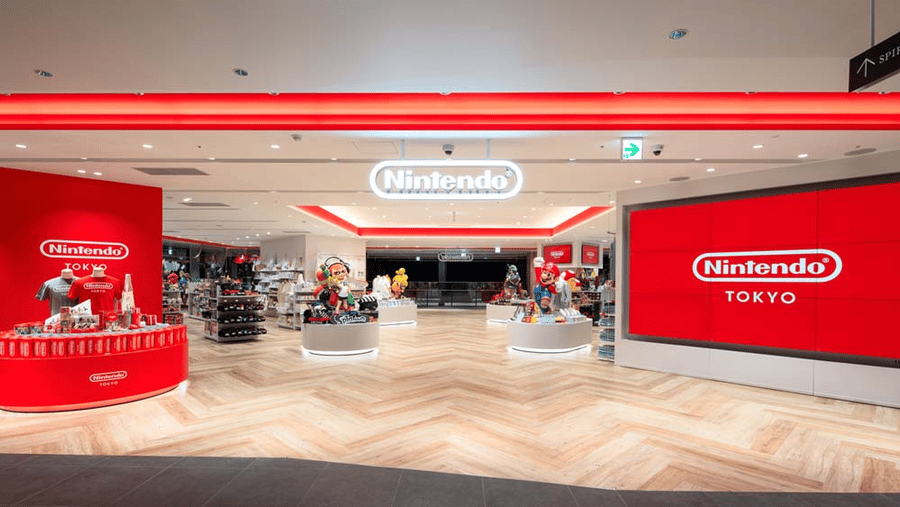
Nintendo’s official retail presence in Japan began later than its international reputation might suggest. The first Japanese store opened in Tokyo in 2019, inside the Shibuya Parco shopping complex, more than a century after the company’s founding. The Tokyo location covers 3,000 square feet on the sixth floor, a footprint that proved successful enough to drive a string of subsequent openings in other Japanese cities.
Osaka followed in 2022 with a nearly 8,600-square-foot location on the 13th floor of the Daimaru Umeda Department Store, more than doubling the Tokyo store’s floor area. Kyoto opened in 2023 on the rooftop of the Takashimaya Kyoto shopping center, adding a location in the city closest to Nintendo’s historical roots and the Nintendo Museum in nearby Uji. The most recent opening, in November 2025, placed the largest Japanese store yet in Fukuoka’s JR Hakata City Amu Plaza, with more than 10,700 square feet on the eighth floor of the shopping complex.
The scale progression across these openings reflects the commercial success of the format and Nintendo’s expanding confidence in its retail concept. Each new location has been larger than the one before it, and the department store and shopping complex settings place the stores within established retail environments that deliver foot traffic beyond dedicated fans. A visitor to any of these cities who makes time for the Nintendo store finds exclusive Japanese merchandise unavailable at the U.S. locations, alongside the game demonstration and photo opportunity infrastructure that defines the brand’s retail experience globally.
For fans traveling to Japan specifically to visit Nintendo-related destinations, the combination of the museum in Uji and the Kyoto store creates a natural pairing within the same geographic area, while the Tokyo, Osaka, and Fukuoka locations fit into city itineraries built around other priorities.
Credit: Universal Studios Japan
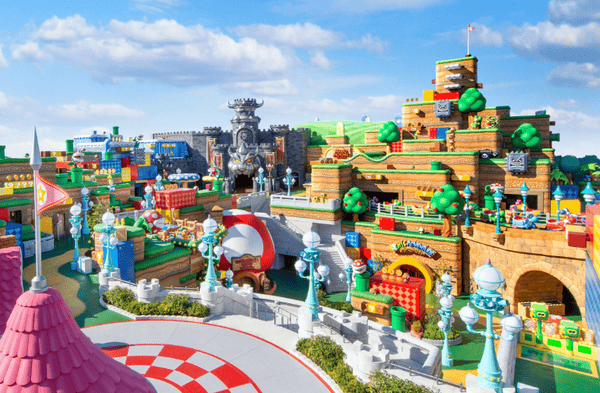
Super Nintendo World at Universal Studios Japan in Osaka debuted in 2021 as the first full realization of Nintendo’s theme park concept, establishing the visual language, ride attractions, and interactive systems that the subsequent Hollywood and Orlando locations built on. The land entered its fifth anniversary celebration on March 18, 2026, with exclusive meet-ups, decorations, merchandise, and food running through January 11, 2027, giving visitors who plan trips around this window access to programming beyond the standard offering.
The current anniversary storyline centers on Mario, Luigi, Princess Peach, Toad, and Yoshi baking a cake together, with Super Stars generating the visual spectacle that Nintendo describes as sending excitement to a new level. The narrative framework gives the seasonal programming a coherence that themed merchandise and food alone would lack, connecting the limited-time additions to the land’s broader character relationships rather than treating them as standalone promotions.
The Power-Up Band wristband system, which allows visitors to collect coins and compete in interactive challenges throughout the land, gives Super Nintendo World a participatory dimension that passive ride-and-look theme park experiences do not replicate. Guests interact with elements embedded in the environment, accumulating points and unlocking achievements in a system that borrows the logic of the video games the land represents. The layered experience this creates rewards extended visits and repeat attendance in ways that a single attraction cannot.
As the original location, Universal Studios Japan’s Super Nintendo World carries a first-mover quality that the subsequent installations share the concept but not the history. For fans who want to experience the land where the format was developed, Osaka provides that specific connection alongside the broader Universal Studios Japan context.
Credit: Nintendo
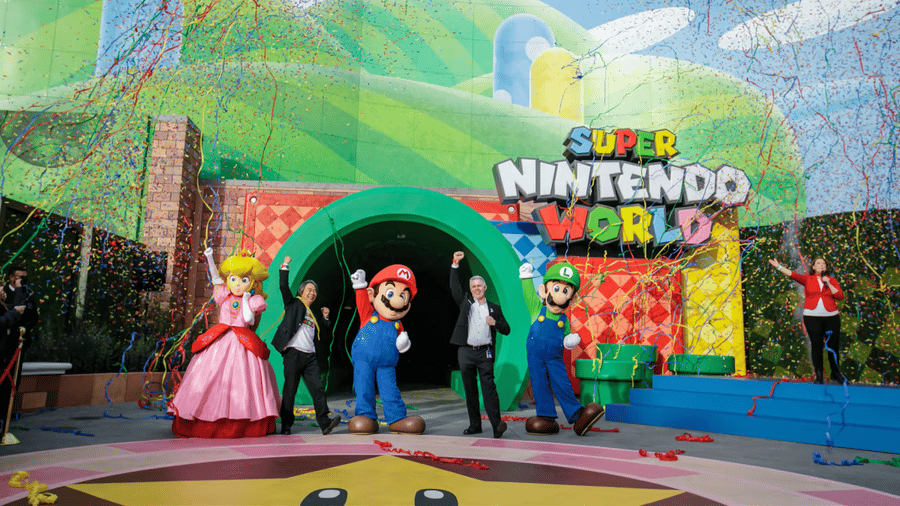
Super Nintendo World at Universal Studios Hollywood opened in 2023 on the park’s Lower Lot, occupying the most compact footprint of the three Super Nintendo World locations. The smaller scale has not prevented the land from delivering its signature attraction: Mario Kart: Bowser’s Challenge uses augmented reality and physical set design to put riders inside the racing game in a way that the attraction’s popularity across all three locations consistently validates.
The Toadstool Cafe operates within the Hollywood location, extending the Nintendo theming into the dining experience with a menu and environment designed around the franchise’s visual identity. Food and beverage at themed areas of this kind varies widely in quality across the theme park industry, and the cafe’s presence gives visitors a full-service dining option within the land rather than requiring a departure to the broader park for a meal.
Limited-time activations tied to the release of “The Super Mario Galaxy Movie” run through April 13 at the Hollywood location, including meet-and-greets, photo opportunities, and themed merchandise and food. Galaxy popcorn and Rosalina cupcakes represent the food side of this programming, connecting the film’s characters and visual style to the physical experience of visiting the land. The Upper Lot’s Power Up Cafe, which opened in 2024, extends Nintendo’s presence beyond the Lower Lot land to a second location within the park.
For visitors based in Southern California or traveling to Los Angeles, Universal Studios Hollywood provides the most geographically accessible Super Nintendo World experience in the United States, and the compact scale of the land makes it manageable within a single park day that includes other Universal attractions.
Credit: Universal Orlando
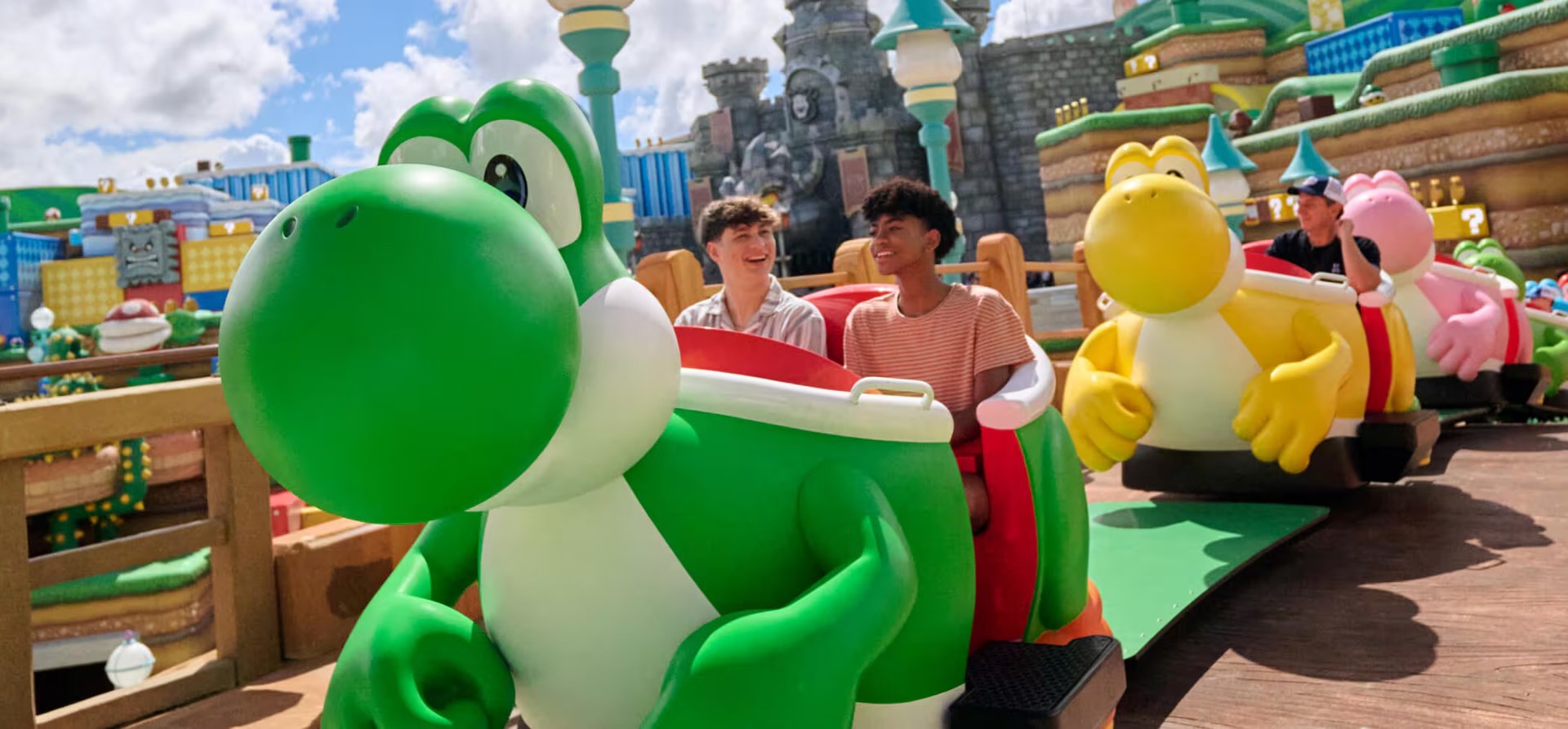
Universal Epic Universe opened in Orlando in May 2025 as the first major new U.S. theme park in roughly two decades, and its Super Nintendo World represents the largest and most developed version of the concept built to date. The land is divided into two distinct sections: Super Mario Land, which contains Mario Kart: Bowser’s Challenge and Yoshi’s Adventure, and Donkey Kong Country, which adds Mine-Cart Madness as a third major attraction. The two-section structure gives the Orlando installation a geographic scope and attraction density that the Hollywood and Japan locations do not match.
Donkey Kong Country constitutes the most significant addition to the Super Nintendo World formula at Epic Universe. The section introduces a major Nintendo franchise that the earlier installations did not incorporate at this scale, expanding the land’s character roster and giving visitors who have experienced the Japan or Hollywood versions a genuinely new territory to explore. Mine-Cart Madness delivers the Donkey Kong Country game experience in physical form, using the ride format to translate the franchise’s kinetic platforming energy into a theme park attraction.
Character encounters and dining options operate across both sections, and the Power-Up Band system that enables interactive challenges throughout the land functions at Epic Universe as it does at the other locations. The Florida climate creates outdoor conditions that differ from the enclosed or partially covered environments of the Japan and Hollywood installations, and the scale of the Epic Universe park surrounding Super Nintendo World gives visitors a full-day destination that the Hollywood location, set within an existing park, does not replicate.
Limited-time film activations running through April 13, 2026, mirror the programming at the Hollywood location, giving both U.S. Super Nintendo Worlds a synchronized promotional moment tied to the theatrical release. For visitors planning a Florida trip around Nintendo specifically, the Epic Universe opening has created a destination argument for Orlando that did not exist before May 2025.
