
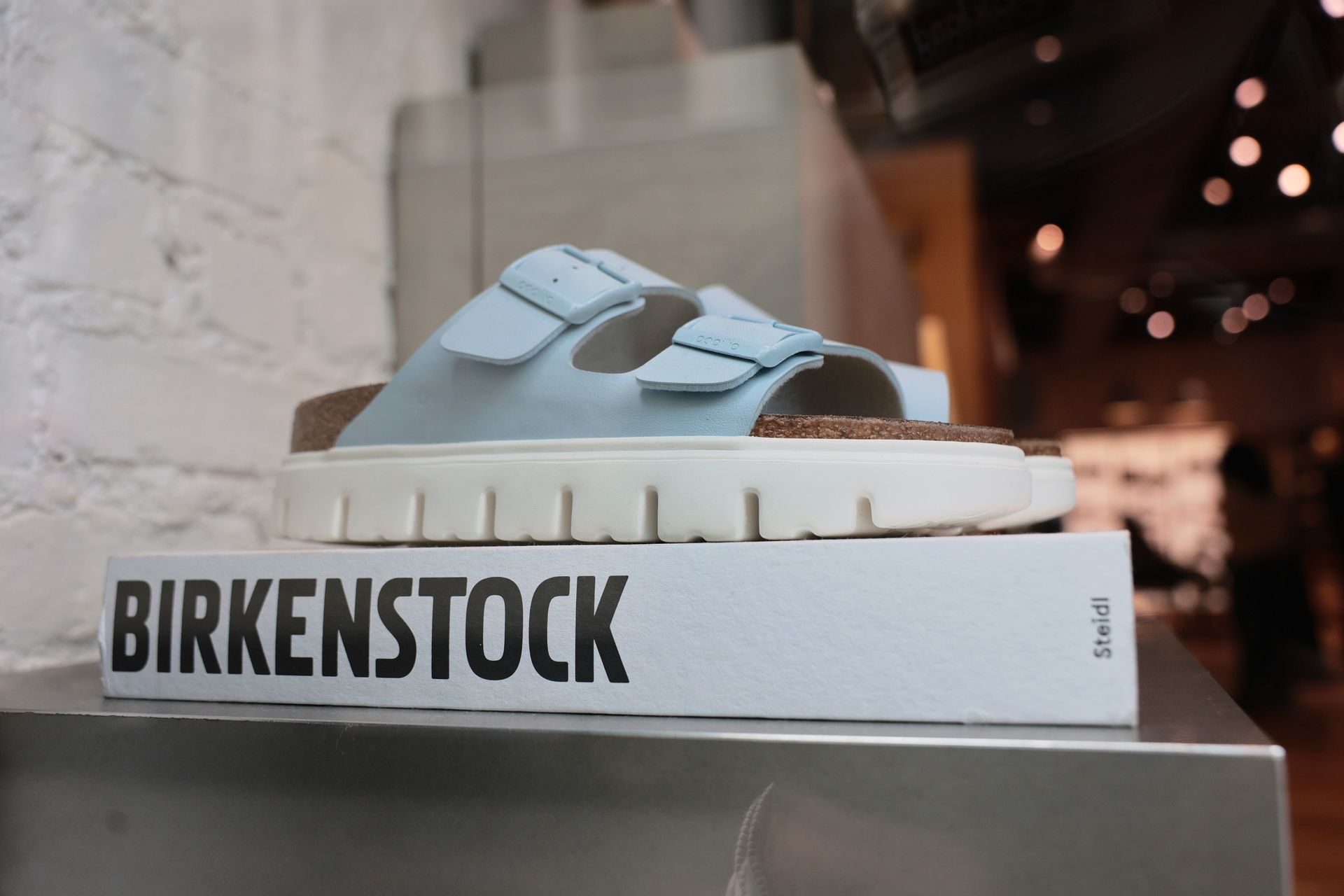
Birkenstock stock fell after the German sandal maker reported fiscal second-quarter results showing a sharp drop in net profit and margin pressure from U.S. tariffs and the ongoing conflict in the Middle East.
Earnings for the three months through March 31 dropped 22% on a year-over-year basis, landing at €82 million, equivalent to €0.45 per diluted share, compared with €105 million, or €0.56 per share, in the prior-year quarter, the company said. Revenue rose 8% to €618 million on a reported basis, and 14% in constant currency, within the company's guidance range of 13% to 15%.
Revenue came in just below analyst expectations of €620.3 million, according to WWD.
Three factors weighed on gross profit margin, which contracted 380 basis points to 53.9% in the quarter: currency translation headwinds, which the company attributed to 230 basis points of pressure; U.S. tariff costs, responsible for 90 basis points; and channel mix, which subtracted a further 30 basis points, the company said. Costs related to folding Birkenstock Australia Pty. Ltd. into the business following its October 2025 purchase contributed a separate 70 basis points of margin pressure, the company said.
The Middle East conflict weighed on the company's EMEA segment, reducing regional revenue by about €6 million and creating an estimated 300 basis point headwind to EMEA growth, the company said. About half of that impact came from disrupted deliveries to the region, with the remainder attributed to softened consumer sentiment in Europe tied to higher energy costs and inflation.
Birkenstock stock was down 6.3% in pre-market trading at one point, according to WWD.
All three of Birkenstock's geographic segments posted double-digit constant currency revenue growth. The Americas grew 14% in constant currency, EMEA grew 11%, and Asia-Pacific grew 30%. Five additional company-owned stores debuted during the period, lifting the total owned-retail footprint to 111 locations.
Adjusted EBITDA margin fell 270 basis points to 32.1%, with currency translation responsible for 240 basis points and U.S. tariffs for 90 basis points of the decline, the company said. Adjusted earnings per share came in at €0.50, down 9% year-over-year.
Despite these challenges, Birkenstock kept its full-year 2026 outlook. The company expects constant currency revenue growth of 13% to 15%, an adjusted gross profit margin of 57.0% to 57.5%, and an adjusted EBITDA margin of 30.0% to 30.5%. The adjusted EPS forecast of €1.90 to €2.05 includes the effects of tariffs and foreign exchange, the company said.
CEO Oliver Reichert said in a statement that the company's performance reflected resilience in a difficult environment. "Despite the ongoing instability in the Middle East, persistent inflationary pressures, U.S. tariff policy evolving unfavorably for us and continued F/X $TWTR headwinds, we delivered constant currency revenue growth of over 14%," Reichert said.
Birkenstock's stock has come under broader pressure in recent months, according to Reuters. Shares hit an all-time low of $32.44 in a post-earnings selloff exceeding 14%, a decline that cut the company's market capitalization to roughly 38% less than the $9.3 billion valuation established at its 2023 IPO. Tariffs on goods entering the U.S. — Birkenstock's biggest single market — rose to 20%, double the prior rate, squeezing margins in the quarter, Reuters added.