
25 books that defined the 20th century
From Orwell's totalitarian nightmares to Achebe's postcolonial reckoning, these 25 books didn't just reflect the last century — they changed what came after

miljko / Getty Images
The 20th century produced more books than any previous era in recorded history. Mass literacy, the rise of the paperback, and the global expansion of publishing meant that by the middle of the century, a novel written in Buenos Aires or Lagos could reach readers in London and New York within months. Most of those books faded. A small number did not.
What separates a definitive book from a merely popular one is a particular kind of staying power. These are the works that changed how people thought about race, power, gender, and what it means to be a self in a modern world. They invented literary forms that writers are still working within. They named conditions — political, psychological, social — that had no name before. Some were burned. Some were banned. Governments and institutions fought over them, which is its own measure of consequence.
The 25 books on this list were chosen for cultural weight, not literary quality alone. Some have aged imperfectly. A few are genuinely uncomfortable to read. One was written in hiding by a teenage girl. One was published in Paris because no American publisher would touch it. Several of their authors died before they could see the full impact of what they had written. But each one altered something — a conversation, a movement, a way of seeing the world — in ways that remain traceable today.
The list spans continents and languages. English-language literature is well represented, but Camus wrote in French, García Márquez in Spanish, Kafka in German, de Beauvoir in French, Proust in French. The century's most consequential books were not produced only in New York and London, even if those cities controlled much of their distribution and reception.
This is not a ranking of the "best" novels by any purely aesthetic measure. Ulysses is here because of what it did to the novel form. The Diary of a Young Girl is here because of what it did to human testimony. Silent Spring is here because it helped create an entire political movement. Literary excellence matters, but it is only part of the argument these books make.
Taken together, these 25 books are a record of what the 20th century was actually arguing about.
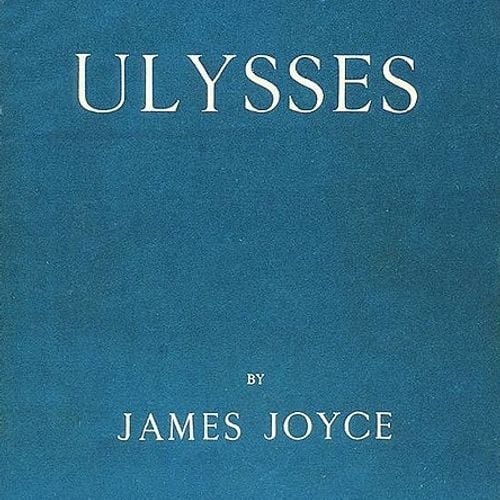
Ulysses — James Joyce (1922)
Credit: James Joyce, Wikipedia
Published on February 2, 1922, by Sylvia Beach's Shakespeare and Company bookshop in Paris, Ulysses arrived in the world less like a novel and more like a detonation. James Joyce had been working on it for seven years, and the book bore the marks of that obsession in every sentence. Its publication by a small Parisian bookshop rather than a mainstream house was not incidental — no conventional publisher could figure out what to do with it, and in several countries it was immediately deemed obscene.
The novel follows three characters — Leopold Bloom, his wife Molly, and the young Stephen Dedalus — across a single day in Dublin: June 16, 1904. That date, chosen because it was the day Joyce first walked out with Nora Barnacle, the woman who would become his wife, is now celebrated annually as Bloomsday by readers in Dublin and around the world. The choice of a single day as the canvas for an 800-page novel was itself a statement about what literature could do with time and interiority.
What Joyce pioneered, and what made Ulysses so disorienting to its first readers, was the sustained use of stream-of-consciousness narration — a technique that attempts to render the full, unedited flow of a character's thoughts, including digressions, half-formed ideas, and sensory impressions. Each of the novel's 18 episodes is written in a distinct style, ranging from a parody of newspaper journalism to a courtroom drama to the famous unpunctuated soliloquy that ends the book, in which Molly Bloom's thoughts unspool across dozens of pages before closing with "yes I said yes I will Yes."
The novel was banned in the U.S. until 1933, when Judge John M. Woolsey ruled in federal court that it was not obscene — a decision that opened American publishing to a broader range of literary expression. In the U.K., copies were seized and burned.
Joyce spent the years after Ulysses writing Finnegans Wake, an even more radical experiment that took 17 years to complete. But it was Ulysses that most permanently reset the terms of what a novel could attempt. Writers as different as William Faulkner, Virginia Woolf, and Saul Bellow absorbed its lessons about interiority and fragmentation. The stream-of-consciousness technique became one of the defining tools of 20th-century fiction — not because Joyce invented it, but because he pushed it further than anyone before or since. Almost every novel written after 1922 that takes seriously the question of how consciousness actually works owes something to what Joyce did in this book.
In search of lost time — Marcel Proust (1913–1927)
Credit: christies.com, Wikipedia
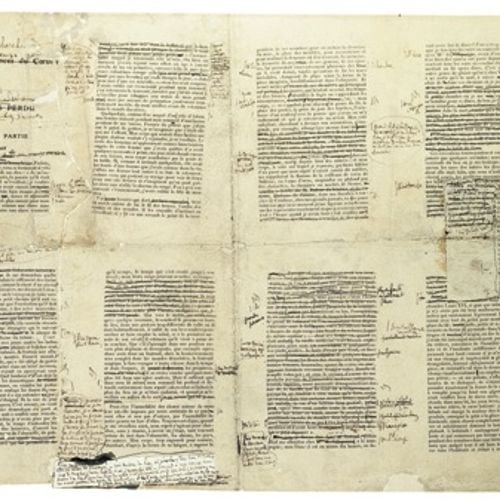
Marcel Proust's seven-volume novel, published in French as À la recherche du temps perdu between 1913 and 1927, is one of the longest works of fiction ever written — over 1.5 million words across volumes that appeared across 14 years, the last three of them posthumously. Proust died in 1922, having revised and expanded the later volumes almost to the end of his life, working from a cork-lined bedroom in Paris that became his entire world in his final years.
The novel is narrated by Marcel, a writer looking back on his life from early childhood through to middle age in French high society, tracking the complex social world of the Belle Époque and its dissolution in the wake of the First World War. But its reputation does not rest on plot, which is minimal. It rests on what Proust does with time — specifically with memory, and the way the past is not merely recalled but suddenly relived in physical, sensory detail.
The most famous passage in the novel — perhaps the most famous passage in 20th-century literature — occurs early in Swann's Way, the first volume, when the narrator dips a madeleine biscuit into a cup of tea. The taste triggers a sudden, involuntary rush of memory so complete that it reconstitutes an entire world: the town of Combray, his aunt's house, the people and smells and textures of his childhood. Proust called this phenomenon mémoire involontaire — involuntary memory — and distinguished it sharply from the deliberate, lifeless kind of recollection we produce when we simply try to remember something.
This idea — that the past is not gone but latent, waiting to be recovered through the senses — became one of the central intellectual contributions of the novel. It influenced psychology, philosophy, and the theory of how trauma and nostalgia function. It also gave subsequent writers a framework for understanding why certain images and sensations carry such disproportionate emotional weight.
The novel's other great subject is social performance — the gap between who people present themselves as and what they actually feel, especially around love, jealousy, and status. The extended portrait of Charles Swann's agonizing jealousy over Odette, a woman he knows is not worth it, remains one of the most precise analyses of romantic obsession in any language. The Search is a book that takes the intelligence of its reader seriously, and rewards patience with observations that feel less like fiction than like a theory of how human experience actually works.
The trial — Franz Kafka (1925)
Credit: Wikimedia Commons, Wikipedia
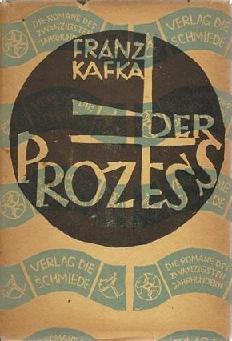
Franz Kafka never published The Trial. He wrote it in 1914 and 1915, set it aside unfinished, and died of tuberculosis in 1924 at the age of 40, having instructed his friend Max Brod to burn all his manuscripts. Brod did not. He published The Trial in 1925, the year after Kafka's death, and with that act of disobedience made possible one of the most consequential literary legacies of the century.
The novel follows Josef K., a bank employee who is arrested one morning without being told what he has done. He is not imprisoned — he goes to work, sees his neighbors, moves through the city — but he is under a kind of juridical shadow that steadily consumes him. He cannot find out what he is charged with. He cannot locate the court that has jurisdiction over him. He encounters lawyers, officials, and petitioners who are all trapped in the same system, all pretending to understand it better than they do. The case proceeds without him and ends, in the novel's final chapter, with his execution.
What Kafka captured in this structure was something that would become one of the defining experiences of the century: the individual crushed by an administrative machinery that offers no explanation, no appeal, and no coherent logic. He wrote it before Stalin's show trials, before the Gestapo, before McCarthyism, before the surveillance states of the Cold War. Yet the novel reads as a precise description of all of them. The word "Kafkaesque" — meaning a situation that is at once bureaucratic, nightmarish, and absurd — entered common usage in English and several other languages, the rare case of a writer's name becoming an adjective that captures something essential about modern life.
Kafka's other major works — The Metamorphosis, The Castle, Amerika — are also central to the 20th-century literary canon. But The Trial is the one that most directly confronted the architecture of power and the individual's helplessness within it. In a century defined by totalitarianism, that confrontation was not merely literary. It was diagnostic. Writers from Orwell to Camus to Borges acknowledged Kafka's influence, and scholars of political theory read The Trial alongside Hannah Arendt. It remains the most useful novel for understanding what happens when law and justice become entirely separate things.
The great Gatsby — F. Scott Fitzgerald (1925)
Credit: User:Flask, Wikipedia
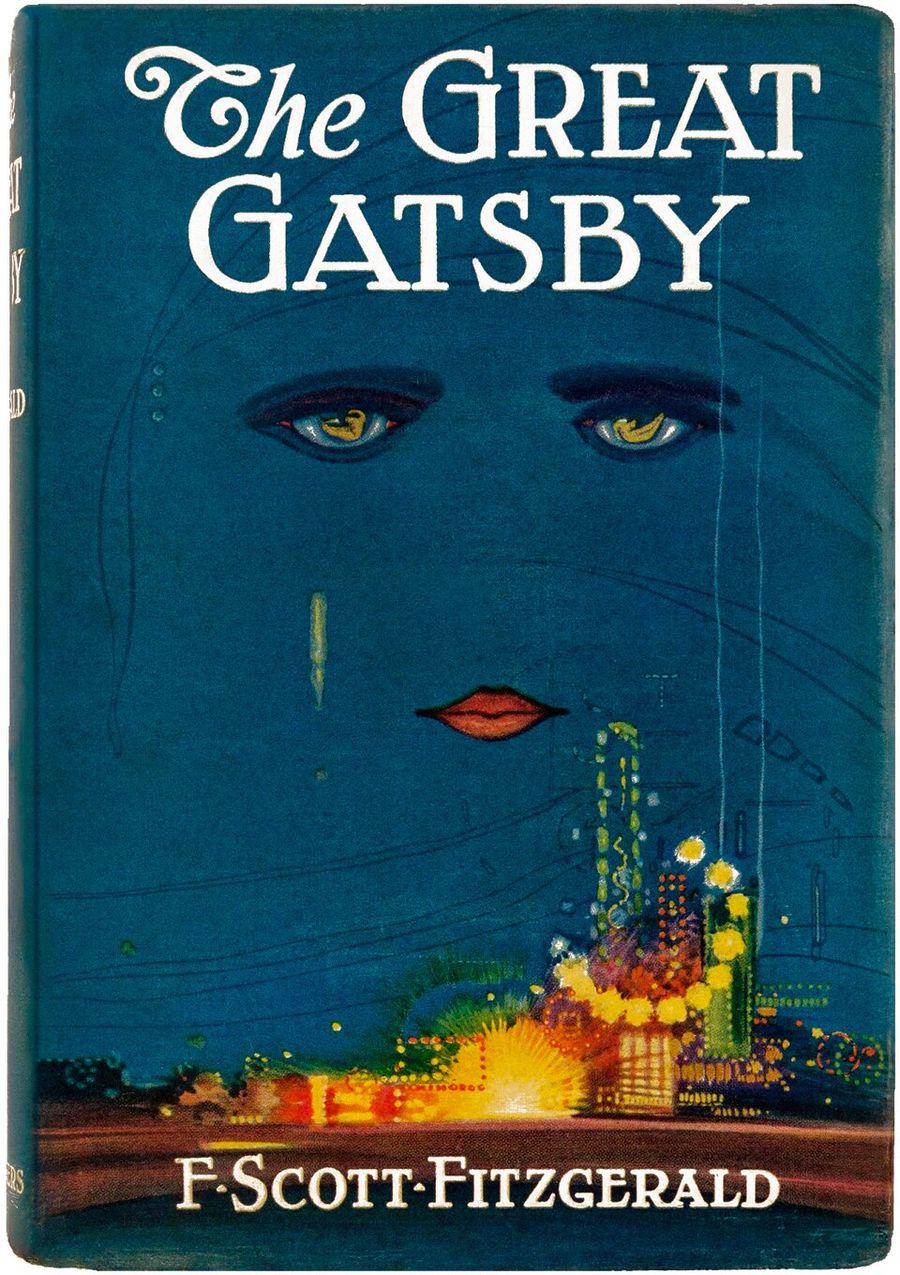
The Great Gatsby sold about 20,000 copies in its first year after publication in April 1925 — a commercial disappointment by Fitzgerald's standards. He had hoped it would cement his reputation, and instead it nearly ruined him. He died in 1940, convinced the book had failed. He did not live to see what happened next.
During World War II, the Council on Books in Wartime produced a series of Armed Services Editions — cheap, pocket-sized reprints distributed to soldiers. The Great Gatsby was one of the titles chosen. Hundreds of thousands of copies circulated among U.S. troops, and when those soldiers came home, the book came with them. By the 1950s it was being taught in schools across the country, and it has not left American classrooms since.
The novel is narrated by Nick Carraway, a Yale graduate from the Midwest who rents a small house on Long Island in the summer of 1922, next door to the mansion of Jay Gatsby — a fabulously wealthy man of unclear origins who throws enormous parties but seems to know nobody at them. Nick gradually discovers that Gatsby, born James Gatz in North Dakota, has reinvented himself entirely in pursuit of a single goal: to recapture the past, specifically his relationship with Daisy Buchanan, Nick's cousin, whom Gatsby loved before the war.
The novel is often read as a critique of the American Dream — the idea that self-invention and wealth can deliver happiness — and it is that. But it is also a novel about class, which the American Dream insists does not exist. Tom Buchanan, Daisy's husband, is careless in a way that only old money allows. Gatsby, for all his wealth, cannot cross the invisible line between new money and the established aristocracy of East Egg. He can acquire every material signal of belonging, but he cannot acquire the thing itself.
Fitzgerald captured this distinction with precise, economic prose that has been studied and imitated for a century. The green light at the end of Daisy's dock — Gatsby reaching toward it in the dark — has become one of the most cited images in American literature. The novel's final lines, about being boats against the current, borne back ceaselessly into the past, are quoted wherever the contradiction between American ambition and American reality is discussed. Few books have said so much about a country in so little space.
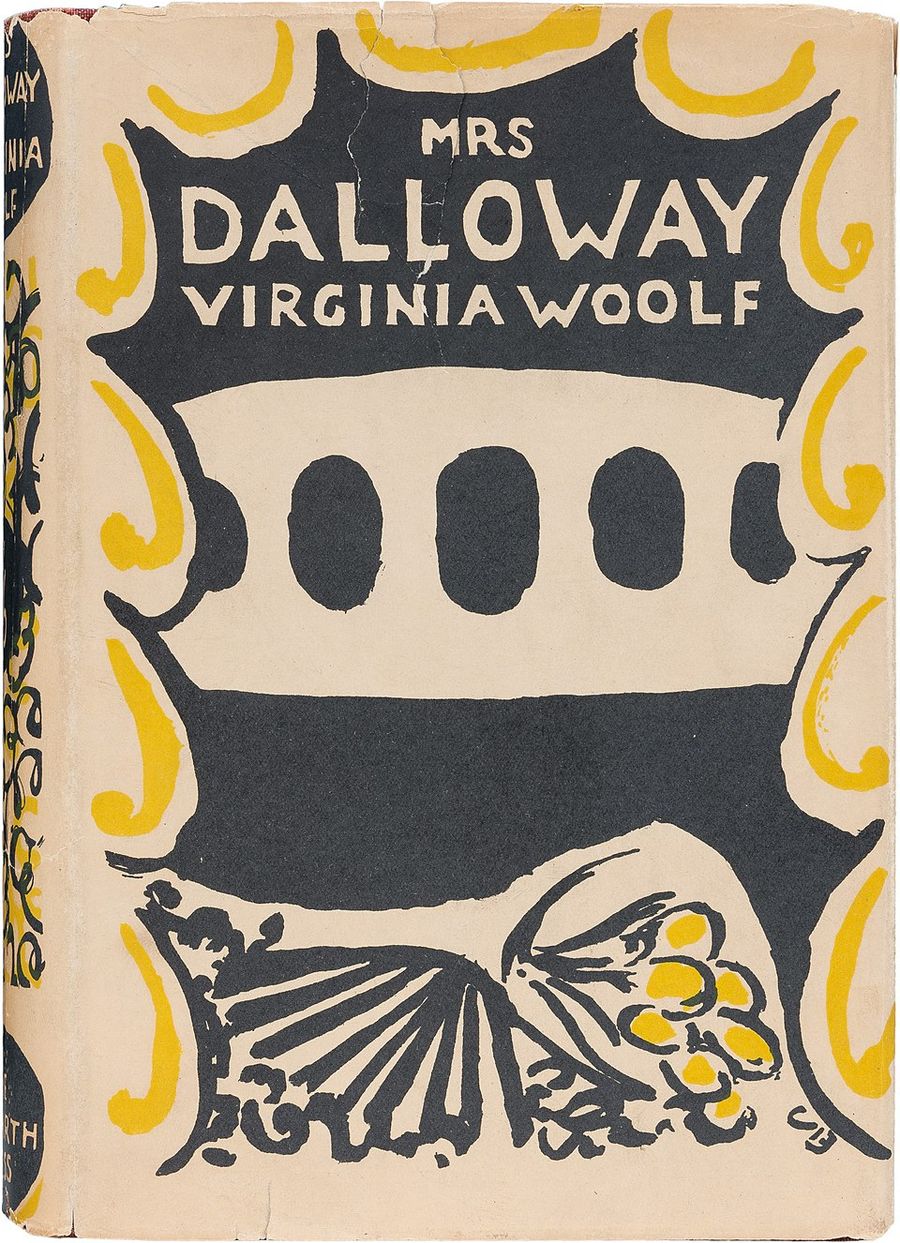
Mrs Dalloway — Virginia Woolf (1925)
Credit: Wikipedia
Virginia Woolf published Mrs Dalloway on May 14, 1925, through the Hogarth Press, which she and her husband Leonard ran from their home. It is a novel of compressed intensity: everything happens on a single day in London, sometime in June 1923, and almost nothing happens externally. Clarissa Dalloway, a politician's wife, prepares for a party she is hosting that evening. She goes for a walk, buys flowers, sees old friends, thinks about the past. This is the surface.
Beneath it, the novel does something formally audacious. Woolf moves between the interior lives of multiple characters without warning, using stream of consciousness to track not just thought but the texture of consciousness — the involuntary associations, sensory distractions, and emotional undertows that constitute a mind in motion. The transition between characters is sometimes marked only by a shift in the rhythm of the prose.
The structural counterpart to Clarissa's comfortable preparations is Septimus Warren Smith, a First World War veteran suffering from what the novel calls shell shock and what we would now recognize as severe post-traumatic stress disorder. Septimus and Clarissa never meet. They exist in parallel, and the novel suggests that the two characters are versions of each other — one insulated by class and social function, the other destroyed by the same war whose effects she has been protected from acknowledging.
Woolf was explicit that she wanted to examine mental illness from the inside rather than as a spectacle observed by healthy characters. Her portrayal of Septimus drew on her own experience with what she called her "madness" — extended periods of breakdown and depression that would eventually lead to her death. The novel refuses to sentimentalize either character's interiority or to make Septimus's suffering a simple counterpoint to Clarissa's vitality.
The book's influence on subsequent fiction has been enormous. Writers as different as Michael Cunningham, whose 1998 novel The Hours braids the lives of three women across three time periods around Woolf's novel, and Kazuo Ishiguro have cited Woolf's management of consciousness as formative. For feminist literary scholars, Mrs Dalloway was also foundational: it took seriously the interior life of a woman who appears, from the outside, to do nothing of consequence.
The sun also rises — Ernest Hemingway (1926)
-600x872.jpg)
Credit: Cleo Damianakes, Heritage Auctions, Wikipedia
Ernest Hemingway's first novel was published on October 22, 1926, by Scribner's, and it made him famous almost immediately. He was 27. The Sun Also Rises introduced a style of prose that would become one of the most recognized and most imitated voices in American literature: spare, declarative, stripped of adjectives, with meaning carried in the white space between what characters say and what they feel.
The novel follows Jake Barnes, an American journalist living in Paris in the mid-1920s, and a group of expatriate friends whose lives revolve around drinking, travel, and a circling, unresolvable erotic tension. Jake is in love with Lady Brett Ashley, a twice-divorced Englishwoman of compelling vitality. The relationship is impossible — Jake was wounded in the war in a way the novel never explicitly states but clearly implies — and the narrative is organized around this impossibility, which neither character can speak about directly.
The book's epigraph — "You are all a lost generation," attributed to Gertrude Stein, who quoted a garage owner using the phrase to describe young mechanics who had grown up during the war — gave a name to the generation of Americans who came of age in World War I and emerged from it without the moral and social certainties they had been promised. Hemingway was skeptical of the label even as he used it. The novel's other epigraph, from Ecclesiastes, asserts that the earth abides forever — a counterweight to the theme of drift and disillusion.
The second half of the novel takes place in Pamplona during the festival of San Fermín, including the running of the bulls. Hemingway had attended the festival the previous year, and his reporting of it — the crowds, the corridas, the male rituals of endurance and courage — is dense with observed detail. Pedro Romero, the young bullfighter whom Brett pursues, embodies an unsentimental grace under pressure that Hemingway returned to throughout his career.
The Hemingway style — what critics sometimes call the iceberg theory, the idea that narrative power comes from what is left beneath the surface — shaped American fiction for decades. Writers including Raymond Carver, Joan Didion, and Cormac McCarthy absorbed its lessons about restraint and implication. It also embedded certain assumptions about masculinity and stoicism that later critics examined more critically, but even those examinations are a mark of the novel's enduring presence in the conversation about what American literature is for.
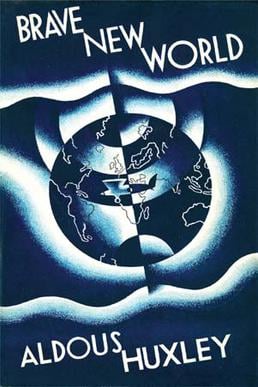
Brave new world — Aldous Huxley (1932)
Credit: betweenthecovers.com, Wikipedia
Aldous Huxley published Brave New World in 1932, and the social order he depicted — a technologically perfected civilization in which human beings are manufactured, conditioned, and kept placid through a pleasure drug called soma — was intended partly as a parody of the utopian fiction being written at the time, particularly the optimistic technocratic futures imagined by H.G. Wells. Where Wells saw technology as liberation, Huxley saw it as a more sophisticated cage.
The novel is set in the year 632 After Ford $F — Henry Ford, inventor of the assembly line, has become the civilization's deity, and the mass-production logic of the automobile factory has been applied to human reproduction. Babies are decanted from bottles rather than born. Psychological conditioning begins before birth. The population is divided into five castes — Alphas, Betas, Gammas, Deltas, and Epsilons — each predestined by chemical treatment to occupy a particular social function and to feel content within it. Nobody suffers. Nobody rebels. Nobody reads Shakespeare.
The plot turns on the arrival of the Savage — John, a young man raised on a reservation outside the World State, who has grown up with Shakespeare, religion, and natural birth, and who reacts to the World State with a mixture of longing and revulsion. His confrontation with Mustapha Mond, one of the World Controllers, produces the novel's most explicit philosophical argument: Mond defends the sacrifice of truth, beauty, and religion in exchange for stability and happiness. John insists on the right to suffer, to be imperfect, to be human in the messy and demanding sense.
What made Huxley's vision so durable was the particular nature of the control he depicted. The totalitarianism of Brave New World is not enforced through fear and violence — it is enforced through pleasure. Citizens are not oppressed; they are gratified. The threat to freedom comes not from a jack-booted authority but from a system so perfectly satisfying that no one wants to be free of it. This distinction would become increasingly relevant in the second half of the century, as consumer culture, pharmaceutical mood management, and mass entertainment raised exactly the questions Huxley had posed.
The novel is frequently paired with Orwell's Nineteen Eighty-Four in discussions of political dystopia. Neil Postman's 1985 media criticism book Amusing Ourselves to Death opened with the argument that it was Huxley, not Orwell, who had correctly predicted the dominant form of social control in democratic societies.
The diary of a young girl — Anne Frank (1947)
_-_front_cover,_first_edition.jpg)
Credit: Anne Frank museum site, Wikipedia
Anne Frank was 13 years old when she received a red-and-white checkered diary as a birthday gift on June 12, 1942. She began writing in it almost immediately. A month later, her family went into hiding.
The Frank family — Anne, her older sister Margot, her parents Otto and Edith, and four others — hid in a concealed apartment behind a bookcase in an Amsterdam warehouse for just over two years, from July 1942 to August 1944. They called it the Secret Annex. They were arrested on August 4, 1944, following an anonymous tip to the Gestapo. Anne and Margot died in Bergen-Belsen concentration camp in February or March of 1945. Otto Frank was the only member of the household who survived.
Before going into hiding, Anne had expressed a wish to be a writer. She rewrote her diaries with publication in mind after hearing a radio broadcast from the Dutch government-in-exile encouraging citizens to keep records of their wartime experiences. Miep Gies, one of the employees who helped hide the family, recovered the diaries after the arrest and kept them without reading them. She gave them to Otto Frank when he returned from Auschwitz.
Otto Frank compiled and edited the diaries, and after some difficulty finding a publisher, the book appeared in Dutch in 1947 as Het Achterhuis — The Secret Annex. The English translation appeared in 1952. It has since been published in more than 70 languages and has sold over 30 million copies, making it one of the most widely read books ever written.
What gives the diary its particular force is the tension between the ordinary and the catastrophic. Anne argues with her mother, nurses a crush, reads voraciously, worries about her appearance, analyzes her own character with unusual self-awareness for someone her age — and all of this takes place under the constant possibility of discovery and death. She wrote, in the entry that many readers know best, that she still believed in the goodness of people. She wrote this from hiding. She was 15 when she was arrested.
The diary did something that no historical account or casualty statistic could do: it made the Holocaust individual. It turned abstraction into a specific, particular voice that had opinions about books and boys and her own future, and that was silenced at 15. Its influence on how people in the postwar West understood and transmitted the history of the Holocaust has been incalculable.
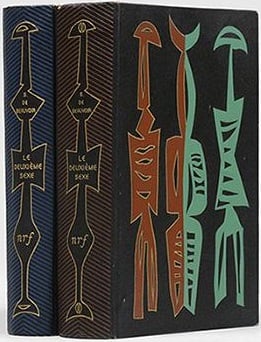
The second sex — Simone de Beauvoir (1949)
Credit: abebooks.co.uk, Wikipedia
Simone de Beauvoir published Le Deuxième Sexe — The Second Sex — in French in 1949, and the sentence that opens its second volume became one of the most quoted lines in feminist thought: "One is not born, but rather becomes, a woman." That formulation — the idea that femininity is not a biological destiny but a social construction, a role imposed and internalized — would shape the intellectual framework of women's liberation movements for the next half-century.
De Beauvoir's argument, built over nearly 800 pages, was that women throughout Western history had been constructed as the "Other" — the second sex, defined in relation to men rather than as autonomous subjects in their own right. She drew on biology, psychoanalysis, history, myth, and literature to trace how this construction operated and was reinforced, and in the second part she followed the arc of a woman's life from childhood through marriage, motherhood, and old age, examining at each stage the ways that femininity was trained into women rather than emerging from them.
The book was condemned by the Vatican, which placed it on its Index of Forbidden Books, and attacked by male reviewers who dismissed it as personal grievance dressed up as philosophy. Françoise Sagan called it the most important book of the postwar era. Albert Camus reportedly told de Beauvoir that she had made French men look ridiculous. She considered that something of a compliment.
H.M. Parshley's English translation, published in 1953, became the standard version in English-speaking countries for decades, but it was significantly abridged and contained errors that softened some of de Beauvoir's sharper arguments. A complete, more accurate translation by Constance Borde and Sheila Malovany-Chevallier appeared in 2010.
The influence of The Second Sex on what became known as second-wave feminism is direct and documented. Betty Friedan, Germaine Greer, Kate Millett, and others read de Beauvoir and argued against her or through her. The idea that gender is performed rather than inherent — later developed and extended by Judith Butler — runs from de Beauvoir's foundational observation. The book remains both a historical document and a living intellectual resource.
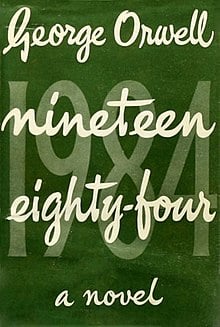
1984 — George Orwell (1949)
Credit: Michael Kennard, Wikipedia
George Orwell wrote Nineteen Eighty-Four while dying. He had been diagnosed with tuberculosis in 1947 and retreated to Barnhill, a remote farmhouse on the Scottish island of Jura, to finish the novel. The conditions were extreme — the house was isolated and cold, the damp exacerbated his illness — but Orwell pressed on, working in bed during periods when he was too unwell to sit at a desk. He completed the manuscript in December 1948 and transposed the last two digits of the year for his title. He died in January 1950, less than a year after the book was published.
The novel depicts a totalitarian state in which the ruling Party, led by the figurehead Big Brother, exercises total control over thought, language, and history. Winston Smith, a low-ranking Party functionary, harbors secret doubts about the regime and begins a clandestine relationship with a woman named Julia. Their rebellion is small, private, and, the novel makes clear from early on, doomed.
What Orwell created in this novel was not just a political warning but a vocabulary. Doublethink — the capacity to hold two contradictory beliefs simultaneously without recognizing the contradiction. Thoughtcrime — the offense of thinking against the Party, detectable before any action is taken. Newspeak — a deliberately impoverished language designed to make dissident thought literally unthinkable by removing the words needed to express it. The Ministry of Truth, which falsifies history. Room 101, where prisoners are confronted with their deepest fear. All of these entered the language and have remained there.
Orwell had worked at the BBC during the Second World War and had observed propaganda operations directly. His earlier novel Animal Farm, published in 1945, had been a satirical allegory about Stalinist Russia. Nineteen Eighty-Four was more totalizing — a portrait of how power operates at the deepest level of consciousness, not just through force but through the colonization of thought itself.
The novel has experienced surges in sales during periods of political anxiety — after the election of authoritarian governments, after mass surveillance disclosures, after contested elections — which suggests that readers reach for it when they need a vocabulary for what they are experiencing. Sales spiked noticeably in the U.S. in early 2017. That pattern alone speaks to the kind of book it is.
The stranger — Albert Camus (1942)

Credit: Jean Louis, Wikipedia
Albert Camus published L'Étranger — The Stranger — in 1942, in occupied Paris, and its opening sentence — "Mother died today. Or maybe yesterday; I can't be sure" — immediately announced that something unusual was happening. The narrator, Meursault, an Algerian Frenchman, relates his mother's death and funeral with a flatness that most readers find chilling. He does not weep. He cannot remember the exact date. He goes to the beach the next day, meets a woman, goes to a film.
The detachment is not indifference in any simple sense. Camus was developing a philosophy he called absurdism — the recognition that human beings seek meaning in a universe that offers none, and the argument that the honest response to this condition is neither despair nor denial but a kind of clear-eyed acceptance. Meursault is the absurdist anti-hero: a man who has stripped away social performance and simply exists, without the usual scaffolding of explanation, regret, or aspiration.
The novel's second half turns on the consequences of this attitude. On a beach, in the blazing Algerian sun, Meursault shoots an Arab man. The trial that follows is less concerned with the killing than with Meursault's emotional comportment at his mother's funeral — his failure to cry, his going to the cinema the next day, his apparent absence of grief. The system condemns him not for violence but for not performing humanity correctly.
Camus won the Nobel Prize in Literature in 1957, with The Stranger among the primary reasons cited. The novel has sold tens of millions of copies in more than 40 languages and remains one of the most assigned texts in university literature and philosophy courses.
It has also been critiqued for its treatment of Arab characters — the man Meursault kills is referred to only as "the Arab," unnamed and without interiority. Kamel Daoud's 2013 novel The Meursault Investigation directly addresses this absence, retelling the story from the perspective of the Arab man's brother and giving him a name. That response is itself a measure of The Stranger's centrality: it has become canonical enough that its silences demand a counter-narrative.
The grapes of wrath — John Steinbeck (1939)
-600x890.jpg)
Credit: Elmer Hader, Heritage Auctions Lot, Wikipedia
John Steinbeck published The Grapes of Wrath on April 14, 1939, and the country's reaction was immediate and divided. The novel follows the Joad family — Oklahoma tenant farmers displaced by drought, failed crops, and the mechanization of agriculture — as they make their way in a broken-down truck to California, where they have been told there is work. What they find is exploitation, contempt, and camps where migrants compete for wages too low to live on.
Steinbeck had done his research. He had spent weeks in migrant labor camps in California's Central Valley, reporting for the San Francisco News, and the novel is dense with specific, observed detail: the way dust settles on food, the mechanics of a car engine failing on a desert highway, the geography of highway camps and company towns. The human particulars are embedded in a broader structural argument about capitalism, land ownership, and the treatment of the poor.
The novel won the Pulitzer Prize for Fiction in 1940 and was cited when Steinbeck received the Nobel Prize in Literature in 1962. It was also banned upon publication by Kern County, California — one of the counties it depicts — on the grounds that it was obscene and misrepresented conditions in the region. The Associated Farmers of California called it communist propaganda. These reactions were, in part, a measure of how accurately Steinbeck had described what he had seen.
John Ford $F directed a film adaptation in 1940 with Henry Fonda as Tom Joad, and the combination of novel and film embedded the Dust Bowl migration into American cultural memory in a way that shaped how subsequent generations understood that period.
Steinbeck's prose style in this novel alternates between close third-person narrative following the Joads and broader, interstitial chapters written in a more documentary or lyrical register — descriptions of the migration as a mass phenomenon, the land itself, the banks as abstract machines of dispossession. This structural alternation was unusual and made the individual story feel part of something systemic. It remains the defining literary portrait of American poverty in the 20th century.
Lord of the flies — William Golding (1954)
Credit: Faber & Faber, Wikipedia
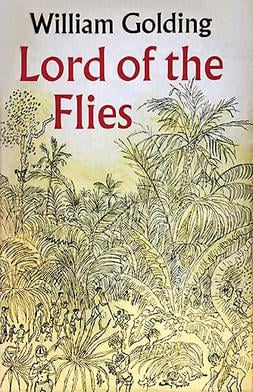
William Golding's first novel was rejected by 21 publishers before Faber and Faber accepted it in 1954. One of the rejections described it as an absurd and uninteresting fantasy. Lord of the Flies won Golding the Nobel Prize in Literature in 1983, and the Nobel committee noted it as one of the works through which the novel had, in the 20th century, become a vehicle for moral inquiry.
The premise is deliberately simple. A group of British schoolboys, evacuated during an unspecified nuclear war, are stranded on an uninhabited island when their plane is shot down. There are no adults. They must organize themselves. The novel tracks what happens when they do, and the answer is not reassuring.
Golding was consciously responding to R.M. Ballantyne's 1857 Victorian novel The Coral Island, in which British boys stranded on an island demonstrate enterprise, Christian virtue, and pluck. Golding, who had served in the Royal Navy during World War II and had seen what people did to one another under extreme conditions, regarded that vision as fantasy. His island does not bring out the best in boys. It strips away the thin social coating and reveals something more primitive underneath — not because children are especially savage, but because human beings are.
The novel's central division is between Ralph, who tries to maintain the fire that might signal rescue and organize a functioning society, and Jack, who pursues hunting and the psychological satisfactions of power and violence. The transition of most of the boys from Ralph's order to Jack's tribe tracks the seduction of authoritarian community: it offers excitement, belonging, and a shared enemy where Ralph's democracy offers only obligations and delay.
Piggy, who represents reason and technical knowledge, and Simon, who represents a kind of mystical moral intuition, are both killed. Their deaths come not from the island's dangers but from the boys themselves.
Golding's allegory is not subtle, but its directness is part of its power. The novel does not need to be decoded; it states its thesis openly and then makes you feel it. Its influence on subsequent dystopian fiction — from The Hunger Games to countless other stories about children as political actors — is direct. It raised a question about human nature that the 20th century's wars had made impossible to avoid asking.
Invisible man — Ralph Ellison (1952)
-900x1394.jpg)
Credit: E. McKnight Kauffer, Random House, Heritage Auctions, Wikipedia
Ralph Ellison's Invisible Man was published on April 14, 1952, and won the National Book Award in 1953 — one of the first novels by a Black American to receive that recognition. Its opening is among the most arresting in American literature: "I am an invisible man. No, I am not a spook like those who haunted Edgar Allan Poe; nor am I one of your Hollywood-movie ectoplasms. I am a man of substance, of flesh and bone, fiber and liquids — and I might even be said to possess a mind. I am invisible, understand, simply because people refuse to see me."
The narrator is unnamed throughout the novel — a structural choice that Ellison made deliberately, to emphasize that his protagonist is being denied individual identity by the society around him. The novel follows him from a Southern college, through a series of encounters with white authority and Black institutions, to Harlem and involvement with a political organization called the Brotherhood, which is clearly modeled on the American Communist Party.
What Ellison was tracking was the way that Black Americans in the mid-20th century were invisible not because they were literally unseen but because white America projected onto them images, roles, and expectations that had nothing to do with who they actually were. The Brotherhood uses the narrator as a political instrument while ignoring his actual experience. Southern white men see him as a type. Even within Black communities, expectations are prescribed rather than discovered. The novel is about the violence of being made to represent something rather than being permitted to simply exist.
Ellison was drawing on the intellectual tradition of W.E.B. Du Bois — particularly Du Bois's concept of "double consciousness," the awareness that Black Americans carry of being seen through white eyes — and on the protest tradition of Richard Wright, while pushing both in new directions. The novel's modernist structure, with its surreal set pieces and non-linear interludes, placed it in conversation with European as well as American literary traditions.
Ellison worked on a second novel for the rest of his life but never completed it. Juneteenth was published posthumously in 1999 from the existing fragments. But Invisible Man was sufficient. It is one of the essential American novels about what America actually was.
The catcher in the rye — J.D. Salinger (1951)
-900x1046.jpg)
Credit: Michael Mitchell, Nate D. Sanders auctions, Wikipedia
J.D. Salinger published The Catcher in the Rye on July 16, 1951, and Holden Caulfield entered the American literary imagination as a voice that a particular kind of adolescent reader — alienated, perceptive, contemptuous of what Holden calls "phoniness" — immediately recognized as their own. The novel had been rejected several times, including by The New Yorker, before Little, Brown published it. Within months it was on bestseller lists.
The novel is set over a weekend in New York City. Holden, 16, has been expelled from Pencey Prep, his fourth school, and instead of going home spends several days drifting through the city, talking to cab drivers, visiting bars, calling people he half-knows, and narrating his experience in a confessional, digressive voice addressed directly to the reader. The voice is the book: wry, self-aware, self-contradictory, and carrying beneath its wisecracking surface a genuine grief — for his dead brother Allie, for the loss of innocence, for the gap between what the adult world promises and what it delivers.
Salinger never authorized a film adaptation of the novel and spent the decades after its publication in almost complete seclusion in Cornish, New Hampshire, granting almost no interviews and publishing nothing after 1965. The contrast between the novel's enormous cultural presence and its author's disappearance became its own kind of story.
The book's darker history is also unavoidable. Mark David Chapman was carrying a copy of The Catcher in the Rye when he shot and killed John Lennon in December 1980. John Hinckley Jr. had a copy in his hotel room when he attempted to assassinate President Ronald Reagan in 1981. These associations attached themselves to the novel and to a certain discourse about the dangers of alienated, solitary young men. Salinger's Holden did not cause these acts, but the book was present at them in a way that complicated the novel's cultural reception.
It remains one of the most frequently challenged and banned books in American school libraries — which is itself a measure of how much it still unsettles, decades after its publication.
Lolita — Vladimir Nabokov (1955)
Credit: Olympia Press, Wikipedia
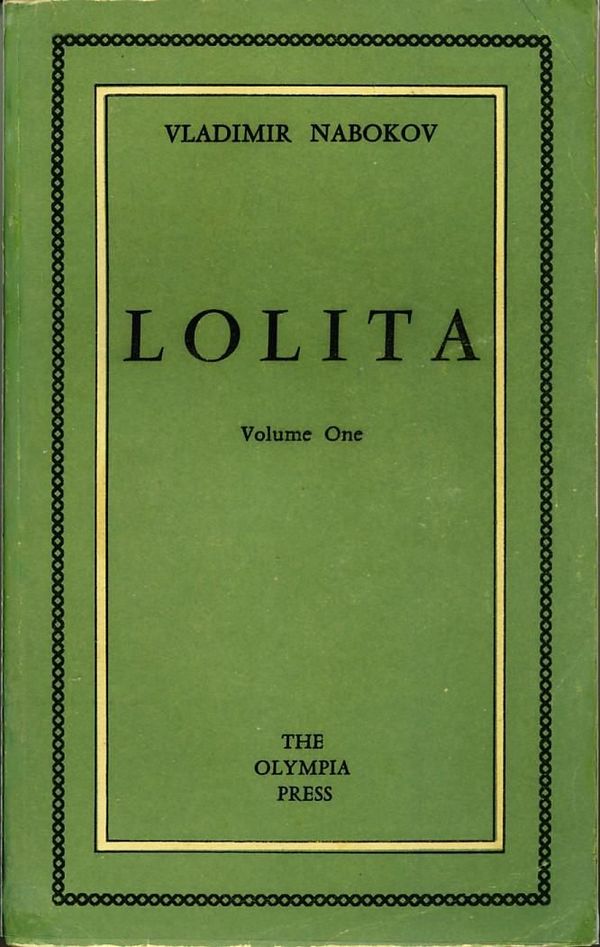
Vladimir Nabokov completed Lolita in English — his adopted language, not his native Russian — and was unable to find an American publisher willing to print it. Four publishers declined. In 1955, it was published in Paris by the Olympia Press, a house known primarily for erotic fiction. The company's willingness to print it was essentially commercial; its lasting consequence was literary.
The novel is narrated by Humbert Humbert, a European scholar of middle age who describes his obsession with, and sexual abuse of, Dolores Haze — a 12-year-old girl he calls Lolita. The narrative voice is extravagantly literary, self-aggrandizing, witty, and seductive, which is exactly the point: Humbert is an unreliable narrator of the most dangerous kind, one who uses the resources of culture and language to justify and aestheticize what is, in fact, the systematic destruction of a child's life.
The novel asks its reader to hold two things simultaneously: the pleasure of Nabokov's prose — the density of its wordplay, the precision of its imagery, the jokes embedded in street names and academic citations — and the moral reality of what Humbert is actually describing. Lolita is never given a voice. Her desires, her perspective, her suffering are consistently filtered through and suppressed by Humbert's narration. The novel makes visible exactly how predators construct narratives that cast themselves as romantic heroes. Nabokov later wrote that Lolita's tragedy is precisely the tragedy of the "little miscalculated shiver" — Dolores's story, not Humbert's.
The novel was published in the U.S. in 1958 by G.P. Putnam's Sons and became an immediate bestseller. Stanley Kubrick adapted it in 1962. The fame of the title and its misreadings — treating the novel as a love story, or worse, treating "Lolita" as a descriptor for an attractive young girl rather than a victim's name — have been a source of ongoing critical debate.
Nabokov was born in Russia, educated in England, lived in Berlin and Paris before emigrating to the U.S. in 1940. He wrote several novels in Russian before switching to English. His mastery of English prose was itself an argument about what language can do when its resources are pushed to their limits.
Things fall apart — Chinua Achebe (1958)
Credit: abebooks.co.uk, Wikipedia
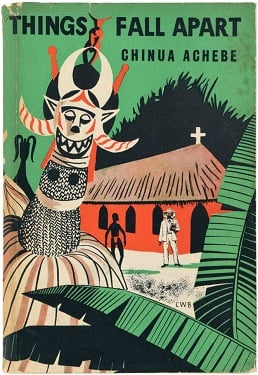
Chinua Achebe published Things Fall Apart in 1958, the year before Nigerian independence. He was 28. He had written it, he said later, in deliberate response to the European literary tradition that depicted Africa as a place without history, culture, or human interiority — in particular Joseph Conrad's Heart of Darkness, which Achebe criticized in a 1975 lecture as a racist text that dehumanized Africans to serve as a backdrop for a white protagonist's psychological journey.
Things Fall Apart is set in the late 19th century in the Igbo community of Umuofia, in what is now southeastern Nigeria. Its protagonist is Okonkwo, a physically powerful, emotionally rigid man who has built his status from nothing — his father was considered a failure — through farming, wrestling, and war. The novel follows Okonkwo's life across three sections: his rise and standing in Umuofia, his exile, and his return to find his community transformed by the arrival of Christian missionaries and British colonial administration.
The title comes from W.B. Yeats' poem "The Second Coming": "Things fall apart; the centre cannot hold." Achebe's use of it signals that he is entering into dialogue with the Western literary tradition, not rejecting it — but insisting that the story of the centre not holding looks entirely different from the perspective of those whose world was destroyed in order to replace it with another.
Achebe wrote in English, a choice he defended on the grounds that it was the language of the colonial experience that formed his subject, and that African writers needed to reshape it rather than abandon it. His prose is declarative and precise, incorporating Igbo proverbs and oral narrative rhythms in a way that creates a genuinely different texture from European realist fiction.
The novel has sold over 20 million copies and has been translated into more than 50 languages. It has been foundational to the entire field of postcolonial literature and is one of the most taught texts in African universities and high schools. Achebe's insistence that African cultures had complexity, dignity, and tragedy before European intervention seems obvious now; in 1958, it was a radical assertion that needed to be made in novel form.
On the road — Jack Kerouac (1957)
_front_cover,_first_edition-900x1358.jpg)
Credit: Bill English, Heritage Auction, Wikipedia
Jack Kerouac had been working on On the Road for years by the time he reportedly typed a manuscript version on a 120-foot scroll of paper in a concentrated burst in April 1951, drawing on notebooks he had kept of his travels across America with Neal Cassady between 1947 and 1950. The scroll version is mostly true in broad outline: he did draft quickly that month, though subsequent revisions extended over years. Viking Press published it on September 5, 1957, and the New York Times review, which appeared the same day, called it "the most beautifully executed, the clearest and the most important utterance" of the Beat Generation.
The novel follows Sal Paradise — a thinly disguised Kerouac — and his charismatic friend Dean Moriarty, based on Cassady, as they make a series of cross-country trips by car, bus, and hitchhiking. The geography is the story: Denver, San Francisco, New Orleans, Mexico City, New York, and the highways between them. America itself, in its physical expanse and its social diversity — jazz clubs, migrant workers, diners at three in the morning — is the subject as much as any individual character.
The novel was a rejection of what the Beat writers saw as the settled, conformist materialism of postwar American life. The car trip as liberation, the jazz idiom as an alternative to academic culture, the idealization of the outcast, the marginal, and the perpetually moving — these became templates for a certain kind of American counter-cultural self-conception that persisted through the 1960s and beyond. Bob Dylan cited it. The hippie movement drew from it. The road-trip genre in American film and fiction has Kerouac somewhere in its ancestry.
The original scroll was purchased in 2001 by Jim Irsay, owner of the Indianapolis Colts, for $2.43 million. Its existence became a kind of relic — proof of the spontaneous energy the novel claimed for itself. Kerouac spent the rest of his life writing prolifically and drinking heavily, unable to escape the fame On the Road had made. He died of alcoholism in 1969, at 47.
One hundred years of solitude — Gabriel García Márquez (1967)
.jpg)
Credit: Wikipedia
Gabriel García Márquez finished writing Cien años de soledad in early 1966 and, facing a postal bill he could not pay, reportedly sent the manuscript to his Buenos Aires publisher in two installments — pawning his wife's hair dryer and other household items to cover the cost of the second package. The book was published by Editorial Sudamericana in Buenos Aires in May 1967. The first edition of 8,000 copies sold out in days.
The novel follows the Buendía family across seven generations in the fictional town of Macondo, which García Márquez based loosely on his birthplace of Aracataca in northern Colombia. It begins with the founding of Macondo and ends with its destruction — a cyclical structure that mirrors the family's repeating patterns: the men are named José Arcadio or Aureliano in alternating generations and inherit the same compulsions, the same loneliness, the same capacity for obsessive love and political violence. The town's history overlaps with Colombian history: civil war, banana company exploitation, massacre.
What distinguished the novel formally was the mode of magical realism — a narrative register in which miraculous events are described in the same matter-of-fact tone as ordinary ones. Characters ascend to heaven while hanging laundry. A priest levitates after drinking chocolate. Yellow butterflies precede the arrival of Mauricio Babilonia. None of this is flagged as unusual. The prose does not pause to explain or qualify the impossible. This technique, which García Márquez adapted from the storytelling style of his grandmother, gave the novel a quality of myth without sacrificing the density of its realism.
Gregory Rabassa's 1970 English translation, which García Márquez said was better than his original, introduced the novel to English-language readers and helped precipitate what became known as the Latin American Boom — a period when Latin American literature achieved global readership and transformed how the novel was understood. García Márquez won the Nobel Prize in Literature in 1982.
Beloved — Toni Morrison (1987)
-900x1331.jpg)
Credit: R. D. Scudellari, Alfred A. Knopf, Heritage Auctions, Wikipedia
Toni Morrison published Beloved in 1987, and the novel was based on a real event: the case of Margaret Garner, an enslaved woman who escaped from Kentucky to Cincinnati, Ohio, in 1856 and, when captured, killed her two-year-old daughter with a butcher knife rather than allow her to be returned to slavery. Garner's explanation — that she had done it out of love, to spare her daughter the life she herself had lived — generated public debate at the time and was largely then forgotten by history. Morrison found the story in a clipping and spent years thinking about it before writing the novel.
The book is set in the years immediately after the Civil War. Sethe, a woman who escaped slavery, lives outside Cincinnati with her daughter Denver and is haunted — literally, in the novel's register — by the ghost of the baby she killed. When a man named Paul D arrives from the plantation where he and Sethe were enslaved, the ghost intensifies. Then a young woman calling herself Beloved appears at the house, and it becomes clear that she is, or is connected to, the dead daughter.
Morrison's use of the supernatural is not incidental. She was explicit that the ghost of Beloved represented not just Sethe's specific child but the accumulated weight of the 60 million and more — the number she cited in the novel's dedication — who died during the Middle Passage and American slavery. The ghost cannot be explained or resolved by psychological realism; it requires a mode of storytelling that can hold that much unprocessed grief.
Morrison won the Pulitzer Prize for Fiction in 1988 and the Nobel Prize in Literature in 1993. During the Nobel ceremony, Beloved was specifically cited. The Nobel committee's statement noted that she "gives life to an essential aspect of American reality" in work characterized by "visionary force and poetic import."
The novel's status has been periodically contested in school boards and state legislatures, which is its own kind of testimony to its power. It tells the truth about slavery in a way that does not permit comfortable distance.
The feminine mystique — Betty Friedan (1963)
Credit: Wikipedia
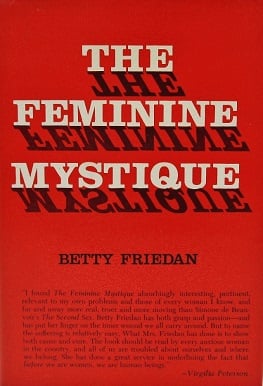
Betty Friedan published The Feminine Mystique on February 19, 1963, and its opening chapter named something that had been circulating without a name in American middle-class life for over a decade. Friedan called it "the problem that has no name" — the sense of dissatisfaction, meaninglessness, and quiet desperation reported by educated women who had followed the prescribed path of marriage, domesticity, and suburban life, and found it insufficient.
Friedan had graduated from Smith College in 1942, intending an academic career in psychology, and had instead spent much of the 1950s as a suburban housewife and magazine writer. For the Smith 15th-anniversary reunion in 1957, she sent a questionnaire to her classmates asking about their lives. The responses were not what the women's magazines of the era would have predicted: many of her educated, married, materially comfortable classmates were quietly miserable. Friedan spent the next five years researching and writing the book.
Her argument was that American culture, particularly after World War II, had constructed an image of the ideal woman — fulfilled by homemaking, defined by her relationships to her husband and children, unsuited to the intellectual or professional world — and had systematically pressured women to conform to it. Women's magazines, advertising, television, psychoanalytic theory, and the education system all worked together to produce what she called the "feminine mystique": the idealization of domesticity as women's highest calling. The consequence was a generation of women who felt inexplicably wrong for not finding it enough.
The book sold 3 million copies in its first three years and is widely credited with helping ignite second-wave feminism in the U.S. Friedan went on to help found the National Organization for Women in 1966. The Feminine Mystique had critics — later feminists noted that it largely addressed white, middle-class, educated women and did not account for the experiences of working-class or Black women, many of whom had never had the "luxury" of domesticity Friedan described. Those critiques are valid and important. They do not diminish the book's historical consequence.
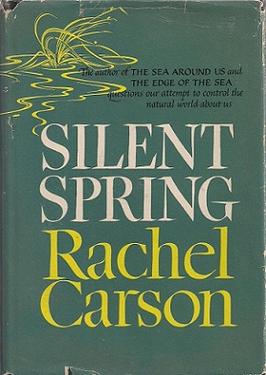
Silent spring — Rachel Carson (1962)
Credit: Wikipedia
Rachel Carson published Silent Spring on September 27, 1962, and within months it had provoked a national debate, Congressional hearings, attacks from the chemical industry, and a review by the President's Science Advisory Committee. Carson was a marine biologist who had written three previous books about the natural world, most notably The Sea Around Us in 1951. Silent Spring was different in kind: it was a work of advocacy based on scientific evidence, and its subject was the damage being done to ecosystems and human health by the widespread use of synthetic pesticides, particularly DDT.
The title referred to a spring in which no birds sang — a future made possible by the wholesale application of pesticides that moved up the food chain, killing insects, then birds, then larger animals, and contaminating water and soil. Carson did not invent this concern; biologists and wildlife managers had been documenting bird population declines and pesticide contamination for years. What she did was synthesize that evidence and present it in prose accessible to general readers, with a moral clarity that made avoidance difficult.
The chemical industry's response was aggressive. Velsicol Chemical Corporation wrote to Carson's publisher threatening legal action before the book appeared. Industry representatives called her a hysterical woman, a communist sympathizer, and questioned her scientific credentials. Carson was by then dying of breast cancer — a fact she had not made public — and she continued working and testifying even as her health declined. She died in April 1964, less than two years after publication.
The legacy was concrete. Silent Spring is credited as a catalyst for the environmental movement that grew through the 1960s. The U.S. Environmental Protection Agency was established in 1970. DDT was banned in the U.S. in 1972. The book also established a model for public scientific communication that subsequent writers on climate, ecology, and public health have drawn from: accessible, evidence-based, and willing to assign responsibility for harm.
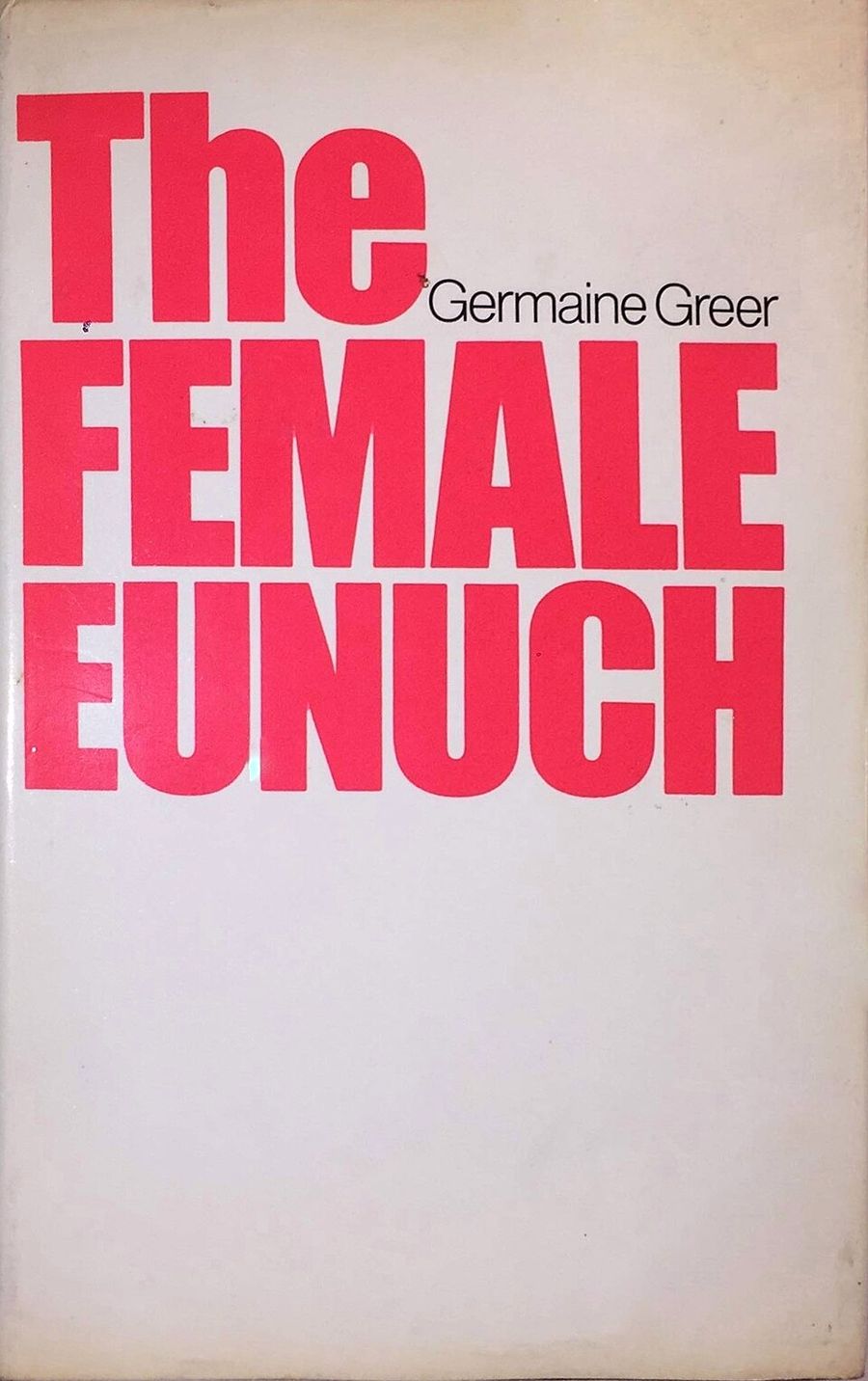
The female eunuch — Germaine Greer (1970)
Credit: Wikipedia
Germaine Greer published The Female Eunuch in October 1970 through MacGibbon & Kee in the U.K., and it arrived as a kind of explosion into a feminist conversation that had been building since the early 1960s. Where Betty Friedan had analyzed the suburban housewife's dissatisfaction from a sociological perspective, and where Simone de Beauvoir had given feminism its philosophical architecture, Greer brought a tone of aggressive, irreverent personal energy. She was funny, confrontational, and deliberately provocative, and the book sold with a velocity that established her as one of the most visible public intellectuals of the decade.
Greer's central argument was carried in the title. She proposed that women had been conditioned to suppress their own energy, sexuality, and desire — that the "eunuch" in her title was not a reference to literal castration but to the psychological and social process by which female vitality was contained, redirected, and ultimately negated. Women had been taught to accept a diminished version of themselves, and to identify with that diminishment as natural or even desirable. The Female Eunuch called this process out and rejected it.
Greer was Australian-born and was based in the U.K. when the book appeared, and she quickly became a presence in British and American television and public debate in a way that academic feminists rarely had been. She argued on talk shows, debated Norman Mailer — whose hostility to feminism was vociferous — and became a figure both celebrated and attacked in the popular press. The accessibility of her argument, combined with her willingness to be a public combatant, gave the book a reach it might not otherwise have had.
The Female Eunuch is of its moment in ways that are visible now — its treatment of race and its arguments about female sexuality have been criticized from within feminist theory — but its historical importance as a radicalizing text is clear. Alongside Friedan and de Beauvoir, it made up the essential reading list of a generation of women who were renegotiating what their lives could be.
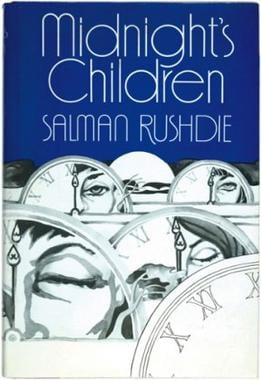
Midnight's children — Salman Rushdie (1981)
Credit: Wikipedia
Salman Rushdie published Midnight's Children in April 1981, and it won the Booker Prize that year — the beginning of a run of recognition that would later include the "Booker of Bookers" in 1993 and the "Best of the Booker" in 2008, both awarded to determine the best novel in the prize's history. No other book has won both.
The novel's premise is a literalization of metaphor. Saleem Sinai is born at the stroke of midnight on August 15, 1947 — the exact moment of India's independence from British rule. His birth is simultaneously the nation's birth, and the novel draws a connection between his personal history and India's political history that is sustained across 600 pages with an inventiveness that rarely flags. The 1,001 children born in the first hour of independence are all gifted with supernatural powers; they form a kind of committee of the nation's possibilities, eventually suppressed by the forces of political order.
Rushdie's style — maximalist, pun-dense, allusive, mixing registers from the colloquial to the formal — drew explicitly on the tradition of Sterne, Dickens, García Márquez, and Günter Grass's The Tin Drum, producing something that felt new and particular to the postcolonial condition: a literature as crowded, contradictory, and polyglot as India itself.
The novel is not merely a celebration of independence. Its later sections cover the Emergency of 1975 to 1977, when Prime Minister Indira Gandhi suspended civil liberties, imposed censorship, and implemented forced sterilization programs. The novel's account of this period led Gandhi to sue Rushdie for defamation over a passage in which Saleem implies she was motivated by her son Sanjay's death. The case was eventually settled.
Midnight's Children established Rushdie as a central figure in what became known as postcolonial literature in English, and it demonstrated that the novel could absorb the complexity of decolonization — the multiplicity of voices, the unresolved inheritances, the competing versions of history — in a form equal to the subject.
To kill a mockingbird — Harper Lee (1960)
-900x1113.jpg)
Credit: Shirley Smith, Nate D. Sanders auctions, Wikipedia
Harper Lee published To Kill a Mockingbird on July 11, 1960, and it won the Pulitzer Prize for Fiction the following year. It has since sold over 40 million copies and has rarely been out of an American school curriculum in the decades since — which makes it one of the most widely read novels in the country's history, as well as one of the most frequently challenged for removal from school libraries.
The novel is narrated by Jean Louise "Scout" Finch, looking back from adulthood on three years of her childhood in Maycomb, Alabama, during the early 1930s. Scout is six when the novel begins. Her father, Atticus Finch, is a lawyer who is assigned to defend Tom Robinson, a Black man falsely accused of raping a white woman, Mayella Ewell. Scout narrates the trial and its aftermath through the eyes of a child who has not yet fully absorbed the logic of the racial order she lives in, and this perspective — curious, literal, without protective social distance — is the instrument through which the novel does its moral work.
Lee grew up in Monroeville, Alabama, and was a childhood friend of Truman Capote, who appeared in a thinly veiled version as the character Dill. The novel draws heavily on the racial dynamics of the American South in the Jim Crow era, and on the particular kind of liberal white conscience that understood racial injustice but operated within the system rather than against it.
Atticus Finch became one of the most discussed figures in American legal and moral culture — a model of principled defense and reasoned argument. That reading was complicated by the 2015 publication of Go Set a Watchman, an earlier draft of the novel in which an older Atticus holds segregationist views, prompting a reassessment of what the character had always actually been. The novel's moral architecture turned out to be more complex than four decades of classroom reading had suggested.
The book is a portrait of the American South's racial violence rendered through the consciousness of a white child, which is both its power and its limitation. It created empathy in millions of readers. Later critics argued that the empathy was organized around the white characters' response to racism rather than the experience of its Black victims — that Tom Robinson's interiority is as invisible here as the Arab man's is in Camus. Both observations are true.