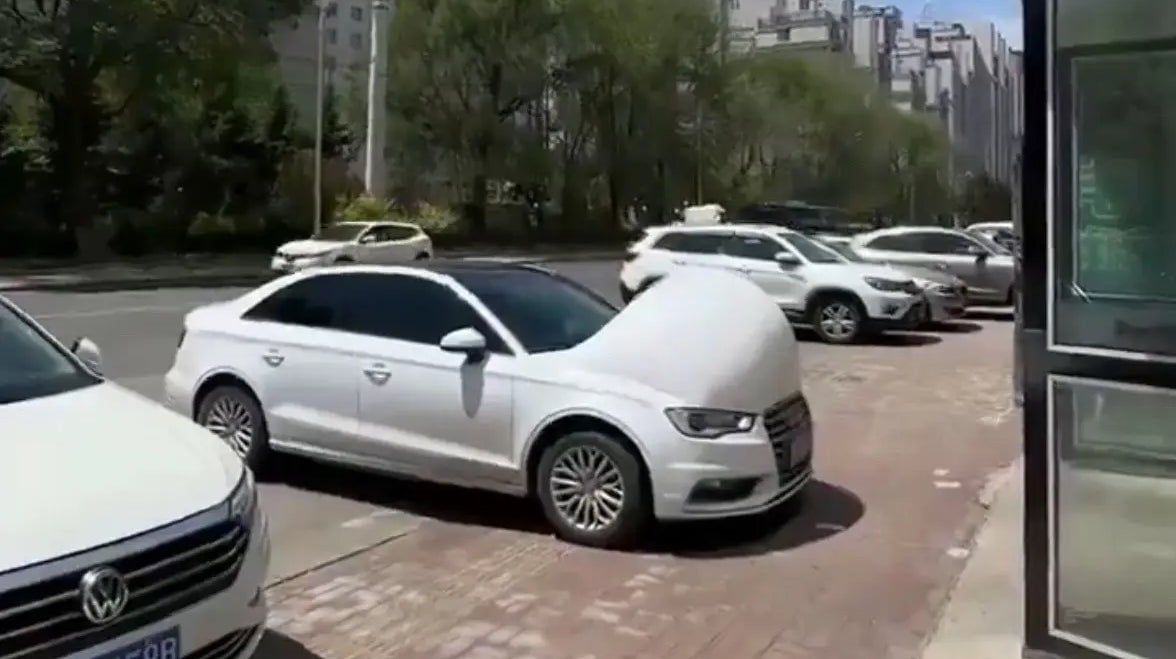
Imagine that a whole quart (~0.94 L) of air was trapped underneath the vinyl wrap on the hood of one of these vehicles. That would be a sizeable bulge that you could never miss on sight. Nobody would accept a wrap with a bubble that big, but let’s be generous in our calculations. Imagine that air bubble was there when the vinyl was installed at a temperature of 68 F (20 C). If you then took that car outside on a hot day of 104 F (40 C), the air would expand. By how much? Only a disappointing 7%! Your quart-sized bubble would now be 1.068 quarts (1.004 L) in volume assuming the same atmospheric pressure.
Meanwhile, the bubbles we’re seeing are many gallons in size. That doesn’t check out. Basically, there’s no way heat alone could have caused these bulges. Air simply doesn’t expand enough to generate such extreme results…
There is one thing, however, that generates bubbles in vinyl wraps exactly like these ones. Compressed air! In fact, blowing air under a vinyl wrap is a pretty common way to remove it. The typical technique involves inserting a compressed air nozzle under the corner of the wrap and inflating it to lift the wrap up from the hood. Head over to one of the many discussions on Reddit $RDDT, and you’ll find a bunch of commenters from the vinyl industry saying just that.
The exaggerated bubbles shown in the original video are not feasibly possible just from high heat or humidity. One of the most effective ways to remove a wrap from a car is by shooting compressed air between the adhesive wrap and the car’s actual paint, which is the most likely explanation for the massive bubbles. This is definitely not a build quality issue with Chinese cars, as many tweets claim, especially since of the swollen cars two are German Audi A3-based cars and one is a German Audi A6.