
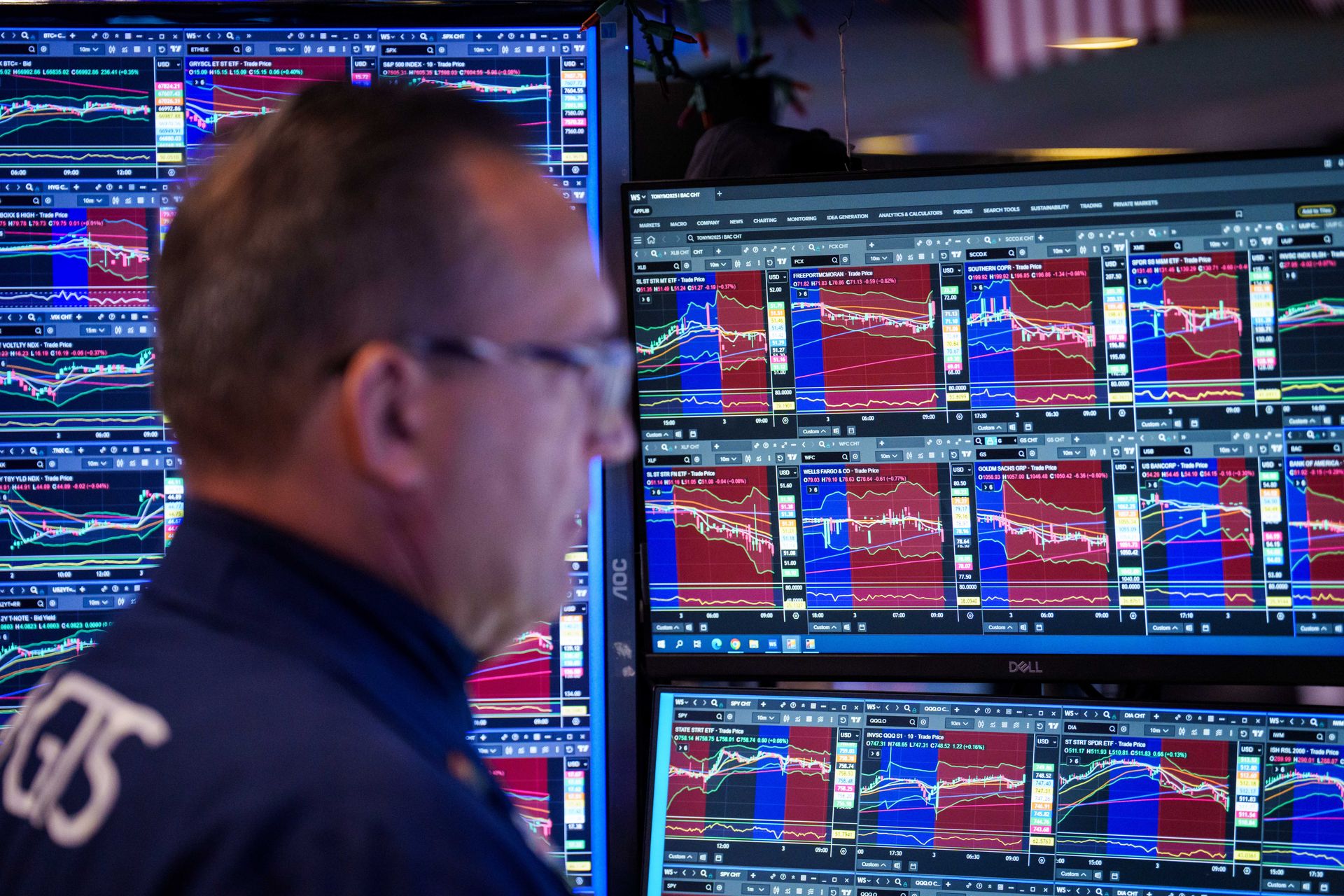
Global chip stocks fell sharply Thursday, dragging down Asian and European markets while U.S. futures pointed to a softer open ahead of the June jobs report.
A fourth straight month of gains above 100,000 would represent a run of job growth not seen since the start of 2024
Bloomberg / Getty Images
Global chip stocks fell sharply Thursday, dragging down Asian and European markets while U.S. futures pointed to a softer open ahead of the June jobs report.
Nasdaq $NDAQ futures were about 0.4% lower in pre-market trading. Futures tied to the Dow Jones Industrial Average were up about 90 points, a gain of roughly 0.2%, and S&P 500 contracts hovered just below breakeven. Across the Atlantic, early declines in the Stoxx 600 gave way to a 0.6% gain by mid-morning, with money flowing away from technology shares and into lower-risk areas of the market such as utilities, healthcare, and consumer staples.
Ending the session at 7,648.09, a level not seen since June 8, the Kospi shed 7.89% in South Korea. Shares of Samsung lost 9.06%, closing at 286,000 won, while SK Hynix suffered steeper losses of 14.57%, settling at 2,187,000 won. Korea's small-cap Kosdaq index finished at 866.72, down 6.74%. In Japan, memory-chip maker Kioxia tumbled 13%, while the Nikkei 225 fell 2.47% to 68,733.15. In premarket U.S. trading, shares of Micron $MU and Nvidia $NVDA were also lower.
The June jobs report is scheduled for release at 8:30 a.m. ET. A survey of economists by Dow Jones puts the expected job gain at 115,000, which would represent a pullback from May's 172,000, and forecasters see the unemployment rate remaining unchanged at 4.3%. A fourth straight month of gains above 100,000 would represent a run of job growth not seen since the start of 2024, according to The Wall Street Journal.
The chip-sector weakness follows losses in U.S. markets on Wednesday. Ned Davis Research strategist Rob Anderson said the rotation out of semiconductors reflects a pattern that has characterized the broader bull market, according to CNBC. Anderson wrote that the ongoing rotation is healthy and consistent with the bull market's character, adding: "A passing of the baton to a non-commodity cyclical sector would be further evidence that the stock market is entering the second half of the year in a position of strength."
Brent crude futures slid to $70.38, a price point that takes the benchmark below where it traded in the days preceding the U.S. strike on Iran.
Join 500,000+ readers who start their day with Quartz.
By subscribing, you agree to our Terms of Service and Privacy Policy.