
25 computer science concepts explained for non-engineers
From algorithms to technical debt, these 25 foundational ideas explain how software actually works — no coding experience or engineering degree required
Credit: Bernd 📷 Dittrich / Pexels
Software runs payroll, routes ambulances, prices airline tickets, and decides which posts appear in your feed. Yet the vocabulary of the people who build it remains opaque to almost everyone else. When an engineer says a feature is "blocked on an API dependency" or that a fix will "add latency," most colleagues nod along without a clear picture of what those words mean. That gap has real costs. Managers approve timelines they can't evaluate. Marketers write copy about products they can't describe accurately. Policymakers regulate systems they can't reason about.
The good news is that the core ideas of computer science are not mathematics-heavy or inaccessible. They are, at heart, ideas about organization: how to describe a task precisely, how to store information so it can be found again, how to split work among many hands, and how to cope when things go wrong. A recipe is an algorithm. A library card catalog is an index. A coat check is a hash table with a human attendant. The machinery is unfamiliar, but the logic is not.
This list covers 25 concepts that come up constantly in workplaces, news coverage, and everyday products. Some explain how computers represent information — binary, bits, and compression. Some explain how software is built and maintained — version control, debugging, and technical debt. Others explain the internet itself — IP addresses, DNS, cookies, and the client-server model. A final group covers the ideas behind modern artificial intelligence, including machine learning and neural networks.
Each entry stands alone. You can read them in order or jump to the term you heard in a meeting this morning. None requires prior knowledge, and none asks you to write a line of code. The goal is not to turn you into a programmer. It is to give you a working mental model of the systems you already depend on, so the next time an engineer explains why something is hard, slow, or expensive, you understand exactly what they mean.
Algorithms: step-by-step instructions for solving a problem
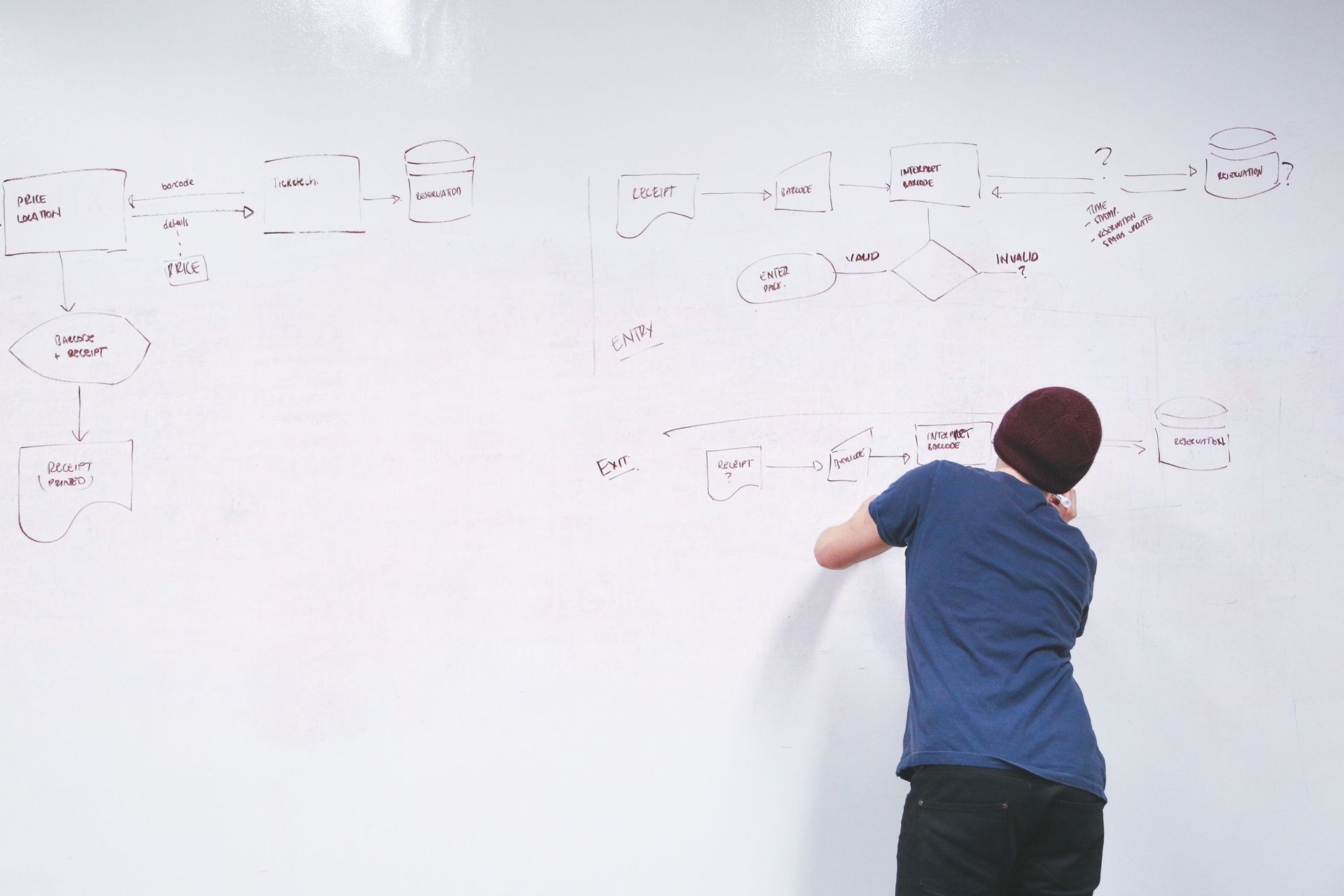
An algorithm is a precise sequence of steps for accomplishing a task. That is the entire definition. A recipe for banana bread is an algorithm. So are the directions your navigation app reads aloud, and the long division method you learned in grade school. In computing, algorithms matter because computers cannot improvise. A person told to "sort these files" will figure it out. A computer needs every step spelled out: compare two items, decide which comes first, swap them if needed, repeat.
The word carries an aura of mystery in public discussion — "the algorithm" that decides what you see on social media — but there is no single algorithm anywhere. Every app contains thousands of them, each handling a narrow job: one ranks posts, one compresses images, one checks your password, one figures out the fastest route to send data across a network.
What separates a good algorithm from a bad one is usually efficiency. Consider looking up a name in a printed phone book. You could start at page one and scan every entry until you find it. Or you could open to the middle, see whether your name falls earlier or later alphabetically, and discard half the book in one move. Repeat, and you find any name in a book of a million entries within about 20 steps. Both methods work. One is dramatically faster.
Computer scientists spend careers on exactly this kind of comparison, because at scale the difference is enormous. An inefficient approach that works fine on 100 records may take hours on 100 million. When engineers debate which algorithm to use, they are debating tradeoffs: speed versus memory use, simplicity versus performance, average behavior versus worst-case behavior.
The practical takeaway for non-engineers: when someone blames "the algorithm," ask which one, and what it was designed to optimize. That single question cuts through most of the fog.
Binary: why computers count with only two digits
Credit: Canva Images
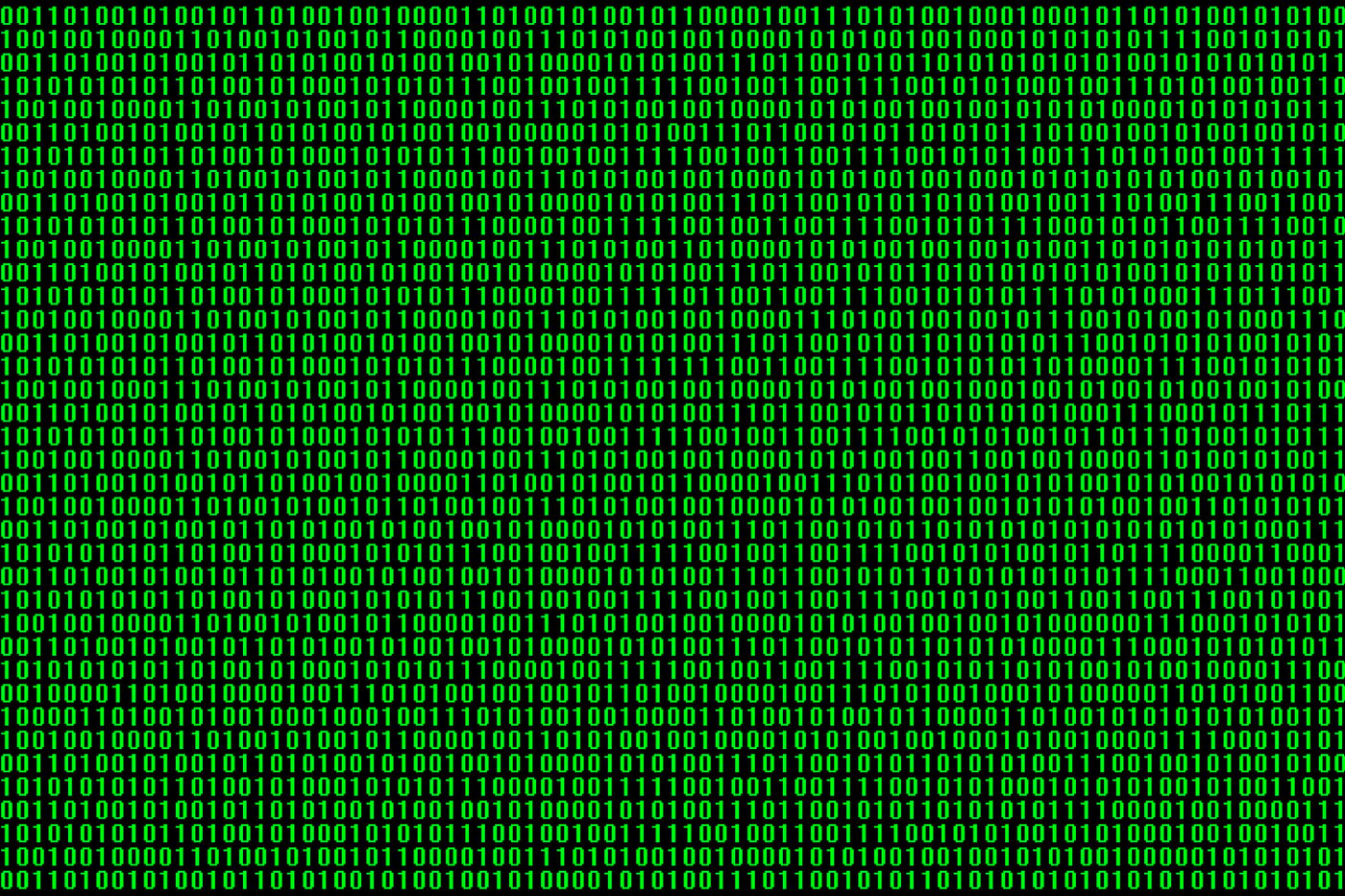
Computers store and process everything — photos, spreadsheets, movies, this article — as sequences of just two symbols: 0 and 1. Each individual 0 or 1 is called a bit, short for binary digit. Eight bits grouped together make a byte, the basic unit you see in file sizes: kilobytes, megabytes, gigabytes.
The reason for two symbols is physical, not mathematical. A computer chip contains billions of microscopic switches called transistors. Each switch is either on or off, carrying electrical charge or not. Two states map naturally to two digits. Engineers could theoretically build machines with ten voltage levels to match our decimal system, but distinguishing ten levels reliably is far harder than distinguishing on from off. Binary is robust: even a degraded signal is clearly closer to one state or the other.
Counting in binary works like counting in decimal, just with fewer digits. In decimal, after nine you carry over to make 10. In binary, after one you carry over: the number two is written 10, three is 11, four is 100. Any whole number can be expressed this way, and rules exist for fractions, negative numbers, and text. The letter A, for instance, is stored as 01000001 under a standard called ASCII, later extended into Unicode to cover the world's writing systems.
Everything above the level of bits is layers of interpretation. A photo is millions of numbers describing the color of each pixel. A song is thousands of numbers per second describing the shape of a sound wave. The same string of bits can mean different things depending on which program reads it — which is why opening a file in the wrong application produces gibberish.
Once you internalize that everything digital is just numbers, several mysteries dissolve. Copying a file is copying numbers, which is why digital copies are perfect. Corruption means some numbers changed. Encryption means the numbers were scrambled by a reversible mathematical recipe.
Big O notation: how engineers measure whether software will scale

Credit: Canva Images
When engineers say an approach "doesn't scale," they usually have a specific mathematical claim in mind, and Big O notation is how they express it. Big O describes how the work an algorithm must do grows as its input grows. It ignores the exact speed of any particular computer and focuses on the shape of the growth curve.
An example makes it concrete. Suppose you need to find a friend's number in an unsorted list of contacts. In the worst case you check every entry. Double the list, double the work. Engineers call this linear time and write it as O(n), where n is the number of items. Now suppose the list is sorted alphabetically and you use the split-the-difference strategy: check the middle, discard half, repeat. Doubling the list adds only one extra step. That is logarithmic time, written O(log n), and it is the reason search engines can query billions of pages in a fraction of a second.
Some algorithms grow faster than their inputs. Comparing every item in a list against every other item — say, checking a guest list for duplicate invitations by brute force — requires work proportional to the square of the list size, or O(n²). At 100 guests that is 10,000 comparisons, trivial for a computer. At 10 million users it is 100 trillion comparisons, which is not.
This is why software that worked beautifully in a demo can collapse under real traffic. The prototype ran on 1,000 test records; production has 50 million. Nothing is "broken" in the usual sense. The growth curve simply caught up.
For non-engineers, Big O explains a common pattern in product conversations. When a developer says a feature is easy for small accounts but needs redesign for enterprise customers, they are often describing a curve, not making excuses. Scale changes what counts as a workable solution.
Data structures: the containers that organize information

Credit: Maksym Kaharlytskyi / Unsplash
If algorithms are the verbs of computing, data structures are the nouns. A data structure is a way of organizing information in a computer's memory so it can be used efficiently. The choice of structure shapes what operations are fast, what operations are slow, and sometimes what is possible at all.
The simplest structure is the array: items stored in a numbered row, like mailboxes in an apartment lobby. Grabbing mailbox number 47 is instant, because the position tells you exactly where to look. But inserting a new mailbox in the middle means shifting every box after it, which is slow.
A linked list flips those tradeoffs. Each item holds a pointer to the next, like a scavenger hunt where every clue leads to the following one. Inserting an item mid-list is easy — just redirect two pointers — but finding item 47 requires walking through the first 46.
Stacks and queues add rules about order. A stack works like a pile of cafeteria trays: the last item added is the first removed. Your browser's back button is a stack of pages. A queue works like a checkout line: first in, first out. Print jobs and customer support tickets typically live in queues.
Trees organize items hierarchically, the way folders contain subfolders. They make sorted data fast to search. Graphs, the most general structure, represent networks of connections: friendships on a social platform, roads between cities, links between web pages.
None of these structures is best. Each trades speed in one operation for speed in another, or memory for time. When engineers estimate that a seemingly small feature request requires major rework, the reason is often structural: the data was organized for one pattern of use, and the new feature demands a different one. Reorganizing data is like renovating a foundation — invisible from outside, and expensive.
Recursion: solving a problem by solving smaller versions of it

Credit: Diana ✨ / Pexels
Recursion is a technique in which a procedure solves a problem by invoking itself on a smaller piece of that same problem. The idea sounds circular, but it works because each self-invocation shrinks the problem, and a defined stopping point — the base case — ends the process.
Russian nesting dolls offer a physical analogy. To count the dolls, open the outermost one and count the dolls inside, then add one. How do you count the dolls inside? The same way: open the next doll, count what is inside, add one. Eventually you reach the smallest doll, which contains nothing. That is the base case. The answers then cascade back up: zero, plus one, plus one, until the full count emerges.
Many real problems have this nested shape. A file folder contains files and other folders, which contain files and other folders. To compute the total size of a folder, add up its files, then recursively compute the size of each subfolder. Family trees, corporate org charts, the structure of sentences in a language, and the layout of elements on a web page are all naturally recursive, and software that handles them is usually written recursively too.
Recursion also underlies famous algorithms. Merge sort, one of the standard ways to sort data, splits a list in half, sorts each half by the same method, then merges the results. The strategy of dividing a problem, solving the parts, and combining the answers is called divide and conquer, and it appears throughout computing.
The danger in recursion is a missing or unreachable base case. A function that keeps calling itself without shrinking the problem runs until the computer exhausts the memory set aside for tracking the calls — a failure called a stack overflow, which lent its name to the popular programming question-and-answer site. For non-engineers, recursion is worth knowing mainly as a mindset: many hard problems become tractable once you find the smaller copy of the problem hiding inside.
APIs: how software talks to other software

Credit: Canva Images
API stands for application programming interface, and it is the reason modern apps can do so much without building everything themselves. An API is a defined set of requests one program can make of another, along with the format of the answers it will get back.
A restaurant menu is the standard analogy, and it holds up well. You do not walk into the kitchen and cook. You choose from a fixed list of dishes, place an order through a waiter, and receive a plate. The menu is the interface: it tells you what you can ask for and what you will receive, while hiding how the kitchen works. An API does the same between programs. A weather app does not run its own satellites. It sends a request to a weather service's API — "give me the forecast for Manila" — and receives structured data in return, which it formats into the screens you see.
APIs are everywhere once you look. When a shopping site shows a map of store locations, it is calling a mapping API. When you pay with a card online, the merchant calls a payment API. When you sign into a new app with your Google $GOOGL account, that handshake happens over an API. Entire companies, such as payment processor Stripe and communications provider Twilio $TWLO, sell their products primarily as APIs for other developers to build on.
The business implications are significant. APIs let companies expose a capability without exposing their code or data wholesale, and they let small teams assemble sophisticated products from rented parts. They also create dependencies: if a provider changes or shuts down an API, every product built on it breaks. Disputes over API access — between social platforms and third-party apps, for instance — are really disputes over who controls the menu.
When engineers say two systems "don't integrate," they often mean no API exists between them, or the APIs speak incompatible formats.
Databases: where information lives and how it gets found
Credit: Brett Sayles / Pexels
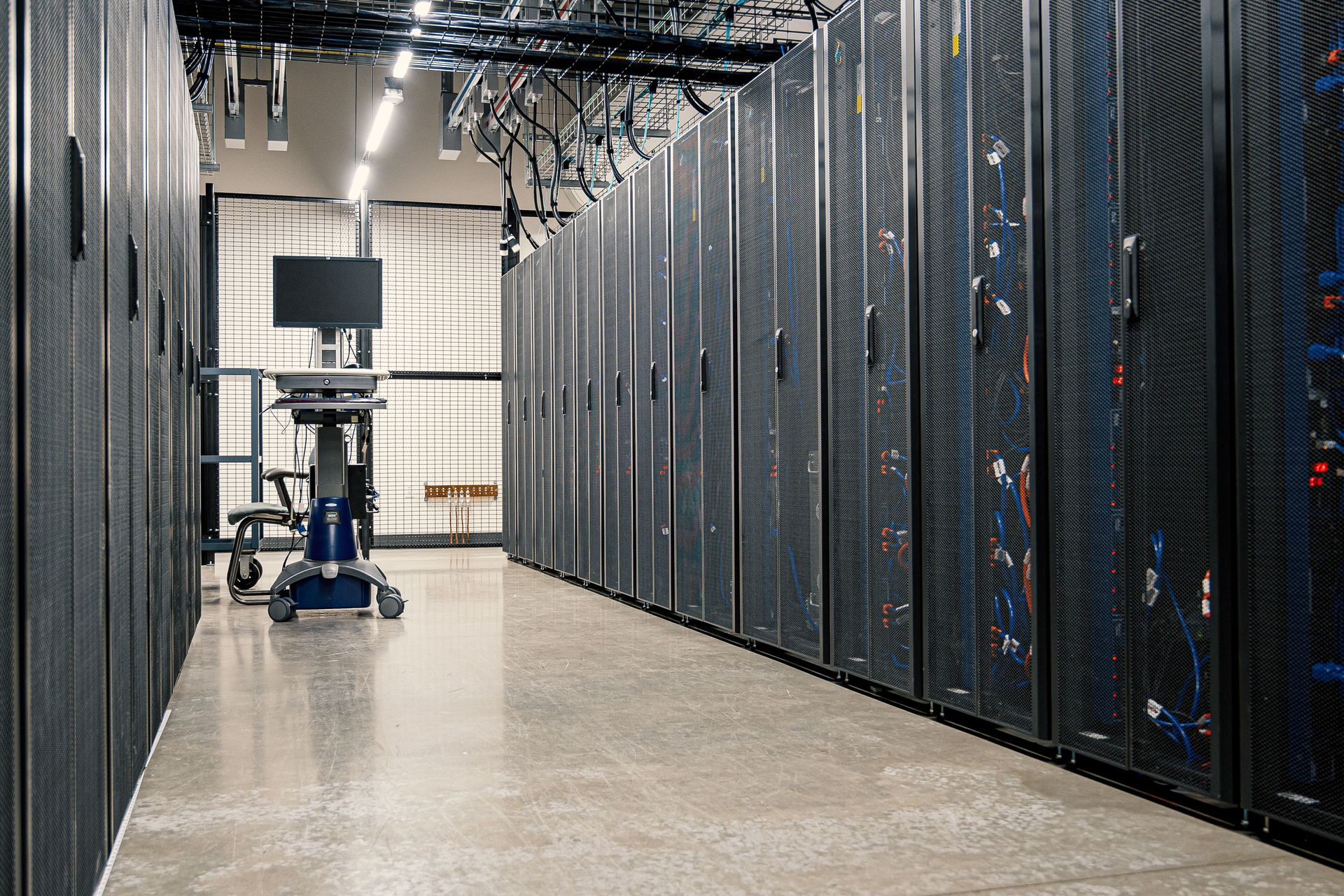
A database is software dedicated to storing information reliably and retrieving it quickly. Nearly every app you use sits on top of one. Your bank balance, your order history, your medical records, and every post you have ever liked all live in databases.
The dominant model for decades has been the relational database, which organizes data into tables of rows and columns, much like spreadsheets. A retailer might keep one table of customers, one of products, and one of orders. The power comes from relationships between tables: each order row points to a customer and a product, so the database can answer questions that span tables, such as "which customers in Cebu bought running shoes last month?" The language used to ask such questions is SQL, short for Structured Query Language, and it is one of the most widely used tools in all of technology.
Databases earn their keep in the unglamorous work of correctness. They guarantee that a transaction either completes fully or not at all — money leaves one account and arrives in another, never half of each. They handle thousands of simultaneous users without letting their changes trample each other. They keep working through power failures by writing changes to durable storage before confirming them.
A newer family, loosely called NoSQL databases, relaxes the rigid table format to handle data that does not fit neat rows: documents, sensor streams, social graphs. These systems often trade some consistency guarantees for the ability to spread data across many machines, a bargain that makes sense at the scale of global consumer apps.
For non-engineers, the useful insight is that most software is a thin layer of screens and buttons over a database. When a product manager asks whether a report is possible, the honest answer usually depends on whether the data was stored in a way that supports the question.
Encryption: scrambling data so only the right people can read it
Credit: Franck / Unsplash
Encryption transforms readable information into an unreadable jumble using a mathematical recipe and a secret value called a key. Anyone holding the correct key can reverse the process and recover the original. Anyone without it sees noise.
The oldest schemes were simple substitutions — Julius Caesar reportedly shifted each letter of military messages three places down the alphabet. Modern encryption is vastly stronger. Standard algorithms such as AES use keys so large that trying every possibility would take the fastest computers longer than the age of the universe. The security rests not on keeping the method secret — the algorithms are published and studied worldwide — but on keeping the key secret.
There are two broad kinds. Symmetric encryption uses the same key to lock and unlock, which is fast but raises a problem: how do two strangers agree on a key without an eavesdropper learning it? Public-key encryption, developed in the 1970s, solves this with key pairs. Each person has a public key, shared openly, and a private key, kept secret. A message locked with your public key can be unlocked only with your private key. It is like a mailbox with a public slot anyone can drop letters into, but only you hold the key to the door.
This machinery runs constantly in the background of daily life. The padlock icon in your browser means your connection uses TLS, a protocol that combines both kinds of encryption to protect what you send and receive. Messaging apps advertising end-to-end encryption mean the keys exist only on your device and the recipient's, so even the company relaying the messages cannot read them.
Encryption also sits at the center of policy fights. Law enforcement agencies in the U.S., the U.K., and elsewhere have pressed for special access to encrypted data. Cryptographers respond that a door built for police is a door, and doors can be forced by anyone.
Hashing: the one-way fingerprint that protects your password

Hashing looks superficially like encryption but serves a different purpose. A hash function takes any input — a password, a document, a full-length movie — and produces a fixed-size string of characters called a hash or digest. Two properties make it useful: the same input always yields the same hash, and the process cannot be run backward. From the hash alone, you cannot recover the input.
Think of it as a fingerprint. A fingerprint identifies a person uniquely for practical purposes, but you cannot reconstruct the person from the print. Hash functions such as SHA-256 produce fingerprints for data. Change even one letter of the input and the hash changes completely, with no resemblance to the original.
The most familiar application is password storage. A responsibly built website never stores your actual password. It stores the hash. When you log in, it hashes what you typed and compares the result to the stored value. If thieves steal the database, they get fingerprints, not passwords. This is why legitimate services can never email you your forgotten password — they genuinely do not have it — and can only offer a reset. It is also why breach announcements distinguish between stolen plaintext passwords, which is a disaster, and stolen hashed passwords, which is serious but survivable. Attackers can still guess common passwords, hash the guesses, and look for matches, which is why unique, long passwords matter and why sites add random data called salt before hashing.
Hashes also verify integrity. Software downloads often publish a hash so you can confirm your copy was not tampered with in transit. Version control systems identify every change by its hash. Blockchains chain blocks of transactions together by including each block's hash in the next, making past records effectively unalterable.
Encryption hides data you intend to recover. Hashing fingerprints data you only need to verify.
Machine learning: software that improves from examples instead of rules

Credit: Canva Images
Traditional programming works by rules. A developer writes explicit instructions: if the email contains this phrase, mark it as spam. Machine learning inverts the approach. Instead of writing rules, engineers feed a system thousands or millions of examples — these 100,000 emails are spam, these 500,000 are not — and the system works out the distinguishing patterns on its own. The result is a model: a mathematical function that maps new inputs to predictions.
The shift matters because many tasks resist explicit rules. No one can write down the full set of rules that distinguishes a photo of a cat from a photo of a dog, or a fraudulent credit card transaction from a legitimate one. Humans recognize these things through accumulated experience, and machine learning gives software an analogous capability: statistical experience distilled from data.
Training a model means adjusting its internal numbers, called parameters, until its predictions on the example data are as accurate as possible. The process is essentially trial and error at enormous speed — make a prediction, measure the error, nudge the parameters to shrink the error, repeat millions of times. Once trained, the model is deployed to make predictions on data it has never seen.
Machine learning's dependence on data is also its central weakness. A model learns whatever patterns its training data contains, including embedded human biases. Hiring models trained on past decisions have penalized women because historical hiring did. Models also fail on situations unlike their training data, and they offer predictions, not explanations — a model can flag a loan applicant as risky without anyone being able to say precisely why.
When you hear that a product "uses AI," it almost always means a machine learning model sits somewhere in the pipeline, trained on examples to score, rank, classify, or generate something. The interesting questions are always the same: trained on what data, optimized for what outcome, and checked how?
Neural networks: the layered math behind modern AI

Credit: Canva Images
A neural network is a particular kind of machine learning model, loosely inspired by the brain, and it powers most of the AI systems in the news: image recognizers, voice assistants, translation tools, and large language models such as the one behind ChatGPT.
The structure is layers of simple units. Each unit, or neuron, receives numbers from the previous layer, multiplies each by a weight, adds them up, and passes the result — squashed through a simple function — to the next layer. Individually, a neuron does almost nothing. Stacked in layers, with millions or billions of weights, the network can represent extraordinarily complex relationships between inputs and outputs. Networks with many layers are called deep, which is where the term deep learning comes from.
Training works by a method called backpropagation. The network makes a prediction, the error is measured, and calculus determines how much each weight contributed to the mistake. Every weight is then nudged slightly in the direction that reduces the error. Repeat this over millions of examples and the weights gradually settle into values that encode useful patterns: edges and textures in early layers of a vision network, whole objects in later layers.
What surprised even researchers is how far scale goes. Larger networks trained on more data with more computing power keep improving, often gaining abilities no one explicitly designed. Large language models are trained on a deceptively simple task — predict the next word in a passage of text — yet at sufficient scale they acquire grammar, factual knowledge, and the ability to follow instructions.
The cost of this power is opacity. A network's knowledge is smeared across billions of numbers, and no one can point to the weight that stores a given fact. Understanding why a network produced a specific answer is an open research field, called interpretability, with direct stakes for medicine, lending, and law.
The cloud: renting someone else's computers
Credit: Christina Morillo / Pexels
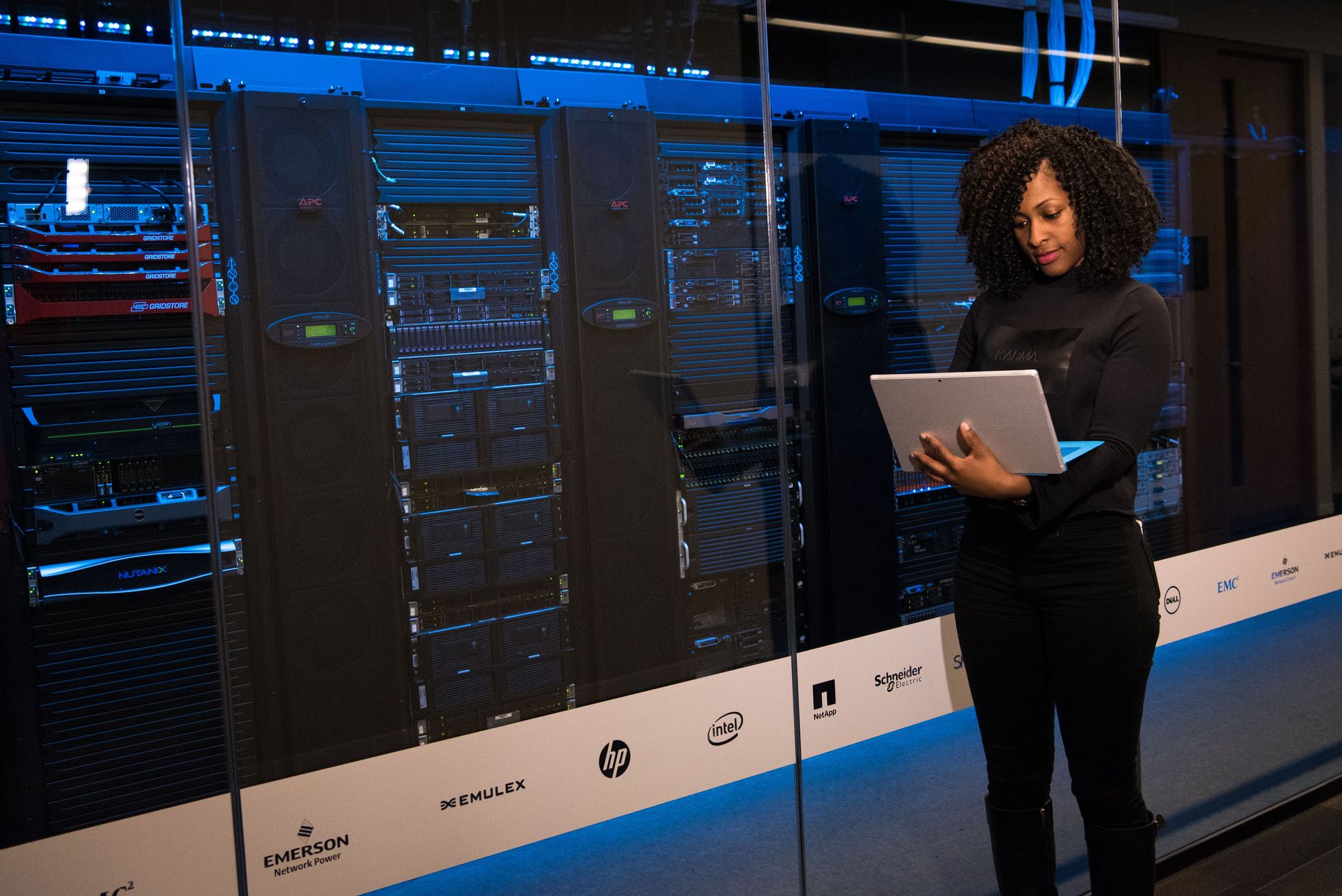
The cloud is not a place or a technology. It is a business model: instead of buying and running your own servers, you rent computing power, storage, and services from a provider's data centers and pay for what you use. Amazon $AMZN Web Services, Microsoft $MSFT Azure, and Google $GOOGL Cloud dominate the market, operating warehouse-sized facilities filled with hundreds of thousands of machines.
Before the cloud, launching an online product meant buying physical servers, installing them in a data center, and guessing how much capacity you would need. Guess low and your site crashed under success. Guess high and money sat idle in racks. Cloud providers turned that capital expense into an operating expense. A startup can rent one small virtual machine for a few dollars a month, then scale to thousands of machines during a spike and release them afterward. This elasticity, more than cost, is the cloud's defining feature.
A key enabling technology is virtualization: software that slices one physical machine into many isolated virtual machines, each behaving like an independent computer. Providers layer services on top — managed databases, file storage, machine learning tools — so customers assemble infrastructure the way they might order from a catalog.
Familiar consumer products are cloud services too. When your phone backs up photos, streams a movie, or syncs documents, the files live in a provider's data center, not in the air. "The cloud" is always a specific building, with a street address, cooling systems, and an electric bill.
The model has tradeoffs. Companies gain reliability and speed but surrender physical control, and moving off a provider is hard once systems entangle with its proprietary services — a bind known as vendor lock-in. Regulators in the E.U. and elsewhere also scrutinize where data physically resides, since a server's location determines whose laws apply to it.
Caching: keeping a copy close so you don't fetch it twice

Credit: Heather McKean / Unsplash
Caching is one of the most widely used performance tricks in computing: store a copy of frequently needed data somewhere fast, so the system does not repeat expensive work. It is the digital equivalent of keeping salt on the counter instead of walking to the pantry every time you cook.
The principle appears at every level of the stack. A processor keeps tiny, ultra-fast caches on the chip itself, because fetching data from main memory takes hundreds of times longer than reading it from cache. Your web browser caches images and scripts from sites you visit, which is why a page loads faster the second time. Apps cache the results of database queries so the same question is not recomputed for every user. Content delivery networks, or CDNs, are caching at planetary scale: companies such as Cloudflare and Akamai $AKAM keep copies of popular content in data centers near users, so a video watched in Jakarta streams from Singapore rather than Virginia.
Caching works because access patterns are lopsided. A small fraction of data accounts for most requests — today's front page, the trending video, your own inbox. Keeping that hot fraction close yields outsized gains.
The catch is staleness. A cached copy can fall out of date the moment the original changes, and deciding when to refresh or discard copies is genuinely hard. A famous line among programmers, attributed to Netscape engineer Phil Karlton, holds that there are only two hard things in computer science: cache invalidation and naming things. Stale caches explain everyday oddities: a website showing your old profile photo after you changed it, or a price that differs between your phone and your laptop.
When support articles tell you to clear your cache, they are asking you to throw away possibly corrupted local copies and fetch fresh ones. It works more often than it should.
Compression: making files smaller without losing what matters

Credit: Timur Weber / Pexels
Compression shrinks data so it takes less space to store and less time to transmit. Without it, modern media would be impractical: an uncompressed two-hour movie at high definition would occupy terabytes, and streaming it over a home connection would be impossible.
There are two families. Lossless compression shrinks data in a way that can be perfectly reversed. It works by finding and exploiting redundancy. Text is full of repeated patterns — common words, spaces, recurring phrases — and a lossless algorithm replaces repetitions with short references, like writing "ditto" instead of copying a line. ZIP files and PNG images use lossless methods. Decompress them and you get back every original bit, which is essential for documents, spreadsheets, and code, where a single changed character matters.
Lossy compression goes further by permanently discarding information that humans are unlikely to notice. JPEG images throw away fine color detail the eye barely registers. MP3 and AAC audio discard sounds masked by louder sounds nearby. Video formats such as H.264 store only the differences between consecutive frames, since most of a scene stays still from one frame to the next. The savings are dramatic — often 10 to 100 times smaller — at the cost of some fidelity. Compress a JPEG repeatedly and the artifacts compound, which is why memes reposted for years look increasingly muddy.
The tradeoff between size and quality is adjustable, and companies tune it constantly. Streaming services encode each title at multiple quality levels and switch between them as your connection fluctuates, which is why video sometimes turns blocky mid-scene and sharpens moments later.
There is also a hard limit. Information theory, founded by Claude Shannon in 1948, proves that truly random data cannot be compressed at all. Compression is possible only because real-world data is predictable, and it works by squeezing out exactly that predictability.
Open source: software anyone can inspect, use, and improve

Credit: Mikhail Nilov / Pexels
Open-source software is software whose source code — the human-readable instructions programmers write — is published for anyone to read, modify, and redistribute under a license that guarantees those freedoms. It is the opposite of proprietary software, where the code is a trade secret and users get only the finished product.
The model sounds like charity but functions more like shared infrastructure. The Linux operating system runs most of the world's servers, the majority of smartphones through Android, and every one of the top 500 supercomputers. The Apache and Nginx web servers deliver much of the web. Programming languages such as Python, databases such as PostgreSQL, and the encryption libraries securing online commerce are all open source. A typical commercial app today is a thin layer of proprietary code atop a deep stack of open components.
Companies participate for hard-nosed reasons. Sharing maintenance of common plumbing is cheaper than each firm building its own. Open code attracts scrutiny from many eyes, which tends to surface bugs and security flaws. Engineers prefer working with tools they can inspect, so open source aids recruiting. Google $GOOGL, Microsoft $MSFT, Meta $META, and IBM $IBM now rank among the largest contributors, and Microsoft — whose former chief executive Steve Ballmer once called Linux a cancer — bought GitHub, the main platform where open-source code lives, in 2018.
The model has strains. Critical projects are sometimes maintained by a handful of unpaid volunteers, a fragility exposed in 2021 when a flaw in Log4j, a small logging library embedded in millions of systems, triggered a global security scramble. Licensing fights have also grown as cloud providers sell hosted versions of open projects without funding them.
For non-engineers, open source explains why so many software components are free, why security depends on the health of obscure volunteer projects, and why "we built it" in a product pitch usually means "we assembled it from parts the whole industry shares."
Version control: how teams change code without destroying it

Credit: Arnold Francisca / Unsplash
Version control is the system that lets many programmers modify the same codebase simultaneously without overwriting each other's work, and lets any past state of the project be recovered exactly. The dominant tool is Git, created by Linus Torvalds in 2005 to manage development of Linux, and it underlies collaboration platforms such as GitHub and GitLab.
The core idea is the commit: a snapshot of the project at a moment in time, stamped with the author, the date, and a message describing what changed and why. A project's history is a chain of commits stretching back to its first line of code. Nothing is ever really deleted. If Tuesday's change broke something, the team can compare snapshots, pinpoint the exact lines that changed, and roll back.
The second idea is branching. A developer starting a risky feature creates a branch — a parallel copy of the project — and works there without disturbing the main version that customers use. When the feature is finished and reviewed, the branch is merged back in. Dozens of branches can proceed at once. When two people change the same lines, the tool flags a merge conflict and a human decides which version wins.
Around these mechanics, teams have built a review culture. On GitHub, proposed changes arrive as pull requests, which teammates read, comment on, and approve before merging. The result is a permanent, searchable record of not just what the code says but why every line exists — often the best documentation a company has.
The concept has spread beyond code. Legal teams, writers, and scientists increasingly track documents and data the same way. Anyone who has emailed a file named report_final_v3_REALLY_FINAL.docx has felt the problem version control solves. The tool's learning curve is real, but the payoff is a team that can experiment freely, because no mistake is permanent and no earlier state is ever lost.
Operating systems: the software that runs all the other software

Credit: Tom Fisk / Pexels
An operating system is the master program that manages a computer's hardware and provides a stable platform for every other program. Windows, macOS, and Linux run desktops and servers; iOS and Android run phones. Without one, every app would need its own code for talking to disks, screens, keyboards, and network chips — an impossible duplication.
The operating system's first job is resource management. Your laptop may show 40 open programs, but the processor can only execute a few instructions streams at once. The OS scheduler switches between programs thousands of times per second, giving each a slice of processor time so quickly that everything appears simultaneous. It performs a similar juggling act with memory, granting each program its own protected space and evicting less-used data to disk when memory runs short.
The second job is protection. The OS walls programs off from each other and from the hardware, so a crashing game cannot corrupt your spreadsheet, and a malicious app cannot read your banking app's memory. Permissions systems — the prompts asking whether an app may use your camera or location — are the OS enforcing boundaries. Security updates matter so much because a flaw in the operating system undermines every program above it.
The third job is abstraction. The OS presents messy hardware as clean, simple concepts. Physical storage is a maze of spinning platters or flash memory cells; the OS presents it as files and folders. Networks are electrical pulses and radio waves; the OS presents them as connections you open and close.
Control of an operating system confers enormous market power, because it determines what software can exist and on what terms. Antitrust cases against Microsoft $MSFT in the 1990s and against Apple $AAPL and Google $GOOGL today all turn on the same question: what may the owner of the platform demand from those who build on it?
Compilers and interpreters: turning human-readable code into action

Credit: Canva Images
Programmers write code in languages such as Python, Java, and C++, which are designed for human comprehension, full of English words and mathematical notation. Processors understand none of it. They execute only machine code — raw binary instructions specific to the chip. Something must bridge the gap, and the two main bridges are compilers and interpreters.
A compiler translates an entire program into machine code ahead of time, producing an executable file. The translation happens once, on the developer's machine, and users run the finished binary. Languages such as C, C++, Rust, and Go work this way. The advantages are speed — the translation cost is paid in advance, and compilers optimize aggressively — and early error detection, since the compiler inspects the whole program before anything runs. The .exe files on Windows are compiled output.
An interpreter translates and executes code on the fly, line by line, every time the program runs. Python and JavaScript traditionally work this way. Development feels faster — change a line, run it immediately, no build step — and the same code runs on any machine with the interpreter installed. The cost is execution speed, since translation happens during every run.
Modern systems blur the line. Java compiles to an intermediate bytecode that a virtual machine then executes, often converting hot spots to machine code mid-run through just-in-time compilation. Today's JavaScript engines inside browsers do the same, which is how web apps became fast enough to rival desktop software.
The practical relevance for non-engineers is mostly about tradeoffs you can now decode. When engineers say a language is fast or slow, they usually mean compiled versus interpreted. When they mention a build pipeline, they mean the compilation and packaging steps between writing code and shipping it. And when a build breaks, it means the translation step found errors — better there than on a customer's screen.
Bugs and debugging: why software breaks and how it gets fixed

Credit: Canva Images
A bug is a flaw in software that makes it behave differently than intended. The term predates computers — engineers used it in the 19th century, and Thomas Edison complained of bugs in his inventions — but it stuck in computing after 1947, when Grace Hopper's team at Harvard found an actual moth jammed in a relay of the Mark II computer and taped it into the logbook.
Bugs are not anomalies. They are a statistical certainty. Large applications contain millions of lines of code written by hundreds of people over years, and every line encodes assumptions that can turn out wrong. Common species include off-by-one errors, where a loop runs one time too many or too few; null references, where code tries to use data that does not exist; race conditions, where two simultaneous operations collide in rare timing windows; and edge cases, inputs the developers never anticipated, like a user whose legal name is one letter or a date of Feb. 29.
Debugging — finding and fixing the flaw — is detective work. The first task is reproduction: making the failure happen on demand, because a bug you cannot reproduce is nearly impossible to fix. Then comes isolation, narrowing down which component misbehaves, often by adding logging or stepping through the program one instruction at a time with a debugger. The fix itself is frequently a single line. Finding that line can take days.
The industry's main defense is prevention: automated tests that run on every change, code review by a second person, and languages designed to make whole categories of error impossible. None of it reaches zero. This is why software ships with known minor bugs, why patches arrive continuously, and why "have you tried turning it off and on again" endures — restarting clears the accumulated bad state that some undiscovered bug left behind.
Latency and bandwidth: the two ways a connection can be slow

Credit: Emre Ateşoğlu / Pexels
People describe internet connections with one word — fast or slow — but engineers measure two independent properties, and confusing them leads to bad purchasing decisions and worse product decisions.
Bandwidth is capacity: how much data can move per second, measured in megabits or gigabits. Latency is delay: how long a single piece of data takes to make the round trip between you and a server, measured in milliseconds. The classic analogy is a highway. Bandwidth is the number of lanes. Latency is the length of the road. Adding lanes lets more cars through per hour, but it does not shorten anyone's trip.
Different activities stress different properties. Streaming video is a bandwidth problem: the service needs to push a steady, large flow of data, and a few hundred milliseconds of delay is invisible because the player buffers ahead. Video calls and online games are latency problems: each moment must arrive nearly instantly, and no amount of bandwidth compensates for a 300-millisecond lag. This is why a gamer with modest bandwidth and low latency has a better experience than one with a gigabit connection routed halfway around the world.
Physics sets a floor under latency. Data travels through fiber at roughly two-thirds the speed of light, so a round trip from New York to Singapore cannot beat about 150 milliseconds no matter how much anyone spends. Distance is why global services replicate data in regional centers, why financial firms pay premiums for straighter fiber routes between exchanges, and why satellite internet from low-orbit constellations such as Starlink beats older satellites parked 22,000 miles higher — the shorter distance cuts the delay from over half a second to tens of milliseconds.
When something feels slow, the diagnostic question is which kind of slow: a thin pipe or a long one. The remedies are entirely different.
IP addresses and DNS: the internet's addresses and phone book

Credit: Leandro Barreto / Unsplash
Every device connected to the internet has an IP address, a numerical label such as 172.217.4.46 that identifies where data should be delivered. IP stands for Internet Protocol, the shared set of rules governing how data moves between networks. When your laptop requests a web page, the request is broken into small chunks called packets, each stamped with the destination address, and routers along the way pass each packet hop by hop toward it — much as postal systems route letters by reading the envelope, not the contents.
Humans are bad at remembering numbers, so the internet has a phone book: the Domain Name System, or DNS. When you type a website name, your device first asks a DNS server to translate the name into an IP address, then connects to that address. The lookup takes milliseconds and happens invisibly billions of times a day. DNS is organized as a global hierarchy — root servers point to servers for .com or .org, which point to servers for individual domains — and no single computer holds the whole book.
This translation layer is a point of both flexibility and fragility. Companies can move services to new servers by updating a DNS record, without users noticing. But when major DNS providers fail, as happened in a 2016 attack on the provider Dyn, huge swaths of the web become unreachable even though the sites themselves are running fine — the addresses exist, but no one can look them up. Governments also censor at this layer, ordering ISPs to return wrong answers for banned sites.
One more wrinkle: the original addressing scheme, IPv4, allows about 4.3 billion addresses, far too few for a world of phones, cars, and thermostats. Its successor, IPv6, provides an effectively inexhaustible supply, and the two systems now run side by side during a transition that has lasted decades.
Cookies: the small files that give the web a memory

Credit: Sarah Blocksidge / Pexels
The web's underlying protocol, HTTP, is stateless: each request a browser makes stands alone, and the server retains no built-in memory of who asked. Left uncorrected, that design would make you log in again on every page and would empty your shopping cart with every click. Cookies are the fix. A cookie is a small piece of text a website asks your browser to store and send back with every future request to that site.
The mechanics are mundane. When you log in, the server generates a random session identifier, stores it alongside your account, and hands it to your browser as a cookie. On each subsequent request, the browser presents the cookie, and the server recognizes you. The same mechanism remembers language preferences, keeps carts full, and lets "remember me" checkboxes work. These first-party cookies — set by the site you are actually visiting — are largely uncontroversial plumbing.
The controversy comes from third-party cookies. Pages routinely embed content from other companies: ad slots, analytics scripts, social media buttons. Each embedded party can set its own cookie, and because the same ad networks appear across thousands of sites, they can recognize the same browser everywhere it goes, assembling a detailed profile of browsing behavior. This is the machinery behind ads that follow you around the web after you glance at a product once.
Regulation and market forces have squeezed the practice. The E.U.'s privacy rules produced the consent banners now blanketing the web. Apple $AAPL's Safari and Mozilla's Firefox block third-party cookies by default, and Google $GOOGL spent years on a stop-start plan to restrict them in Chrome while advertisers, publishers, and the U.K.'s competition regulator fought over the replacement. Meanwhile, tracking has partly shifted to sneakier techniques such as fingerprinting, which identifies browsers by their unique configuration details, no stored file required.
Concurrency: doing many things at once without chaos

Credit: Peggy Anke / Pexels
Concurrency means a program managing multiple tasks in overlapping time periods — handling thousands of website visitors at once, downloading a file while you keep scrolling, or spreading a calculation across the many cores of a modern processor. It is essential to nearly all serious software, and it is one of the hardest things in programming to get right.
For decades, software got faster automatically because chips got faster. Around the mid-2000s, physics intervened: raising clock speeds further generated unmanageable heat. Manufacturers pivoted to putting multiple processing cores on each chip. A laptop today may have eight or more cores, but a program written as a single sequence of steps uses only one. Exploiting modern hardware requires splitting work into pieces that run in parallel.
The trouble starts when concurrent tasks share data. Suppose two threads of a banking program each try to add money to the same account at the same instant. Each reads the balance, adds its deposit, and writes the result back. If their steps interleave badly, the second write overwrites the first, and one deposit silently vanishes. This is a race condition — a bug that depends on precise timing, which means it appears rarely, disappears when you look for it, and may surface only under heavy production load.
The standard defense is the lock: a task claims exclusive access to shared data, works, and releases it, forcing others to wait. Locks bring their own hazard, deadlock, where two tasks each hold a lock the other needs and both wait forever, like two people paused in a doorway each insisting the other go first.
When engineers describe a system as thread-safe, or explain that a bug "only happens under load," or ask for time to redesign something for parallelism, this is the territory. Concurrency bugs are among the most expensive in software because they hide until scale finds them.
The client-server model: how the internet divides its labor

Credit: Matheus Bertelli / Pexels
Nearly everything you do online follows one pattern: a client asks, a server answers. The client is the software near you — a browser, a mobile app — responsible for displaying information and collecting your input. The server is a program on a remote machine, responsible for storing data, enforcing rules, and doing the heavy computation. Every page load, message send, and video stream is a round of this request-and-response game.
The division of labor is deliberate. Servers hold the authoritative data and the business logic, because clients cannot be trusted — anyone can modify an app on their own device. When you buy something online, your browser merely sends your intent; the server checks the price, validates the payment, and records the order. This is why prices displayed in your app cannot simply be edited into discounts, and why security flaws described as server-side are graver than cosmetic client bugs.
The split also explains everyday behavior. When an app works offline, you are seeing cached client-side data; anything requiring fresh information or a permanent change needs the server. When a service is down, its clients are fine — millions of working apps staring at an unresponsive counterpart. When your phone app updates constantly, some changes are client cosmetics, while others track changes in the server's expectations.
Engineers split further within each side. Front-end developers build the client experience; back-end developers build the server systems; full-stack developers span both. Behind a large service, the server is not one machine but fleets of them, with load balancers distributing incoming requests across the fleet the way a host seats arriving diners across open tables.
An alternative pattern, peer-to-peer, lets devices talk directly to each other — BitTorrent and some video-calling paths work this way — but the client-server model dominates because centralizing data and control is simpler to secure, bill, and update.
Technical debt: the interest a company pays on quick fixes

Credit: barış erkin / Pexels
Technical debt is the future cost incurred when software is built the quick way instead of the sound way. The metaphor, coined by programmer Ward Cunningham in 1992, is deliberate: like financial debt, shortcuts let you ship sooner, and like financial debt, they charge interest. Every future change to messy code takes longer, breaks more easily, and demands more testing. Left unpaid long enough, the interest can consume most of a team's capacity.
Debt accumulates in ordinary, defensible ways. A startup racing to demo hard-codes assumptions it plans to fix later. A team bolts a feature onto a structure never designed for it because the redesign would take a quarter. A developer copies a block of code instead of restructuring it, leaving two versions that must now be updated in tandem. Each decision is locally reasonable. The accumulation is what hurts — and unlike financial debt, no ledger displays the balance. It reveals itself as symptoms: estimates that balloon, simple changes that cause unrelated breakage, systems only one veteran employee understands, and engineers who resign rather than keep patching.
Paying debt down is called refactoring: restructuring code to be cleaner without changing what it does. It is real work that produces nothing visible to customers, which is why it loses budget fights to new features — and why some companies eventually face a wholesale rewrite, among the riskiest projects in software. The 2017 Equifax breach illustrated the extreme end of deferred maintenance: attackers entered through a known flaw in an outdated component the company had failed to patch.
Technical debt is often the honest answer to a common executive question: why does adding one button take six weeks? The button is easy. The button is being installed in a structure held together by ten years of shortcuts, and every nail risks the wall.