
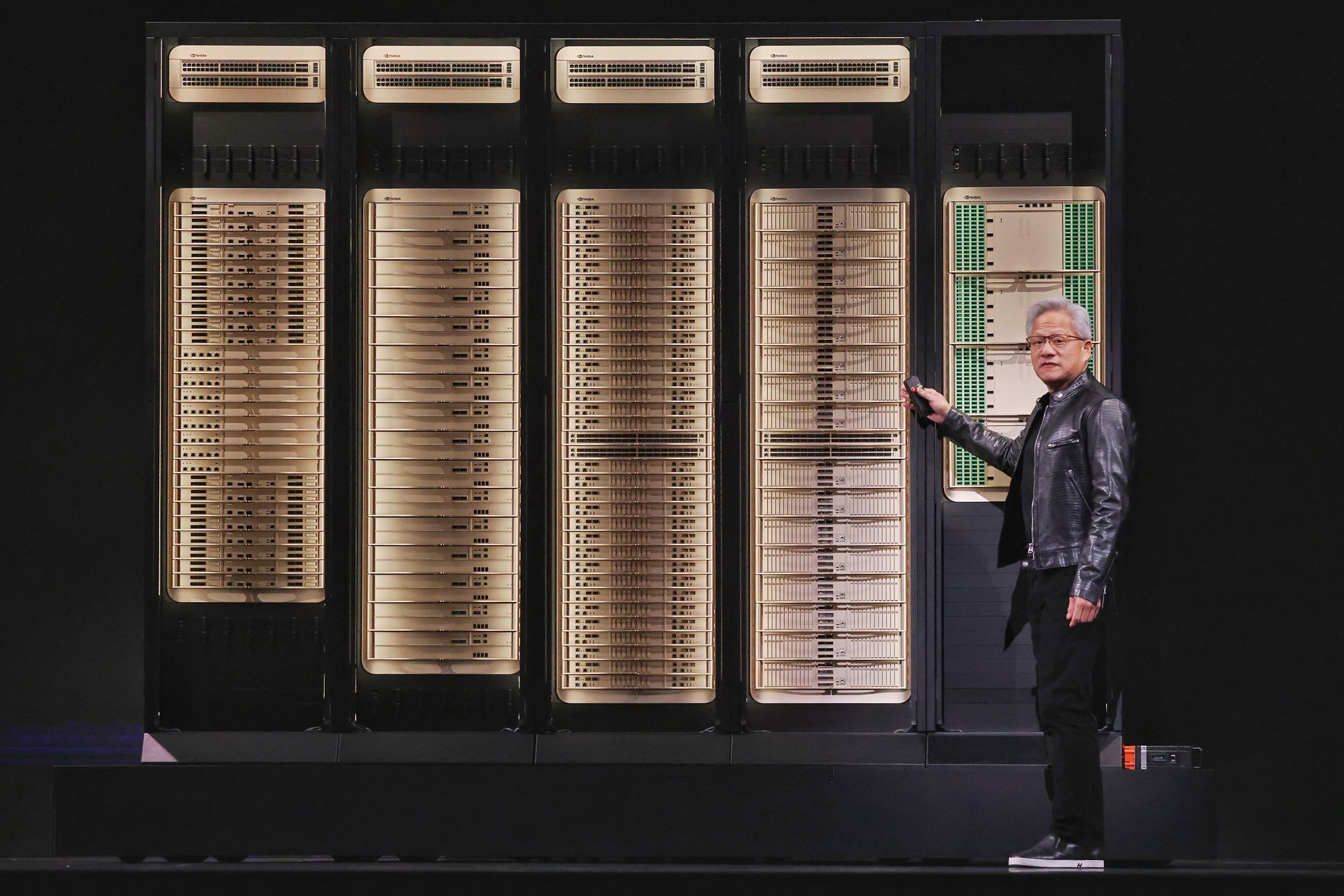
Six companies are trying to build their own AI chips and loosen Nvidia $NVDA's grip on the chip market. Google $GOOGL and Amazon $AMZN are already shipping theirs at scale. Microsoft $MSFT and Meta $META are just now getting their own chips into production. OpenAI and Tesla $TSLA are only at the design stage, lagging their competitors by years rather than months.
Each company has picked a different partner and a different timeline to close the gap. Google designs its chips with Broadcom $AVGO, a chip design and networking company, and manufactures them at TSMC $TSM, the Taiwanese company that makes chips for nearly every firm on this list. Tesla is the outlier, betting on a chip plant of its own instead of a place in TSMC's line.
Nvidia's current market position gives it leverage. Bloomberg Intelligence projects the company will hold 70% to 75% of the AI chip market through 2030. That dominance is what's pushing companies to spend billions designing custom chips instead.
The companies already shipping chips
Google is seven generations deep into its custom AI chip program. The company announced its newest version, called Ironwood, earlier this year. Ironwood is built for inference — the work of running an already trained AI model — and Google can already link up to 9,216 Ironwood chips into a single cluster to run that work at scale. Any Google Cloud customer in North America and Europe can already rent access to it.
Amazon is close behind Google. Its Annapurna Labs subsidiary announced that Trainium3, the newest in its fourth generation of AI training chips, went on sale in December 2025. It's also AWS's first chip built on a more advanced manufacturing process than any of its predecessors, roughly the same scale used in today's newest phone chips. The chip also supports PyTorch, the software most developers already use to build AI models. Developers can switch to Amazon's chips without rewriting any code.
PyTorch support is turning into real revenue for Amazon. Amazon CEO Andy Jassy said in late 2025 that Trainium2, the previous generation, had no spare capacity left to sell. He said it had grown into a multibillion-dollar business at a 150% quarterly clip. Amazon's next chip, Trainium4, which packs three times the performance of its predecessor, could arrive later this year.
Microsoft is moving just as fast, and like Google, it's building for inference rather than training. It announced Maia 200, a chip built for that work, in January 2026, and the chip is already reaching a handful of U.S. data centers. Microsoft says Maia 200 runs at 30% better performance per dollar than the fastest hardware already in its fleet. The chip will power OpenAI's newest models, along with Microsoft's own AI products, such as Copilot.
Microsoft skips Nvidia's specialized networking hardware and connects its chips using standard Ethernet, the same kind of network already found in most data centers. A custom software layer runs on top of that network, scaling up to clusters of 6,144 chips.
Meta is taking a different path with its chip program, called MTIA, short for Meta Training and Inference Accelerator. Meta has said its early MTIA chips were built for the narrower job of ranking and recommending content. Those chips used simpler, cheaper memory instead of the faster kind found in Nvidia's chips.
The newest version, MTIA 300, is already in production for ranking and recommendation work. Meta is set to build three more generations over the next two years with the purpose of running generative AI models. The next one, MTIA 450, arrives in early 2027, doubling how fast the chip moves data in and out of memory. Its eventual successor, MTIA 500, is expected to come later next year, and pushes memory speed another 50% higher.
The companies still waiting to ship chips
OpenAI is at an earlier stage than any of these companies. It announced a partnership with Broadcom in October 2025 to build 10 gigawatts of custom AI chips, a measure of how much power the new chips will draw once installed. None of those chips has shipped yet. Installing them is set to begin in the second half of 2026 and run through the end of 2029. Unlike Google, which sells access to its chips through the cloud, OpenAI will keep every one of its chips for itself.
Tesla is behind OpenAI on chip design but ahead on one thing: it already has a real factory plan, something no other company on this list can match yet. Tesla finished the design of its AI5 inference chip in April 2026, according to Reuters. Production is planned at both TSMC's plant in Arizona and Samsung's plant in Texas.
CEO Elon Musk says the new chip delivers about five times the processing power of the current AI4 setup. He also says it matches the performance of the Nvidia H100, the chip much of the industry treats as its benchmark, on the jobs Tesla actually runs its chips for. Tesla is targeting mid-2027 for mass production. The chip itself is meant to run AI directly inside cars and Optimus, the company's humanoid robot, instead of in a data center.
The company's larger ambition sits outside the chip itself. SpaceX, Musk's other property, filed plans in May for a $55 billion chip manufacturing plant in Texas called Terafab, Reuters reported. Total investment in the plant could reach $119 billion.
The plant would use a manufacturing process licensed from Intel $INTC. Its whole purpose is to help Tesla avoid waiting in TSMC's line entirely. Every other company on this list is still standing in that line.
Broadcom doesn't need any single company to win this race, since it already gets paid whether Google's chips ship or OpenAI's do. The company reported $5.2 billion in AI-related revenue for the third quarter of its 2025 fiscal year.
Musk's chip company and his rocket company are now building the same factory for the same reason. But SpaceX has already admitted it might not pull it off. Tesla's AI5 chip may depend on TSMC and Samsung after all.