The infrastructure of the global economy was built in specific rooms by specific people making choices that still govern how money moves today

Atlantic Ambience / Pexels
The global economy is not a natural phenomenon. It is a constructed one — built from specific decisions made at specific moments by specific people, many of whom were operating under time pressure, incomplete information, and political constraints that shaped what was possible. The reserve currency status of the US dollar was not the inevitable outcome of American economic dominance; it was a negotiating outcome from a three-week conference in New Hampshire in 1944 that could have gone differently. The double-entry bookkeeping system that underlies every company's financial reporting was codified by a Franciscan friar in 1494 whose textbook became the standard before any regulatory body had the authority to enforce one. The interest rate that governs borrowing costs for hundreds of trillions of dollars of financial contracts was, for decades, calculated by a small number of banks reporting numbers to a trade association on an honor system.
The decisions in this list share a specific characteristic: they were made by small groups of people — sometimes committees, sometimes individuals, sometimes accident — and they produced outcomes that scaled to become foundational infrastructure for the entire global economy. The people who made them were often aware of their significance, sometimes were not, and in several cases made decisions that produced consequences they did not intend and could not have predicted.
Understanding how these decisions were made — and how contingent they were on the specific circumstances of their moment — is useful not only as history but as a corrective to the assumption that the economic world we inhabit is the only possible one. Bretton Woods could have produced a different reserve currency arrangement. The container could have been a different size. The Black-Scholes formula could have remained academic. Each of these choices was made by people with specific interests, specific information, and specific constraints — and each one produced a world that billions of people now live in without knowing the room it was made in.

Barry Livingstone / Wikimedia Commons (CC BY-SA 3.0)
In July 1944, 730 delegates from 44 Allied nations gathered at the Mount Washington Hotel in Bretton Woods, New Hampshire, for a three-week conference to design the post-war international monetary system. The outcome — the Bretton Woods agreement — established the US dollar as the world's reserve currency, pegged to gold at $35 per ounce, with all other currencies pegged to the dollar. It created the International Monetary Fund and the World Bank as institutions to manage the resulting system.
The key negotiating contest was between John Maynard Keynes, representing Britain, and Harry Dexter White, representing the United States. Keynes proposed a new supranational currency — the bancor — as the reserve asset, specifically to prevent any single country from gaining the "exorbitant privilege" of issuing the world's reserve currency. White insisted on the dollar. Britain's economic dependence on American wartime lending gave White the negotiating leverage to prevail.
The consequences of White's position winning: the United States gained the ability to run persistent current account deficits without the currency crises that constrain other nations, because global demand for dollar reserves meant that dollars spent abroad were recycled back into US Treasury bonds rather than converting to other currencies. This structural privilege has been worth trillions of dollars to the US economy over eight decades and remains the single most consequential outcome of the Bretton Woods conference — an outcome that was not predetermined but was the result of specific negotiating leverage in a specific three-week window.

Rusky / Wikimedia Commons (CC BY-SA 4.0)
The standard intermodal shipping container — 20 feet or 40 feet long, 8 feet wide, 8.5 feet tall — was invented by Malcom McLean in 1956, but the specific dimensions that became the global standard were not McLean's original dimensions. They were the result of a 1961 decision by the International Organization for Standardization (ISO) to adopt a specific set of container dimensions as the international standard, a decision made in committee after years of competing proprietary standards threatened to produce an incompatible global system.
The containerization of global shipping is widely recognized as one of the most consequential logistical innovations in history — it reduced the cost of loading and unloading cargo so dramatically (from approximately $5.86 per ton by traditional break-bulk methods to approximately $0.16 per ton by container) that it effectively eliminated the cost of distance as a significant factor in manufacturing location decisions, enabling the globalization of supply chains that defined the second half of the 20th century.
Less recognized is that this transformation depended entirely on standardization — on different shipping companies, ports, railroads, and trucking companies all agreeing to use the same container dimensions. A world in which McLean's Sea-Land containers, Matson's containers, and European rail containers had remained different sizes would have been a world in which the efficiency gains of containerization were much smaller. The ISO committee's 1961 decision — specifically the choice of 20-foot and 40-foot as the standard lengths — determined the physical dimensions of the global supply chain.
-1920x1280.jpg)
Edmond J. Safra Center for Ethics / Wikimedia Commons (CC BY 2.0)
In October 1979, Federal Reserve Chairman Paul Volcker announced a fundamental change in how the Fed would conduct monetary policy: instead of targeting interest rates directly, the Fed would target the money supply and allow interest rates to find their own level. The practical consequence was that interest rates rose dramatically — the federal funds rate peaked at approximately 20% in June 1981 — producing the most severe recession in the United States since the Great Depression but breaking the inflationary spiral that had characterized the 1970s.
The decision was made by Volcker and a small group of Federal Open Market Committee members, against significant political opposition (the Carter and Reagan administrations both pressured the Fed to ease, and farmers drove tractors to the Fed's Washington headquarters in protest). The Fed's independence — its ability to make this decision over the objections of elected politicians — was itself a structural feature of the American political economy that was tested by the Volcker shock and survived.
The long-term consequences: inflation in the United States fell from approximately 14% in 1980 to approximately 3% by 1983 and remained low for the following three decades. The credibility of independent central bank inflation targeting — the idea that a technocratic institution insulated from electoral politics could maintain price stability — was established by the Volcker shock and became the dominant model of monetary policy in developed economies for the following 40 years.

Attributed to Jacopo de' Barbari / Wikimedia Commons
In 1494, the Franciscan friar Luca Pacioli published Summa de arithmetica, geometria, proportioni et proportionalità — a comprehensive mathematics textbook that included, as one of its sections, the first printed description of double-entry bookkeeping, the system in which every financial transaction is recorded as both a debit and a credit, ensuring that accounts balance and errors are detectable.
Double-entry bookkeeping had been practiced by Italian merchants, particularly in Venice and Genoa, since at least the 13th century. Pacioli did not invent it — he documented and systematized a practice that already existed. But the codification in print, in a widely distributed textbook, at precisely the moment when the printing press was enabling the rapid spread of standardized knowledge, produced the adoption of a single system across European commerce before any regulatory authority existed to mandate one.
The consequences of this specific system becoming universal: the debit-credit structure of double-entry bookkeeping is the foundation of every financial statement produced by every company in the world today, the basis of GAAP (Generally Accepted Accounting Principles) and IFRS (International Financial Reporting Standards), and the conceptual architecture within which modern corporate finance, investment analysis, and financial regulation operate. A different accounting system codified at a different moment could have produced a different architecture — the historical accident of Pacioli's timing and distribution made one specific system universal.
Jeremy Kemp / Wikimedia Commons
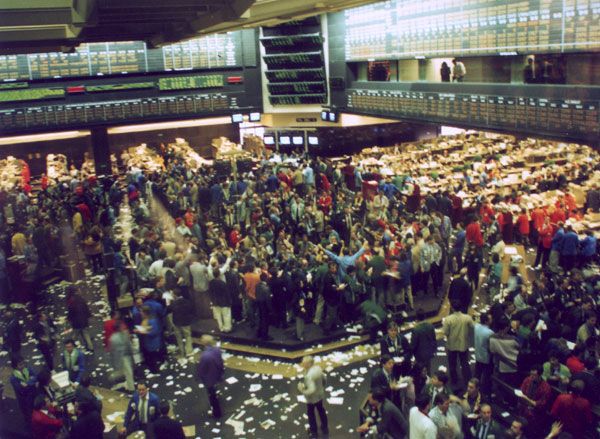
In 1973, Fischer Black and Myron Scholes published "The Pricing of Options and Corporate Liabilities" in the Journal of Political Economy — a paper that provided, for the first time, a closed-form mathematical formula for pricing options contracts. The formula was immediately adopted by the Chicago Board Options Exchange, which had opened in the same year and was struggling with the problem of how to price the contracts it was trading.
The Black-Scholes formula — and its extension by Robert Merton, who shared the 1997 Nobel Prize in Economics with Scholes (Black had died in 1995) — created the theoretical foundation for the modern derivatives market, which by the early 21st century had grown to a notional value exceeding $600 trillion. By providing a mathematically rigorous method for pricing options, it enabled the confident trading of instruments whose value had previously been estimated by intuition and rule of thumb.
The formula's assumptions — particularly that price movements follow a log-normal distribution (the "random walk" assumption) and that volatility is constant — have been known since publication to be imperfect approximations of reality. The 1987 Black Monday crash, the 1998 LTCM collapse, and the 2008 financial crisis all involved situations in which the real distribution of price movements diverged dramatically from the Black-Scholes assumptions. The formula created a market it could not fully describe, and the gap between the model and reality became a recurring source of financial fragility.

Unnerving duck / Wikimedia Commons (CC BY-SA 4)
The General Agreement on Tariffs and Trade, signed in Geneva in October 1947 by 23 countries, was intended as a temporary measure — a placeholder while negotiations on the full International Trade Organization (ITO) were completed. The ITO never came into existence (the US Senate declined to ratify it), but the GATT, as the provisional arrangement, remained in force and became the foundational architecture for international trade for the following 47 years, until it was superseded by the World Trade Organization in 1995.
The GATT established two principles that continue to govern international trade: the most-favored-nation principle (any trade concession granted to one GATT member must be extended to all GATT members), and the national treatment principle (imported goods must be treated no less favorably than domestically produced goods once they have entered the market). These two principles — agreed by 23 countries in 1947 as interim measures — became the constitutional principles of the multilateral trading system.
The specific consequence of GATT's accidental permanence: because the GATT was a temporary measure rather than a full treaty, it had lighter institutional infrastructure and was more flexible than the intended ITO would have been. This flexibility allowed it to accommodate the diverse economic systems and development stages of its expanding membership in ways that a more institutionally rigid ITO might not have. The temporary fix became the permanent foundation.
Pete unseth / Wikimedia Commons (CC BY-SA 4.0)
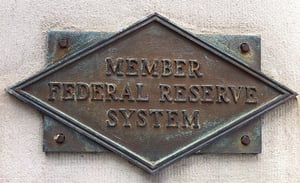
The Federal Reserve Act, signed by Woodrow Wilson on December 23, 1913, created the Federal Reserve System — a network of 12 regional reserve banks coordinated by a Federal Reserve Board in Washington — as the central bank of the United States. The Act's specific institutional design was a compromise between competing visions for American central banking: the progressive concern about Wall Street domination of monetary policy and the financial industry's preference for a single central institution rather than a decentralized regional structure.
The specific architectural feature of the Federal Reserve that shaped American monetary history — and through American monetary hegemony, global monetary history — was the ambiguity of its independence from political control. The Act established the Fed as neither fully independent nor fully subordinate to elected government, a structural ambiguity that has been the source of continuous tension and that has allowed the Fed's de facto independence to expand and contract with the political circumstances of each era.
The model of the Federal Reserve — a central bank with some degree of political insulation, managing monetary policy through interest rate decisions rather than direct money supply controls — became the template for central banking globally in the 20th century. The specific institutional design of 1913, produced by a specific political compromise in a specific historical moment, became the architecture that most of the world's central banks adapted.
._International_central_bank_for_nearly_all_global_fractional_reserve_central_banks_^_curency_issuers_of_fiat_debt-moneti_-_panoramio-1920x1440.jpg)
AlwaysAwakePR / Wikimedia Commons (CC BY-SA 3.0)
The Basel I Accord, agreed in 1988 by the Basel Committee on Banking Supervision — a committee of central bankers and regulators from the G10 countries meeting at the Bank for International Settlements in Basel, Switzerland — established the first internationally agreed minimum capital requirements for banks: banks must hold capital equal to at least 8% of their risk-weighted assets. Before Basel I, capital requirements varied widely between countries, creating competitive distortions and leaving the international banking system without agreed minimum safety standards.
The Basel Committee has no formal authority — its accords are not treaties and are not legally binding. They work by consensus and peer pressure: countries adopt the Basel standards into their domestic banking regulation because their peers do so, and because the alternative is being perceived as a low-regulation jurisdiction whose banks are potentially dangerous counterparties. The informal, consensus-based nature of the Basel process means that the standards that govern the capitalization of every major bank in the world were set by a committee with no legal standing whose decisions are adopted voluntarily.
Basel II (2004) and Basel III (2010, strengthened after the 2008 financial crisis) built on the original framework, introducing more sophisticated risk-weighting and liquidity requirements. The 2008 financial crisis revealed specific weaknesses in the Basel II framework — particularly in the treatment of off-balance-sheet vehicles and the risk-weighting of mortgage-backed securities — demonstrating that the standards written in specific historical contexts cannot fully anticipate the financial innovations that will exploit their gaps.
New York Times, Fred R. Conrad / Wikimedia Commons (Fair use)
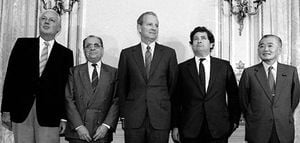
In September 1985, the finance ministers and central bank governors of the G5 nations (the United States, Japan, West Germany, France, and the United Kingdom) met at the Plaza Hotel in New York and agreed to coordinate intervention in currency markets to depreciate the US dollar against the Japanese yen and the German mark. The dollar had appreciated approximately 50% against other major currencies between 1980 and 1985, producing a large US current account deficit and significant political pressure for protectionist trade legislation.
The Plaza Accord was the most explicit exercise of coordinated currency market intervention by major economies in the post-Bretton Woods era, and its success — the dollar depreciated approximately 50% against the yen and the mark over the following two years — demonstrated that coordinated central bank intervention could move exchange rates significantly even in large, liquid currency markets.
The consequences for Japan were severe: the yen appreciation made Japanese exports significantly less competitive, contributing to the economic pressures that led Japanese authorities to maintain excessively loose monetary policy through the late 1980s, inflating the asset bubble whose collapse produced the "Lost Decade" of Japanese economic stagnation in the 1990s. The decision made by five finance ministers in a New York hotel room contributed to a decade of economic stagnation for the world's second-largest economy.
Oliver F. Atkins / Wikimedia Commons
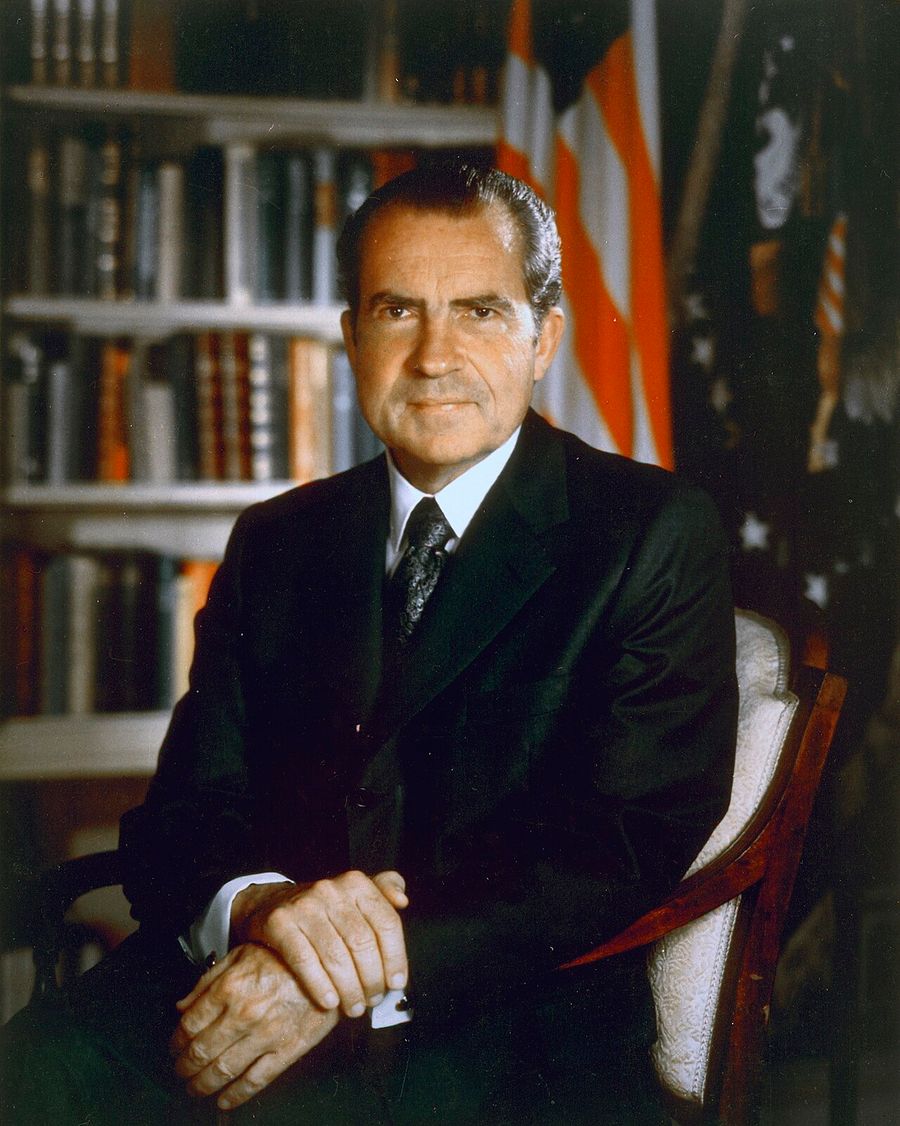
On August 15, 1971, President Nixon announced, without prior consultation with the other nations whose currencies were pegged to the dollar under the Bretton Woods system, that the United States would no longer convert dollars to gold at the fixed rate of $35 per ounce. The announcement — made on a Sunday evening, to be effective the following Monday — ended the Bretton Woods fixed exchange rate system and initiated the era of floating exchange rates that governs the global economy today.
The decision was made in a weekend meeting at Camp David involving Nixon, Treasury Secretary John Connally, Federal Reserve Chairman Arthur Burns, and a small group of economic advisers. The other Bretton Woods countries were not consulted — they were informed by the announcement. Connally's position, summarized in his remark to foreign finance ministers that "the dollar is our currency, but it's your problem," reflected the calculation that the US had more to gain from ending convertibility than from maintaining a system that was constraining American monetary policy.
The transition to floating exchange rates that followed — the current system in which the dollar's value against other currencies is set by market forces — was not planned. It emerged from a series of improvised responses to the dollar's non-convertibility and was not stabilized into a coherent new system until the Jamaica Accords of 1976. The modern foreign exchange market — the largest financial market in the world, with daily turnover exceeding $7 trillion — exists because of a decision made over a weekend at Camp David.

Credit: Wikimedia Commons
The Society for Worldwide Interbank Financial Telecommunication (SWIFT) was founded in 1973 by 239 banks from 15 countries to create a standardized, secure messaging system for international financial transactions. Before SWIFT, international payments were coordinated by telex — a system that was slow, error-prone, and used different message formats at different institutions. SWIFT standardized the message format, the authentication procedures, and the communications network through which international payments instructions were transmitted.
SWIFT did not itself move money — it moved the messages that instructed banks to move money. But by becoming the universal standard for interbank financial messaging, it became the essential infrastructure of the international payments system: to be cut off from SWIFT is to be cut off from the ability to send or receive international payments. The geopolitical significance of this infrastructure became dramatically apparent in 2022, when the exclusion of Russian banks from SWIFT following the invasion of Ukraine became one of the primary tools of Western financial sanctions.
The specific decision that made SWIFT uniquely powerful was the choice to build a cooperative owned by its member banks rather than a commercially operated network. This cooperative structure made SWIFT a neutral infrastructure rather than a commercial competitor to its members, encouraging adoption and creating the network effects that made it effectively the only international payment messaging standard.
-1920x1351.jpg)
World Trade Organization / Wikimedia Commons (CC BY-SA 2.0)
The Agreement Establishing the World Trade Organization, signed in Marrakesh in April 1994, converted the GATT into a formal international organization with a binding dispute settlement mechanism — a significant strengthening of the rules-based trading system. Less noticed in the fanfare around the WTO's creation were the specific exemptions and carve-outs in its rules, particularly the Article XXIV exception that permitted regional free trade agreements and customs unions to discriminate in favor of their members.
The Article XXIV exception — which allowed the European Union, NAFTA, and subsequent regional trade agreements to give preferential market access to their members while maintaining higher barriers against non-members — created a two-tier trading system in which the most-favored-nation principle was formally universal but practically full of exceptions. The proliferation of regional trade agreements in the decades after the WTO's founding — there are now approximately 350 regional trade agreements in force — produced a system so complex that it has been described as a "spaghetti bowl" of overlapping and sometimes contradictory rules.
The specific consequence: the WTO's dispute settlement mechanism became the arbiter of an increasingly complex web of overlapping commitments, and the tension between the multilateral system and the regional agreements has been a persistent source of trade friction. The exemptions agreed in 1994 shaped the structure of the trading system as significantly as the rules they qualified.
The Bush White House / Wikimedia Commons
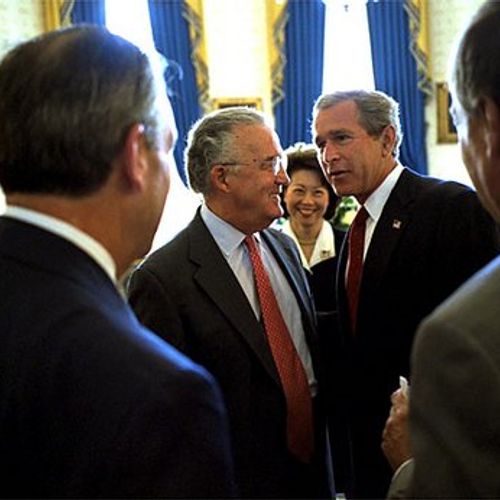
The Sarbanes-Oxley Act, signed by President Bush in July 2002 in response to the Enron, WorldCom, and other corporate accounting scandals, imposed significant new requirements on publicly traded companies in the United States: CEOs and CFOs must personally certify the accuracy of financial statements (with criminal penalties for false certification), audit committees must be composed entirely of independent directors, and auditing firms are prohibited from providing certain consulting services to audit clients.
The Act was written rapidly — passed by the Senate 99-0 in the immediate aftermath of the WorldCom collapse — and its specific provisions were shaped by the specific failures of the previous corporate scandals more than by a comprehensive theory of corporate governance. The requirement for CEO and CFO personal certification of financial statements, which was not a feature of corporate governance in any major economy before Sarbanes-Oxley, became the most significant change in the practical accountability of corporate executives for financial reporting.
The consequences beyond the United States: because Sarbanes-Oxley applied to all companies listed on US exchanges, including foreign companies with US listings, it effectively exported American corporate governance standards internationally. Companies that wanted access to US capital markets had to comply with US governance requirements, making Sarbanes-Oxley a significant instrument of regulatory extraterritoriality — American standards imposed on non-American companies through market access rather than treaty.

Avij / Wikimedia Commons
The euro — the common currency of the European Union's eurozone — was introduced as an accounting currency on January 1, 1999, with euro notes and coins replacing national currencies on January 1, 2002. The decision to create a monetary union without a fiscal union — sharing a currency and a central bank but maintaining separate national fiscal policies and national sovereign debt — was the most consequential architectural choice in the euro's design, and the one whose consequences were most fully revealed by the 2010–2015 European sovereign debt crisis.
The Maastricht Treaty of 1992, which established the framework for monetary union, was negotiated by a small group of European heads of government and central bankers over several years, with the final decisions made at the December 1991 Maastricht summit. The decision not to include a fiscal union — not to create a common European budget large enough to act as a macroeconomic stabilizer — reflected the political reality that the member states, particularly Germany, were unwilling to transfer fiscal sovereignty to a European institution.
The architecture produced by this political constraint — monetary union without fiscal union — created a system in which member states retained the borrowing costs of sovereign debt denominated in a currency they did not control, while losing the exchange rate adjustment mechanism that had previously allowed countries to respond to asymmetric economic shocks. The Greek debt crisis, the Irish bailout, the Spanish banking crisis, and the threat to the euro's existence in 2012 were all direct consequences of this architectural choice made in Maastricht in 1991.

Gianluca Pugliese / Pexels
The London Interbank Offered Rate (LIBOR) — the benchmark interest rate at which major banks reported they could borrow from each other in the London interbank market — was formalized in 1986 by the British Bankers' Association as a standardized reference rate for financial contracts. Within two decades, it had become the reference rate for approximately $350 trillion in financial contracts globally, including mortgages, student loans, corporate bonds, and derivatives.
The specific design choice that made LIBOR both influential and fragile was its calculation method: each day, a panel of banks submitted estimates of their borrowing costs, and the LIBOR rate was calculated as the trimmed average of these submissions. The submissions were self-reported estimates rather than actual transaction prices, verified by no one, with no requirement that they reflect real borrowing activity. This honor-system calculation method was adequate when LIBOR was a niche interbank rate; it was catastrophically inadequate for a benchmark governing $350 trillion in contracts.
The LIBOR scandal, which emerged publicly in 2012, revealed that traders at multiple major banks had routinely manipulated their LIBOR submissions to benefit their own trading positions — a manipulation that was structurally enabled by the self-reported, unverified calculation method that had been chosen in 1986. LIBOR was phased out as a benchmark between 2021 and 2023, replaced by transaction-based rates — a belated recognition that the honor-system design was unsuitable for the scale it had reached.
