The deep ocean remains the least explored environment on Earth — and the creatures living there are strange enough to make the word "alien" feel less like a metaphor than a description
Jeffry Surianto / Pexels
More than 80% of Earth's oceans remain unmapped, unexplored, and unseen by human eyes. The deep ocean — everything below approximately 200 meters, where sunlight no longer penetrates — covers more than half of the planet's surface and contains the largest continuous living space on Earth. It is also, by almost any measure, the least understood. The International Space Station has been continuously occupied since 2000. The full floor of the Mariana Trench has been visited by humans exactly twice. We have better maps of Mars than of our own ocean floor.
The creatures that live in this environment have evolved under conditions that have no parallel in the world above the surface: total darkness, crushing pressure (at 10,000 meters, the pressure is approximately 1,000 times atmospheric pressure at sea level), near-freezing temperatures, and an almost complete absence of the photosynthetically produced food that underlies every surface food web. The solutions these creatures have developed — bioluminescence, expandable stomachs capable of swallowing prey larger than the predator, transparent bodies, photophores that produce counterillumination to eliminate their own shadow from below — are solutions to problems that no surface animal has ever faced, and the forms that result look less like variations on familiar animal themes than like independent inventions of life from different principles entirely.
The 20 creatures in this list have all been photographed — by remotely operated vehicles (ROVs), by deep-sea trawls, or in rare cases by manned submersibles — and all have verified photographic records available for search by name. They have been selected for the combination of genuine visual extraordinariness and documented existence: no creatures known only from sonar traces or from single disputed sightings. Each entry covers the creature, its depth range, the specific biological feature that makes it remarkable, and the specific conditions that produced it.

레이저마인드 / Wikimedia Commons (CC0)
The barreleye fish — a small, translucent-headed fish found in the mesopelagic zone at depths of approximately 400 to 2,500 meters — has a transparent dome covering its entire head, within which sit two barrel-shaped, tubular eyes that can rotate to point either upward (to spot prey silhouettes against the faint light from above) or forward (to track prey directly in front of the fish). The dome itself is filled with fluid and houses additional sensory structures.
For decades, the transparent dome confused researchers: specimens brought to the surface had their domes collapse during decompression, and the eyes that could be observed in collected specimens appeared to point permanently upward. It was not until 2009, when MBARI researchers filmed barreleye fish in situ using ROVs, that the rotatable nature of the eyes — and the function of the dome — was confirmed. The eyes' green color comes from a yellow pigment that filters out downwelling light, improving contrast when hunting bioluminescent prey in dim conditions.
The barreleye is one of the most photographed deep-sea fish precisely because the in situ footage — a small fish floating motionless in the water column with its glowing green eyes and perfectly transparent head dome — is so immediately extraordinary that it reads as obviously impossible even when watching real footage.
Depth range: 400–2,500 meters. Photographed: extensively by MBARI ROV footage; widely available.
-1400x1057.jpg)
National Marine Sanctuaries / Wikimedia Commons
The vampire squid — whose scientific name translates as "vampire squid from hell" — is neither a squid nor an octopus but the sole surviving member of its own order (Vampyromorphida), occupying a position on the cephalopod family tree between the two. It lives in the oxygen minimum zone at depths of 600 to 900 meters, a zone where oxygen levels are too low for most predators, which provides it with refuge.
Its "cloak" — the webbing connecting its eight arms — can be pulled over its body like a cape when threatened (the vampire reference in the name), inverting to expose a mass of cirri (small fleshy spines) on the outer surface. It does not hunt prey in the conventional cephalopod sense but feeds primarily on marine snow — the continuous shower of organic particles, dead organisms, and fecal pellets that falls from the surface ocean — making it the only known cephalopod that is not an active predator.
The vampire squid produces bioluminescent displays from photophores covering its body, and when threatened produces a cloud of bioluminescent mucus rather than ink — a luminous cloud that may confuse predators in the same way that a conventional ink cloud confuses surface predators in lit water.
Depth range: 600–900 meters. Photographed: extensively; particularly striking in ROV footage from MBARI and the Monterey Bay Aquarium.
Donald Davesne / Wikimedia Commons (CC BY 4.0)
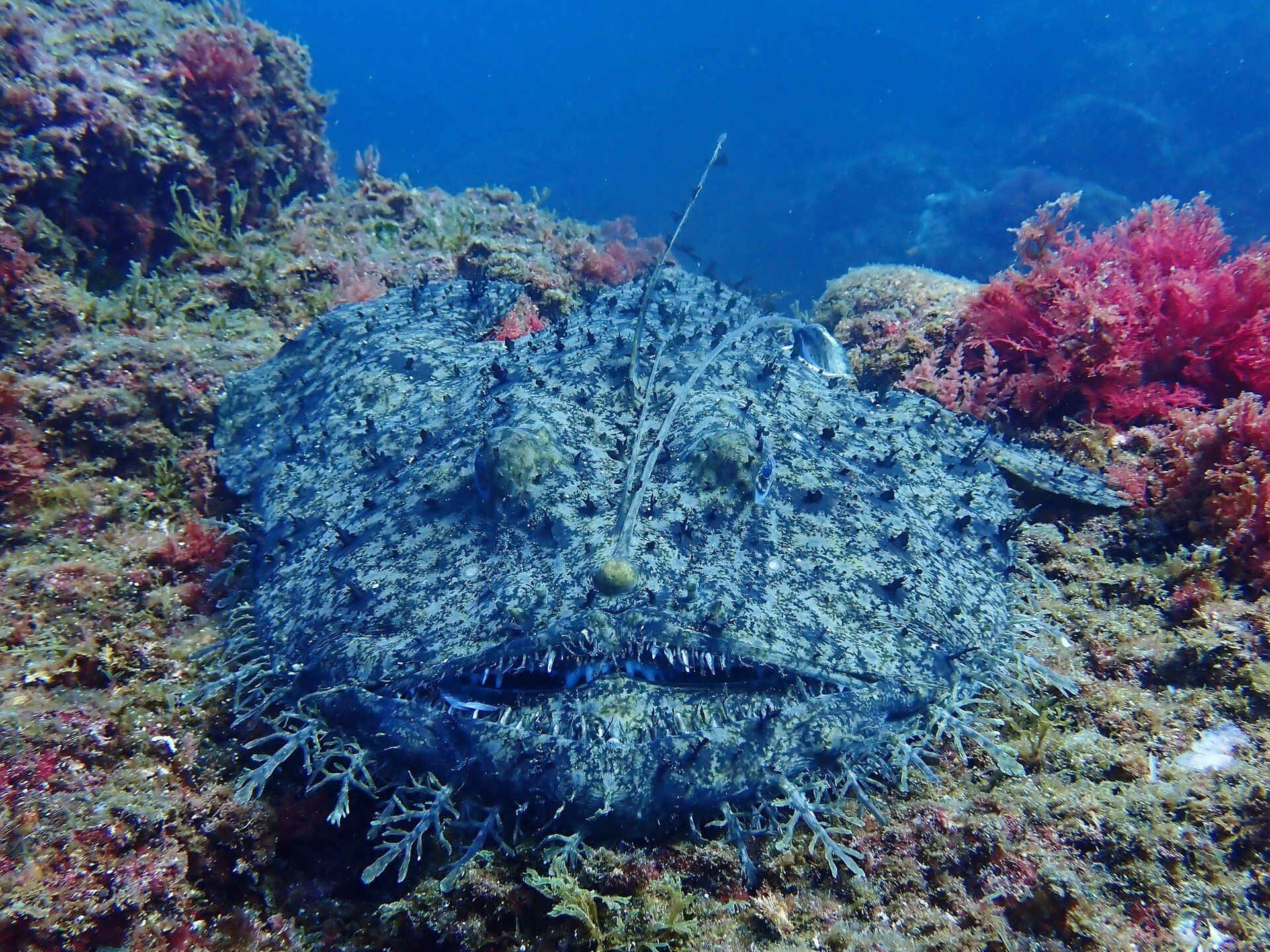
The deep-sea anglerfish — approximately 160 species in the suborder Ceratioidei — are the quintessential deep-sea creature in popular imagination, and the reality is stranger than the popularization. The female (which is the large fish with the bioluminescent lure) attracts prey and mates using the esca — a fleshy outgrowth tipped with bioluminescent bacteria that dangles from a modified dorsal fin spine above the mouth. When a male anglerfish locates a female, he bites into her skin and begins to fuse with her body, his circulatory systems merging with hers until he becomes a permanent, parasitic, sperm-producing appendage.
In the most extreme cases (the genus Haplophryne), a female has been found carrying multiple males simultaneously, each fused to a different part of her body. The males are dramatically smaller than the females — in some species, the male is less than 1% of the female's size — and after fusion retain no independent existence. Their eyes degenerate, their internal organs atrophy, and they persist only as gonads fused to the female's body, nourished entirely by her blood.
The specific evolutionary logic is the extreme difficulty of finding a mate in the deep ocean's darkness and low population density: when a male finds a female, the most effective strategy is to ensure the encounter is permanent.
Depth range: 200–4,000 meters depending on species. Photographed: multiple species in ROV footage; the fused male-female pair has been photographed in specimens.
NOAA Office of Ocean Exploration and Research / Wikimedia Commons
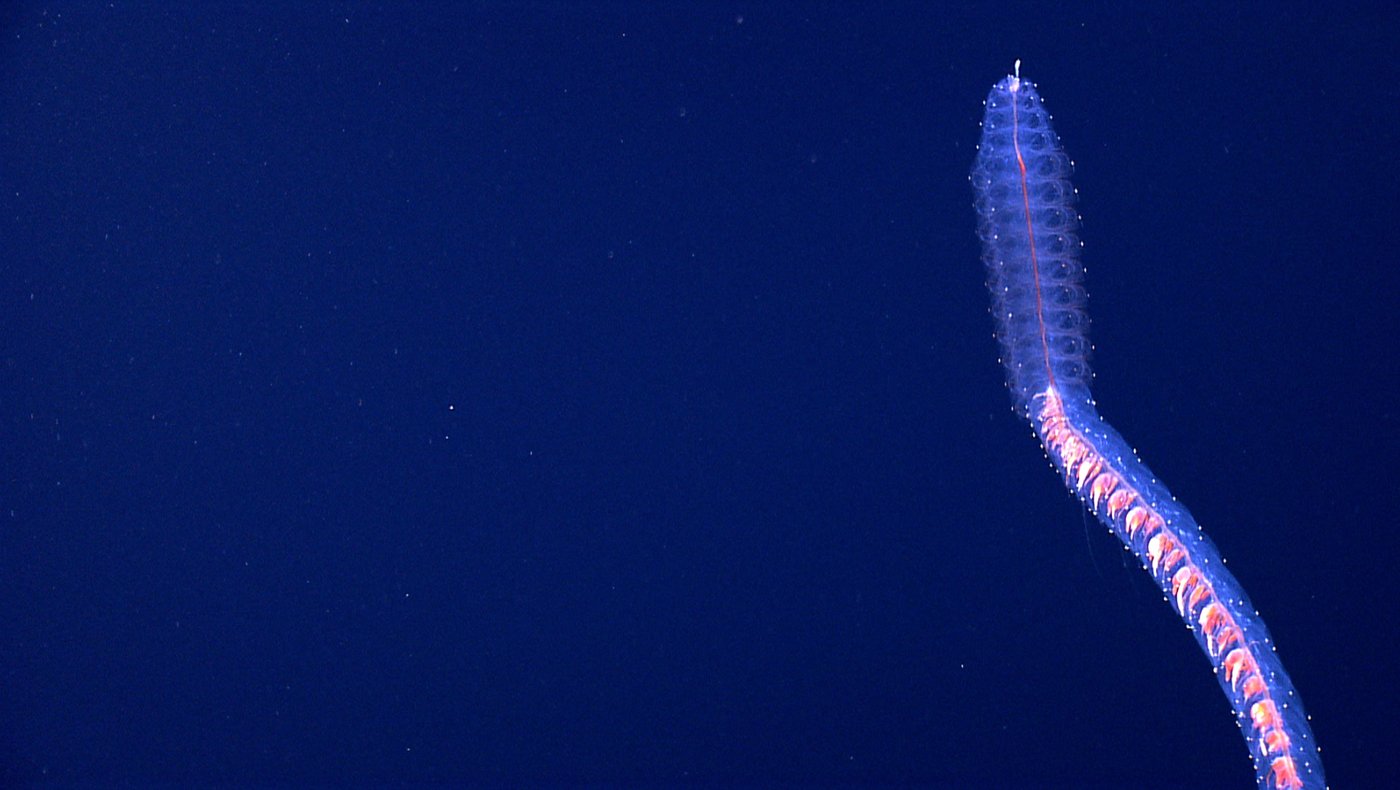
Praya dubia — one of the largest siphonophores ever recorded — can reach lengths of 40 to 50 meters, making it potentially the longest animal on Earth, exceeding the blue whale. It is not, however, a single animal in the conventional sense but a colonial organism: a collection of genetically identical individuals (zooids) that are physically connected and functionally specialized, some for swimming, some for feeding, some for reproduction, and some for defense.
The colony drifts through the water column at depths of 700 to 1,000 meters, trailing long tentacles armed with stinging cells that entangle zooplankton and small fish. The combined tentacle spread of a 40-meter colony can cover a substantial volume of water. The colony moves through coordinated pulsing of its swimming bells (nectophores), controlled by nerve nets rather than a central nervous system — the coordination of a 40-meter organism without a brain.
In situ ROV footage of large siphonophores is among the most ethereal and most otherworldly imagery from the deep ocean — a long, translucent, drifting structure in the water column that looks nothing like the intuitive concept of "animal."
Depth range: 700–1,000 meters. Photographed: extensively by MBARI and Schmidt Ocean Institute ROVs; widely available footage.
NOAA / MBARI via Wikimedia Commons
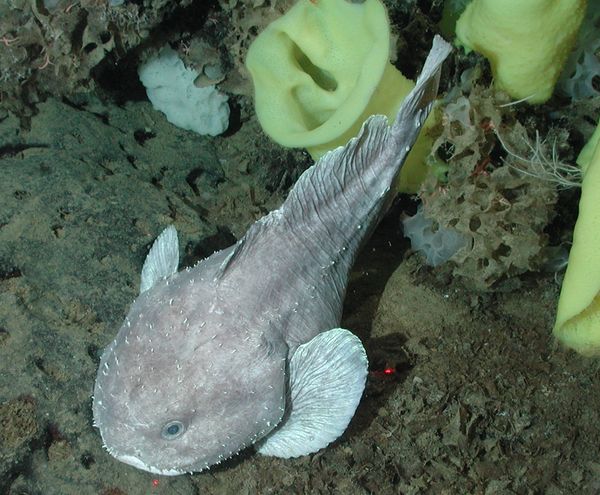
The blobfish became famous — specifically, it was voted the "world's ugliest animal" in a 2013 poll and became an internet icon — through photographs of specimens brought to the surface, which showed a sagging, gelatinous, miserable-looking pink mass with a drooping nose. In its actual habitat at depths of 900 to 1,200 meters, the blobfish looks nothing like its famous photographs.
At depth, the blobfish is a relatively ordinary-looking, slightly pudgy fish. Its body is mostly gelatinous — its flesh is less dense than water, allowing it to maintain neutral buoyancy at pressure without an energy-expensive swim bladder. When brought to the surface, the dramatic pressure reduction causes the gelatinous body to expand and collapse, producing the distinctly unhappy appearance of the famous photographs.
The blobfish is therefore two different creatures visually: a perfectly reasonable fish at depth, and the sagging disaster of its decompressed surface photographs. Most photographs labeled as blobfish in popular media are photographs of decompression damage rather than the actual animal.
Depth range: 900–1,200 meters. Photographed: specimens photographed at surface (widely available); in situ photographs rarer but exist.
NOAA / Wikimedia Commons
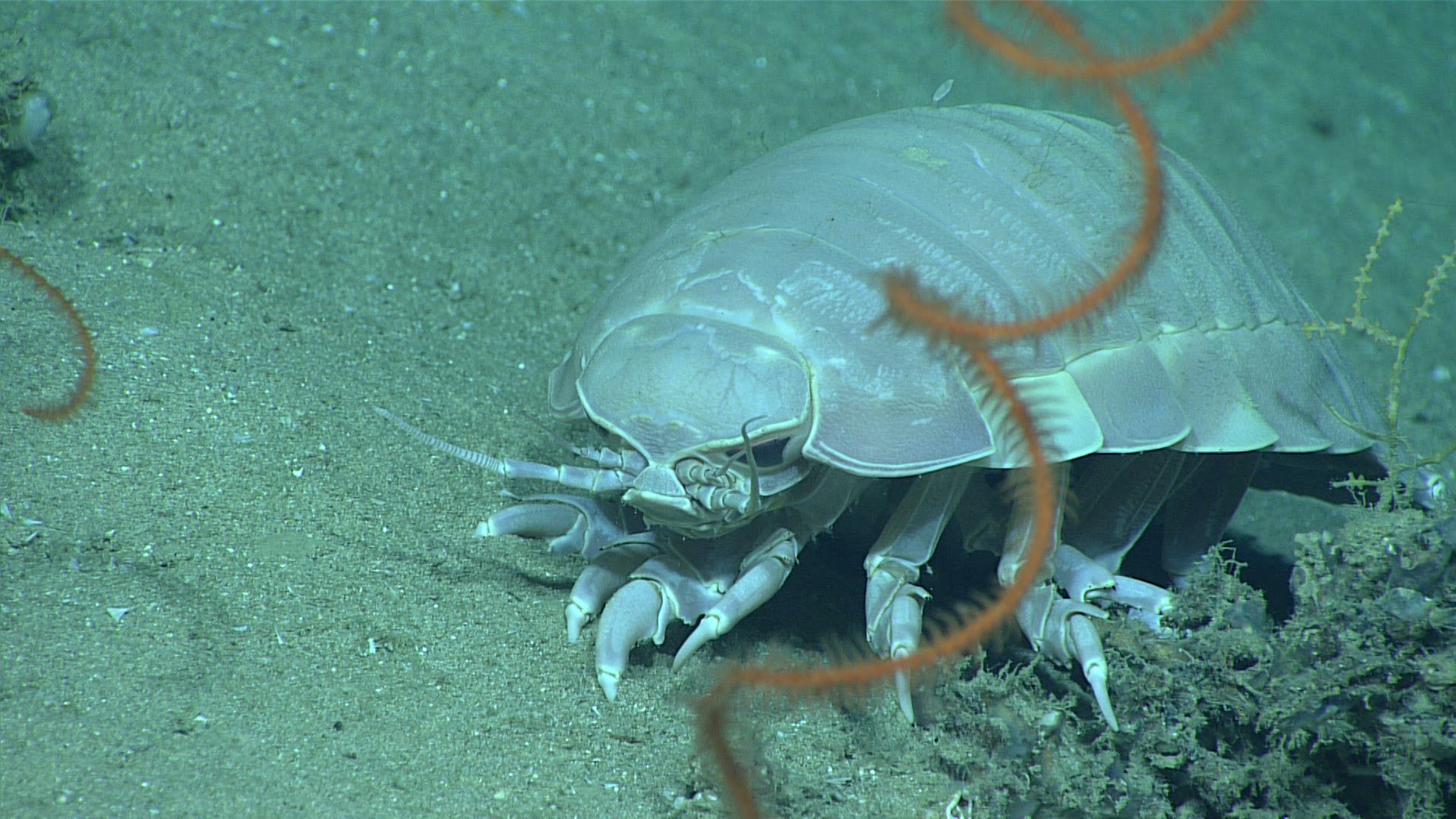
The giant isopod — a crustacean related to the pill bugs (woodlice) found in gardens worldwide — reaches lengths of up to 45 centimeters, making it one of the largest crustaceans in the deep ocean and one of the clearest examples of deep-sea gigantism, the tendency for deep-sea species to grow significantly larger than their shallow-water relatives. The mechanism of deep-sea gigantism is not fully understood but likely involves the combination of cold temperatures (which slow metabolism and extend lifespan), reduced predation pressure, and the abundance of food from whale falls and other large organic deposits.
The giant isopod is a scavenger, feeding primarily on the carcasses of large animals that sink to the ocean floor — whales, fish, squid. It can survive for years without food (one specimen in an aquarium in Japan survived 5 years and 43 days without eating before dying), and when food is available it feeds so voraciously that it can become immobilized through overeating.
Visually, the giant isopod resembles a cartoon alien — the large compound eyes, the seven pairs of legs, the segmented armored body, and the sheer scale of an animal that looks exactly like a familiar garden pill bug but is the size of a large cat.
Depth range: 170–2,100 meters. Photographed: extensively; available in ROV footage and aquarium specimens.
NOAA Office of Ocean Exploration and Research / Wikimedia Commons
The dumbo octopus — approximately 13 species in the genus Grimpoteuthis — takes its common name from the ear-like fins extending from either side of its mantle, which it beats to propel itself through the water in a manner more reminiscent of a cartoon elephant than of conventional octopus jet propulsion. It is the deepest-living known octopus, found at depths of 3,000 to 4,000 meters (though one specimen was recorded at approximately 7,000 meters).
Unlike most octopuses, which use jet propulsion from their siphons as the primary locomotion mode, dumbo octopuses use their fins for primary propulsion and the siphon and arms for steering and fine control. They also lack an ink sac — ink is useless as a defensive measure in total darkness — and have a different relationship to predator avoidance than surface-living cephalopods.
The dumbo octopus swallows its prey whole rather than using a radula to scrape food, and it has been observed moving across the seafloor with a motion that was described by the first researchers who filmed it as resembling a cartoon character walking, contributing to the sense of unreality that characterizes deep-sea ROV footage.
Depth range: 3,000–7,000 meters. Photographed: extensively; widely available ROV footage from multiple expeditions.
-1920x1626.jpg)
The dragonfish — a family of approximately 300 species, including the stoplight loosejaw (Malacosteus niger) and the black dragonfish (Idiacanthus atlanticus) — are among the most visually striking of the deep-sea predators, combining an elongated, scaleless black body with disproportionately large jaws equipped with long, fang-like teeth, a bioluminescent chin barbel (a fleshy whisker-like appendage used to lure prey), and photophores arranged in rows along the body.
The stoplight loosejaw is particularly remarkable for its ability to produce and detect red light — a rare capability in the deep sea, where most organisms can only produce and detect blue-green light. Most deep-sea animals are effectively blind to red light, making the stoplight loosejaw's red searchlight invisible to its prey while remaining visible to other stoplight loosejaws — a private communication channel in the dark.
The loosejaw feature that gives the fish its name is the complete absence of a floor to the mouth: the lower jaw is bare bone, with no skin connecting it to the body, allowing it to open to an angle impossible for animals with fleshed mouths and allowing it to strike faster by eliminating the water resistance that a closed mouth-floor would create.
Depth range: 200–1,000 meters. Photographed: multiple species well-documented; particularly striking specimen photographs available.
NOAA / MBARI via Wikimedia Commons
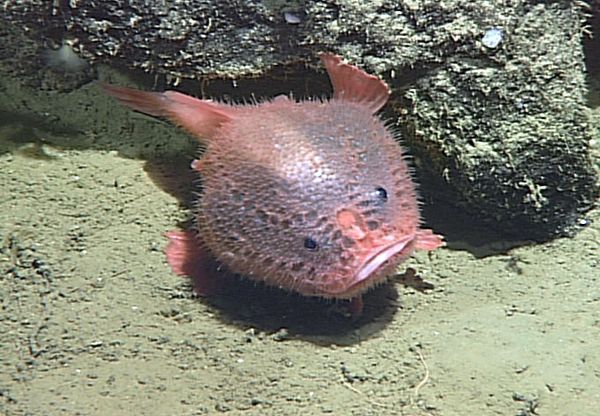
The coffinfish — a type of sea toad found in the deep Pacific at depths of 1,000 to 3,000 meters — is a bottom-dwelling anglerfish relative that is vivid red (unusual in deep-sea fish, which tend toward black or transparent) and that moves across the seafloor by "walking" on its pectoral fins rather than swimming, in a motion described by researchers who first filmed it as resembling a stumbling toddler.
The red coloration is functionally invisible at depth because red wavelengths are absorbed within the first few meters of water, leaving red animals effectively camouflaged in the same way as black animals in total darkness. The coffinfish therefore appears bright red in photographs taken with artificial lighting but is essentially invisible in its natural environment.
The coffinfish inflates itself with water when threatened — expanding its body to make it harder for predators to swallow — a defensive strategy that, combined with its walking locomotion and vivid coloration under artificial light, makes it one of the most visually arresting of the deep-sea fish photographed by ROVs.
Depth range: 1,000–3,000 meters. Photographed: ROV footage from Schmidt Ocean Institute expedition 2021 produced widely circulated footage.
)_(17974453349)-1400x462.jpg)
Internet Archive Book Images / Wikimedia Commons
The telescopefish — a small deep-sea fish found at depths of 200 to 2,000 meters — has tubular eyes projecting forward from its head that are fixed in a forward-facing position, providing binocular vision suited to detecting the silhouettes of prey against the faint downwelling light. The eyes are disproportionately large relative to the body, accounting for a substantial fraction of the fish's total head volume, and give it an appearance resembling a cartoon robot with oversized visual sensors.
The telescopefish's body is highly compressed laterally — very thin when viewed from the front, wider from the side — and its tail is strongly forked, giving it a distinctive profile in photographs. Like many mesopelagic fish, it is covered with photophores — bioluminescent organs — used for counterillumination (producing light from the belly to match downwelling light and eliminate the fish's shadow when viewed from below).
The specific combination of the forward-projecting tubular eyes, the laterally compressed silver body, and the deeply forked tail gives the telescopefish an appearance sufficiently distinct from any surface fish that it consistently registers as implausible in photographs.
Depth range: 200–2,000 meters. Photographed: multiple specimen photographs available; widely documented.
NOAA / Wikimedia Commons
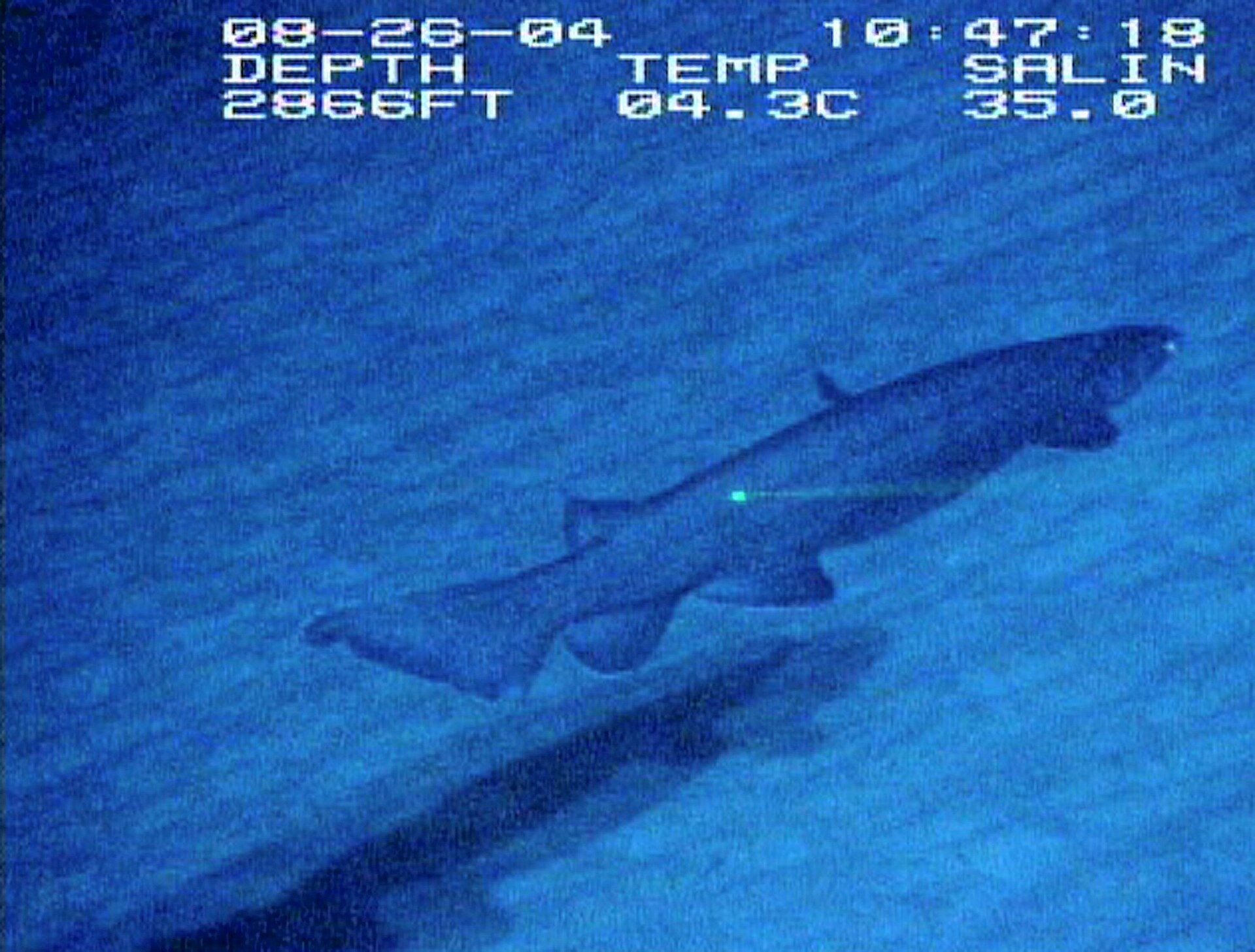
The frilled shark — found at depths of 120 to 1,570 meters — is one of the most primitive living shark species, with a body plan essentially unchanged from fossils dating to approximately 80 million years ago. Its elongated, eel-like body, 300 trident-shaped teeth arranged in 25 rows, six frilled gill slits (conventional sharks have five), and terminal mouth (at the end of the snout rather than on the underside) give it an appearance that is simultaneously recognizable as a shark and profoundly alien.
The frilled shark was for much of its scientific history known primarily from trawled specimens and was rarely seen alive until ROV technology became capable of operating at its depth range. A live specimen was filmed in shallow water off Japan in 2007 — an exceptionally rare occurrence, as the shark was likely ill and had risen to the surface — and the footage produced significant media coverage, partly because a living frilled shark in motion looks immediately like a plausible sea monster from historical accounts.
It is believed to capture prey by bending its body and lunging forward like a striking snake — a behavior that would explain the extremely flexible vertebral column that distinguishes it from most other sharks.
Depth range: 120–1,570 meters. Photographed: specimen photographs widely available; live footage from Japan (2007) available online.
Ericsfr / Wikimedi Commons (CC BY-SA 4.0)
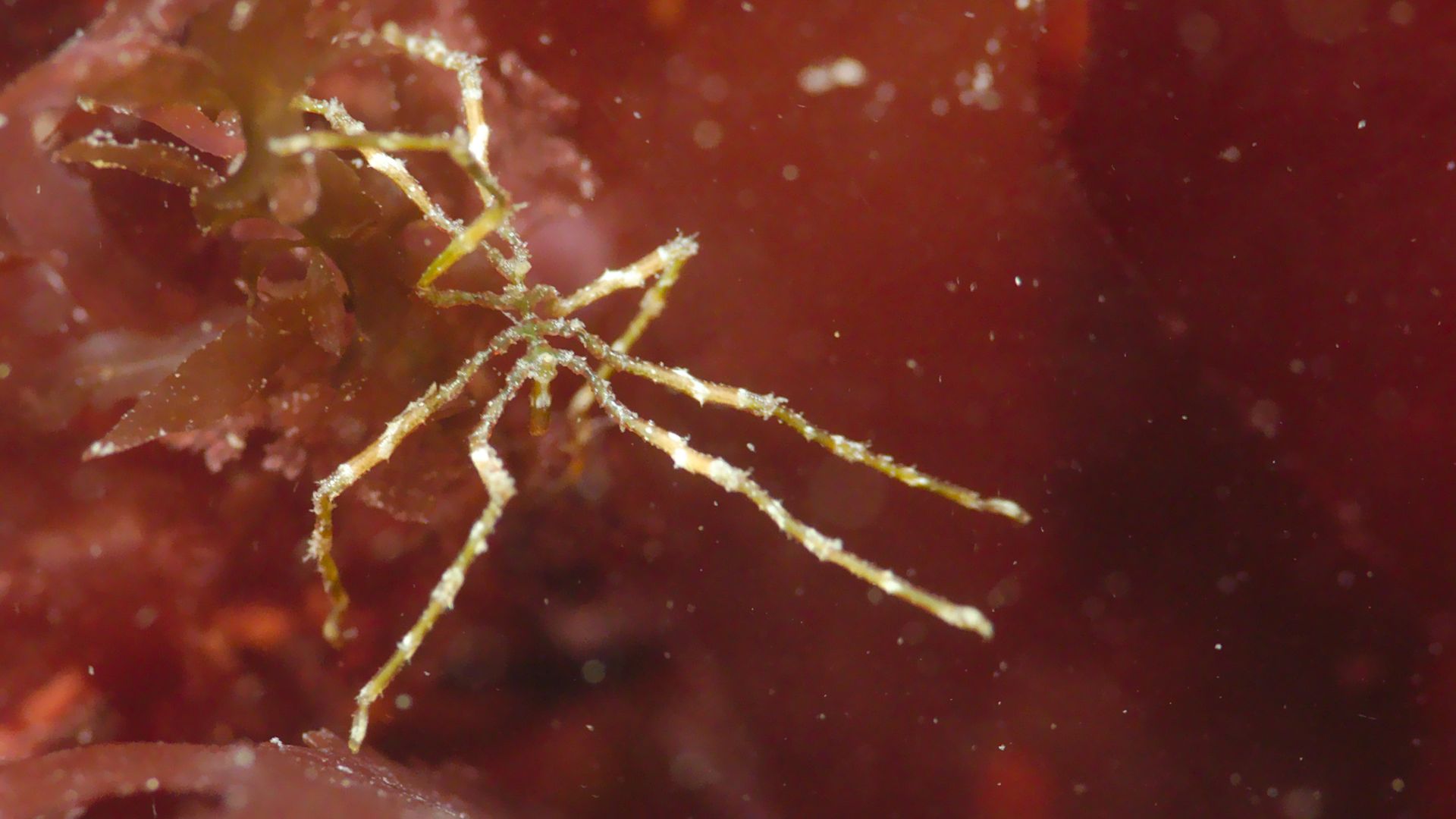
Deep-sea sea spiders — members of the class Pycnogonida — bear only a superficial resemblance to their terrestrial namesakes. They are marine arthropods whose bodies are so reduced relative to their legs that most of their internal organs, including the digestive system and gonads, are housed in the legs rather than the body. The deep-sea species Colossendeis colossea reaches leg spans of up to 70 centimeters, making it one of the largest arthropods by leg span found anywhere on Earth.
The extreme reduction of the central body and the housing of organs in the legs is a consequence of the sea spider's lifestyle: the legs need to be long for navigating complex deep-sea bottom habitats, but the body need not be large, and the solution of distributing internal organs into the legs rather than maintaining a large body cavity is found in no other animal group. Deep-sea pycnogonids are also examples of deep-sea gigantism — shallow-water sea spiders are typically a few centimeters in leg span; the deep-sea species are an order of magnitude larger.
Depth range: 200–6,000 meters. Photographed: ROV footage and specimen photographs available; widely documented.
Ben Jobson / Wikimedia Commons (CC BY 4.0)
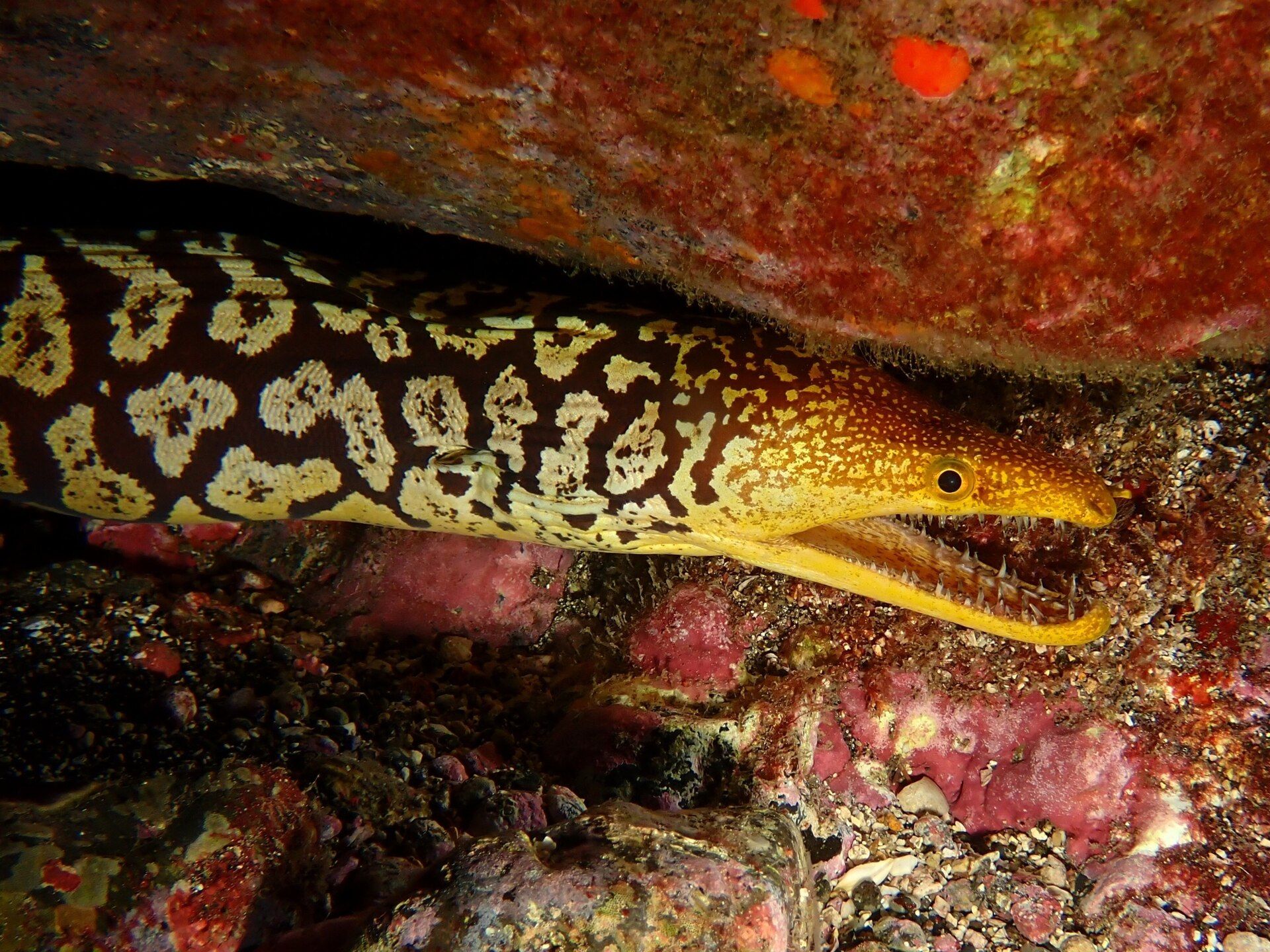
The fangtooth fish — one of the most visually striking of all deep-sea fish — has the largest teeth of any ocean fish relative to body size: its two lower fangs are so long that the fish has evolved sockets in the roof of its mouth to accommodate them when the mouth is closed. A fangtooth 16 centimeters long has teeth approximately 1.5 centimeters — proportionally equivalent to a human having teeth 30 centimeters long.
The fish's appearance — a dark brown-black body covered with small spines, large eyes, and a disproportionately large head dominated by the gaping mouth — is one of the most immediately threatening-looking in the deep ocean. Its menacing appearance is somewhat contradicted by its size: adults rarely exceed 16 centimeters, making it a small fish that looks terrifying in close-up photographs but is not physically large.
The fangtooth compensates for the low prey density of the deep ocean by being able to capture and swallow prey considerably larger than what most fish its size could manage — the extreme fangs and wide jaw gape allow it to grip and hold large prey items that it might otherwise lose in open water.
Depth range: 200–5,000 meters. Photographed: widely available specimen and ROV photographs; one of the most commonly featured deep-sea fish in media.
Ryan Schwark / Wikimedia Commons (CC0)
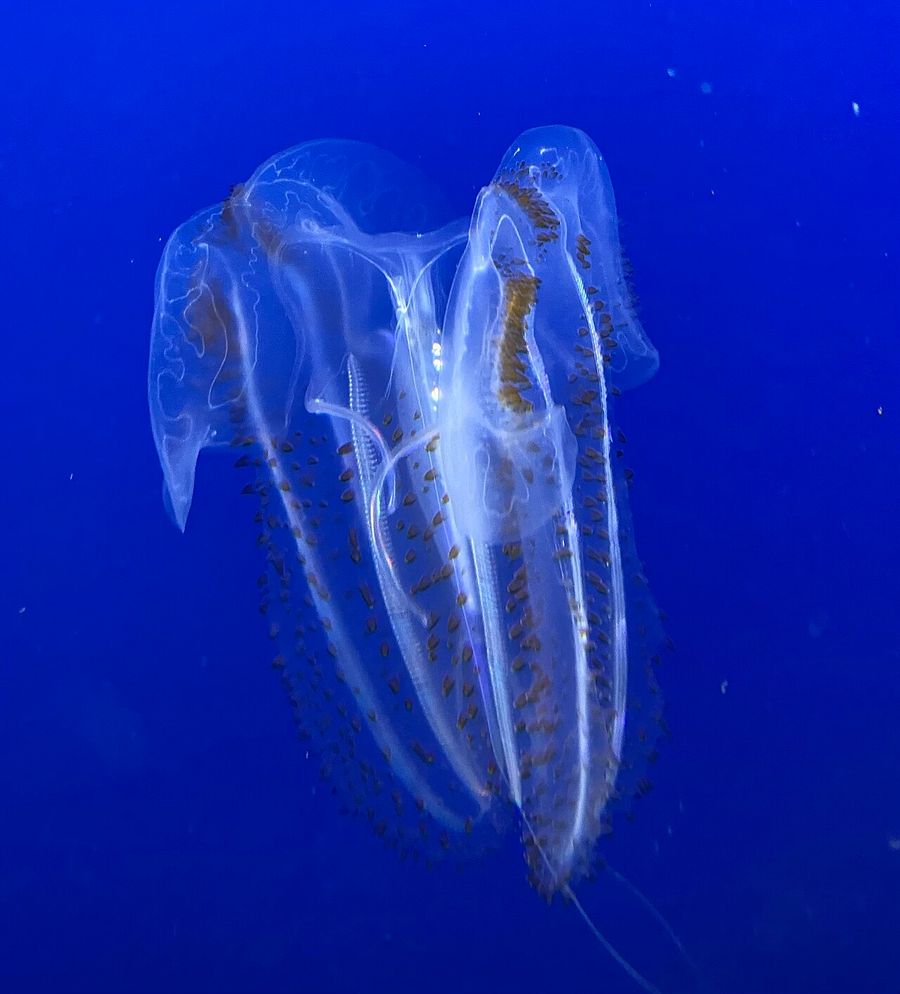
Comb jellies — members of the phylum Ctenophora, found from surface waters to the deep ocean — are among the most visually spectacular creatures photographed by ROVs, producing iridescent rainbow displays from the refraction of light off their rows of cilia (the "combs" of the name) and bioluminescent flashes in deep-water species. They are gelatinous, bilaterally symmetrical, and possess no stinging cells (unlike jellyfish, to which they are not closely related despite their superficial similarity).
Deep-sea comb jellies — particularly Bathocyroe fosteri, Beroe abyssicola, and Thalassocalyce inconstans — have body forms ranging from elongated ribbons to spherical bells to flattened discs, and their bioluminescent displays in darkness produce blue-green light from photophores distributed through the body. The combination of the iridescent cilia refraction (visible only under artificial light) and the bioluminescent flashing produces visual displays that are among the most otherworldly in deep-sea footage.
Comb jellies are also among the most ancient animal lineages: some analyses place them as the earliest branching animal phylum, predating even sponges, making them living representatives of essentially the first multicellular animal body plan.
Depth range: Surface to 3,000 meters. Photographed: extensively; some of the most visually striking footage in MBARI and Schmidt Ocean Institute archives.
Credit: Wikimedia Commons
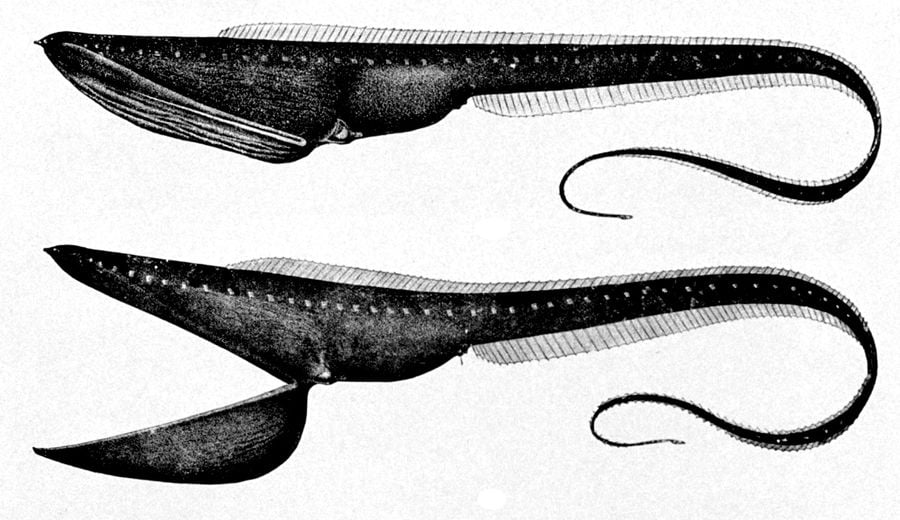
The pelican eel — also known as the umbrella mouth gulper — is a deep-sea eel found at depths of 500 to 3,000 meters whose most distinctive feature is its mouth: a loosely hinged jaw that can open wide enough to swallow prey considerably larger than the eel's own body, and that expands into a large pouch (like a pelican's bill) to engulf prey. The tail bears a complex of photophores and a pink bioluminescent organ whose function is not fully understood but may be used to lure prey.
The pelican eel's body is disproportionate in a specific way: the enormous mouth attached to a long, thin eel body gives it an appearance rather like a sock puppet or a cartoon character, and in motion — opening the massive jaws, expanding the pouch, closing around prey — it looks less like a fish than like a mechanical device with biological properties.
Its digestive system can expand substantially to accommodate large prey items, consistent with the deep-sea strategy of consuming as much as possible when food is available rather than taking regular small meals in an environment where prey encounters are infrequent and unpredictable.
Depth range: 500–3,000 meters. Photographed: specimen photographs widely available; in situ footage exists from multiple expeditions.
NOAA / MBARI via Wikimedia Commons (CC BY-SA 3.0)
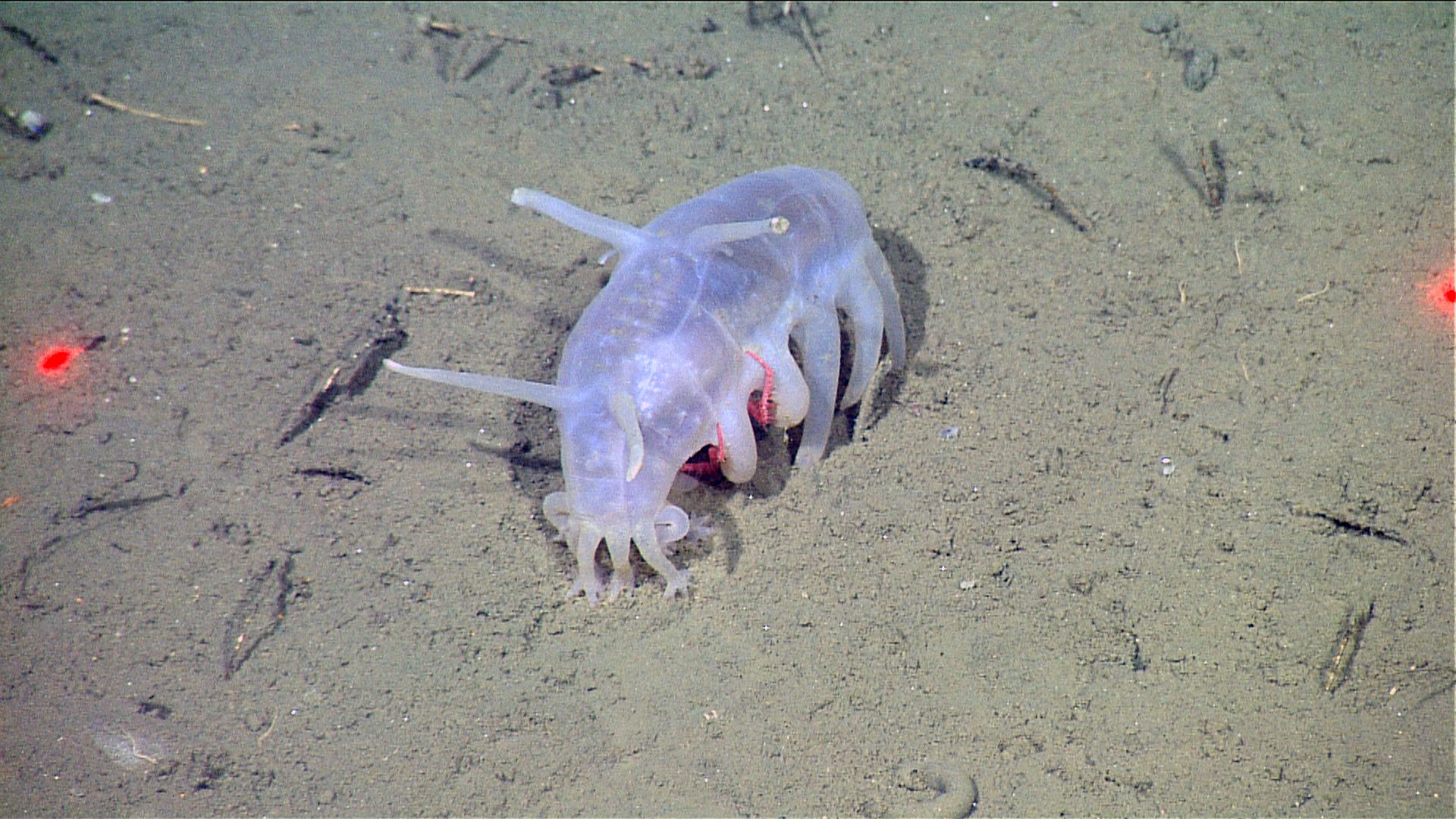
The sea pig — a type of sea cucumber in the genus Scotoplanes — is found in dense aggregations on abyssal plains at depths of 1,000 to 5,000 meters, where it moves across the sediment surface on five to seven inflatable tube feet, processing sediment for organic matter. In ROV footage, groups of dozens of sea pigs moving across the mud in the same direction — oriented into the current to follow the scent of food — look simultaneously comic and deeply strange: pink, translucent, sausage-shaped animals with inflated leg-like appendages marching across the ocean floor in formation.
The sea pig is technically a holothurian (sea cucumber), but its inflated, ambulatory form bears no resemblance to the cylindrical, sedentary sea cucumbers familiar from shallower waters. The inflation of the tube feet with fluid, the relatively rapid locomotion across the sediment surface, and the social behavior of following chemical gradients in groups make it behaviorally unusual for an echinoderm.
Sea pigs are among the most abundant megafaunal organisms on abyssal plains and play a significant role in processing organic material that sinks from the surface — they are, in a functional sense, the earthworms of the deep-sea floor, though their appearance in ROV footage suggests nothing so mundane.
Depth range: 1,000–5,000 meters. Photographed: extensively; widely available in ROV footage from multiple research institutions.
Dianne Bray / Museum Victoria via Wikimedia Commons (CC BY 3.0 au)
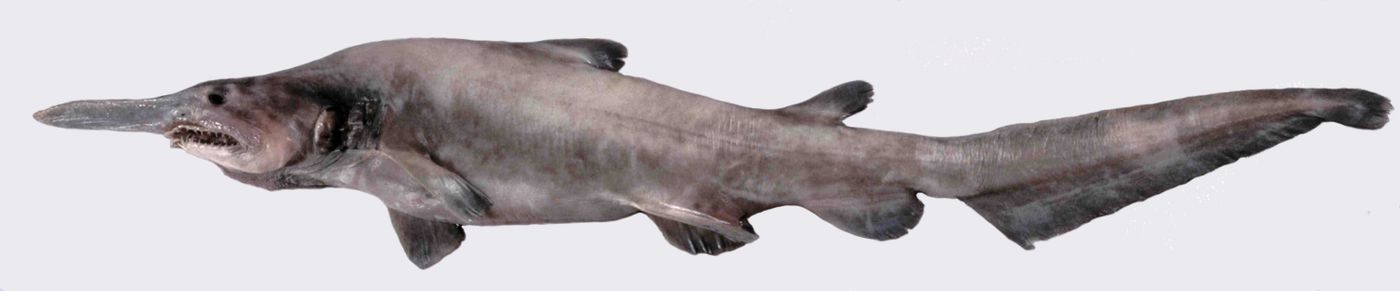
The goblin shark — found at depths of 270 to 1,300 meters — has a distinctive projecting snout (the rostrum) heavily laden with electroreceptors (ampullae of Lorenzini) that detect the electric fields of prey in total darkness, and a jaw that can project forward from the head — slingshot-like — to capture prey at a distance. The jaw protrusion mechanism, which extends the jaws several centimeters forward in milliseconds, is called slingshot feeding and is among the fastest predatory strikes documented in any vertebrate.
The goblin shark's coloration — a pale pinkish-white from the blood vessels visible through its translucent skin — combined with the elongated rostrum, the protrusible jaws, and the flabby, soft body gives it an appearance unlike any other shark and one that reads immediately as anomalous in photographs. It is a genuinely ancient lineage — the family Mitsukurinidae is known from fossils dating to approximately 125 million years ago — making it one of the oldest surviving shark families and contributing to its distinctly archaic appearance.
Depth range: 270–1,300 meters. Photographed: multiple specimen photographs available; live footage rare but documented.
Credit: Wikimedia Commons
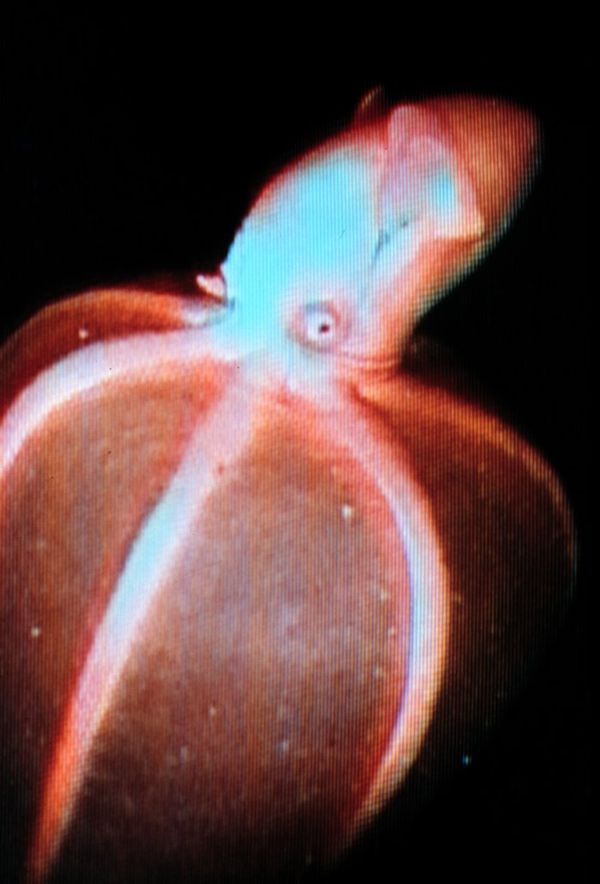
The glowing sucker octopus — found in the Atlantic Ocean at depths of 500 to 4,000 meters — is one of very few octopuses with genuine bioluminescence: approximately 40 of its suckers have been modified into photophores that produce blue-green light, potentially used for communication, predator deterrence, or luring prey. The modified suckers have lost their function as grasping organs and have been repurposed entirely for light production, a transformation that represents a significant functional reorganization of the body.
In ROV footage, the glowing sucker octopus appears as a small, gelatinous animal with webbing connecting its arms (like the vampire squid and dumbo octopus, it uses fin-and-web propulsion rather than jet propulsion) and a pattern of glowing blue-green spots arranged along the arms where the suckers normally appear. The combination of the ghostly body and the bioluminescent sucker patterns produces a visual effect unlike any surface octopus.
The function of the bioluminescent suckers is not definitively established: they may lure small crustaceans (which are attracted to light in deep water), may be used for communication with other members of the species, or may serve as a startle display for predators.
Depth range: 500–4,000 meters. Photographed: ROV footage available; documented by MBARI and other institutions.
SEFSC Pascagoula Laboratory / Wikimedia Commons
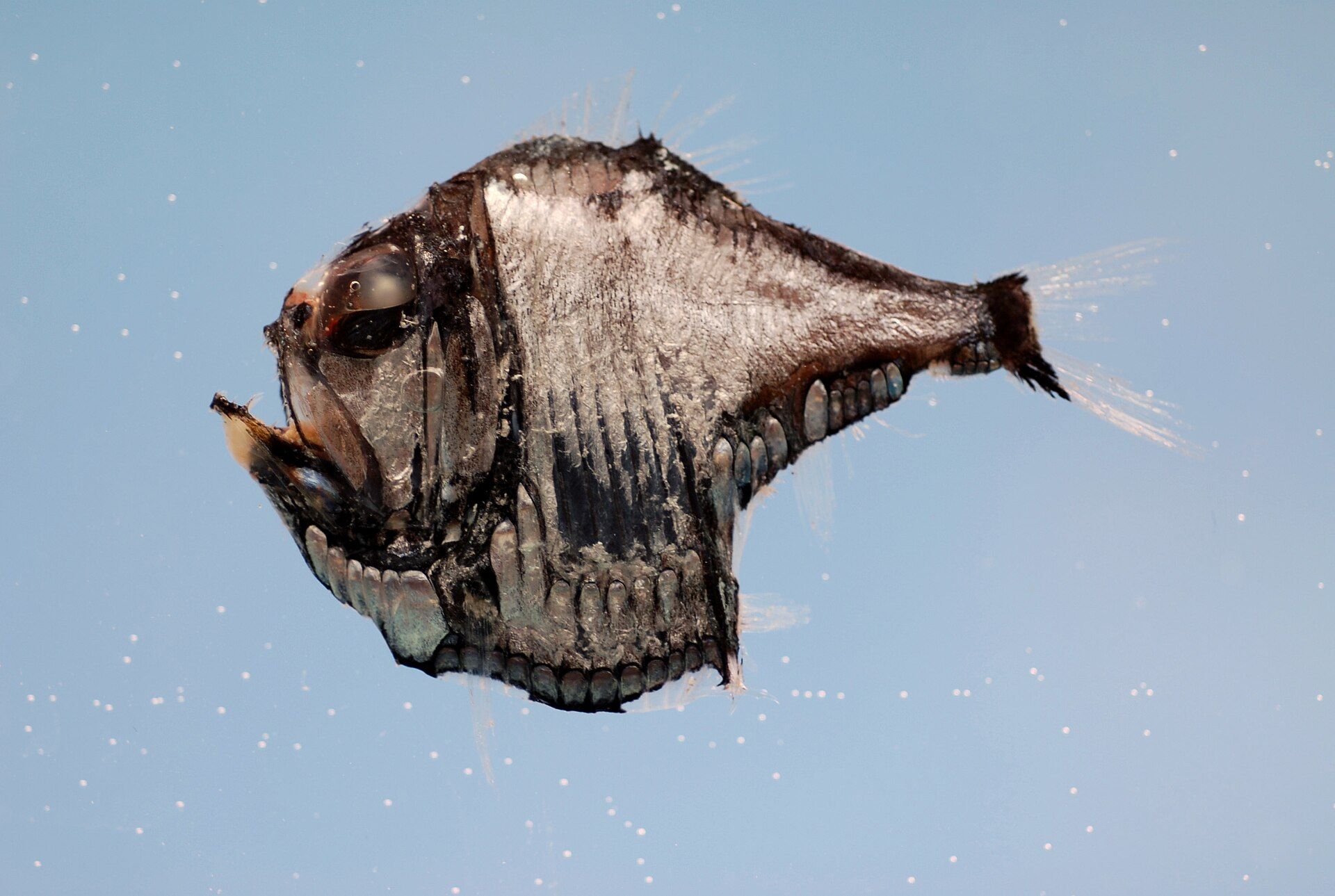
Deep-sea hatchetfish — several species in the genus Argyropelecus and related genera — are named for their body shape: an extreme lateral compression combined with a very deep, knife-edge-shaped body profile that, viewed from the side, resembles a hatchet or axe head. Viewed from the front, they are essentially invisible — the compressed body presents an almost zero-area profile.
The hatchetfish is one of the most refined practitioners of counterillumination: rows of photophores along its underside produce downwelling light precisely calibrated to match the intensity of the ambient surface light from above, eliminating the fish's shadow when viewed from below. Fish and other predators looking upward see the counterilluminating belly as a continuation of the surface light rather than as the silhouette of a fish, making hatchetfish among the most effectively camouflaged animals in the ocean.
Their large, upward-facing tubular eyes — designed to detect the silhouettes of prey above them against the surface light — and their distinctive silver, reflective scales (which scatter any lateral light that reaches them) complete a camouflage system that is multidirectional: invisible from below through counterillumination, effectively invisible from the sides through light scattering, and equipped to detect prey from above.
Depth range: 200–1,500 meters. Photographed: widely documented; specimen photographs and in situ images available.
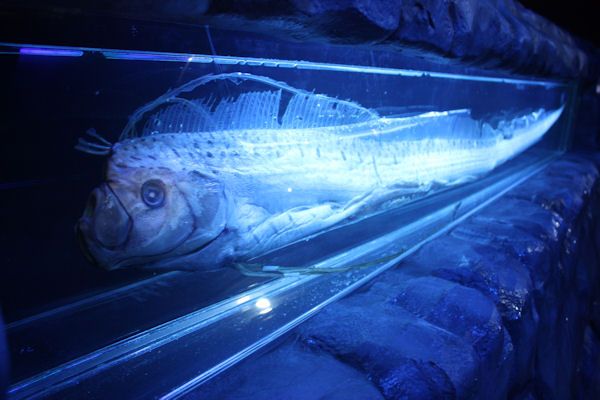
Ryokou man / Wikimedia Commons
The oarfish — the world's longest bony fish, reaching confirmed lengths of up to 8 meters and with anecdotal reports of up to 17 meters — lives at depths of 200 to 1,000 meters and is almost certainly the source of sea serpent legends throughout history. Its elongated, ribbon-like silver body, red dorsal fin crest running the full length of its back, and the red plume-like pelvic fins that extend from its body give it an appearance that, seen partially from the surface or washed ashore, would be unidentifiable as any familiar animal.
Oarfish are rarely seen alive. They are occasionally found washed ashore (typically when dying or dead) and have been filmed in the wild only a handful of times, making each filmed encounter a significant event. The footage that exists — a ribbon of silver several meters long moving through blue water, crest raised, moving in a vertical undulation unlike any other fish — is among the most arresting in ocean photography.
Their depth range and rarity means that what is known about their behavior comes primarily from dead specimens, bycatch from deep trawls, and the small number of in situ encounters, most of which occurred because the fish was sick and had risen to the surface. Healthy, active oarfish at depth remain almost entirely undocumented.
Depth range: 200–1,000 meters. Photographed: washed-ashore specimens widely documented; live in situ photographs and footage exist but are rare and highly circulated.
