26 facts about deep space that will genuinely unsettle you
From rogue planets drifting in total darkness to stars older than the universe seems to allow, deep space is far stranger than any science fiction
Credit: arnaud girault / Unsplash
The universe is approximately 13.8 billion years old, stretches at least 93 billion light-years across, and contains an estimated two trillion galaxies. Those numbers are large enough to be meaningless. The human brain did not evolve to comprehend distances measured in light-years or timescales measured in billions of years. It evolved to track prey across a savanna and judge whether a piece of fruit had gone bad. This fundamental mismatch — between the scale of the cosmos and the scale of human cognition — is part of what makes serious engagement with astrophysics so disorienting.
But the disorientation runs deeper than mere size. Deep space is not simply a bigger version of the world we know. It operates according to conditions so extreme, so alien to everyday experience, that the categories we use to understand ordinary life — solid, empty, hot, cold, alive, dead — begin to break down. There are regions of space where a teaspoon of matter would weigh more than all of humanity combined. There are objects so dense that light itself cannot escape them. There are structures so cold they approach absolute zero, and others so hot that the very concept of a "surface" dissolves into plasma.
What makes deep space genuinely unsettling — as opposed to merely abstract — is that none of this is hypothetical. These are not thought experiments. They are observed, measured, documented features of the physical universe we actually inhabit. The galaxy that appears as a faint smudge in a long-exposure photograph is a real place containing hundreds of billions of stars, each potentially orbited by worlds, some of which may have existed for longer than Earth has had complex life.
There is also the question of what we do not know. The matter and energy we can detect — stars, gas, dust, planets — accounts for roughly five percent of the total content of the universe. The remaining 95 percent consists of dark matter and dark energy, two phenomena whose names describe what we observe rather than what we understand. They are labels for ignorance. The universe is not only stranger than we imagined; it is largely opaque to our best instruments.
The 26 facts that follow are drawn from established astrophysics and cosmology. None require exotic speculation. Each describes a confirmed feature of the cosmos — one that, looked at clearly and without flinching, reveals just how strange a place the universe actually is.
1 / 26
There is a giant cloud of alcohol floating in space
Credit: Marek Pavlík / Pexels
In the direction of the constellation Aquila, roughly 26,000 light-years from Earth, sits a molecular cloud called G34.3. Among the molecules detected within it is ethanol — the same alcohol found in beer, wine, and spirits. The amount of ethanol present is not trivial. Estimates based on spectroscopic data suggest the cloud contains enough ethanol to fill many times over any earthbound reservoir imaginable, produced not by fermentation but by chemical reactions on the surfaces of interstellar dust grains.
This is not the only example of complex organic chemistry occurring in deep space. Interstellar molecular clouds — vast, cold regions of gas and dust where temperatures can drop to around minus 263 degrees Celsius — turn out to be surprisingly productive chemical environments. As gas molecules freeze onto dust grains, they undergo reactions driven by ultraviolet radiation from nearby stars, assembling into increasingly complex compounds. Astronomers have identified over 200 distinct molecules in interstellar space, including formaldehyde, acetone, and glycolaldehyde, a simple sugar.
The existence of these molecules matters beyond curiosity. The organic chemistry that underpins life on Earth — amino acids, sugars, nucleobases — may not have originated entirely on Earth. Some of the raw materials for biology could have arrived via comets and asteroids that swept up interstellar dust during the early solar system's formation. The line between the chemistry of space and the chemistry of life is less sharp than it once appeared.
What makes the alcohol cloud specifically striking is how vividly it illustrates the gap between the universe of human experience and the universe as it actually exists. The cosmos does not organize itself around human categories. It does not reserve complex organic chemistry for planets. It runs those reactions across light-year-scale clouds in the vacuum of interstellar space, producing compounds associated with life and intoxication in regions where nothing alive has ever, as far as we know, existed. The ordinary and the alien are mixed together in proportions that resist easy sorting.
2 / 26
The largest known structure in the universe challenges our understanding of cosmology
Credit: Zelch Csaba / Pexels
The Hercules-Corona Borealis Great Wall is a massive concentration of galaxies spanning approximately 10 billion light-years. Discovered in 2013 and confirmed through subsequent analysis of gamma-ray burst distributions, it represents the largest known structure in the observable universe.
This matters because it should not exist — or at least, it should not exist according to the standard model of cosmology. The Lambda-CDM model, which describes how the universe evolved from the Big Bang to its current state, predicts that matter should be distributed relatively uniformly on scales above roughly 1.2 billion light-years. At those scales, the gravitational pull of any one region on another becomes too weak to have organized matter into coherent structures during the 13.8-billion-year age of the universe.
A structure ten times larger than that theoretical limit does not fit neatly into the model. Cosmologists have proposed several explanations: statistical fluctuations in gamma-ray burst detection, variations in how gamma-ray bursts trace mass, or genuine large-scale structure that requires revisions to standard cosmological theory. The debate has not been fully resolved.
What the Hercules-Corona Borealis Great Wall illustrates is that even the broadest framework for understanding the universe — a framework supported by an enormous body of evidence — may have gaps. The history of cosmology is a history of discovering that the universe is larger, older, more structured, and more homogeneous at some scales and less homogeneous at others than previous models predicted. Each revision to the model is not a failure; it is progress. But progress of this kind involves acknowledging that the map is still incomplete, and that some of the largest features of the territory have only just come into view.
The sheer scale of the structure is itself difficult to absorb. Ten billion light-years is roughly 70 percent of the distance to the edge of the observable universe. A structure of that size is not a feature of the cosmos — it is, in some sense, the cosmos arranging itself in ways that our best theories are still catching up to describe.
3 / 26
A neutron star's surface gravity is 200 billion times stronger than Earth's
Credit: Andre Moura / Pexels
When a massive star exhausts its nuclear fuel and collapses, the result can be a neutron star: an object roughly 20 kilometers in diameter that packs more mass than the Sun into a sphere the size of a small city. The density of a neutron star is approximately equal to the density of an atomic nucleus. Matter at this density does not behave the way ordinary matter does. It cannot be described by the physics of solids, liquids, or gases. It exists in a state that has no everyday analogue.
The surface gravity of a typical neutron star is approximately 200 billion times stronger than Earth's surface gravity. An object dropped from one meter above the surface of a neutron star would impact at roughly half the speed of light. A 68-kilogram person standing on the surface — which is impossible for reasons that extend well beyond the gravity — would effectively weigh approximately 14 trillion kilograms.
The interior of a neutron star is one of the least understood environments in physics. At the core, pressures may be high enough to produce exotic states of matter — quark-gluon plasma, strange quark matter, color superconductors — that exist nowhere else in the current universe and that cannot be replicated in any terrestrial experiment. Theoretical physicists have proposed multiple models of neutron star interiors, but the extreme conditions prevent direct observation.
Neutron stars also spin. Millisecond pulsars — a subclass of neutron stars — rotate hundreds of times per second, maintaining this rotation with extraordinary stability. The pulsar PSR J1748-2446ad rotates 716 times per second. A point on its equator moves at approximately 24 percent of the speed of light. The centrifugal force at that rate of rotation approaches the limit at which the star would begin to shed mass. These objects are, by any reasonable assessment, operating near the physical limits of what matter can do before it collapses further into a black hole.
4 / 26
The universe has a temperature
Credit: Planet Volumes / Unsplash
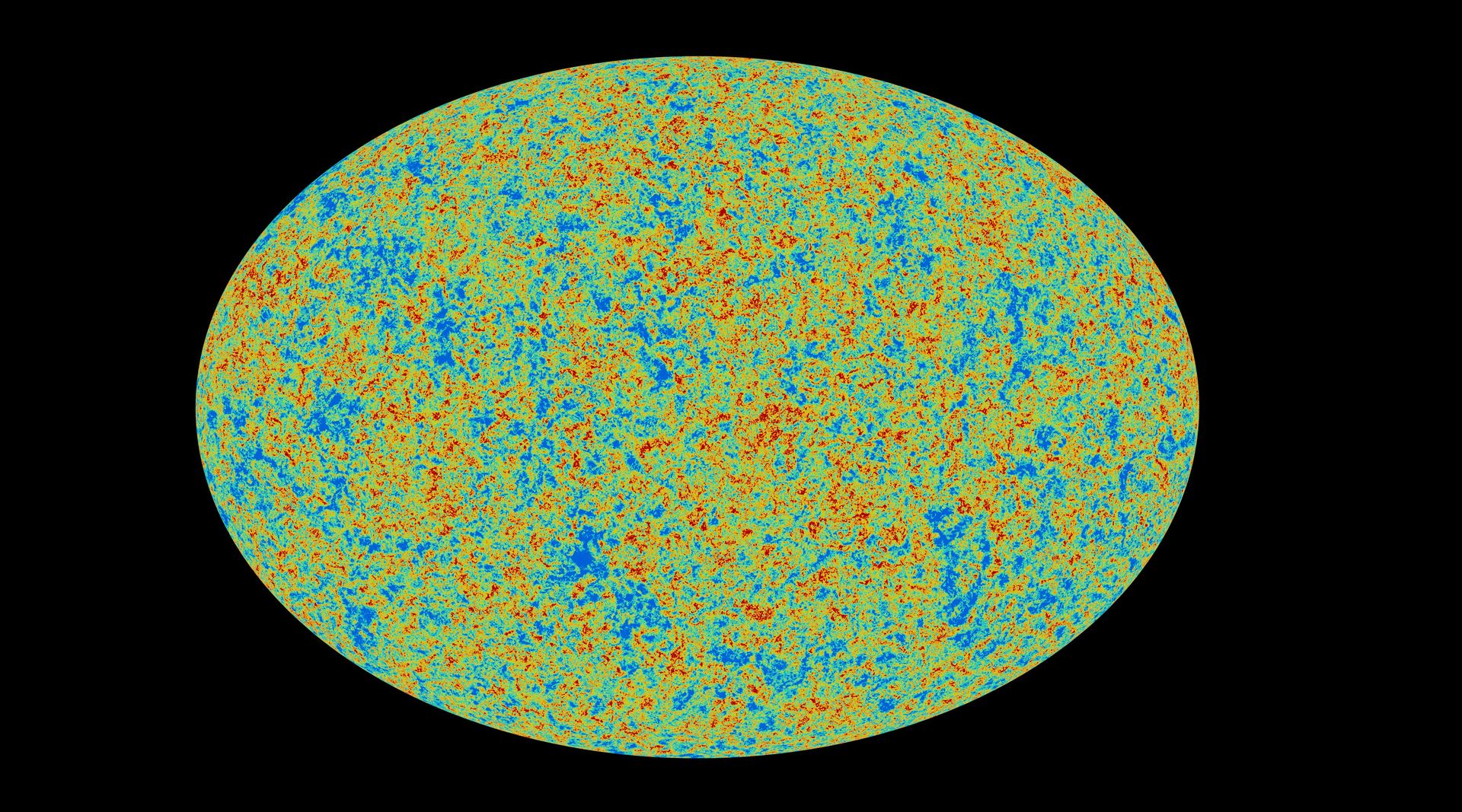
The universe is not simply cold in some vague, general sense. It has a measured temperature: 2.725 degrees Kelvin, or approximately minus 270.4 degrees Celsius. This is the temperature of the cosmic microwave background radiation — the afterglow of the Big Bang, now stretched by the expansion of the universe into microwave wavelengths and filling all of space uniformly.
This temperature represents the lowest natural background temperature in the observable universe. It is colder than any planetary surface, colder than the interstellar medium in most regions, colder than anything in the solar system. The only thing colder is matter that has been deliberately cooled in laboratories, or rare regions of space like the Boomerang Nebula, which reaches about one degree Kelvin due to rapid gas expansion — making it the coldest known natural environment.
The cosmic microwave background is not merely a temperature. It is a fossil. It is the oldest light in the universe, emitted approximately 380,000 years after the Big Bang, when the universe had cooled enough for electrons and protons to combine into hydrogen atoms, allowing photons to travel freely for the first time. That light has been traveling ever since. When an observatory measures the cosmic microwave background, it is detecting photons that have been in transit for more than 13 billion years.
The minute fluctuations in this background — temperature variations of roughly one part in 100,000 — encode the density variations of the early universe. Those variations seeded everything: the galaxies, the galaxy clusters, the cosmic web of filaments and voids. The large-scale structure of the universe today is, in a direct physical sense, an amplified version of quantum fluctuations imprinted on matter in the first fractions of a second after the Big Bang. The temperature of the cosmos, measured with sufficient precision, tells a story that begins before any star existed.
5 / 26
There are rogue planets drifting through the galaxy with no star
Credit: Canva Images
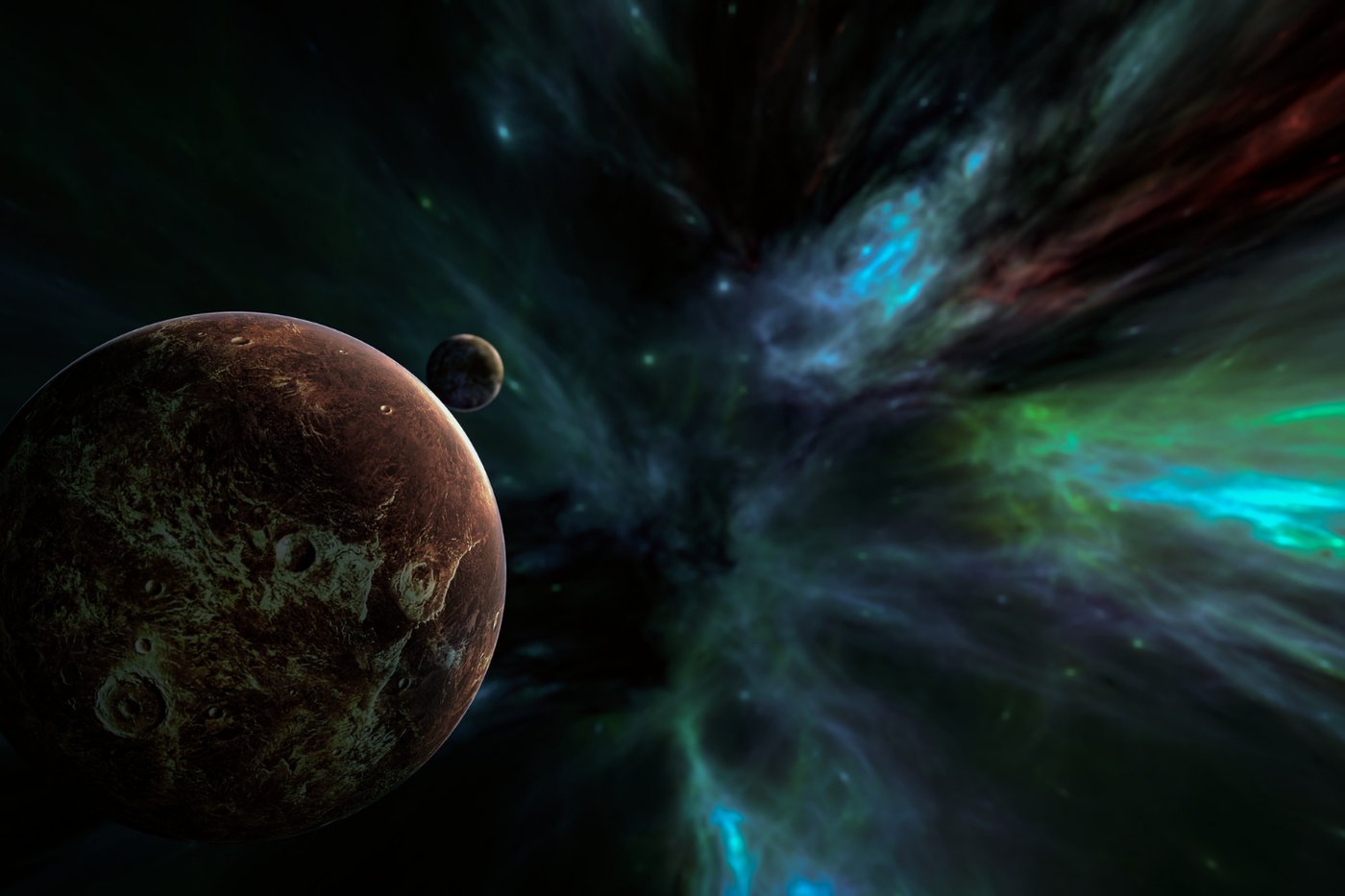
Most planets orbit a star. The assumption is so deeply embedded in the concept of "planet" that it is rarely stated explicitly. But the galaxy contains a substantial population of free-floating planetary-mass objects — bodies of planetary mass that were ejected from their original solar systems through gravitational interactions, or that formed directly from collapsing gas clouds without ever orbiting a star.
These objects are called rogue planets, or free-floating planetary-mass objects. Estimates of their number vary widely, but microlensing surveys — which detect the brief brightening of background stars when a massive object passes in front of them — suggest that rogue planets may be as common as, or more common than, stars in the Milky Way. Some estimates put the population in the trillions.
A rogue planet is a world in darkness. Without a host star, it has no external energy source. Its surface, if it has one, receives no starlight and reflects none. It is invisible to ordinary telescopes, detectable only through gravitational effects or, in some cases, thermal emission from residual internal heat. Some of these worlds may retain thin atmospheres sustained by geothermal energy or pressure from above. Some may even have subsurface liquid water if they contain enough radioactive material to generate internal heat over geological timescales. Life on such a world, if it existed at all, would have no knowledge of stars.
The concept of a rogue planet reframes what we mean by a planet and what we mean by a solar system. The solar system is not the default condition of planetary matter; it is one configuration among several. Some worlds form in the warmth of a star and are later thrown into the dark. Others form in the dark and never know anything else. The galaxy contains worlds in quantities and varieties that the history of astronomical observation, centered almost entirely on star-orbiting planets, has only recently begun to account for.
6 / 26
Sound cannot travel through most of space, but space is not silent
Credit: Rahul Ray / Pexels
Space is commonly described as silent, and in a narrow sense this is accurate: sound waves require a medium to propagate through, and the interstellar medium — the gas and dust between stars — is far too diffuse to transmit sound at frequencies humans could detect. At average interstellar densities, a sound wave would attenuate to nothing almost immediately.
But the interstellar medium is not empty. It contains gas at densities low enough to be considered near-vacuum by terrestrial standards, but high enough to support pressure waves at very low frequencies and very long wavelengths. In 2003, NASA's Chandra X $TWTR-ray Observatory detected pressure waves in the hot gas of the Perseus galaxy cluster generated by a supermassive black hole at the cluster's center. These waves — which technically qualify as sound — have a frequency roughly 57 octaves below middle C, far beyond any human hearing. The "note" has a period of approximately ten million years.
Radio emissions from planetary magnetospheres, converted to audio frequencies, reveal complex, eerie signals — Jupiter's magnetosphere produces sounds resembling static and tones; Earth's produces so-called "chorus," a rising, birdsong-like signal generated by electrons interacting with the planet's magnetic field. These are electromagnetic waves, not acoustic waves, but they carry information about the dynamics of space environments in a form that, when shifted into audible range, conveys genuine physical structure.
The silence of space is real in a specific technical sense: no acoustic waves travel between stars. But the cosmos is full of oscillations, waves, and signals of every other kind — gravitational, electromagnetic, plasma-dynamic. The detection of gravitational waves by LIGO in 2015 added another dimension. The merger of two black holes 1.3 billion light-years away produced a ripple in spacetime that arrived on Earth as a strain — a stretching and squeezing of space — lasting a fraction of a second. Space is not loud. But it is not quiet either.
7 / 26
A day on Venus is longer than a year on Venus
Credit: Javier Miranda / Unsplash
Venus rotates so slowly on its axis that a single Venusian day — the time it takes the planet to complete one rotation relative to the stars — lasts approximately 243 Earth days. Its orbit around the Sun takes approximately 225 Earth days. This means that by the time Venus has completed one full rotation, it has already traveled more than once around the Sun.
This is not merely a quirk of planetary rotation rates. It reflects something genuinely odd about Venus's rotational history. Most planets in the solar system rotate in the same direction as their orbital motion, a consequence of the angular momentum of the disk of gas and dust from which the solar system formed. Venus rotates in the opposite direction — retrograde — meaning that on Venus, the Sun rises in the west and sets in the east. The cause of this retrograde rotation is debated: proposals include a large impact early in the planet's history, tidal interactions with the Sun, or the gravitational effects of its dense atmosphere acting over billions of years.
The Venusian atmosphere itself is one of the most hostile environments in the solar system. Surface temperatures reach approximately 465 degrees Celsius — hotter than Mercury, despite Venus being twice as far from the Sun — sustained by a runaway greenhouse effect. The atmospheric pressure at the surface is about 92 times Earth's, equivalent to being roughly 900 meters underwater. The Soviet Venera probes that landed on the surface in the 1970s and 1980s survived for between 23 minutes and two hours before the conditions destroyed them.
Venus is, in many respects, the nearest thing to Earth in terms of size and mass. It orbits in a zone where, under different conditions, liquid water might exist. Instead, it is a place where lead would melt on the surface and spacecraft survive for less than an hour. It is a useful reminder that proximity in space does not imply similarity in character.
8 / 26
The observable universe is not the whole universe
Credit: Chirayu Sharma / Unsplash
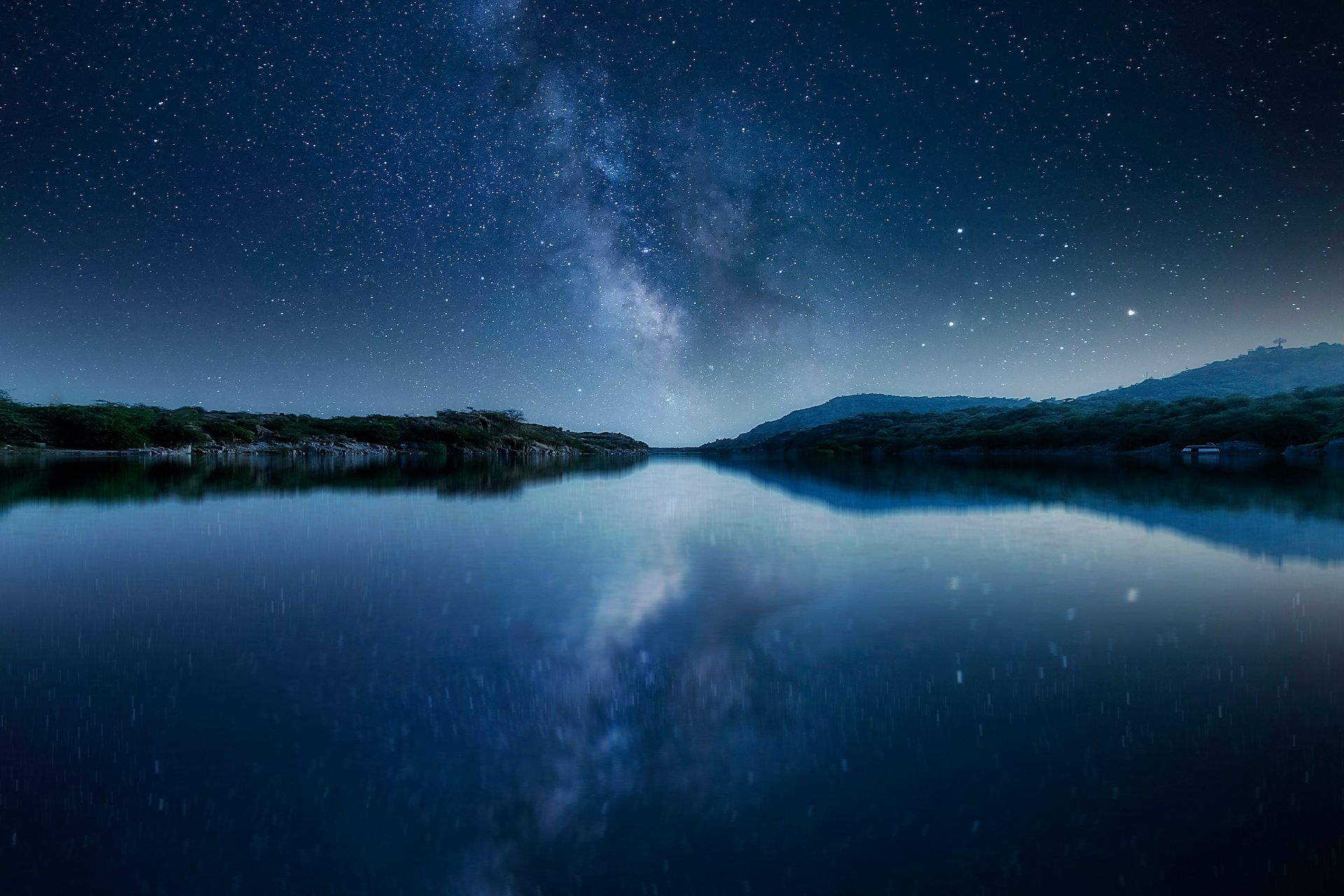
When astronomers refer to the "observable universe," they mean a specific, finite volume of space: the region from which light has had time to reach us since the Big Bang. This sphere is centered on Earth — not because Earth occupies a privileged position, but because we are the observers — and extends approximately 46 billion light-years in all directions.
The universe itself extends far beyond this boundary. How far is unknown. Current models suggest that the universe may be either much larger than the observable portion — potentially hundreds or thousands of times larger — or, in some inflationary cosmology scenarios, effectively infinite. The uniformity of the cosmic microwave background across the observable volume is consistent with the universe being much larger than what we can see; there is no indication that the observable universe represents a boundary of any kind.
This has a precise implication: every observation ever made in the history of astronomy describes a subset of a larger whole whose scale and nature we cannot determine. The most powerful telescopes ever built, pointed at the most distant objects ever detected, are mapping a finite bubble inside something whose extent is unknown. Outside the observable universe, the same physical laws presumably apply. Stars presumably exist. Galaxies presumably exist. Whatever large-scale structures dominate the unobservable universe are presumably similar in kind to those we can see — but we cannot verify this. We cannot even verify that the universe is the same everywhere.
The cosmological principle — the assumption that the universe is homogeneous and isotropic on large scales — is well supported within the observable volume. Whether it holds beyond is a matter of theoretical preference. Some inflationary models predict regions where the physics differs from our own — different constants, different laws, or a vacuum state with different properties. These regions, if they exist, are outside the observable universe and will remain so forever.
9 / 26
Black holes evaporate
Credit: Iceberg San / Pexels
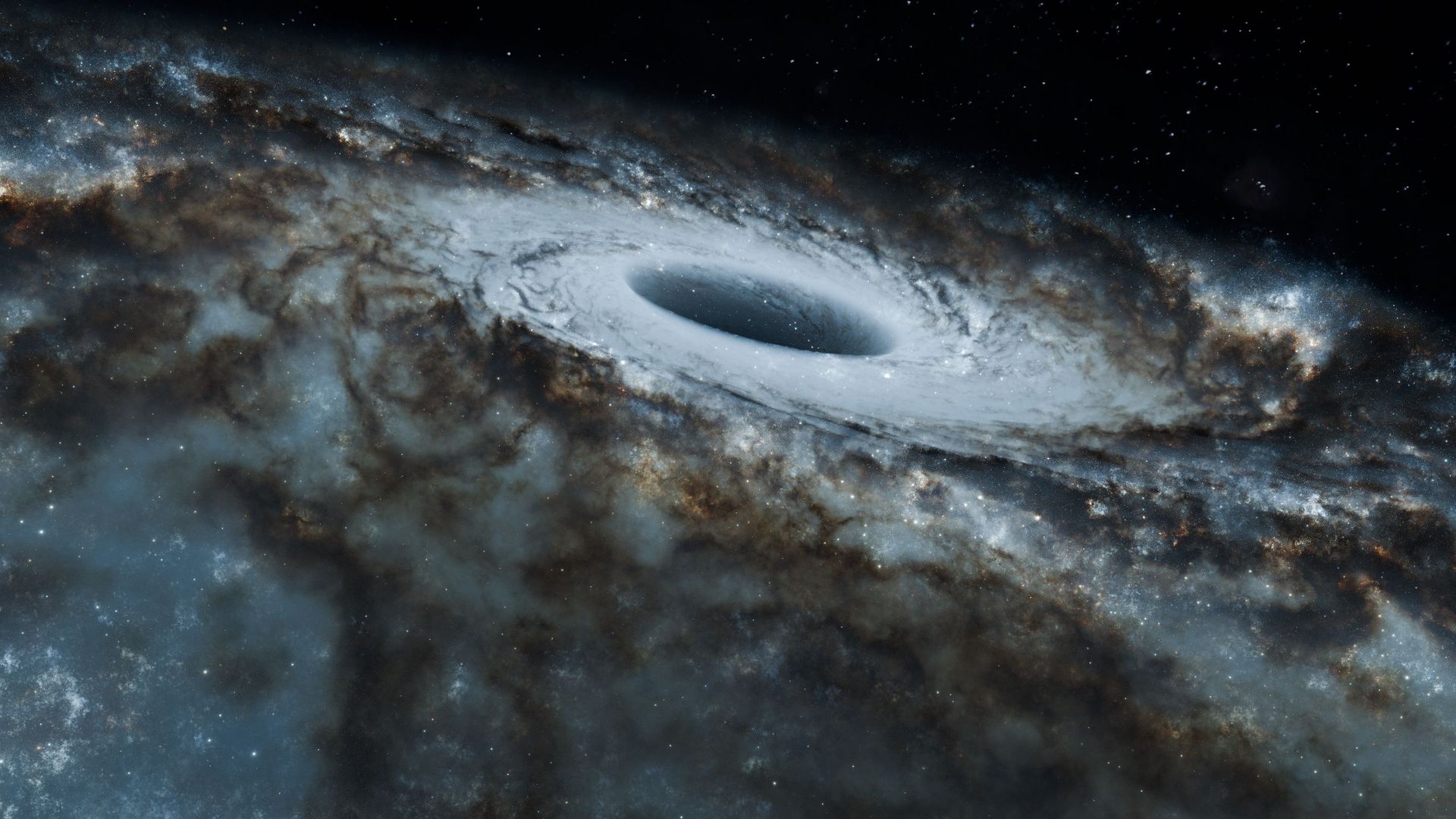
Black holes are commonly understood as permanent fixtures — objects that trap matter and energy indefinitely. Stephen Hawking's theoretical work in 1974 introduced a complication. When quantum mechanical effects are applied to the boundary of a black hole — the event horizon — the result is a slow, continuous emission of thermal radiation. This is called Hawking radiation.
The mechanism involves virtual particle pairs that quantum mechanics permits to appear briefly near the event horizon. Ordinarily, these pairs annihilate almost immediately. Near an event horizon, one particle can fall into the black hole while the other escapes. The escaping particle carries energy, and that energy must come from somewhere — it comes from the black hole's mass. Over time, this process causes the black hole to lose mass and, eventually, to evaporate entirely.
The timescale for this process is incomprehensibly long for the black holes known to exist. A black hole with the mass of the Sun would take approximately 2 times 10 to the power of 67 years to evaporate — many orders of magnitude longer than the current age of the universe. Supermassive black holes at the centers of galaxies would take far longer still. The evaporation is effectively unobservable for any black hole that has formed from stellar collapse.
But the theoretical implication is significant. Black holes are not eternal. They are objects with a finite lifespan, governed by quantum mechanics operating at the boundary between general relativity and the quantum world. Hawking radiation has never been directly detected — the radiation from any astrophysical black hole would be utterly overwhelmed by cosmic background radiation. Its existence is a theoretical prediction, widely accepted but unconfirmed by observation. The final moments of a black hole — the last burst of radiation as it evaporates — represent a frontier in physics that connects gravity, quantum mechanics, thermodynamics, and information theory in ways that are still not fully understood.
10 / 26
The Milky Way and Andromeda are on a collision course
Credit: Scott Lord / Pexels
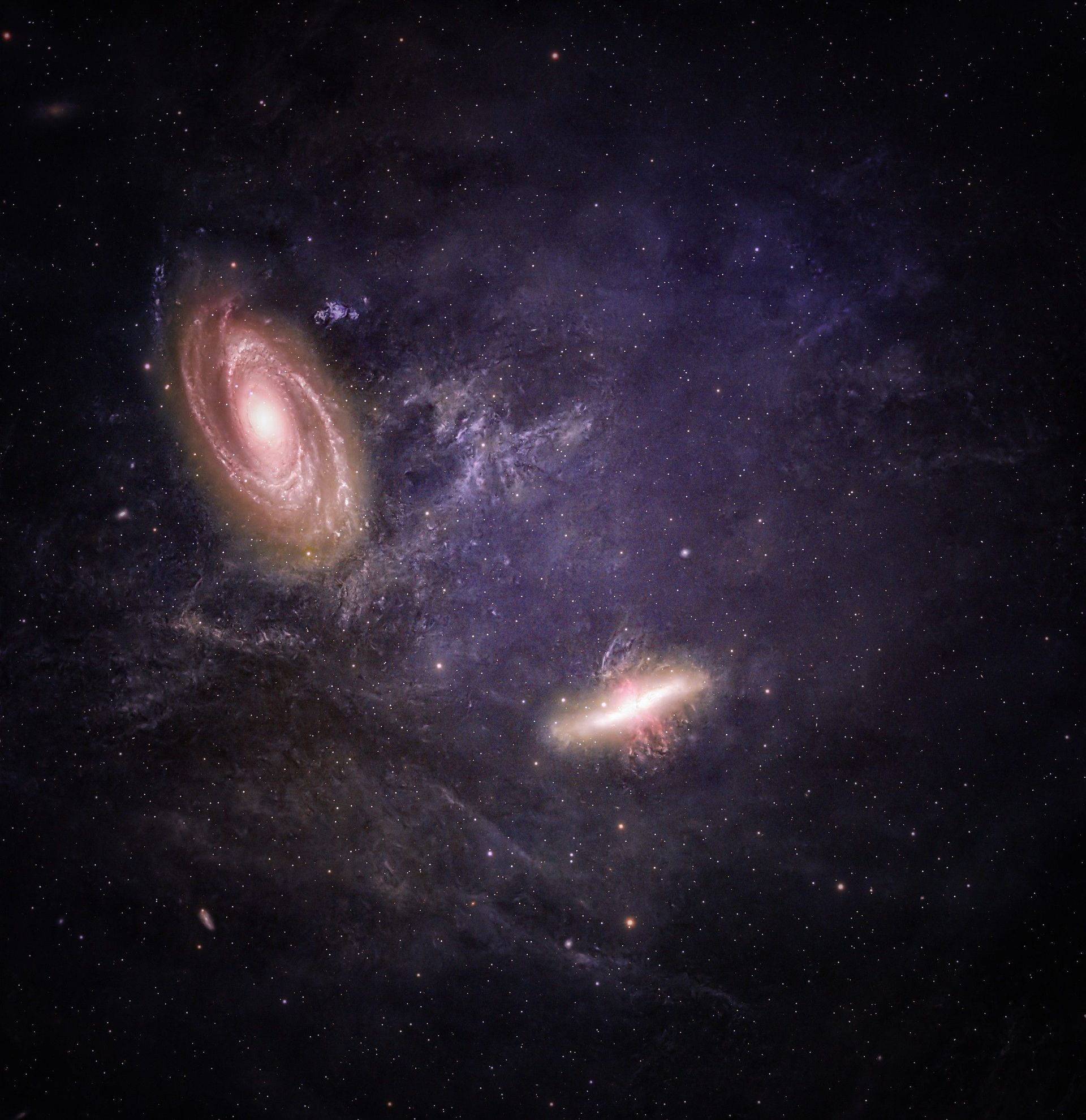
The Andromeda Galaxy — the nearest large spiral galaxy to the Milky Way — is approaching at approximately 110 kilometers per second. In roughly four billion years, the two galaxies will begin to merge. This event will not resemble a collision in the everyday sense: galaxies are mostly empty space, and individual stars are so far apart that direct stellar collisions are extremely unlikely. But the gravitational interaction will reshape both galaxies profoundly over hundreds of millions of years.
The merger will disrupt the spiral structures of both galaxies. Stars will be flung into new orbits. The supermassive black holes at the centers of each galaxy — the Milky Way's Sagittarius A*, which contains about four million solar masses, and Andromeda's central black hole, which may contain up to 100 million solar masses — will eventually spiral toward each other, merge, and produce a burst of gravitational waves and electromagnetic radiation. The resulting object has been informally called Milkomeda or Milkdromeda.
The Sun will almost certainly survive the merger. Its orbit will change as the gravitational structure of the galaxy is reorganized, but the odds of it encountering another star closely enough to disrupt its planetary system are low. Earth, if it still exists in four billion years — which depends on the Sun's own evolution — would orbit within a transformed galaxy that no longer has a defined spiral structure.
The timing of the merger is known with some precision because the Hubble Space Telescope measured Andromeda's proper motion — its movement across the sky, as distinct from its approach velocity — with sufficient accuracy to project the trajectories of both galaxies forward. The collision is not a possibility; it is a scheduled event, already underway in a gravitational sense, with a timeline longer than the current age of the Earth.
11 / 26
Stars can die in multiple different ways, and most don't explode
Credit: Caio Mantovani / Pexels
The public image of stellar death tends to feature supernovae — violent explosions visible across millions of light-years. Supernovae are real and spectacular, but they apply only to stars above a certain mass threshold, roughly eight solar masses. The majority of stars, including the Sun, end their lives by a quieter and in some ways stranger process.
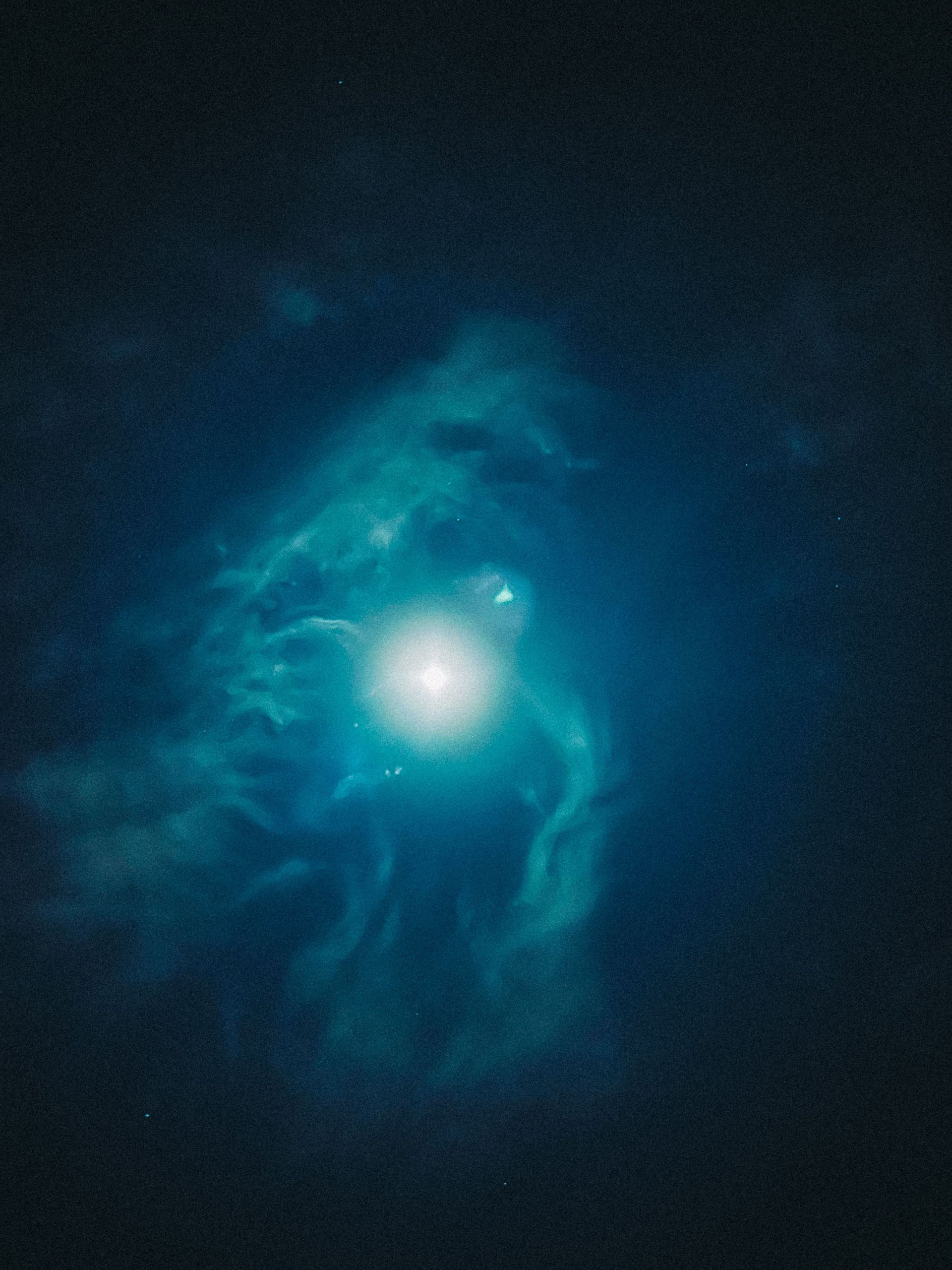
When a Sun-like star exhausts the hydrogen in its core, it expands into a red giant, swelling to tens or hundreds of times its current size. The outer layers are then ejected in pulses and stellar winds, forming a planetary nebula — a shell of ionized gas surrounding the exposed core of the star. That core, now deprived of nuclear fuel, is a white dwarf: an object roughly the size of Earth but with a mass close to that of the Sun, supported not by nuclear reactions but by electron degeneracy pressure, a quantum mechanical effect.
A white dwarf is not burning. It is simply hot from residual heat and will cool over billions of years, eventually becoming a black dwarf — a cold, dark, inert remnant. No black dwarf is thought to exist yet; the universe is not old enough for any white dwarf to have cooled completely.
For the most massive stars — above roughly 20 to 25 solar masses — the endpoint can be even more extreme. The collapse of the core, if it produces a black hole directly rather than a neutron star, may occur without a visible supernova. The star appears to dim and disappear. This is called a failed supernova or a direct collapse event. A star in the galaxy NGC 6946, designated N6946-BH1, showed early signs of this behavior in 2009 — it brightened briefly and then faded from view, with no supernova detected. The fate of the matter that made up that star is now a black hole with no marker of the transition except the absence of a star where one used to be.
12 / 26
Time passes at different rates depending on where you are in a gravitational field
Credit: John Fernald / Pexels
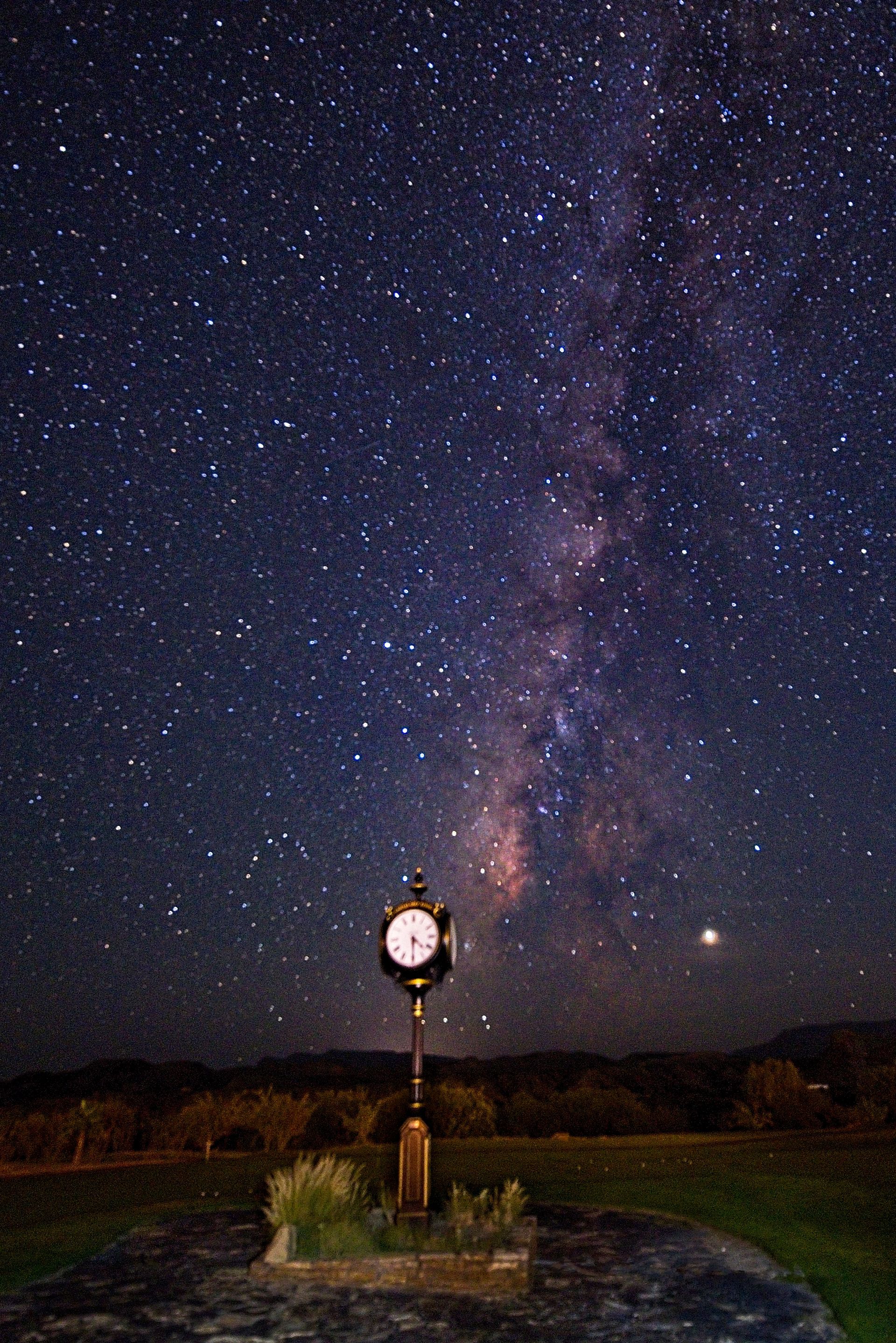
General relativity, confirmed repeatedly over more than a century of observation, predicts that time passes more slowly in stronger gravitational fields. This is not a metaphor or a philosophical statement. It is a physical effect, measured directly and accounted for in practical technology.
GPS satellites orbit Earth at an altitude of approximately 20,200 kilometers, where Earth's gravity is weaker than at the surface. Because gravity dilates time — clocks in stronger gravitational fields run slower — a clock on the surface of Earth runs slightly slower than a clock in orbit. The GPS satellites must correct for this effect, along with the time dilation caused by their orbital velocity under special relativity, to maintain the precision required for accurate positioning. Without these corrections, GPS positions would drift by several kilometers per day.
Near much stronger gravitational sources, the effect is more dramatic. A clock positioned just outside the event horizon of a stellar-mass black hole would run so slowly, relative to a clock far from the black hole, that it would appear essentially frozen from a distant observer's perspective. An observer falling into a black hole would not notice anything unusual about their own clock — time still flows normally from their perspective — but they would age far more slowly relative to the rest of the universe.
At cosmological scales, this means that the universe does not have a single unified "now." Events that are simultaneous in one reference frame are not simultaneous in another. Time is not a backdrop against which events occur; it is a dimension of spacetime, curved by mass and energy, flowing at different rates in different places. The universe contains no master clock. Every object, every particle, every atom has its own time — varying continuously depending on gravitational environment and velocity. This is not a limit of our instruments. It is a feature of reality.
13 / 26
The universe is expanding, and the expansion is accelerating
Credit: Marek Piwnicki / Pexels
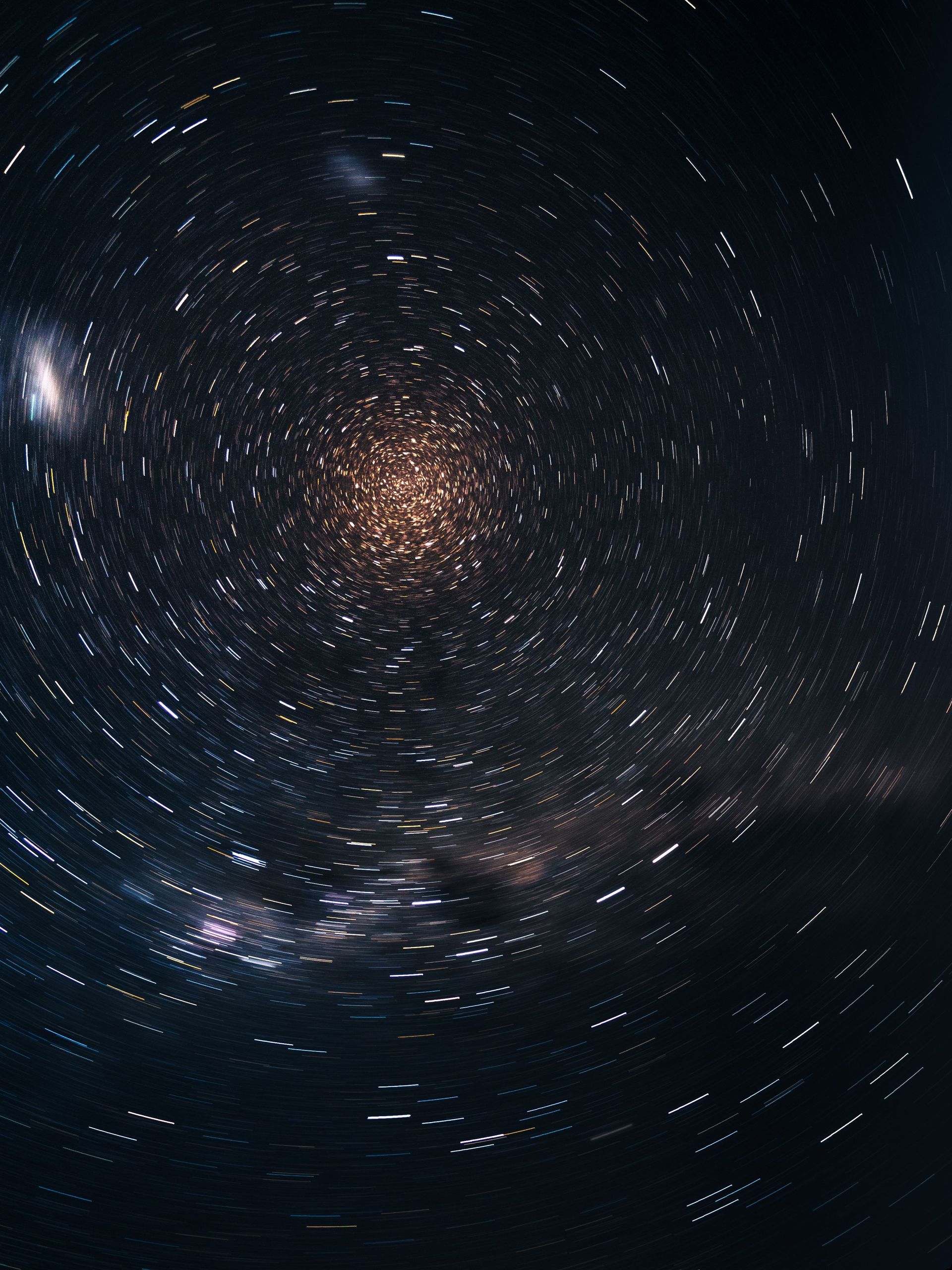
Edwin Hubble's 1929 observation that distant galaxies are moving away from us — and that more distant galaxies are moving away faster — established the expansion of the universe. For decades, cosmologists assumed this expansion was slowing down, gradually braked by gravity. In 1998, two independent research teams studying distant Type Ia supernovae found the opposite. The expansion is accelerating.
The cause of this acceleration is attributed to dark energy, a term for whatever is driving the universe to expand faster over time. Dark energy is not a substance that has been detected or characterized in any direct way. It is inferred from the observation that distant supernovae are dimmer than they would be in a universe where expansion was decelerating — meaning they are farther away than expected, meaning space between us and them has expanded more than it would under gravity alone.
Dark energy is estimated to make up approximately 68 percent of the total energy content of the universe. Dark matter accounts for roughly 27 percent. All the ordinary matter that makes up stars, planets, gas, dust, and every structure ever observed accounts for roughly five percent. The composition of the universe is, by a very wide margin, unknown.
The acceleration has a long-term implication. If it continues indefinitely, distant galaxies will eventually recede faster than light — not because they are moving through space faster than light, but because the space between us and them is expanding. There is no violation of relativity; no information is transmitted. But it means that those galaxies will eventually pass beyond our observable horizon. Their light will never reach us again. The observable universe will, over trillions of years, become smaller as more and more of what is currently visible recedes beyond contact. The universe will become increasingly lonely — not through destruction, but through distance growing faster than light can cross it.
14 / 26
There is a void in space nearly a billion light-years across
Credit: Neon Sumer / Unsplash
The Boötes Void, discovered in 1981 by Robert Kirshner and colleagues while surveying galaxy redshifts, is a region of space approximately 330 million light-years in diameter that contains almost no galaxies. Where a typical region of comparable volume would contain thousands of galaxies, the Boötes Void contains only a handful — about 60, compared to the several thousand that would be expected.
Cosmic voids are a normal feature of large-scale structure. The universe, at the largest scales, resembles a foam: dense filaments and walls of galaxy clusters surrounding vast, nearly empty regions. But the Boötes Void is larger than most models of structure formation would predict. The question of how such a large underdensity formed — whether from a single primordial fluctuation, from the merging of smaller voids over cosmic time, or through some process not fully accounted for in standard models — has not been definitively resolved.
Later surveys found that the Boötes Void is not completely empty; some galaxies were identified within it, though their distribution remains unusual. The void is elongated rather than spherical, and its boundaries are not sharp. It grades gradually into the surrounding large-scale structure rather than ending at a defined wall.
The existence of structures like the Boötes Void illustrates a property of the universe that is easy to state but hard to internalize: most of the volume of the universe is nearly empty space. The galaxies, the stars, the planets — everything that has ever been observed, every civilization that has ever existed — occupy the thin filaments and walls of the cosmic foam. The vast majority of the universe, by volume, is void. Empty is not the exception; it is the rule.
15 / 26
Magnetars have the strongest magnetic fields in the known universe
Credit: Nicola Narracci / Pexels
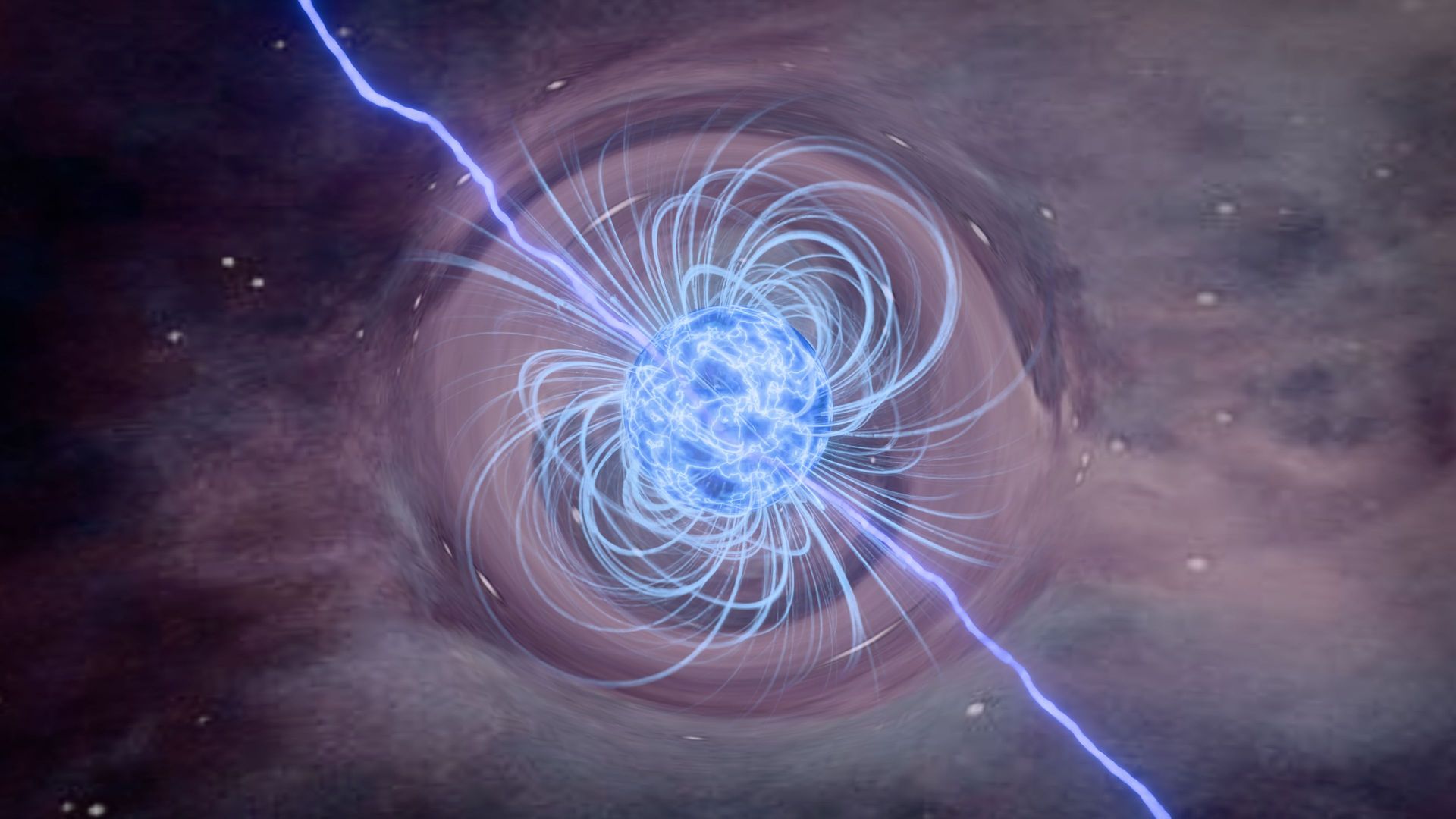
A magnetar is a type of neutron star with an extraordinarily powerful magnetic field — approximately 1,000 times stronger than that of an ordinary neutron star and roughly 10 quadrillion times stronger than Earth's magnetic field. There are currently about 30 known magnetars in the Milky Way, though theoretical models suggest there could be many more that have not yet been detected or that have already decayed.
The magnetic field of a magnetar is strong enough to distort the shapes of atoms. At such field strengths, the electron clouds of hydrogen atoms become elongated along the field lines, producing structures that have no analogue in ordinary chemistry. Matter behaves in ways that cannot be observed or reproduced in any laboratory on Earth.
When a magnetar's field undergoes a sudden reorganization — a "starquake" in the outer crust — it can release a burst of energy in a fraction of a second that exceeds the total output of the Sun over thousands of years. On December 27, 2004, a magnetar called SGR 1806-20 released a gamma-ray flare powerful enough to measurably affect Earth's ionosphere despite the source being approximately 50,000 light-years away. The burst lasted about a tenth of a second for its most intense phase. In that tenth of a second, it released more energy than the Sun emits in approximately 250,000 years.
Had that magnetar been located within a few light-years of Earth — the distance to the nearest stars — the event would have caused significant damage to the atmosphere and potentially to life on the surface. The fact that no magnetar currently known is within dangerous range of Earth is not a law of physics. It is circumstance.
16 / 26
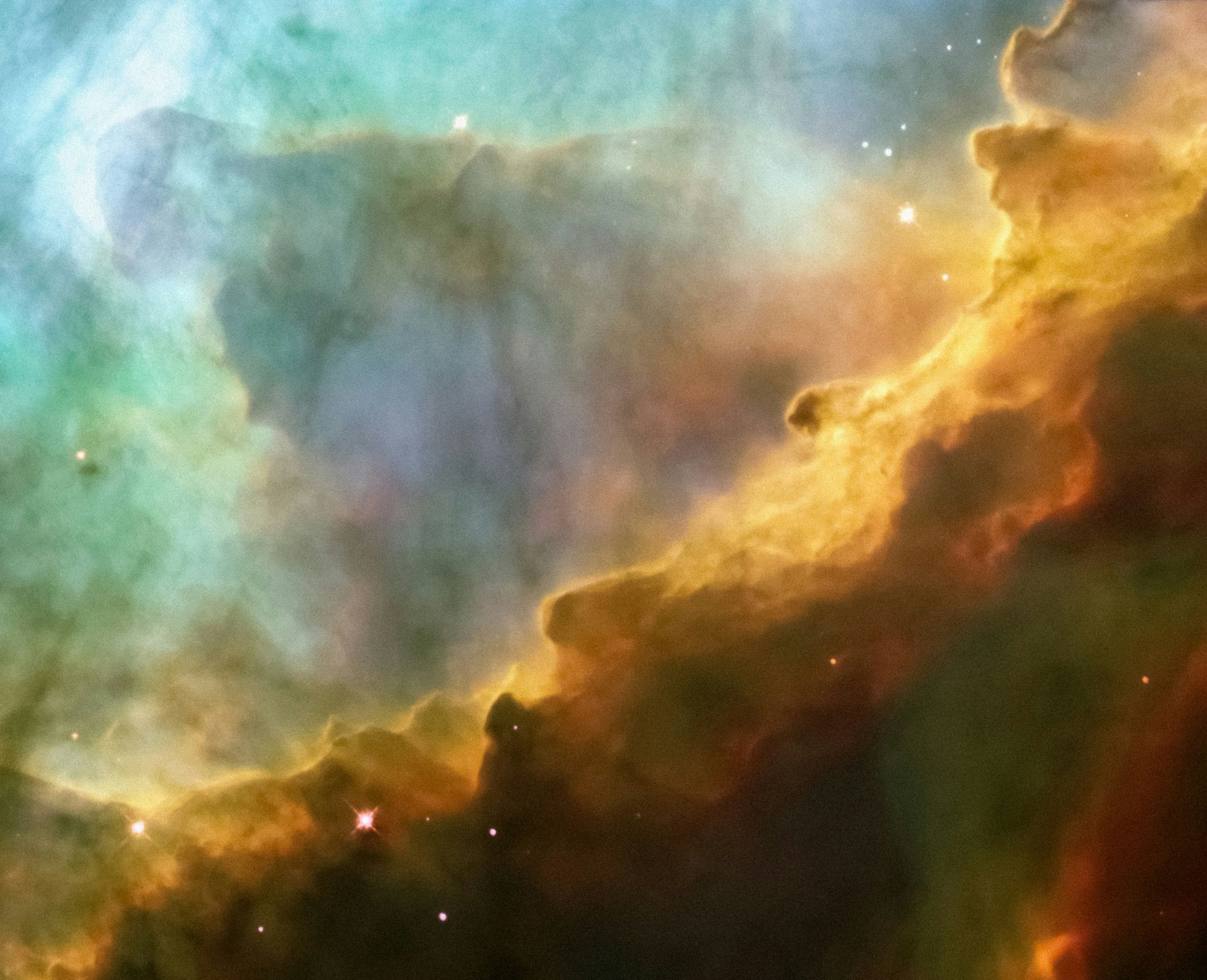
The first stars that ever existed were fundamentally different from the Sun
Credit: NASA Hubble Space Telescope / Unsplash
The Sun is a Population I star — a second or third generation star, formed from gas that had already been processed and enriched by previous stellar generations. It contains carbon, oxygen, nitrogen, iron, and dozens of other elements forged in earlier stars and distributed through supernovae. These metals, as astronomers call all elements heavier than helium, make up a small fraction of the Sun's mass but profoundly affect its structure, its spectrum, and the chemistry of any planets that formed around it.
The first stars in the universe — Population III stars — formed from primordial gas containing only hydrogen, helium, and trace amounts of lithium. Without heavier elements, this gas could not cool as efficiently during collapse, which means the first stars were likely far more massive than the Sun — potentially hundreds of times the solar mass. Such massive stars burn through their fuel quickly and violently, living for only a million years or so before dying in hypernovae, the most energetic type of stellar explosion, seeding the surrounding gas with the first heavy elements.
No Population III star has ever been directly observed. They all died billions of years ago, before any currently observable stars formed. Their existence is inferred from stellar evolution models, from the elemental abundances of the earliest observed stars, and from the requirement that heavy elements had to be produced somewhere before later generations of stars could form. Some extremely metal-poor stars — very old stars with nearly primordial compositions — are thought to be second-generation stars that formed from gas enriched by a single Population III supernova.
The James Webb Space Telescope has identified galaxy candidates at redshifts corresponding to the first few hundred million years of the universe, where Population III stars may have been active. Direct detection of their chemical signatures remains an active research goal.
17 / 26
A pulsar is more accurate than most atomic clocks
Credit: Alexandre P. Junior / Pexels
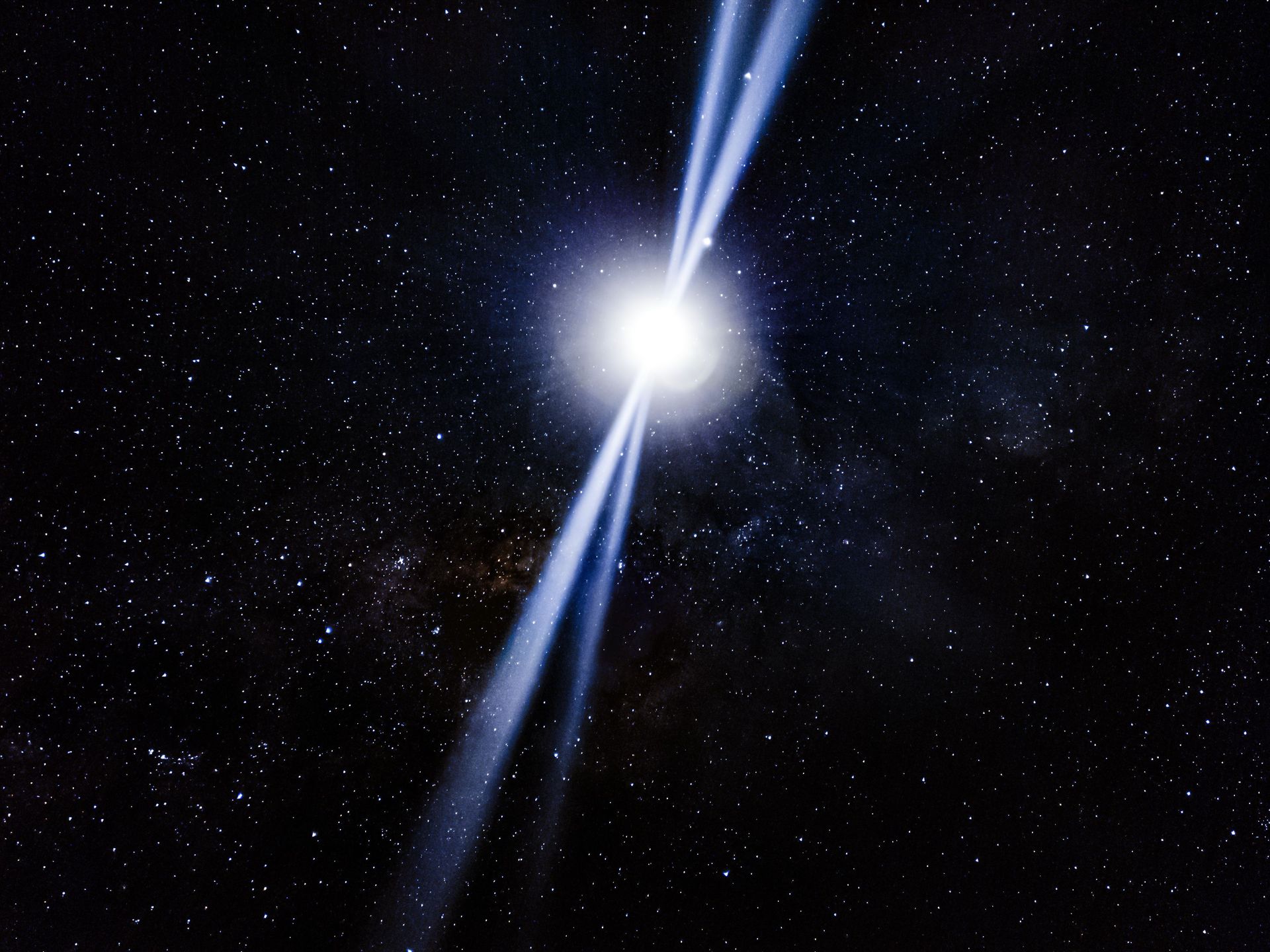
Pulsars are rotating neutron stars that emit beams of electromagnetic radiation from their magnetic poles. Because the rotational axis and magnetic axis are not aligned, the beam sweeps around like a lighthouse beam and, when oriented toward Earth, produces a pulse detectable by radio telescopes. The regularity of these pulses reflects the stability of the neutron star's rotation.
Millisecond pulsars — those spinning hundreds of times per second, which have been spun up by accreting mass from a companion star — are extraordinarily stable rotators. Their timing precision rivals or exceeds that of atomic clocks over certain timescales. The pulsar PSR B1937+21, the first millisecond pulsar discovered, rotates 641 times per second with a slowdown rate so small that it would take billions of years for its period to change by one second.
This stability is not absolute. Pulsars do slow down, due to the energy radiated away in the pulsar beam, and occasionally experience "glitches" — sudden, small increases in rotation rate thought to be caused by the transfer of angular momentum from the superfluid interior to the solid crust. These glitches and their aftermaths give astrophysicists indirect information about the internal structure of neutron stars.
Millisecond pulsars are being used as the basis of a pulsar timing array — a galaxy-scale gravitational wave detector. By monitoring the precise arrival times of pulses from dozens of millisecond pulsars distributed across the sky, astronomers can detect tiny, correlated deviations in timing that would indicate the passage of very low frequency gravitational waves — waves produced by pairs of supermassive black holes orbiting each other in the centers of distant merging galaxies. The North American Nanohertz Observatory for Gravitational Waves (NANOGrav) announced evidence for a gravitational wave background of this type in 2023, using pulsars as the detection instrument.
18 / 26
There is a place in the solar system that may harbor life
Credit: Carlos Kenobi / Pexels
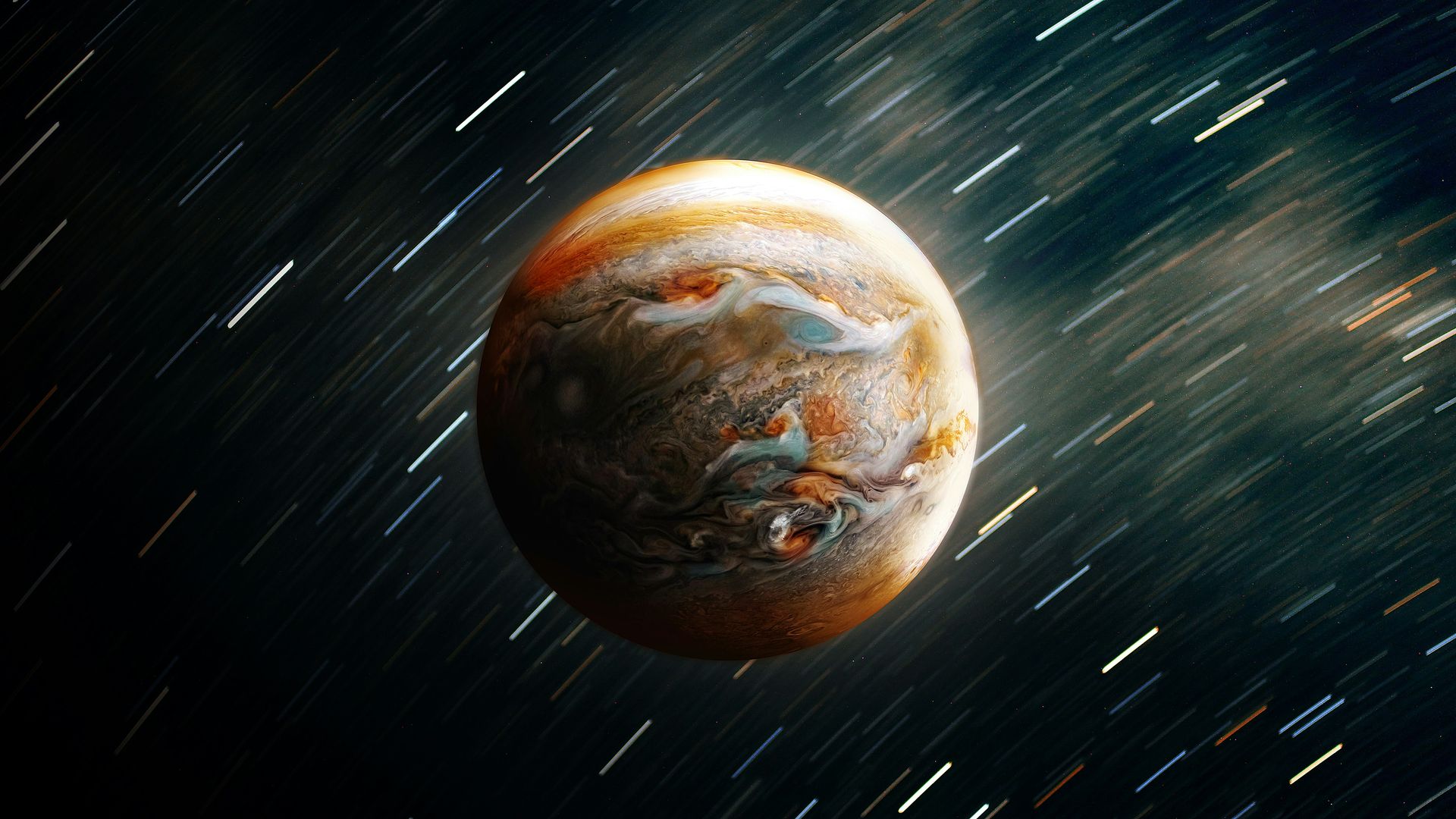
Europa, one of Jupiter's four large Galilean moons, has a surface of water ice covering a global subsurface ocean. The ocean is kept liquid not by solar warmth — Europa orbits Jupiter at a distance where surface temperatures average around minus 160 degrees Celsius — but by tidal heating. Jupiter's gravity flexes Europa's interior as the moon orbits on its slightly elliptical path, generating friction and heat that keeps the water beneath the ice liquid. The ocean is estimated to be between 60 and 150 kilometers deep, containing more liquid water than all of Earth's oceans combined.
The ocean floor of Europa may have hydrothermal vents — areas where heated water rises from geological activity — similar to those on Earth's ocean floor. On Earth, hydrothermal vents support ecosystems that require no sunlight, drawing energy entirely from chemical reactions between the vent water and the surrounding rock. These ecosystems were discovered only in 1977 and fundamentally changed thinking about the range of environments where life can exist. Whether Europa's ocean floor has vents, and whether conditions there are favorable for chemistry complex enough to qualify as life, are questions that cannot yet be answered.
NASA's Europa Clipper mission, launched in October 2024, is en route to the Jovian system. It will conduct dozens of close flybys of Europa to characterize the ice shell, the ocean beneath it, and the moon's surface chemistry. It will look for evidence of material from the ocean being transported to the surface — which could include organic molecules or other indicators of subsurface chemistry.
Europa is not the only candidate in the outer solar system. Enceladus, a moon of Saturn, actively vents water vapor and ice particles into space from geysers near its south pole, a process driven by a subsurface ocean. The Cassini spacecraft flew through these plumes and detected organic molecules, molecular hydrogen — a potential energy source for microbial life — and silica particles that indicate hydrothermal activity.
19 / 26
The universe went dark for hundreds of millions of years
Credit: Marek Piwnicki / Pexels
After the Big Bang, the universe expanded and cooled. About 380,000 years in, it became transparent — the cosmic microwave background was emitted as electrons and protons combined into hydrogen. But transparency did not mean visible light. The universe at that point contained no sources of light: no stars, no galaxies, only a cooling, expanding fog of hydrogen and helium gas.
This period is called the cosmic dark ages. It lasted roughly 150 to 800 million years, with the precise boundaries still under investigation. During this time, dark matter halos slowly accumulated under gravity, drawing ordinary matter along with them. Eventually, pockets of gas grew dense enough, cold enough, and massive enough to collapse under their own gravity and ignite nuclear fusion. The first stars turned on.
This process is called reionization, because the radiation from the first stars was energetic enough to strip electrons from the surrounding hydrogen gas, ionizing it. The universe transitioned from opaque neutral hydrogen to the transparent ionized plasma we observe today in the intergalactic medium. This transition did not happen instantaneously or uniformly; it proceeded as expanding bubbles of ionized gas grew around clusters of early galaxies until they merged.
The James Webb Space Telescope is observing galaxies deep enough in redshift to probe this period directly. Early results have produced some tension with standard models: galaxies at very high redshift appear to be more numerous and more luminous than many predictions suggested, implying that the first structures formed more rapidly than expected. The reionization epoch — when the universe emerged from its dark age — is currently one of the most active areas of observational cosmology.
20 / 26
Space is expanding between galaxies but not within them
Credit: Neon Sumer / Unsplash
The expansion of the universe does not apply uniformly everywhere. It is a property of the largest scales of space — the scale of galaxy clusters and above. On smaller scales, other forces dominate. Within galaxies, gravity is strong enough to keep stars bound together. Within the solar system, gravity, electromagnetism, and the strong nuclear force hold matter together. The expansion of space does not stretch a ruler, pull atoms apart, or cause a galaxy to spread out.
This distinction matters because a common misunderstanding presents cosmic expansion as a force that everything is subject to, like a wind blowing through all of space. It is more accurate to describe it as a property of the metric — the mathematical description of how distances between objects change over time — that applies in regions where no other force is dominant. Where gravity or other forces are holding structures together, those structures simply do not participate in the expansion.
The practical consequence is that the Milky Way is not expanding. The solar system is not expanding. Earth is not expanding. Atoms are not expanding. The space between gravitationally bound systems — between the Local Group of galaxies and the Virgo Supercluster, for instance — is expanding. And the rate of expansion, driven by dark energy, increases with distance, which is why distant galaxies appear to recede faster than nearby ones.
The far future implication of this is sometimes called the Big Rip: a hypothetical scenario in which dark energy's density increases over time, eventually overcoming first gravity between galaxy clusters, then gravity within galaxies, then the gravity of solar systems, then the electromagnetic and nuclear forces holding matter together — expanding space ripping apart all structures down to the atomic scale. Whether dark energy behaves in a way that would lead to this outcome depends on its equation of state, which is not yet known with sufficient precision to confirm or rule it out.
21 / 26
The elements that make up your body were forged in stellar explosions
Credit: Canva Images
The hydrogen in your body — about 10 percent of its atoms by number — is primordial: it was produced in the first few minutes after the Big Bang during Big Bang nucleosynthesis. The helium in the universe shares this origin. Nothing heavier was produced in significant quantities during the Big Bang.
Everything else — the carbon in your organic molecules, the oxygen you breathe, the nitrogen in your proteins, the calcium in your bones, the iron in your blood — was synthesized inside stars and distributed into space by their deaths. Carbon, oxygen, and nitrogen are primarily produced in the cores of stars through successive fusion reactions and ejected when those stars die as planetary nebulae or supernovae. Heavier elements up to iron are produced by fusion in massive stars. Elements heavier than iron require more exotic processes.
The r-process, or rapid neutron capture process, produces many of the heaviest elements — gold, platinum, uranium, and others — in environments with extreme neutron densities. For decades the exact site of this process was debated. The detection of gravitational waves from a neutron star merger in 2017, accompanied by a kilonova — an optical and infrared flash from the radioactive decay of freshly synthesized heavy elements — confirmed that neutron star mergers are a primary site of r-process nucleosynthesis. The gold in any piece of jewelry you own was almost certainly produced in a neutron star collision billions of years ago.
This is not metaphor or poetic license. The specific isotopes of specific elements that compose biological molecules on Earth were produced by specific astrophysical processes in specific types of objects that no longer exist, scattered across space by their deaths, collected into the molecular cloud that formed the solar system, incorporated into Earth, and eventually into organisms. The atoms that make up a human body have a history that begins inside stars.
22 / 26
There are places in the universe colder than the cosmic background temperature
Credit: Marek Pavlík / Pexels
The cosmic microwave background represents the floor temperature of the universe at roughly 2.7 degrees Kelvin. Yet there are places colder than this floor, produced not by any cosmic cooling process but by the rapid expansion of gas.
The Boomerang Nebula, located roughly 5,000 light-years away in the constellation Centaurus, has a measured temperature of approximately one degree Kelvin — the coldest known natural environment. It is a protoplanetary nebula: a star similar to the Sun in the late stages of shedding its outer layers, expelling gas at extremely high velocities. This rapid expansion causes the gas to cool through the same mechanism a spray can's nozzle cools when you release the valve. The gas has cooled below the ambient temperature of the surrounding universe.
This creates a peculiar situation: the nebula absorbs microwave background radiation rather than emitting it in that part of the spectrum. Against the cosmic microwave background, it appears as a cold shadow. Astronomers using the Atacama Large Millimeter Array confirmed this in 2013, observing that the nebula's inner regions are colder than the background radiation they are silhouetted against.
The Boomerang Nebula is a transient phenomenon. The expelled gas will eventually slow its expansion and re-equilibrate with the surrounding universe. It will warm back up toward the background temperature and eventually dissipate into the interstellar medium. The star at its center will become a white dwarf, and the nebula will become a planetary nebula as the ultraviolet radiation from the white dwarf ionizes the surrounding gas and causes it to glow. The current cold phase is a brief episode in the star's multi-billion-year history — a momentary dip below the floor that pervades the rest of the observable universe.
23 / 26
Gamma-ray bursts are the most energetic events in the universe
Credit: NASA Hubble Space Telescope / Unsplash
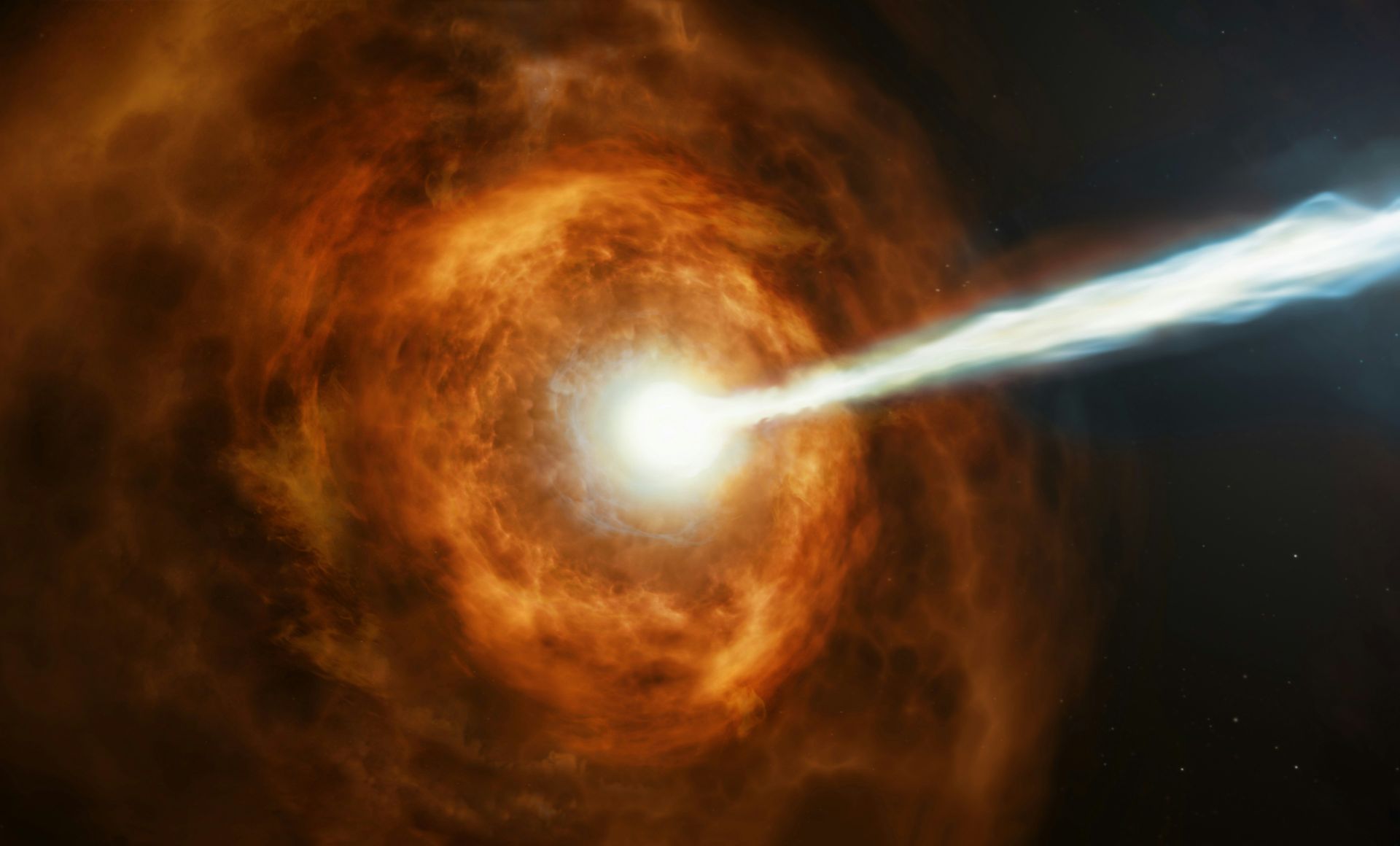
A gamma-ray burst releases more energy in seconds than the Sun will radiate over its entire 10-billion-year lifespan. In that brief window, the burst can outshine an entire galaxy of hundreds of billions of stars. These events are detected by space-based observatories at a rate of roughly one per day, distributed uniformly across the sky — confirming that they are cosmological in origin, not concentrated in the Milky Way.
There are two types. Short gamma-ray bursts, lasting less than two seconds, are produced by the merger of two neutron stars or a neutron star and a black hole. Long gamma-ray bursts, lasting from a few seconds to several minutes, are associated with the collapse of very massive, rapidly rotating stars — a process called a collapsar — that produces a jet of relativistic matter along the star's rotation axis. It is these jets, when pointed toward Earth, that produce the observable burst.
The energy released is not spread uniformly in all directions. It is beamed into a narrow cone by the jet structure, which is why the detected brightness is so extreme. Were the same energy distributed isotropically — in all directions equally — the event would still be extraordinarily luminous but not to the same degree as the beamed emission.
A long gamma-ray burst within a few thousand light-years and pointed toward Earth would be catastrophic for life on the surface, stripping away much of the ozone layer through X $TWTR-ray and gamma-ray ionization. One proposed explanation for the Ordovician mass extinction, approximately 443 million years ago, is a nearby gamma-ray burst. The evidence for this hypothesis is indirect, but the physical mechanism is sound. No gamma-ray burst with a confirmed nearby source has been detected in the modern era, but the rate of such events in the Milky Way over geological time suggests that Earth's biosphere has likely been exposed to significant gamma-ray events at least once.
24 / 26
The Sun will eventually engulf Earth
Credit: Marek Pavlík / Pexels
In approximately five billion years, the Sun will exhaust the hydrogen in its core. Without the outward pressure of nuclear fusion balancing gravity, the core will contract and heat up, causing the outer layers of the Sun to expand enormously. The Sun will become a red giant, growing to perhaps 100 to 200 times its current radius.
Whether Earth itself is directly engulfed is uncertain. Some models suggest the Sun's outer boundary will reach approximately Earth's current orbital radius. Others suggest it will fall just short. The uncertainty arises partly from the Sun's mass loss during the red giant phase: as the Sun sheds material in a strong stellar wind, it loses mass, which causes the planets' orbits to expand outward. Earth's orbit will be farther from the Sun by the time the red giant phase peaks than it is today.
But even if Earth is not engulfed, it will be rendered completely sterile long before the red giant phase begins. The Sun's luminosity increases by approximately one percent every 100 million years as helium accumulates in the core and the core contracts slightly, raising the rate of fusion. In roughly one billion years, the increased solar output will intensify enough to trigger a runaway greenhouse effect similar to what Venus experienced, boiling off Earth's oceans and destroying the conditions for surface life.
Earth's history of life — from the first microbes roughly 3.5 to 4 billion years ago to the present — represents only a portion of the total habitable window. The Sun and Earth are approximately 4.6 billion years old. Earth's habitable period is therefore nearing its midpoint, or possibly slightly past it, depending on how broadly "habitable" is defined. The Earth on which human civilization exists is a temporary condition, measured in geological time rather than astronomical time, but temporary nonetheless.
25 / 26
The universe contains structures made of dark matter we cannot see
Credit: Mathew Schwartz / Unsplash
Dark matter does not emit, absorb, or reflect light. It interacts with ordinary matter only through gravity. It cannot be photographed, sampled, or directly detected by any current instrument. Its existence is inferred from its gravitational effects on things that can be observed: the rotational velocities of galaxies, the bending of light around galaxy clusters, the distribution of galaxies on large scales, and the acoustic peaks in the cosmic microwave background.
Galaxies are embedded in dark matter halos — extended, roughly spherical distributions of dark matter that are far more massive than the visible galactic disk. The Milky Way's dark matter halo extends roughly 10 times farther than its visible disk and contains several times as much mass as all its stars combined. The visible Milky Way, the band of stars crossing the night sky, is a thin disk floating inside an invisible sphere of matter that makes up the majority of the galaxy's total mass.
Galaxy clusters — the largest gravitationally bound structures — contain even more dark matter relative to their visible mass. The Bullet Cluster, two galaxy clusters that collided approximately 150 million years ago, provided direct evidence for dark matter's separation from ordinary matter. When the clusters collided, the hot gas — the majority of ordinary matter in galaxy clusters — was slowed by electromagnetic interactions between the particles. The dark matter passed through essentially unimpeded, separating from the gas. Gravitational lensing maps of the cluster show mass concentrated where there is no visible matter, coinciding with the position the dark matter halos should occupy after the collision.
Despite decades of searching, no particle candidate for dark matter has been directly detected. The leading candidate for many years, the weakly interacting massive particle, has not been found in large-scale dedicated experiments. The identity of dark matter remains one of the most significant open questions in physics.
26 / 26
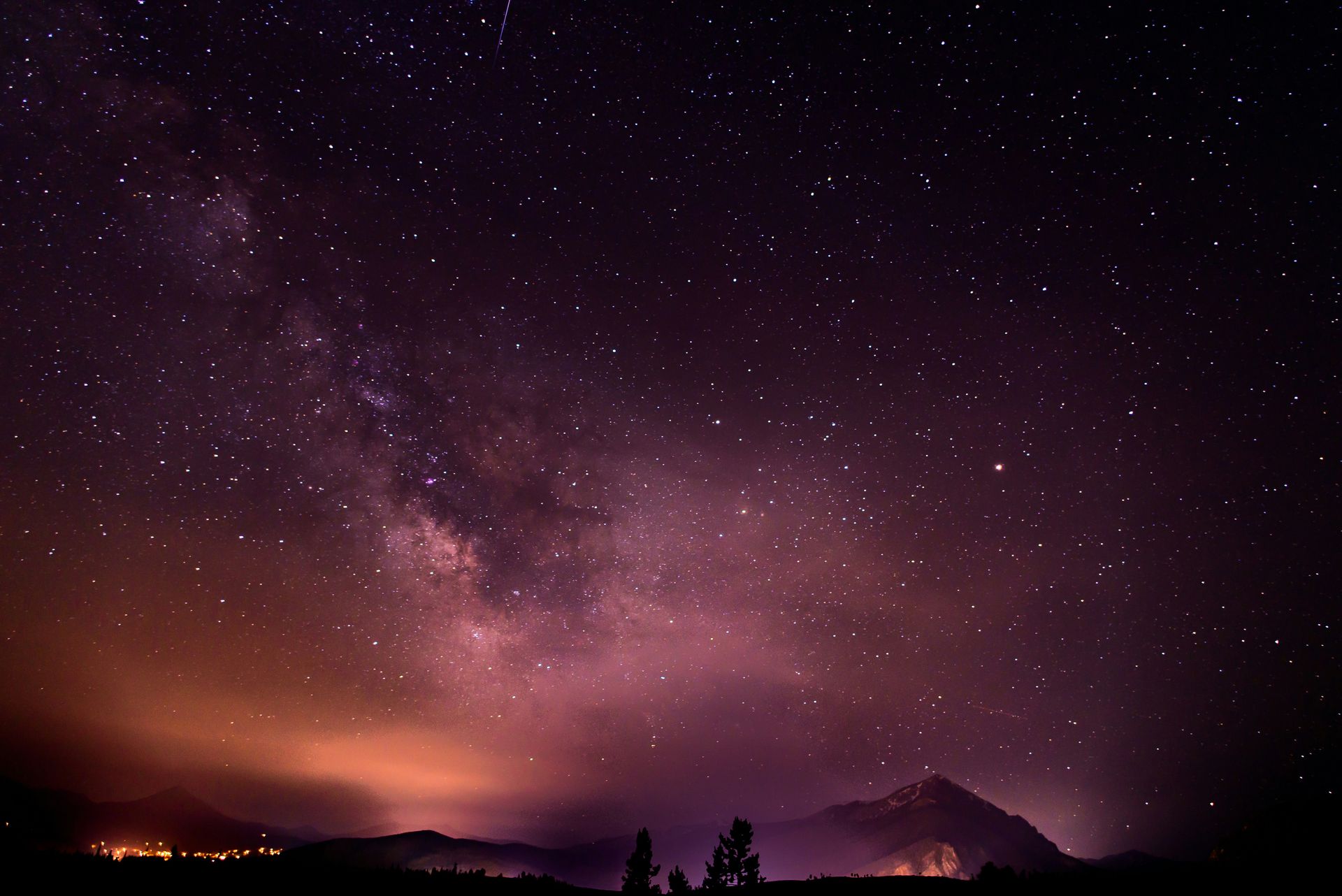
When you look at the night sky, you are looking into the past
Credit: Nathan Anderson / Pexels
Light travels at approximately 299,792 kilometers per second — the fastest anything can travel in the universe. This speed is finite, which means any light reaching an observer left its source at some point in the past. For objects at ordinary human scales the delay is negligible. For astronomical objects it is not.
The Moon is roughly 384,000 kilometers away. Light from the Moon takes about 1.3 seconds to reach Earth. The Sun is approximately 150 million kilometers away; light takes about eight minutes. The nearest star system, Alpha Centauri, is about 4.24 light-years away — light from it takes 4.24 years to reach Earth. Looking at Alpha Centauri tonight, you are seeing it as it was in early 2022.
For deep sky objects, the delay becomes geological or cosmological. The Andromeda Galaxy is approximately 2.5 million light-years away. Its light takes 2.5 million years to reach Earth. The Andromeda you can see on a dark night with the naked eye is a picture of that galaxy as it existed before the genus Homo had appeared on Earth. The most distant galaxies ever imaged by the James Webb Space Telescope are so far away that the light detected left them when the universe was only a few hundred million years old — less than five percent of its current age.
There is no way to see any object in the universe as it is now. Every observation is a historical record. The sky is not a view of the present; it is a layered archive of the past, with different objects corresponding to different historical moments depending on their distance. The universe cannot be observed all at once. It can only be observed as it was — and the depth of the past that is visible depends entirely on how far you are willing to look.
