
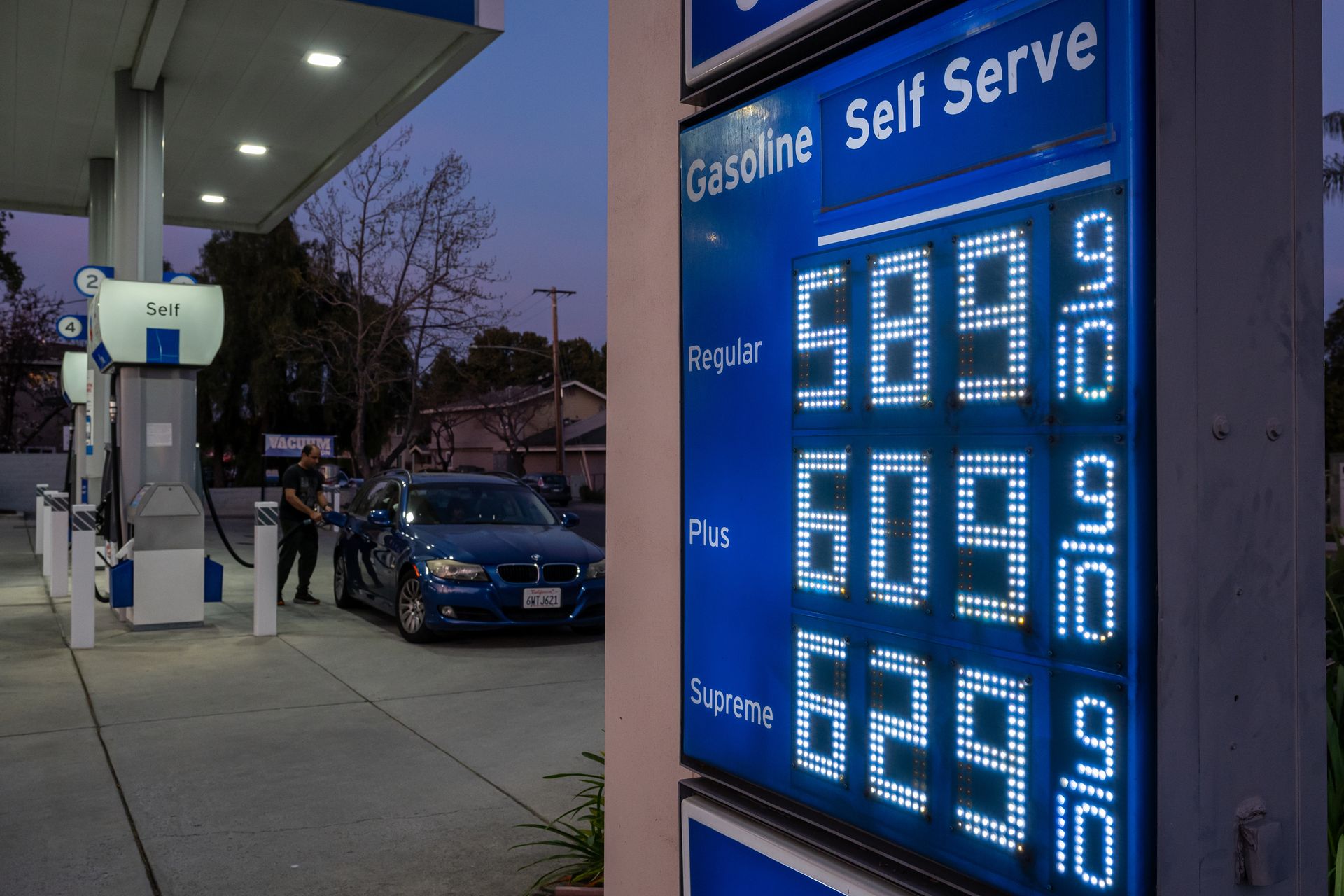
Gas prices are creeping closer to the dreaded $5 per gallon level, last reached in June 2022
David Paul Morris/Bloomberg via Getty Images
Gas prices are creeping up to $5 per gallon with oil prices hovering in triple-digit territory. In some states like California, gasoline already surpassed the dreaded milestone, the result of an international crunch in energy supplies due to a foreign conflict that injected disarray into the global economy.
That was four years ago. Back then, Russia’s invasion of Ukraine in February 2022 caused a global energy crunch that led to a similar spike in gas prices that Americans are experiencing today. The national average for gasoline prices peaked at $5.01 in early June 2022, and gradually dropped like a feather over six months to its pre-invasion levels.
Join 500,000+ readers who start their day with Quartz.
By subscribing, you agree to our Terms of Service and Privacy Policy.
For Americans who hit the road back then, this summer will be an unwelcome déjà vu of staggering price increases at the gas pump. Gas prices stood at $4.55 as of Friday, according to AAA motor club. The national average climbed 25 cents for the second week in a row given the sharp plunge in oil shipping.
Analysts warn that gasoline will cross the $5 per gallon threshold sometime this summer as the critical Strait of Hormuz remains virtually frozen to commercial shipping with the Iran War paused for now with a delicate ceasefire. About one-fifth of global oil supplies usually passed through the strait on 150 vessels daily. That has slowed to a tiny trickle: On Monday, four ships made the perilous trek and only one of them was an oil tanker.
"This is bad news for the consumer… if the Strait remains closed another month, we will be at $5.00 per gallon,” Andrew Lipow, an oil analyst and president of Lipow Oil Associates, wrote in a client note this week. He added that Americans are already paying $1 billion more in extra fuel costs per day compared to the start of the war.
Four Western states are already dealing with gas prices crossing beyond $5: California, Oregon, Nevada and Washington. Prices vary across the country due to different refining and production strategies employed by energy companies, in addition to taxes.
Gas typically trails the cost of crude oil, a market that remains at the mercy of developments in the Iran War. Ceasefire extensions, brief flashes of combat, and the crawling progress towards an agreement between the U.S. and Iran that President Donald Trump insists is within reach all have varying effects on crude oil prices. U.S. and Iranian forces traded fire in the strait on Thursday, but Trump maintained the ceasefire remains in effect.
The price of Brent crude hovered around the $100 mark in the last few days, though it’s lower than the $115 level it reached on Monday.
Compared to two decades ago, The U.S. is a petroleum power in its own right. It’s the result of a shale boom that slashed U.S. dependence on nations like Saudi Arabia and made it into a net exporter of oil and natural gas. Much of the world is hooked on consuming petroleum products fracked from Texas, North Dakota and New Mexico for their energy needs.
That has insulated the U.S. from grappling with a bigger economic shock compared to other nations more susceptible to tremors in energy markets. In 2020, the Federal Reserve Bank of Dallas projected that oil prices were 36% lower in 2018, due to the shale oil boom.
Before the Iran War, the world was awash in oil. Two weeks before the war started, the Energy Information Administration projected crude oil prices sliding to $60 per barrel from $68, which would have helped cool inflation. That landscape has vanished, and Americans must adjust to a summer in which gas prices are headed in only one direction for now, upward.
This is usually the type of environment that tempts oil companies to drill more and chase lucrative profits while oil prices are shooting up. However, oil firms have prioritized cautious decision-making and steady growth to deliver hefty rewards to their investors. Think dividends and stock buybacks after a positive quarter.
“I think it’s really steady as she goes,” Wirth told investors in their quarterly conference call last week. Wirth added that Chevron $CVX wasn’t “going to make any rash or immediate changes” to a production system that’s operating at desired levels of efficiency.
ConocoPhillips $COP CFO Andy O'Brien said in a similar call to investors that the company planned to bump up its expected capital spending to $12.5 billion from $12 billion to account for additional production activity in the Permian Basin, an oil-rich region that straddles Texas and New Mexico. Even then, the company didn’t announce a major increase in oil production.
“These modest activity additions will maintain our operational continuity into 2027,” O’Brien said.
A recent survey from the Federal Reserve Bank of Dallas polled oil and gas executives. A plurality of respondents — or 45% — expected the strait to be reopened as normal by August 2026. A similar plurality believed an increase in U.S. daily oil production would be capped to 250,000 barrels.
That's a drop in the bucket since the U.S. produces 13.9 million barrels daily on average.