
From bipedalism to language to the ability to throw accurately, the specific traits that made humans the planet's most successful species are stranger and more specific than most people realize

Cottonbro Studio / Pexels
Humans are, by most physical measures, unimpressive animals. We are slower than horses, weaker than chimpanzees, less durable than cockroaches, without the night vision of cats, the olfactory sensitivity of dogs, the echolocation of bats, or the regenerative capacity of axolotls. We are born helpless, develop slowly, and require decades of intensive investment before we become independent. We have no fur, no venom, no armor, no claws, and no beak. In a fair fight — which evolution never arranges — a human adult is comprehensively outcompeted by most large animals and by a surprising number of small ones.
And yet Homo sapiens is the most successful large animal in the history of the planet, by almost any reasonable measure of success. We occupy every terrestrial ecosystem on Earth. We have altered the climate, reshaped the landscape, and driven dozens of other species to extinction. We have seven times more biomass than all other wild land mammals combined. We have visited the moon and sent machines to interstellar space. We have, for better and worse, remade the planet in our image.
The explanation for this discrepancy — between the physical modesty of the individual human and the collective dominance of the species — lies in a specific set of traits that evolution produced in the Homo lineage over the past two to three million years. Several of these traits are unique to humans. Several are shared with other animals but developed in humans to a degree that produces qualitatively different outcomes. Several are so ordinary-seeming that their evolutionary significance is not apparent without explanation. All of them combine to produce the specific cognitive, social, and physical profile of a species that is genuinely unlike anything else that has existed.
This list covers 20 of those traits — the evolutionary developments that most directly explain human dominance. Each slide covers what the trait is, when and how it evolved, and what specific advantage it conferred. The scientific understanding of human evolution has changed significantly in the past two decades, and several entries here reflect findings that are more recent and more nuanced than the standard account.

Jan van der Wolf / Pexels
Walking upright on two legs is the oldest uniquely human trait in the fossil record, emerging in the australopithecine ancestors of the Homo lineage approximately three to four million years ago — long before the expansion of the brain that most people associate with human uniqueness. The evolution of bipedalism is, in this sense, the foundational event of human evolutionary history: everything that followed depended on it.
The specific advantages of bipedalism are multiple and interacting. Freeing the hands from locomotion made them available for carrying food, tools, and infants — allowing a foraging strategy in which food could be gathered and transported rather than consumed immediately. It elevated the eyes and nostrils above the grass of the African savanna, improving the detection of predators and prey. It reduced the body surface area exposed to the sun during the hottest part of the day (when the sun is directly overhead, an upright body presents a smaller target than a horizontal one) and increased the distance of the skin from the hot ground, reducing heat load in the open environments where australopithecines were beginning to spend time.
Bipedalism also enabled the evolution of the human throwing ability, the persistence hunting strategy, and the specific anatomy of the human foot — the arch, the big toe aligned with the others, the shortened toes — that make long-distance walking and running economically efficient in ways that no other primate's foot achieves. The costs are also real: the human spine, reshaped from the horizontal primate spine to support upright weight, is prone to the disc problems and lower back pain that affect a significant proportion of adults; the human pelvis, narrowed for bipedal locomotion, makes childbirth more dangerous than in any other primate.
Mart Production / Pexels
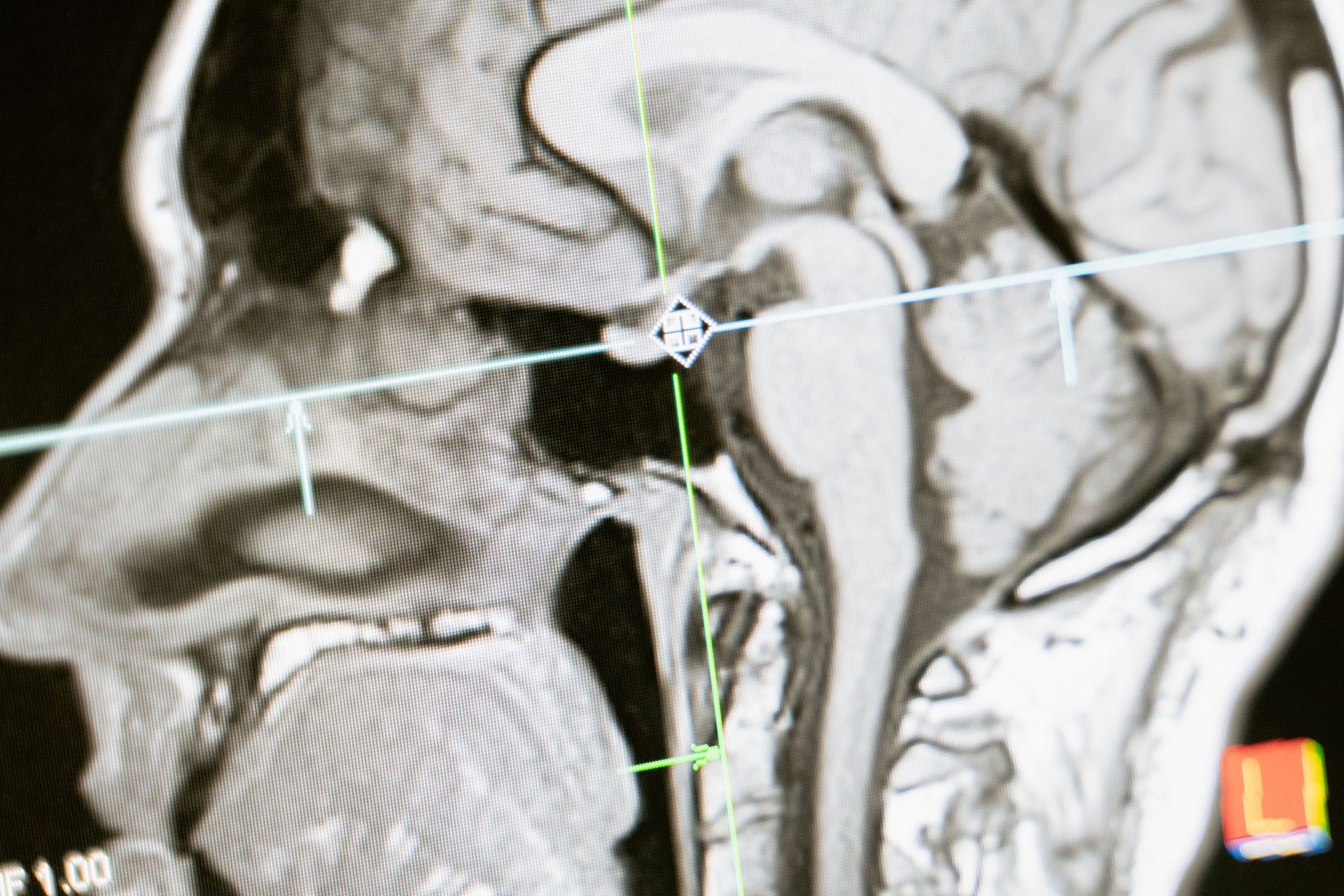
The human brain is approximately three times larger than would be expected for a primate of our body size, and this expansion — which occurred rapidly in evolutionary terms, tripling in volume over the past two million years — produced the cognitive capacities that underlie everything that makes humans uniquely effective: language, planning, social cognition, cumulative culture, and the ability to construct and use tools of arbitrary complexity.
The expansion of the brain is not simply a matter of more neurons doing more of the same thing. The human prefrontal cortex — the region most associated with planning, decision-making, impulse control, and social cognition — is disproportionately large even relative to our already enlarged overall brain size. The specific wiring of the human brain, and particularly the connectivity between regions, differs from that of other primates in ways that support the specific cognitive demands of language, theory of mind, and long-term planning.
The costs of a large brain are substantial. The brain consumes approximately 20% of the body's energy at rest — a disproportionate demand that required dietary changes (specifically, the incorporation of energy-dense foods, including cooked food, meat, and fat) to sustain. The large fetal head required the evolutionary compromise of delivering infants at an earlier developmental stage than other primates — the helplessness of human newborns reflects a brain that cannot fit through the birth canal if it develops further before delivery.
The specific timing of brain expansion in human evolution — occurring after bipedalism and the freeing of the hands, alongside the development of tool use and the expansion of social groups — reflects the interaction of multiple selective pressures rather than a single cause.

August de Richelieu / Pexels
Human language is qualitatively different from every other communication system in the animal kingdom in a specific way: it is compositional and generative. It consists of a finite set of meaningless sounds (phonemes) that are combined by grammatical rules to produce an effectively infinite set of meaningful sentences, each of which can express a thought that has never been expressed before. No other animal's communication system has this property. Honeybee dances communicate location and distance but cannot express anything else. Vervet monkey alarm calls distinguish predator types but cannot combine to say anything beyond those specific distinctions.
The evolution of language — whose neural and anatomical preconditions (the descended larynx, the FOXP2 gene mutation associated with the fine motor control of speech, the Broca's and Wernicke's areas of the brain) are traceable in the fossil and genetic record — is estimated to have occurred in something like its current form within the Homo sapiens lineage, though proto-language capabilities may extend further back. Its specific advantage is the ability to transmit information — about the environment, about social relationships, about the past and the future — with a precision and flexibility that no other communication medium achieves.
Language also makes cumulative culture possible in the specifically human sense: knowledge and techniques can be transmitted across generations with enough fidelity that each generation builds on rather than merely replicates the previous one. The ratchet effect of cumulative culture — each generation inheriting the full accumulated knowledge of its predecessors rather than rediscovering it — is the mechanism underlying the explosion of human technological and social complexity.

Chinmay Singh / Pexels
Theory of mind — the ability to attribute mental states (beliefs, desires, intentions, knowledge) to other individuals and to understand that those mental states may differ from one's own — is the cognitive capacity that underlies human social intelligence, and its development in the human lineage to a degree qualitatively beyond that of other primates is one of the most important cognitive evolutionary events in human history.
The capacity is assessed in developmental psychology through the "false belief task," in which the subject is tested for the ability to understand that another person holds a belief the subject knows to be false. Most neurotypical human children pass this test at approximately age four. Chimpanzees show limited versions of the capacity in some experimental conditions; no non-human animal demonstrates the full, recursive theory of mind that adult humans deploy automatically in every social interaction.
Theory of mind is what makes human-scale social cooperation possible. A person who can model the beliefs, intentions, and knowledge of others can predict their behavior, communicate strategically, deceive and detect deception, coordinate actions through shared intention, and build the trust that large-scale cooperative institutions require. A social group whose members can model each other's mental states is capable of a qualitatively more sophisticated form of cooperation than one whose members can only respond to observed behavior.
The anthropologist Robin Dunbar has linked theory of mind to the size of social groups that primates can maintain: each level of intentionality (I know that you believe that she wants...) corresponds to a larger manageable social group. Humans can maintain fifth- or sixth-order intentionality — I know that you believe that she thinks that he wants... — which is associated with the larger and more complex social networks that characterize human societies.

Aiden Heastan / Pexels
The human ability to throw objects with speed and accuracy is unique in the animal kingdom and is the product of a specific set of anatomical adaptations — the position of the shoulder joint, the rotation of the torso, the wrist's range of motion — that were selected for in the Homo lineage and that produced a biomechanical capability no other primate comes close to matching.
Harvard biological anthropologist Daniel Lieberman and colleagues have argued that the evolution of accurate throwing was a major driver of human evolutionary success because it fundamentally changed the economics of hunting. A hunter who can kill or seriously injure prey from a safe distance — without the risk of injury from grappling with a large, dangerous animal — can hunt more safely, hunt larger prey, and hunt with more energy efficiency than one who must close to killing range. The ability to throw also functions as a long-range weapon in intergroup conflict.
Chimpanzees throw, but inaccurately and with limited force — their shoulder anatomy does not permit the rotation of the thorax that generates the elastic energy storage underlying the human throw. A trained human can throw a baseball at 100 miles per hour, releasing forces that chimps' shoulder anatomy cannot produce or safely absorb.
The athletic throwing motion — wind-up, step, rotation, release — is an extraordinarily complex neuromuscular coordination that the human nervous system performs automatically and that requires specific anatomical features at the shoulder, elbow, wrist, and hip that are unique to the Homo lineage. It is the specific physical capability that made humans effective hunters of large game long before the development of projectile weapons.

Alva Shoot / Pexels
Humans are among the best long-distance runners in the animal kingdom, not because we are fast — most quadrupeds can outrun us at any sprint distance — but because we can sustain a moderate running pace for extraordinarily long distances, for reasons that are directly connected to our bipedal anatomy, our sweating capacity, and our hairlessness.
Persistence hunting — the practice of following prey at a moderate trot over distances of ten to thirty kilometers in the heat of the day, until the prey overheats and collapses — was practiced by Bushmen of the Kalahari, Australian Aborigines, and Native American tribes and is documented in ethnographic accounts and, in the case of the Kalahari, in filmed footage. It is possible because humans dissipate heat through sweating with a efficiency no other mammal matches: we have two to four million eccrine sweat glands distributed across the body surface, and our hairlessness allows the sweat to evaporate directly from the skin rather than from the tips of fur.
Most quadrupedal mammals lose heat primarily through panting, which limits their pace (they cannot pant and gallop simultaneously), and are covered in fur that traps the evaporating sweat. A running ungulate in hot conditions accumulates heat faster than it can dissipate it, eventually reaching a core temperature that forces it to stop. A persistence hunter who matches the prey's trot pace, forces the prey to run at or near its sprint speed to escape, and tracks it as it rests and recovers — forcing it to run again before it has fully cooled — can follow it to exhaustion.

Andres Ayrton / Pexels
The two traits most directly responsible for human thermoregulatory excellence — eccrine sweat glands distributed across the body surface, and relative hairlessness that allows efficient evaporative cooling — represent an evolutionary trade-off: the loss of the insulation and UV protection that fur provides in exchange for the ability to sustain aerobic activity in hot, open environments that most mammals cannot tolerate.
The human body has approximately two to four million eccrine sweat glands, significantly more than any other primate, and can produce approximately two liters of sweat per hour under intense heat load — enough to sustain core body temperature during prolonged exertion in conditions that would force most other animals to seek shade. The specific distribution of sweat glands across the body surface maximizes evaporative surface area relative to body mass, making human thermoregulation the most effective in the animal kingdom.
The evolutionary pressure that produced this adaptation was most likely the transition to an open-habitat, diurnally active lifestyle in the African savanna — an environment that presented both the opportunity for persistence hunting during the hottest part of the day (when quadrupedal prey animals were least able to escape) and the thermal challenge that the sweat gland and hairlessness adaptations addressed.
The secondary effects were significant: relative hairlessness made ectoparasites (lice, ticks, fleas) less able to sustain themselves on human hosts, reducing the vector-borne disease load compared to furry primates in dense forest environments.

Gary Barnes / Pexels
Cooking — the application of heat to food before eating it — is a uniquely human behavior whose evolutionary significance extends well beyond its role in making food safe and palatable. Harvard biological anthropologist Richard Wrangham has argued that cooking was the pivotal innovation in human evolution, responsible for the brain expansion and gut reduction that characterize Homo erectus compared to its australopithecine predecessors.
The argument runs as follows: cooking makes food easier to digest by breaking down cell walls and denaturing proteins, increasing the caloric yield per unit of food consumed and per unit of digestive energy expended. The adoption of cooking — which the fossil record suggests occurred at least one million years ago in Homo erectus and possibly earlier — allowed the hominin gut to shrink (since less digestive processing was required) and the brain to grow (since more calories were available for the expensive neural tissue). The specific correlation between cooking, reduced gut size, and brain expansion in the human fossil record supports the hypothesis.
Cooking also enabled the exploitation of food sources that are indigestible or toxic when raw — starchy tubers, grain, many legumes — enormously expanding the dietary range available to Homo sapiens and contributing to the colonization of diverse environments where raw food sources were insufficient.
The social dimension of cooking — gathering around a fire, sharing food, the specific social behaviors that communal eating promotes — may also have contributed to the evolution of pair-bonding, extended family structures, and the social organization that distinguishes human societies from those of other great apes.

Andrea Bova / Pexels
The whites of human eyes — the sclera — are visibly white and make the direction of the gaze obvious to observers. In virtually all other primates and most other animals, the sclera is dark, concealing the direction of gaze. This seems like a minor anatomical difference, but its evolutionary implications are significant: visible eye whites make it possible for humans to communicate gaze direction silently and at a distance, enabling a form of non-verbal social communication that other primates cannot perform with equivalent precision.
The "cooperative eye hypothesis," proposed by Michael Tomasello and colleagues at the Max Planck Institute, argues that white sclera evolved specifically to facilitate cooperative communication in human social groups. In a species whose success depends on coordinated collective action — pointing, indicating, drawing attention to shared objects of interest — the ability to communicate "look at that" silently through gaze direction has significant adaptive value. The theory is supported by experiments showing that human infants follow the direction of an adult's eyes even when the head points in a different direction — they track the gaze rather than the head — while dogs follow the head direction and chimpanzees follow neither reliably.
The white sclera also makes deception about the direction of attention more difficult, which may have co-evolved with the cooperative function: in a cooperative social group, the ability to verify that others are paying attention where they say they are has value for maintaining the trust that cooperation requires.

Antonius Ferret / Pexels
Human children have the longest childhood of any primate — reaching sexual maturity at approximately 12 to 14 years compared to 8 to 9 years in chimpanzees — and this extended developmental period is not simply a consequence of having a large brain to grow. It represents a specific evolutionary strategy: investing enormous amounts of parental resources in producing a smaller number of highly capable offspring rather than the higher-turnover, lower-investment strategy of other primates.
The adaptive value of extended childhood is the opportunity for learning. A species that acquires complex skills — language, tool use, social knowledge, cultural practices — through a long developmental period produces adults whose accumulated learning makes them more capable than adults whose development was rapid. The human childhood is, in evolutionary terms, a massive investment in learning time: the specific activities of childhood play, imitation, language acquisition, and socialization are not simply pleasurable — they are the mechanism by which human cognitive and cultural potential is realized.
Extended childhood also required the evolution of specific social structures to support it. A child who requires ten or more years of intensive investment before contributing to the group's subsistence creates a care burden that cannot be borne by the mother alone — it requires the cooperative investment of fathers, grandparents, and the broader social group. The "grandmother hypothesis," proposed by anthropologist Kristen Hawkes, argues that the evolution of post-reproductive longevity in human females — grandmothers — was selected for specifically because grandmother investment in grandchildren allowed mothers to have shorter inter-birth intervals than other primates, increasing reproductive rate while maintaining the long childhood that brain size and cultural complexity require.

Nguyen Tinth / Pexels
Menopause — the cessation of female reproductive capacity at approximately age 50, well before the end of life expectancy — is unique to humans (and killer whales and short-finned pilot whales) among all animals, and its evolutionary explanation is one of the most interesting questions in human evolutionary biology.
The prevailing explanation is the grandmother hypothesis: post-reproductive women increase the reproductive success of their daughters by investing in grandchildren, allowing their daughters to have shorter inter-birth intervals and more surviving offspring than would be possible without the grandmother's support. Under this model, a woman who stops reproducing at 50 and redirects her investment to grandchildren has a higher inclusive fitness (counting the genes in grandchildren as well as children) than one who continues reproducing until death.
The adaptive significance of menopause depends on the specific human life history — the long childhood, the offspring helplessness, the food-sharing social organization — that makes grandmother investment particularly valuable. In species where offspring become independent quickly, the value of grandmother investment is lower and the fitness cost of stopping reproduction is higher. In humans, the combination of extended dependency and grandmother-specific contributions (gathering of high-return foods, childcare, transmission of cultural knowledge) creates the specific ecological context in which menopause is adaptive rather than simply a fitness cost.

Monstera Production / Pexels
The human capacity for abstract thought — for reasoning about things that are not present, concepts that have no physical referent, possibilities that do not yet exist, and categories that are defined by relations rather than by perceptible properties — is the cognitive ability that most directly underlies human technological and cultural achievement and that is most distinctly human in its scope and flexibility.
Abstract thought enables planning beyond the immediate future, the construction of hypothetical scenarios, the development of mathematics and logic, the creation of religious and philosophical systems, and the design of tools and technologies for purposes that cannot be demonstrated by physical example. It is what allows a human to design a bridge before the bridge is built, to invent a word for a category that does not yet exist, to reason about the consequences of actions not yet taken.
The neural basis of abstract thought is primarily in the prefrontal cortex and its connectivity with other brain regions, particularly the parietal cortex (which processes spatial and numerical relationships) and the temporal cortex (which supports semantic memory and language). The prefrontal cortex is disproportionately large in humans even relative to our already enlarged brain, and its specific connectivity — the white matter tracts that connect it to other regions — differs from other primates in ways that support the long-range integration of information that abstract reasoning requires.
The evolutionary advantage of abstract thought is its combinatorial power: a brain that can reason about categories and relations can generate novel solutions to novel problems, can communicate those solutions to others in abstract language, and can build on previous solutions cumulatively. It is the cognitive foundation of the ratchet effect that makes human culture uniquely cumulative.

Edita Brus / Pexels
Cumulative culture — the ability of each generation to inherit, build on, and transmit an improved version of the previous generation's technology, knowledge, and social organization — is what distinguishes human culture from the cultural behaviors observed in other animals. Chimpanzees have culture in the sense of group-specific learned behaviors transmitted between individuals. But chimpanzee culture does not cumulate: the nut-cracking techniques of Bossou chimpanzees are not measurably more sophisticated now than they were 30 years ago. Human technology accumulates, each generation starting where the previous one left off.
The ratchet effect of cumulative culture is the mechanism behind the explosion of human technological complexity from the first stone tools to the smartphone. Each generation does not rediscover fire or reinvent the wheel — it inherits a body of knowledge and technique that took generations to develop and extends it. The specific cognitive prerequisites are language (to transmit complex information with fidelity), theory of mind (to understand the intention behind observed behaviors and learn from demonstration rather than mere imitation), and the motivation to conform to and transmit cultural norms.
The evolutionary time scale on which cumulative culture operates is far shorter than genetic evolution, which makes it the primary mechanism of human adaptation to new environments. A population moving into a new habitat can develop the specific technologies and practices for exploiting its resources within generations, far faster than genetic adaptation to the new environment would require. This cultural adaptability is the primary explanation for the rapid colonization of every terrestrial ecosystem on Earth — including the Arctic, deserts, and tropical rainforests — by anatomically modern humans within approximately 50,000 years of their dispersal from Africa.

Thư Tiêu / Pexels
Most animals cooperate, but primarily with genetic relatives or established reciprocal partners — individuals with whom a history of interaction supports trust. Humans cooperate at a scale and with a range of strangers that has no parallel in the animal kingdom: cities of millions of people, global trade networks, multi-national institutions, and the complex division of labor that produces modern economies all require the ability to cooperate with people one has never met and will never meet again, on the basis of shared institutions, norms, and beliefs.
The evolutionary and cultural mechanisms that enable cooperation with strangers include: the internalization of social norms (the willingness to follow rules even when enforcement is absent or unlikely), the capacity for altruistic punishment (the willingness to punish norm violators at personal cost), reputation systems that make past behavior visible to future interaction partners, and the specific role of religious and cultural beliefs in creating shared identities that extend the boundary of the cooperative in-group beyond genetic kin.
Samuel Bowles, Herbert Gintis, and Joseph Henrich, among others, have argued that large-scale cooperation in humans is the product of both genetic evolution (the evolution of prosocial psychology through group-level selection during the period of intergroup warfare in human prehistory) and cultural evolution (the development of institutions, norms, and beliefs that solve the cooperation problem in increasingly large and complex social groups). The specific mechanism is still debated, but the phenomenon — the ability of genetically unrelated humans to cooperate in groups of millions — is the proximate cause of most of what distinguishes human civilization from any other animal society.

Alina Rossoshanska / Pexels
The capacity for symbolic thought — the ability to use one thing to represent another, to imbue objects and actions with meaning beyond their physical properties — is the cognitive foundation of language, art, religion, mathematics, and every other distinctly human cultural production. It is most directly evidenced in the fossil record by the cave paintings and carved objects of the Upper Paleolithic, whose sudden appearance approximately 40,000 years ago (though evidence for earlier symbolic behavior is mounting) has been interpreted as the "creative explosion" of modern human cognition.
The ochre engravings at Blombos Cave in South Africa, dated to approximately 75,000 years ago, and the shell beads found at sites across Africa and the Levant from approximately 100,000 years ago, push the evidence for symbolic behavior further back and suggest that symbolic thinking was present in early Homo sapiens before the dispersal from Africa rather than developing later. The specific neural capacity for symbolic thought is associated with the integration of information across multiple brain regions — the connectivity that is disproportionately developed in humans — rather than with any single structure.
The adaptive function of symbolic thought is not entirely clear, but several hypotheses are well-developed. Art and symbolic objects may have functioned as social signals — markers of group identity, demonstrations of skill and cognitive capacity, and mechanisms for maintaining group cohesion in larger social groups than personal acquaintance could sustain. The capacity for symbolic representation enabled the development of systems of meaning that could bind large groups together around shared beliefs, which is the cultural mechanism underlying large-scale human social organization.

Joao Guerreiro / Pexels
Humans are the only species that has domesticated other species — selectively bred plants and animals over generations to produce varieties better suited to human purposes — and this capacity has had consequences for human success that dwarf those of any other single technological development.
The domestication of plants in the Fertile Crescent, China, and Mesoamerica beginning approximately 10,000 to 12,000 years ago produced the food surpluses that supported the first cities, the first states, the first standing armies, and the first complex division of labor. The domestication of animals produced draft power, transport, secondary products (milk, wool), and the denser human settlement patterns that gave agricultural populations demographic and military advantages over hunter-gatherers — the dynamics Jared Diamond analyzed in "Guns, Germs, and Steel."
The cognitive prerequisites for domestication are significant: understanding that selective breeding produces heritable changes in offspring requires a theory of biological inheritance that was not formally articulated until Mendel in the 19th century but that human farmers implemented empirically thousands of years earlier. The willingness to invest decades of effort in breeding programs whose payoffs extend beyond the individual's lifetime requires the long-term planning capacity and cultural transmission of agricultural knowledge that are distinctly human capabilities.
The unintended consequence of dense settlement with domesticated animals was the evolution of epidemic infectious diseases — measles, smallpox, influenza — that originated in domesticated animal populations and were transmitted to humans. These same diseases, to which Old World populations had developed partial immunity through millennia of exposure, contributed to the catastrophic mortality of New World populations after European contact.

Katerina Holmes / Pexels
Teaching — actively modifying one's behavior to facilitate learning in another individual who is not currently performing the behavior — is vanishingly rare in the animal kingdom and ubiquitous in human societies. While imitation learning occurs in many species and some forms of social learning occur in primates, active teaching — in which the teacher incurs a cost (time, energy, risk) to transmit knowledge to a learner — is almost exclusively human.
The specific human teaching behavior goes beyond mere demonstration: human teachers calibrate their explanations to the learner's current understanding, use language to transmit knowledge that cannot be demonstrated, correct errors through feedback, and organize knowledge into sequences that build from simple to complex. This active, responsive, sequenced transmission of knowledge is the mechanism that makes cumulative culture specifically cumulative — it ensures that the transmission is not merely imitation of surface behavior but understanding of underlying principles that can be extended to new situations.
The evolutionary prerequisites for teaching are theory of mind (the teacher must model the learner's current knowledge to calibrate the explanation), language (to transmit abstract knowledge), and the specific motivation to invest in others' learning that is characteristic of human prosociality. The emergence of formalized teaching — schools, apprenticeships, written instruction — represents the cultural institutionalization of a behavior whose roots are in the evolved psychology of the human social species.

Charles Parker / Pexels
The human capacity for belief in invisible, unobservable entities — gods, spirits, ancestors, forces — that can be appeased, communicated with, and whose favor is worth cultivating, is universal across known human cultures and appears to be a product of specific cognitive tendencies (hyperactive agency detection, the extension of theory of mind to non-human entities) that were adaptive in the environment of evolutionary adaptedness even if their specific religious expressions are culturally variable.
The evolutionary explanation most widely accepted is the byproduct hypothesis: the cognitive systems that produce religious belief — the tendency to detect agents behind unexplained events (hyperactive agent detection device, or HADD), the tendency to attribute mental states to non-social entities (the extension of theory of mind), and the tendency to reason about counterfactual and fictional scenarios — were selected for their adaptive value in social cognition and in the interpretation of ambiguous natural events, and religious belief is a byproduct of these systems rather than a directly selected adaptation.
The cultural evolutionary explanation adds a second layer: beliefs in moralizing gods — deities who monitor and punish moral violations — may have been culturally selected because they solve the large-scale cooperation problem. Shared religious beliefs create shared identities that extend the in-group beyond genetic kin, and moralizing gods provide a monitoring and sanctioning mechanism for cooperative norms that scales beyond what personal reputation systems can achieve. Ara Norenzayan's "Big Gods" hypothesis argues that belief in morally concerned deities was a cultural innovation that enabled the large-scale cooperation that underlies complex civilization.

Mikhail Nilov / Pexels
The "self-domestication hypothesis," proposed by Brian Hare at Duke $DUK University, argues that Homo sapiens underwent a process of selection against aggression and for prosocial behavior — a process analogous to the domestication of wolves into dogs — that produced the specific psychological profile of the cooperative, low-reactive adult human.
The evidence for self-domestication comes from multiple sources. The human skeleton has become gracile (lighter and smaller) compared to archaic Homo sapiens and Neanderthals — a reduction in robusticity associated with domestication in other species. The human face has become shorter and rounder compared to archaic hominins — a paedomorphic (juvenile-retaining) change associated with reduced aggression in domesticated animals. The reduction in between-group violence and the increased capacity for cooperation with strangers that characterizes modern humans relative to earlier hominins suggests a psychological change in the direction of reduced reactive aggression.
The proposed mechanism is cultural: groups that developed social norms against reactive aggression and the institutional capacity to enforce those norms — to collectively punish bullies and despots — selected against the most reactive individuals, producing population-level changes in the psychology and physiology of aggression over thousands of generations. The specifically human tolerance for living in dense proximity with strangers, the reduced reactive aggression relative to other great apes, and the specific facial and skeletal changes that parallel domestication syndrome in other species are all consistent with this hypothesis.

Kindel Media / Pexels
The human hand — specifically the combination of a long, mobile thumb and short fingers that allows both a power grip (wrapping the whole hand around an object) and a precision grip (holding an object between the tips of the thumb and one or two fingers) — is the anatomical foundation of the entire human material culture. Every tool, every written word, every manufactured object, every surgical procedure depends on the specific anatomy of a hand that can both hold a hammer and thread a needle.
The precision grip, in which the thumb pad is brought into direct opposition with the fingertip pads, is made possible by the specific proportions and musculature of the human hand — the length of the thumb relative to the fingers, the degree of thumb mobility, and the fine motor control of the intrinsic hand muscles — that differ from the hands of other primates. Chimpanzees have a power grip but a limited precision grip; their thumbs are shorter relative to their fingers and their fine motor control is less developed.
The evolutionary significance of the precision grip is in its enabling of tool manufacture and use at a level of complexity no other animal approaches. The Acheulean hand axe — a stone tool shaped to a specific form by controlled flaking, requiring the application of precise forces at specific points on the stone — demands both the anatomical capability of the human hand and the planning and spatial reasoning of the human brain. The combination of cognitive and anatomical prerequisites for complex tool manufacture is uniquely human, and the archaeological record of increasingly sophisticated tool manufacture over the past 2.5 million years reflects the co-evolution of hand anatomy and cognitive capacity.
The secondary effects of precision grip extend to the writing system, the musical instrument, the surgical tool, and the keyboard — every technology that has extended human cognitive and communicative capacity depends on the specific anatomy of the human hand performing fine motor operations with the speed and accuracy that human neural control enables.