The long-maligned Export-Import Bank could serve a key role in Trump's push to drum up private-sector financing for Venezuela's oil sector
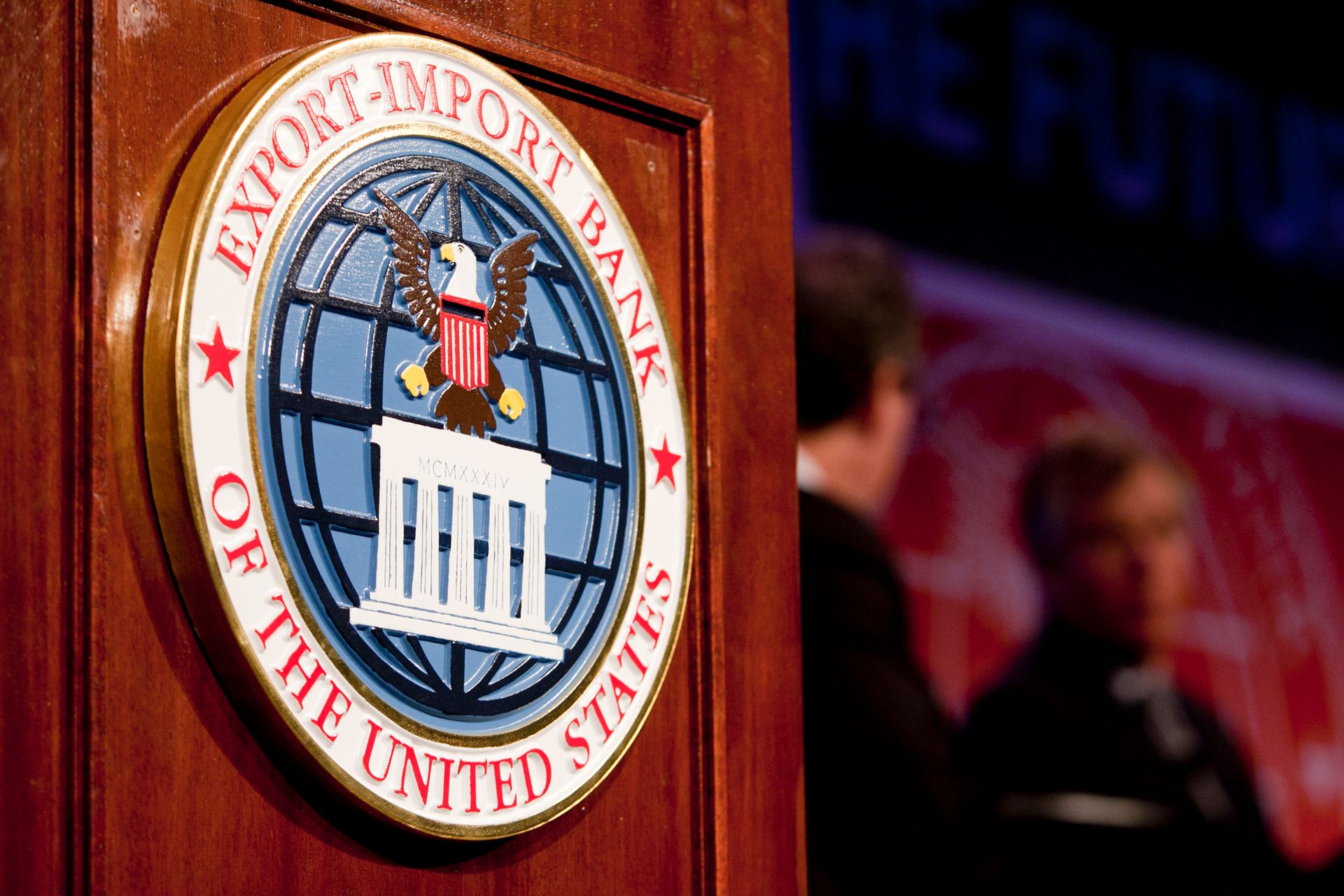
The logo of the Export-Import Bank of the United States is seen during the annual meeting in Washington, D.C., U.S., in 2011. (Andrew Harrer/Bloomberg via Getty Images)
In 2015, then-candidate Donald Trump vowed to shut down the Export-Import Bank and described it as a "one-way street" that only served privileged politicians and well-connected companies. Over a decade later, President Donald Trump may lean on it to clear the path for an investment bonanza in Venezuela.
Trump administration officials have suggested in the past week that the Export-Import Bank (Ex-Im) could provide credit for oil and gas firms that decide to establish operations in Venezuela. Ex-Im is a government-owned bank that underwrites cheap loans to U.S. companies selling products abroad when private capital is unavailable. Their charter must be reauthorized by December 2026.
Join 500,000+ readers who start their day with Quartz.
By subscribing, you agree to our Terms of Service and Privacy Policy.
Both Treasury Secretary Scott Bessent and Energy Secretary Chris Wright mentioned Ex-Im as a potential vehicle to ease investment demand, which would put the obscure agency in a key supporting role in Trump's push to drum up private-sector financing for Venezuela's strangled oil sector.
"We might use the Export-Import Bank as credit support for large projects down there," Wright said in a Fox Business interview. "That's a real possibility."
So far, U.S. oil giants such as ExxonMobil $XOM and ConocoPhillips $COP have balked at restarting operations in oil-rich Venezuela, citing a lack of financial and security assurances. Trump's endeavor there has killed 100 people, according to Venezuela's interior minister, and could cost over $100 billion. Exxon is reportedly proceeding with sending a technical team, despite Trump's threat to shut out the firm from restarting operations in the South American nation.
Ex-Im must overcome barriers before stepping into Venezuela-linked endeavors. Chief among them is the agency's own rules.
Ex-Im's charter dictates it can only authorize transactions with a "reasonable assurance of repayment." Those conditions currently aren't met in Venezuela. Caracas has been stuck in default since 2017, with $150 billion in outstanding public debt, and it ranks near the bottom globally in sovereign creditworthiness.
Ex-Im didn't respond to a request for comment.
Throughout the 2010s, the 91-year-old Ex-Im was assailed by conservatives as an agency subsidizing large corporations. Multinationals including Boeing $BA and General Electric $GE long benefited from customers in developing countries snapping up passenger jets, satellites, and spare parts. From 2015 to 2019, Ex-Im didn't have authority to approve loans above $10 million since its board lacked a quorum to proceed with more ambitious projects. Export deals languished for years as GOP senators blocked Ex-Im nominees from advancing.
Ex-Im isn't a lightning rod on the right anymore so its not dormant anymore. Trump's staunch opposition to the bank's existence melted away early in his first term. “So instinctively you would say it’s a ridiculous thing, but actually it’s a very good thing and it actually makes money,” he told the Wall Street Journal in April 2017. Trump's top economic aides later cast Ex-Im as an effective tool in its effort to shrink the U.S.' persistent trade deficit with China.
Ex-Im Director John Jovanovic, a former investment banker, was confirmed to the agency's top job following a party-line vote in the Senate this past September. The Ex-Im bank's portfolio only grew through 2025.
Last year, it approved financing for a $2.2 billion project in Australia to fortify supply chains for critical minerals. Ex-Im also authorized its largest transaction ever in a $4.7 billion loan for French petroleum firm TotalEnergies to carry out a gas drilling project in Mozambique. That project drew a rebuke from Democratic Sen. Jeff Merkley of Oregon, who said Ex-Im didn't give advance notice to Congress about funding a project that could damage the environment.
On Thursday, Ex-Im published a notice in the Federal Register that it was considering a loan worth more than $100 million to ease the sale of Boeing aircraft to an Ethiopian airline.
"Our goal is to really be on standby — be a powerful economic tool for the president and be available to U.S. companies large and small as they want to do more business abroad, whether it's in Venezuela or countless markets around the world," Jovanovic said in a Fox Business interview this week.
Trump has put his stamp on Ex-Im as he's done to other portions of the federal government. In October, he fired Ex-Im inspector general Parisa Salehi — part of his broader purge of government watchdogs who ensure taxpayer money isn't wasted or abused. The move ignited rare GOP backlash in Congress; then Bryce McFerran, an Ex-Im board nominee, withdrew from consideration later that month over growing scrutiny of his ties to Russian oligarchs.
Scores of Republicans are warm towards Ex-Im. "The Ex-Im Bank is consistently a very good tool," Sen. Mike Rounds of South Dakota, a senior GOP member of the Senate Banking Committee, told Quartz. He reserved judgment, though, on whether it should get involved in Venezuela.
