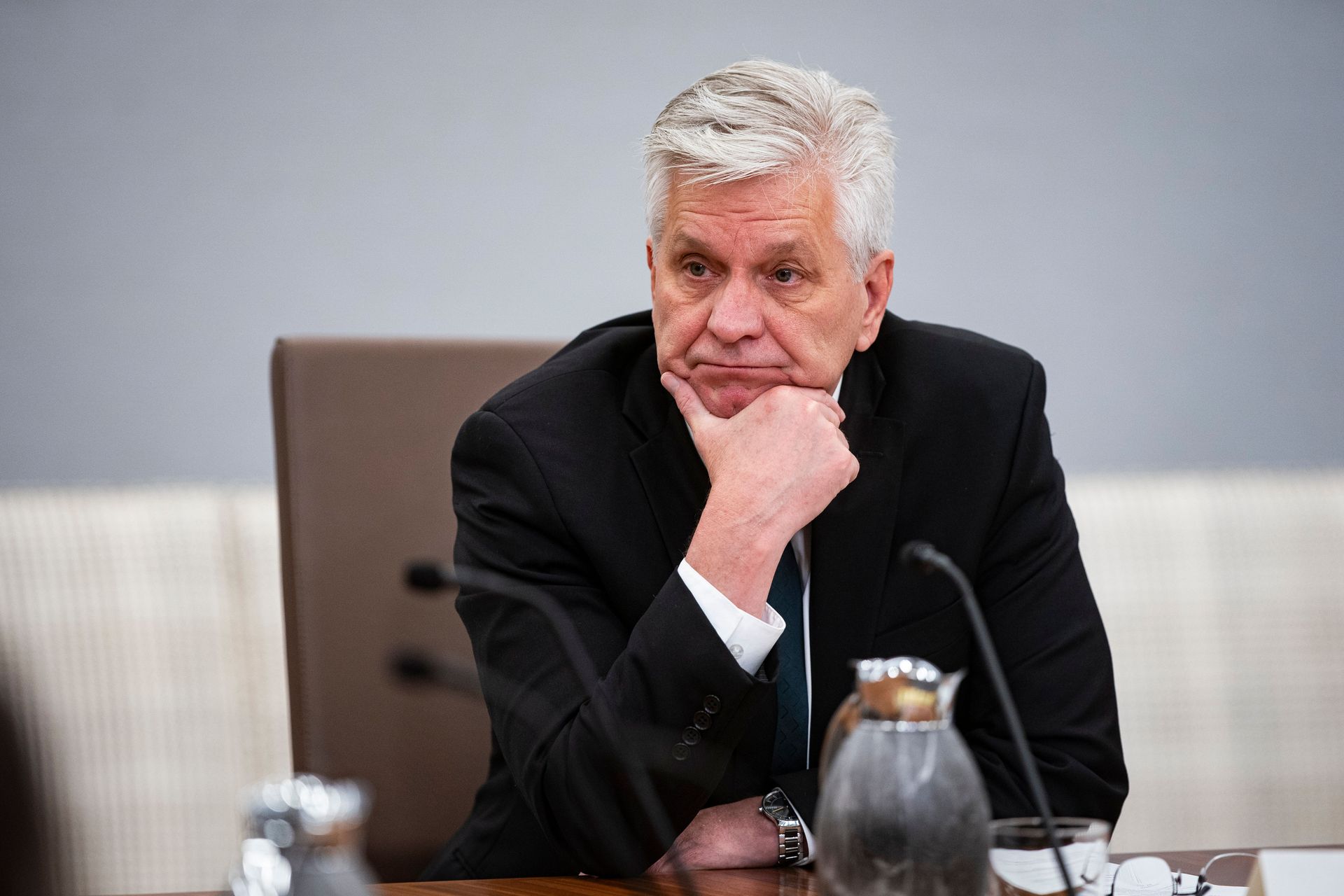
Federal Reserve Governor Christopher Waller warned Monday that the central bank may need to raise interest rates in the near term if incoming inflation data show price pressures continuing to broaden — but cautioned against overreacting to avoid the risk of a recession.

"If we get another hot reading on core inflation this week, then the FOMC will need to consider tightening monetary policy in the near term," Waller said in prepared remarks at the New York Association for Business Economics. At the same time, he stressed that "the desire to avoid past mistakes is often the author of new ones," adding that the Fed should not reflexively tighten policy merely because it moved too slowly in 2021.
Waller described monetary policy as being at a "crossroads," with the direction depending on a string of data releases beginning Tuesday, when the Bureau of Labor Statistics publishes the June Consumer Price Index. The Producer Price Index is due later in the week. Even a favorable reading this week, he said, would not be enough: "I will need to see several months of lower readings to feel that inflation is moving in the right direction."
The governor's concern centers on core personal consumption expenditures inflation — which strips out volatile food and energy prices — rising from 3% in December 2025 to 3.4% in May. Among core services — a segment that makes up roughly three-quarters of the core price basket — close to 70% of individual categories are showing annualized gains above 3% across both short- and longer-term horizons. Waller pointed to three forces he sees as responsible: trade levies put in place during 2025, higher energy costs stemming from hostilities in the Middle East, and excess demand generated by the rapid expansion of artificial intelligence infrastructure.
Waller argued the current situation differs from 2021 in two important ways. The labor market is far less tight, with job vacancies roughly equal to the number of unemployed workers, compared with two vacancies per unemployed person when the Fed began raising rates in 2022. And market-based inflation expectations remain anchored near 2%, with 2- and 5-year Treasury Inflation-Protected Securities implying expectations of 2.1% and 2.3%, respectively.
That said, Waller cautioned that well-anchored expectations are not a substitute for action. "Sternly staring at inflation until it melts before our withering gaze is not an option," he said.
At the June 16–17 gathering, FOMC members voted to leave borrowing costs unchanged within the 3.5%–3.75% target band. The FOMC is next scheduled to vote on rates July 28–29. Traders in interest-rate futures markets put the odds of a July hike somewhere between 39% and 45%, with the range reflecting different snapshots in time captured by Reuters and CNBC.
The speech comes against a backdrop of elevated headline inflation. As consumer inflation expectations climbed to multi-year highs in June, the PCE price index rose 4.1% in the 12 months through May — the first reading above 4% in three years — driven in large part by the U.S.-led conflict with Iran, which sent energy prices sharply higher before a fragile ceasefire pulled fuel costs off their peaks.
