There are lingering doubts that Warsh will share Powell's backbone in defending the Fed against Trump's endless attempts to bring it under his control
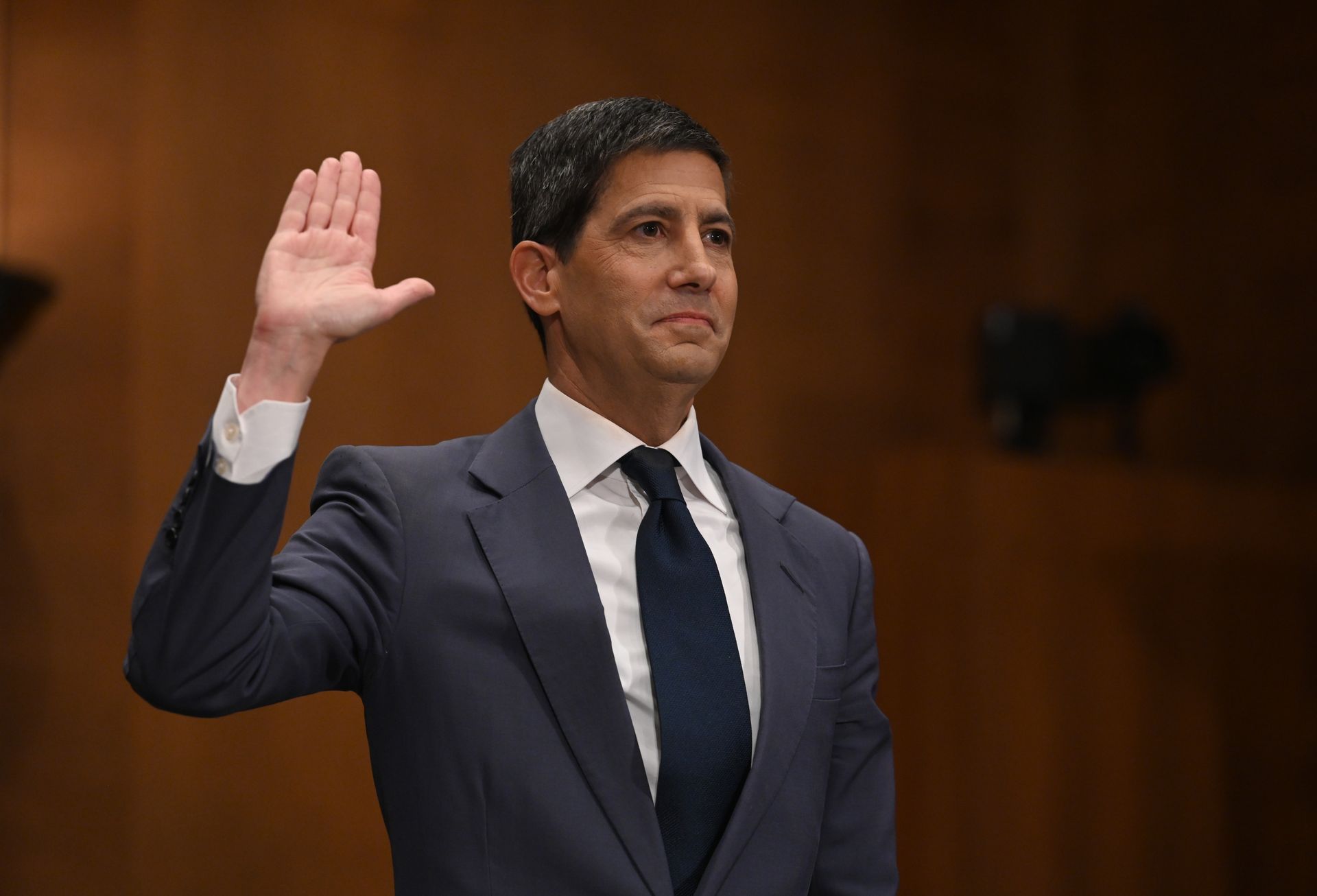
Kevin Warsh, chairman of the US Federal Reserve nominee for US President Donald Trump, is sworn in during a Senate Banking, Housing, and Urban Affairs Committee confirmation hearing on April 21, 2026 in Washington, DC. (Chen Mengtong/China News Service/VCG via Getty Images)
Federal Reserve Chair Jerome Powell developed a stiff spine overseeing the central bank for the last eight years. His successor Kevin Warsh will now grapple with a president who has an insatiable appetite for lower interest rates.
Warsh has a straight path to helm the Fed after clearing a milestone on Tuesday in a rocky confirmation process that was frozen at one point. The Senate Banking Committee voted 13-11 with all Democratic senators opposed to advance his nomination, leaving a final floor vote as the last hurdle before he's able to assume the post. In a sign of creeping polarization, Warsh was the first Fed chair nominee sent from the committee on party lines.
Join 500,000+ readers who start their day with Quartz.
By subscribing, you agree to our Terms of Service and Privacy Policy.
The breakthrough was only possible after Republican senator Thom Tillis of North Carolina dropped his blockade on Fed nominees. The one-man campaign forced the Trump administration to abandon a three-month criminal probe into Powell related to budget overruns in Fed renovations. Powell has long said the probe carried out by the Department of Justice was politically motivated to browbeat Fed policymakers into slashing interest rates quicker. Many lawmakers and Fed observers sided with him.
It'll soon be Warsh's turn in the hot seat. Powell's term as Fed chair ends on May 15, and he'll be tasked with safeguarding the Fed's distance from the executive branch to set monetary policy. Warsh has his work cut out for him. His supporters, though, argue he's up to the job.
"Kevin Warsh understands the need for an independent Fed, and I think he will be a defender of the Fed," Sen. Mike Rounds of South Dakota, a member of the Senate Banking panel, told Quartz. "Everybody's different in the way they approach things... I think Kevin Warsh will handle that job well."
There are lingering doubts, particularly among Democrats, that Warsh will share Powell's backbone in defending the Fed against Trump's endless attempts to bring it under his control. During his confirmation hearing, Warsh declined to state definitively that Trump lost the 2020 election — a feature of the president's nominees — and was labeled a "human sock puppet" by Democratic Sen. Elizabeth Warren of Massachusetts.
"So far, he's batting zero on that," Sen. Warren, the ranking Democratic member of the Senate Banking panel, told Quartz. Warsh also faced scrutiny related to his investments in Wall Street and Silicon Valley.
Warsh will inherit a Fed confronting a string of sizable challenges that complicate both its independence and ability to steer the economy in the coming months. The Trump administration is still attempting to oust Fed Governor Lisa Cook from her post, and the Supreme Court still hasn't issued a ruling on her case. For the time being, the high court has decided she can still vote on interest rates while her case proceeds.
Clashes between the Fed and the White House seem virtually unavoidable given Trump's caustic campaign against Powell. He remarked in a CNBC interview that Warsh might need an office "next to me" in the White House since the Fed renovation won't be complete soon.
Though Powell is stepping down as Fed chair, he said he will be staying on as a Fed governor until the Trump administration ceases its legal threats against the central bank. His term on the Board of Governors expires on Jan. 2028.
Usually, Fed chairs leave the institution unless they are renominated. But the extraordinary pressure campaign from the Trump administration made Powell rethink the idea of an early departure.
“My concern is really about the series of legal attacks on the Fed, which threaten our ability to conduct monetary policy without considering political factors,” he said at a Wednesday news conference. “I worry that these attacks are battering the institution.”
Indeed, Tillis said that he expected Fed independence to be tested again.
"We have to have that separation," Tillis told Quartz. "I don't begrudge the president trying to press into it. What we have to do is stand in the breach, though, just to keep it independent. Over time, people can complain all they want about the Fed. They've been right more often than they've been wrong."
Warsh sought to shed concern about close proximity with Trump. He told senators last month that the president "never asked me to predetermine, commit, fix, decide on any interest rate decision in any of our discussions, nor would I ever agree to do so."
Warsh said he'd attempt to cultivate a livelier deliberative process for the meetings of the 12-member Federal Open Market Committee. He has said he'd prefer to have "a good family fight." He may be about to get them.
Fed officials on Wednesday extended their pause interest rate-cut pause given the messy economic terrain they're in. Four members of the committee dissented against the official Fed statement in a potential rebellion that may complicate the start of Warsh's tenure.
It was the highest number of Fed officials dissenting in the official statement since 1992, and three of them objected to the "easing bias" that signals rate cuts are likelier than hikes.
The U.S. war with Iran has spiked energy prices and they will remain elevated for the forseeable future. Gas prices have climbed to $4.40 per gallon, per AAA. The World Bank said in a forecast this week that rising commodity prices will amplify inflation and dent economic growth. Trump's tariffs are still filtering into everyday products as well.
For Warsh, it all adds up to a changing of the guard that carries high stakes for the Fed and the U.S. economy.
