
Hollywood's AI war cools off
Three years after strikes put A.I. at the center of Hollywood’s labor battle, studios and creatives are shifting from resistance to cautious adoption
Three years after strikes put A.I. at the center of Hollywood’s labor battle, studios and creatives are shifting from resistance to cautious adoption
Mario Tama/Getty Images
A version of this article originally appeared in Quartz’s AI & Tech newsletter. Sign up here to get the latest AI & tech news, analysis and insights straight to your inbox.
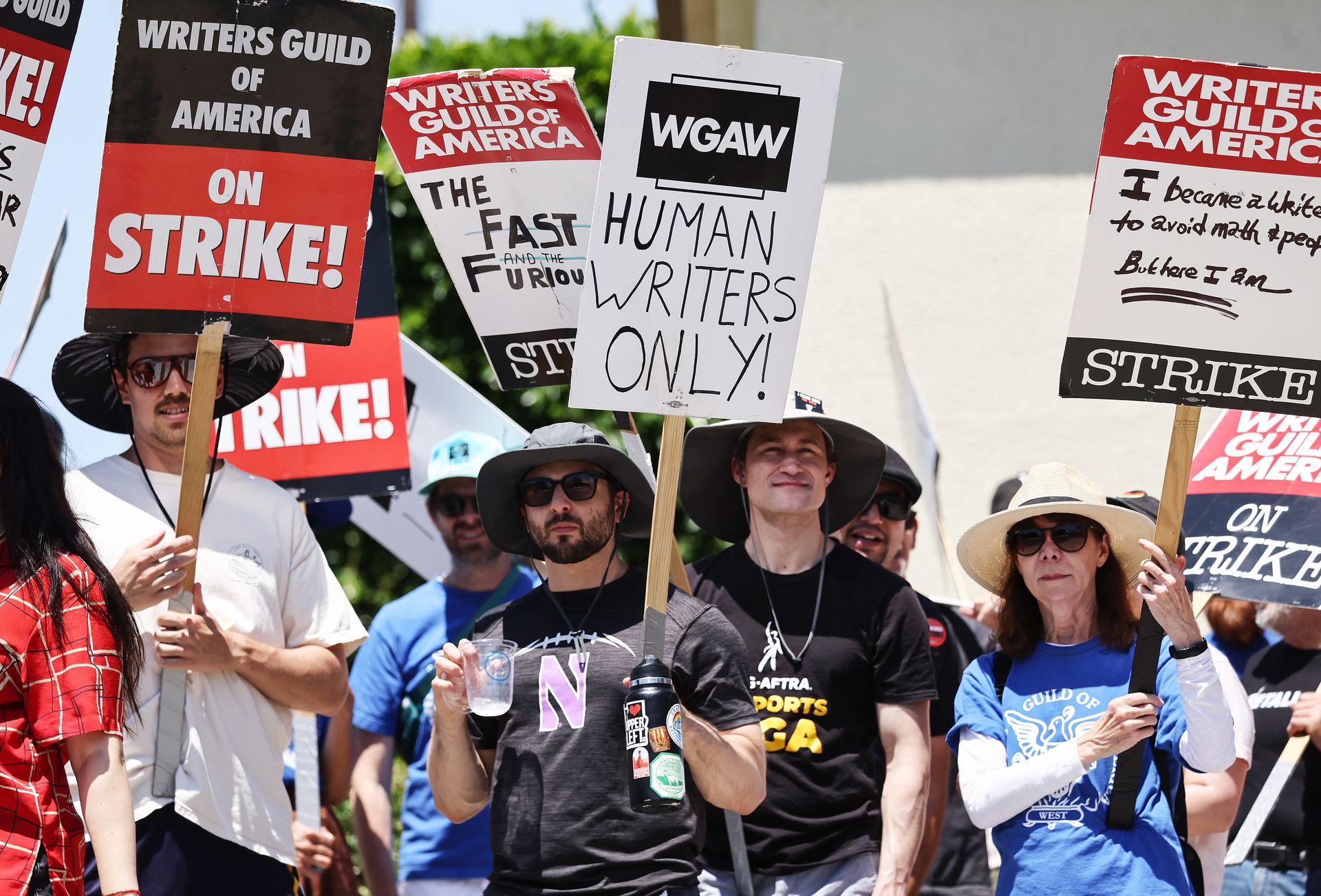
When the Writers Guild and SAG-AFTRA walked off the job in 2023, artificial intelligence was on the picket signs. Studios wanted to scan background actors and reuse their likenesses indefinitely. They wanted the right to feed scripts into models that could spit out drafts or do edits on human-written versions. The unions came back with contract language designed to contain it all, and the strikes were, in part, framed as Hollywood's stand against an industry-changing technology.
Three years on, Sandra Bullock can stand at an industry summit and tell colleagues to "lean into" AI, and the line lands more like common sense than betrayal.
The early resistance was loud. Family Ties star Justine Bateman, who has a computer science degree from UCLA, became the public face of the movement, advising SAG-AFTRA during the 2023 strike and launching a no-AI film festival.
Even cautious adopters got hammered. The Poker Face star Natasha Lyonne announced an "ethical" AI hybrid film and the internet erupted, with one Reddit $RDDT commenter posting they would rather find out she was a Scientologist. In January, more than 700 actors and creatives, including some of the biggest names in entertainment, backed a campaign called "Stealing Isn't Innovation."
AI is no longer the only thing keeping Hollywood up at night. TikTok and YouTube have continued reshaping where audiences spend their attention. Studios keep consolidating, with Warner Bros. Discovery shareholders approving a Paramount $PARA megadeal last month. Production in Los Angeles has cratered, with motion picture and video production employment down 30 percent from its late-2022 peak.
The Writers Guild's new four-year deal, ratified in April, made AI an afterthought rather than a centerpiece. The studios agreed to keep meeting on AI and to notify the guild when writers' work is licensed for training. They did not agree to pay for that training, and the WGA dropped the demand.
What the union fought for instead was health care. The WGA's own health fund is roughly $200 million in the red, forcing the union to negotiate higher premiums and deductibles in its new contract. They also got their "success bonus" for hit streaming shows to go higher. TV staffing minimums, the other big win from 2023, were preserved. Writers picked their fights. AI was not the one they picked.
It has also helped that AI has not lived up to the existential fear. Merriam-Webster picked "slop" as its 2025 word of the year, defining it as low-quality digital content produced by AI. People hate it. Hollywood has started to understand its own value, which is that audiences can tell the difference.
Another thing that has helped is that guardrails actually arrived. YouTube announced that its likeness detection tool, originally piloted with CAA in late 2024, is now open to any actor, athlete, or creator who wants to upload their face and request takedowns of deepfakes.
Stars are pursuing individual protections too. Matthew McConaughey filed a series of trademarks in January covering his image, video, and audio likeness, and Taylor Swift followed with applications for two voice clips and a stage image, a use of trademark law that has not been tested in court before.
There is also the question of which AI tools the industry is actually adopting. Ben Affleck sold his AI startup to Netflix $NFLX in March, and the company was not in the business of generating video from prompts. It built models for post-production tasks like fixing missing shots and lighting inconsistencies, the kind of unglamorous work that solves real problems without trying to replace anyone on set. Netflix bought it because that is the layer where AI is currently useful and currently uncontroversial.
None of this is new behavior. Every wave of new technology produces a faction ready to die clutching its typewriters and practical effects, and another quietly working out how to do things faster or cheaper. Sound, color, CGI, digital editing, streaming. The split is familiar. So is the eventual integration.
Things may yet change. A model may someday write a heartfelt sequel to Casablanca, perform every role, and edit it together. The current generation cannot. It fixes lighting. It flags deepfakes. That is the AI Hollywood has decided it can live with.
Join 500,000+ readers who start their day with Quartz.
By subscribing, you agree to our Terms of Service and Privacy Policy.