Indians are increasingly likely to ditch their offices for shared working spaces.
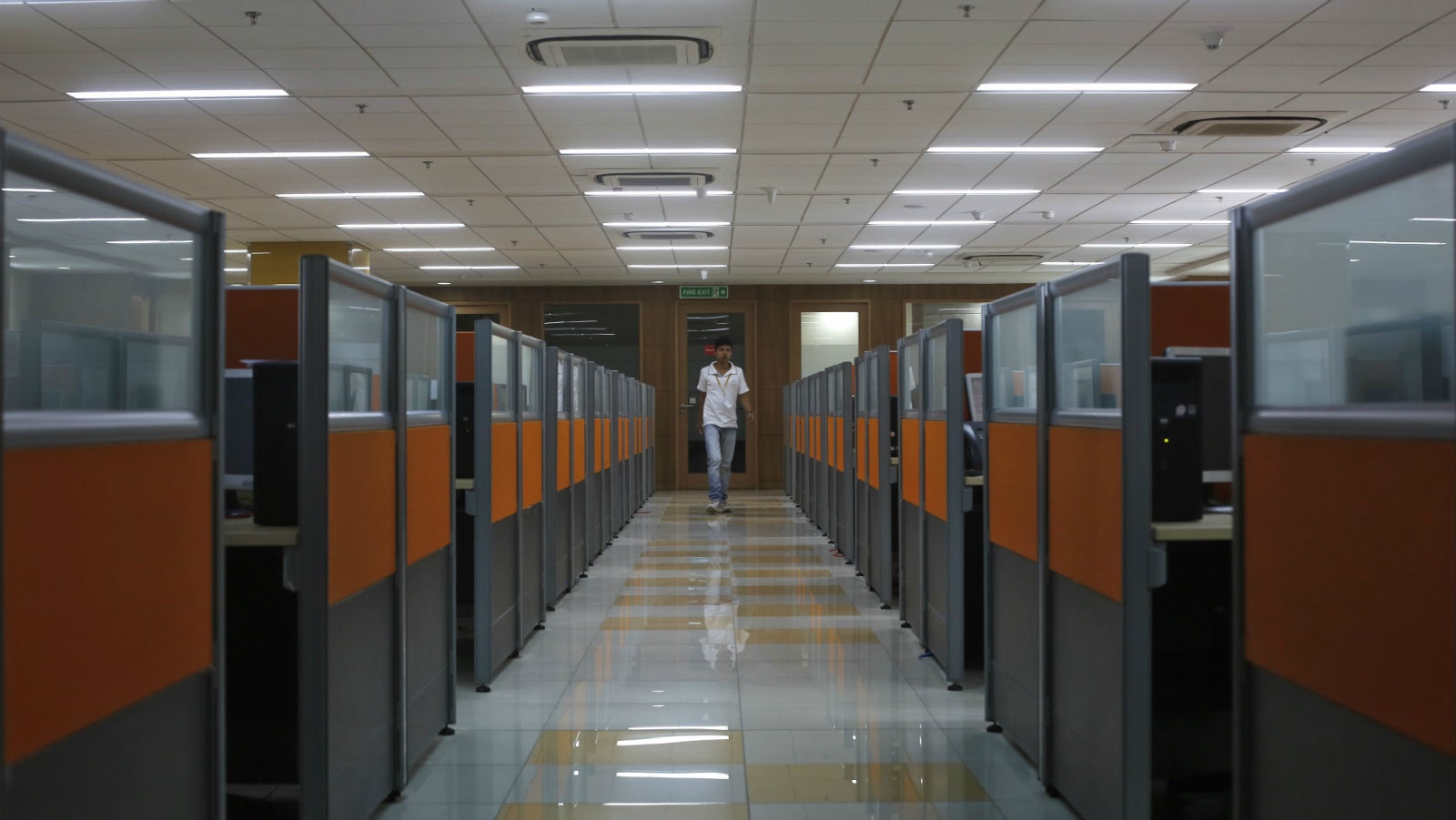
Indians are increasingly likely to ditch their offices for shared working spaces.
Demand for co-working spaces and flexible offices is likely to jump by between 30% and 40% in 2018, according to estimates from real estate consulting firm Jones Lang LaSalle (JLL). And by 2020, some 13.5 million Indians will operate out of such facilities. This will include 10.3 million employees of large companies, 1.5 million freelancers, and around 100,000 startup workers.
Join 500,000+ readers who start their day with Quartz.
By subscribing, you agree to our Terms of Service and Privacy Policy.
The demand will largely be driven by an increasingly young population and small businesses and startups, and further fuelled by expensive office rentals.
Co-working spaces typically work on a leasing model where workers can rent out workstations on an hourly, daily, weekly, or monthly basis. This saves companies the cost of leasing out office space and setting up infrastructure such as air conditioning, printers, coffee machines, etc.
As demand rises, co-working spaces are expected to attract $400 million in investments in the next one year, JLL added. Over the last few years, both foreign and domestic firms have upped investments into the market, especially in big cities.
Demand for co-working spaces is coming from both metros and smaller cities, according to JLL. Currently, a bulk of these are concentrated in the country’s top six cities: Delhi-NCR, Mumbai, Chennai, Bengaluru, Hyderabad, and Pune. Going forward, these cities will need an estimated five million seats, while 8.5 million seats of the projected demand will come from tier 2 and tier 3 cities.
Even among the big cities, the distribution of co-working spaces is uneven.
For instance, with 200 million square feet of co-working area available for lease, Bengaluru tops the Asia-Pacific region and is at par with other Asian cities like Beijing and Shanghai. At the same time, Delhi and Mumbai are among the lowest in the Asia-Pacific region in this regard.
Overall, by 2020, such working spaces will still comprise roughly only 20% of India’s overall premium working spaces, JLL estimated.
“While the growth of this segment in India has been phenomenal, most corporates are in pilot or experimentation phases,” said Sandeep Sethi, JLL’s managing director for integrated facilities management in west Asia.
