
There’s a misogynist aspect of Buddhism that nobody talks about
Hinduism is patriarchal. No doubt about it. So are Christianity and Islam, Sikhism and Shinto, Jainism and Judaism. But Buddhism? It is not the first religion that comes to mind when we talk about misogyny.
Hinduism is patriarchal. No doubt about it. So are Christianity and Islam, Sikhism and Shinto, Jainism and Judaism. But Buddhism? It is not the first religion that comes to mind when we talk about misogyny.
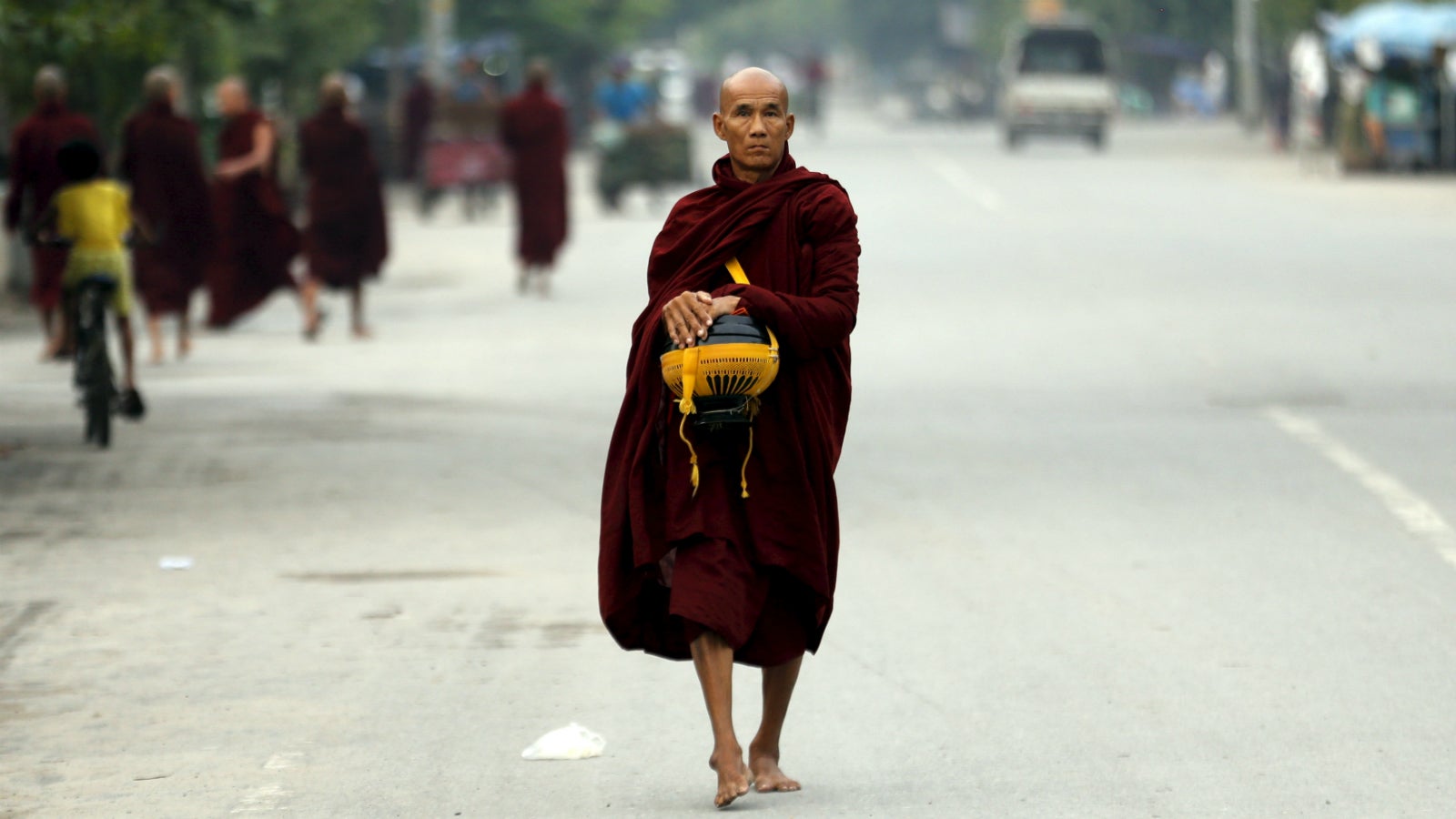
The assumption is that Buddhism is rational, modern, agnostic, and liberal in matters of gender and sexuality. Book after book has conditioned us to see the celibate and chaste Buddha as a kind of androgynous, asexual, gentle sage with a beatific smile. Yet, some of the earliest and most systematic documentation of rejection of female sexuality in Indian literature is from Buddhist scriptures, especially the rules of monastic discipline (Vinaya Pitaka), traditionally attributed to the Buddha himself.
Rules of monastic discipline
Consider this:
- There are more rules for nuns (bhikkunis) than monks (bhikkus), 331 as against 227, because while everyone has to control their desires, women have the additional burden of not “arousing the desires of men.”
- Monks are advised to sleep indoors, not outdoors, after an incident where women had sex with a monk while he, apparently, was sleeping under a tree. Monks who do not wake up, or do not yield to temptation despite being accosted by women for sexual pleasure, are seen as innocent and not expelled from the monastic order. Monks who voluntarily submit to female charms are declared defeated (parajita).
- In the tale of Sudinna, a young monk breaks his vows of celibacy after his old parents beg him to give his wife, whom he had abandoned, a child so that his family lineage may continue. When this is revealed, the Buddha admonishes him thus: “It is better for you to have put your manhood in the mouth of a venomous snake or a pit of burning charcoal than a woman.”
- In one conversation, the Buddha states, “Of all the scents that can enslave, none is more lethal than that of a woman. Of all the tastes that can enslave, none is more lethal than that of a woman. Of all the voices that can enslave, none is more lethal than that of a woman. Of all the caresses that can enslave, none is more lethal than that of a woman.”
- Buddhist monks, unlike other monks of that period, are not allowed to wander naked for fear they would attract women with their charms, believed to be enhanced because of their chastity and celibacy.
- Monks are advised to walk straight, without moving their arms and bodies too much, looking at the ground and not above, lest they get enchanted by “the glance of a woman.” Monks are also advised not to walk with single women, or even sit in the company of men, for it might lead to gossip.
- In a conversation with Kassappa, Bakulla says that in 80 years he has not only not had sex, he has not even entertained thoughts of women, or seen them, or spoken to them.
- Once a woman laughed and showed her charms to Mahatissa, but he remained unmoved. When asked by her husband if he found his wife unattractive, Mahatissa said he saw no woman, only a heap of bones.
- In the story of Sundarasammudha, who leaves his wife to become a monk, the wife approaches the husband and tells him, in what is an allusion to the ashrama system of Hinduism, that they should enjoy the pleasures of marital life till they are old and only then join the Buddhist order together and attain nirvana (liberation through cessation of desires). The monk replies that he would never submit to such seductions which are the snares of death.
- The texts repeatedly describe celibate monks as embodiments of dhamma (the path of enlightenment) while the lustful insatiable women are described as embodiments of samsara (the cycle of death and rebirths).
- Sangamaji left his wife and son to become a monk. One day, his wife and son come to him and beg him to come back but he does not respond, and shows no sign of husbandly or fatherly instincts and so is praised by Buddha of achieving true detachment and enlightenment. A true monk, for whom “female sexuality is like the flapping wings of a gnat before a mountain” is a vira (hero).
- Buddha makes his half-brother Nanda join the monastic order but Nanda is engaged to marry the most beautiful woman in the land and pines for her. So Buddha shows him celestial nymphs who live in the heaven of the 33 gods (Swarga of Hindu Puranas). Buddha asks Nanda if his fiancée is as beautiful as these nymphs, and Nanda says she is like a deformed monkey compared to these nymphs. Buddha says that if he continues to walk the path of dhamma he would be reborn in this heaven and be able to enjoy these nymphs. Spurred by this thought, Nanda actively and diligently engages in monastic practices. By the time he attains enlightenment, all desires for the nymphs and the fiancée are gone.
- Different types of queers (pandakas) are listed who should not be ordained as monks. These include hermaphrodites, transsexuals, eunuchs, cross-dressers, and effeminate gay men. This is done following stories of monks being seduced, or courted, by pandakas, and also because keepers of a nearby elephant stable mocks a monastery because one of its members is a pandaka, who constantly courts them sexually.
- Female hermaphrodites, women who dress like men, or those of deviant sexuality or simply those who do not look like women and are “man-like” women cannot be ordained as nuns.
- There are rules that refer to bestiality. Monks are warned against too much affection for cows and female monkeys.
The code’s influence
Initially, none of these strictures were codified. There was no Vinaya Pitaka. But as many people joined the monastery (vihara), they started behaving in certain ways that were deemed unworthy of monks and seekers of Buddha-hood. People also started making fun of the Buddhist way. So to protect the reputation of the dhamma and the sangha, Buddha began putting down these rules.
These codes were compiled orally and narrated by Upali (a barber before he became one of Buddha’s 10 chief disciples) in the first Buddhist council, a year after Buddha’s death. This happened 2,600 years ago. A thousand years later, these rules were systemised and codified by one Buddhaghosha who lived in the monastery at Anuradhapura in Sri Lanka.
By the time Islam arrived, Buddhism had already waned in most of India. But the Buddhist idea equating women’s sexuality with entrapment and pollution informed Hindu monastic orders (mathas), especially those instituted by Adi Shankara. Shankara was often called a Buddhist with Hindu packaging, by his critics. In his monastic order, he went a step further: there were no nuns.
If we believe the theory that “Jesus lived in India,” this code of monks could even be said to have influenced the anti-women stance outside India, too—in Christianity as well, for while the Buddha abandoned his wife, Yashodhara, Jesus never married at all. Significantly Buddhaghosa lived around the same time as St Augustine of Hippo came forth with his anti-sex and anti-women trope in the Catholic Church.
“Good” Buddhism,“bad” Hinduism
It is interesting that in all writings of patriarchy and misogyny related to India, scholars quote the Ramayana and the Manu Smriti, yet historically these were composed after the Vinaya Pitaka. Buddha lived in pre-Mauryan times while the Ramayana, with its concern for kingship, was written in post-Mauryan times. Arguments of oral traditions and astrology-based dating that place Ram to pre-Buddhist times appeal only to nationalists, not historians. Manu Smriti and other dharmashastras were written in the Gupta era when Brahmins played a key role in legitimising kingship in much of peninsular India. The pre-Buddhist Vedic rituals speak of female sexuality in positive terms as they are concerned primarily with fertility and wealth-generation. The pre-Buddhist Upanishads do not bother much with gender relations and are more interested in metaphysics. Much of Buddhist literature was put down in writing long before Sanskrit texts (Ashokan edicts in Prakrit date back to 2300 years; the earliest Sanskrit royal inscriptions have been dated to only 1900 years ago). This makes Buddhist writings the watershed of Indian literature, after which womanhood came to be seen as polluting, obstacles to the path of wisdom.
We could, of course, argue that that most educated Buddhists were originally Brahmins and so transplanted Hindu patriarchy into Buddhism, that the Buddha had no such intention. We can insist that Vedas and only the Vedas, are the source of misogyny. This follows the pattern of “good” Buddhism and “bad” Hinduism structure we find in most colonial and post-colonial academic papers.
The complete silence on the subject of misogyny so firmly entrenched in the Buddhist scriptures, and traced to the Buddha, is quite remarkable. Research on this topic is well known but restricted to academic circles. There is Buddhism after Patriarchy by Rita Gross and Bull of a Man’ by John Powers, for example. But there is a strong desire in these books to explain away the patriarchy, rather than put the spotlight on them. It is almost as if the scholars are irritated, even embarrassed, that the facts interfere with contemporary perceptions of the Buddha.
Abandoning sex, which effectively means abandoning women, for a “higher” purpose—be it enlightenment or spirituality or service to the nation—has since become a popular model, embraced by religious sects, as well political organisations such as the Rashtriya Swayamsevak Sangh. It has been glamorised and valorised as the ultimate indicator of masculinity and purity. We can trace, at least one major tributary of this idea, to the Vinaya Pitaka of the Buddha, who abandoned his wife, without her consent.
This post first appeared on Scroll.in. We welcome your comments at [email protected].
The essential business news, delivered fresh every morning.
Join 500,000+ readers who start their day with Quartz.
By subscribing, you agree to our Terms of Service and Privacy Policy.