From the transistor to the touchscreen, the inventions that made digital life possible are older, stranger, and more contested than most people realize
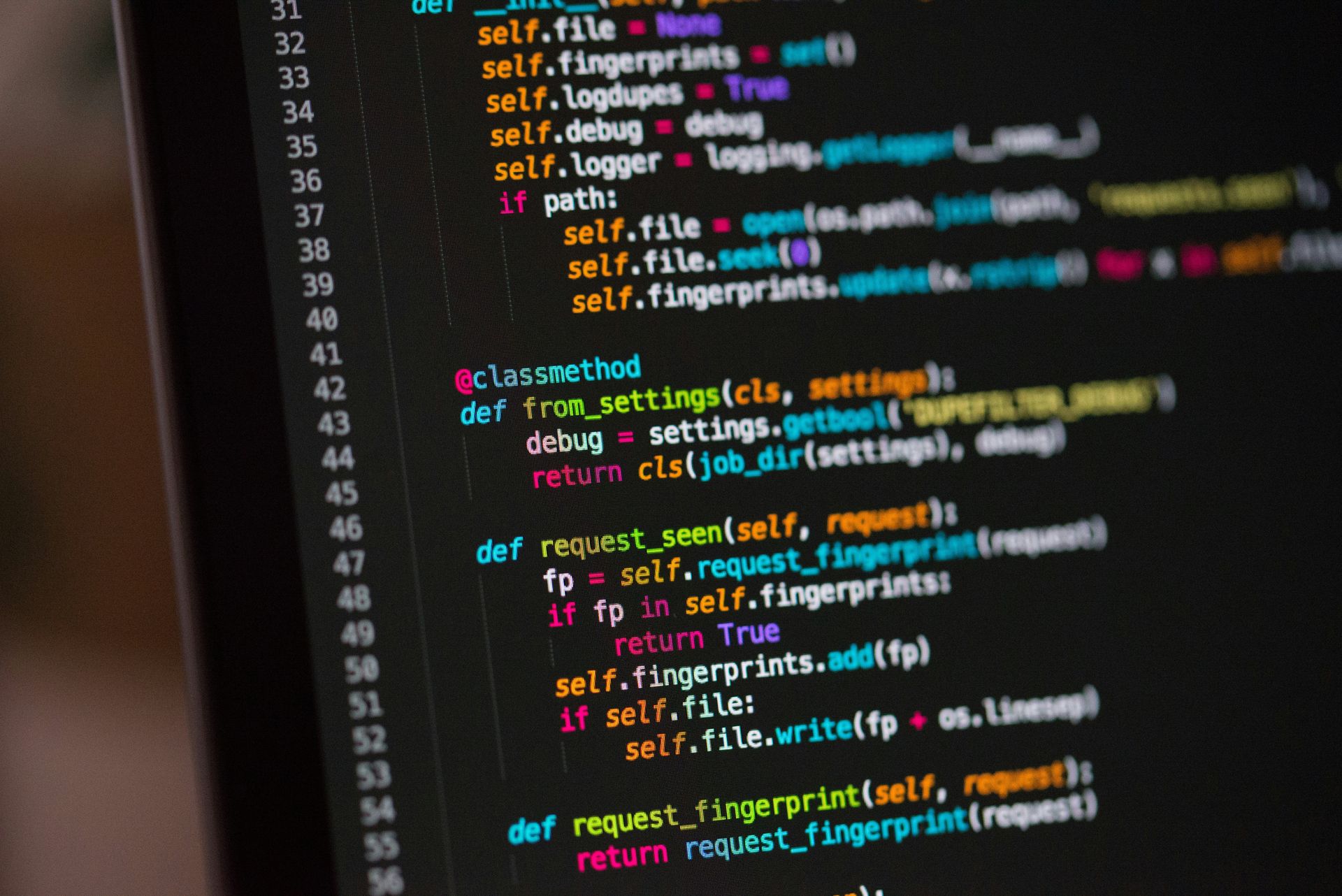
Chris Ried / Unsplash
The digital age has a creation myth, and like most creation myths, it is partly true and mostly incomplete. In the popular version, a handful of visionary founders — Jobs, Gates, Zuckerberg, Bezos — conjured the digital world through a combination of genius and will, working in garages and dorm rooms and changing everything. That story is not wrong exactly. It is just missing about a century of prior work without which none of those garages would have had anything interesting to put in them.
The digital age was not built by founders. It was built by inventors, engineers, mathematicians, and government-funded researchers working across decades, in universities and military laboratories and corporate research divisions, on problems that were often not recognized as consequential until years after they were solved. The transistor was invented in 1947 by three physicists at Bell Labs working on a materials problem. The internet grew from a Defense Department communications project. The GPS system was built to guide nuclear submarines. The touchscreen was developed in the 1960s by a doctoral student in Michigan. None of these people set out to build the digital age. They set out to solve a specific problem, and the digital age accumulated around their solutions.
This list covers 25 inventions that were genuinely necessary for the digital world to exist — not inventions that happened to occur during the digital era, but inventions without which the specific shape of contemporary digital life would be impossible or fundamentally different. Some are hardware: the transistor, the hard drive, the fiber optic cable. Some are software: the operating system, the relational database, the search algorithm. Some are protocols and standards: TCP/IP, the World Wide Web, Wi-Fi. Some are devices: the smartphone, the laptop, the digital camera.
They are presented roughly in the order in which the foundational ideas were developed, though many overlapped and the boundaries between them are porous. The transistor enabled the microchip, which enabled the personal computer, which enabled the internet as a mass-market phenomenon, which enabled everything that came after. The chain of dependency is long, and pulling on any link changes everything downstream.
The transistor is the foundational component of the digital age — the invention from which almost everything else on this list follows, directly or indirectly. Without the transistor, there is no microchip. Without the microchip, there is no personal computer. Without the personal computer, there is no internet as a mass phenomenon. The transistor is the first cause of the digital world.
It was invented in December 1947 at Bell Laboratories in Murray Hill, New Jersey, by a team of three physicists: John Bardeen, Walter Brattain, and William Shockley. The three were awarded the Nobel Prize in Physics in 1956. What they built was a solid-state device — made from germanium, later from silicon — that could amplify or switch electronic signals without the heat, fragility, and bulk of the vacuum tubes that had previously performed the same function.
The vacuum tube had made early electronic computing possible. ENIAC, the first general-purpose electronic computer, completed in 1945, used approximately 18,000 vacuum tubes. It occupied 1,800 square feet, weighed 30 tons, and consumed 150 kilowatts of power. It failed, on average, once every two days because vacuum tubes burned out. The transistor replaced the vacuum tube with a device that was smaller, faster, cooler, more reliable, and cheaper to manufacture — and then kept getting smaller, faster, cooler, more reliable, and cheaper for the following seven decades, in a progression that became known as Moore's Law.
The first commercial transistor radio, the Regency TR-1, appeared in 1954. By the 1960s, transistors had migrated from consumer electronics into computing. By the 1970s, they were being etched onto silicon chips by the thousands. Today, a modern processor contains tens of billions of transistors on a chip the size of a fingernail. The device Bardeen and Brattain assembled by hand from a paper clip, a piece of germanium, and a strip of gold foil in 1947 has been scaled by a factor of tens of billions in the decades since. No other engineered object has improved at anything approaching that rate.
The transistor gave the digital age its basic component. The stored-program computer gave it its basic architecture — the idea that a computer could store both the data it was processing and the instructions for processing it in the same memory, allowing the machine to be reprogrammed without being physically rewired. That idea, which now seems obvious to the point of being unremarkable, was genuinely revolutionary when it was articulated in the 1940s, and it remains the architectural foundation of virtually every computing device in existence.
The concept is most closely associated with John von Neumann, whose 1945 draft report on the EDVAC computer described a machine organized around a central processing unit, a memory unit that stored both instructions and data, and input/output mechanisms. The "von Neumann architecture" that resulted from that report — or more precisely, from the work of the broader team at the University of Pennsylvania that von Neumann was consulting for — became the template for computer design for the following eight decades.
Before the stored-program concept, computers were either fixed-function machines designed to perform a single calculation, or reprogrammable machines that required physical rewiring to change their function. The ENIAC, for example, was reprogrammed by reconnecting cables and resetting switches — a process that could take days. A stored-program machine could be given a new set of instructions in seconds, simply by loading a different program into memory.
The practical consequence was that a single general-purpose machine could perform an unlimited variety of tasks — arithmetic, text processing, simulation, communication — depending on what program was loaded. That generality is what made the computer a universal tool rather than a specialized instrument, and it is the property that has allowed computing to penetrate every domain of human activity from science to entertainment to commerce to medicine. The stored-program computer is the reason a device that fits in your pocket can function as a phone, a camera, a map, a bank, and a library simultaneously.
Bermix Studio / Unsplash
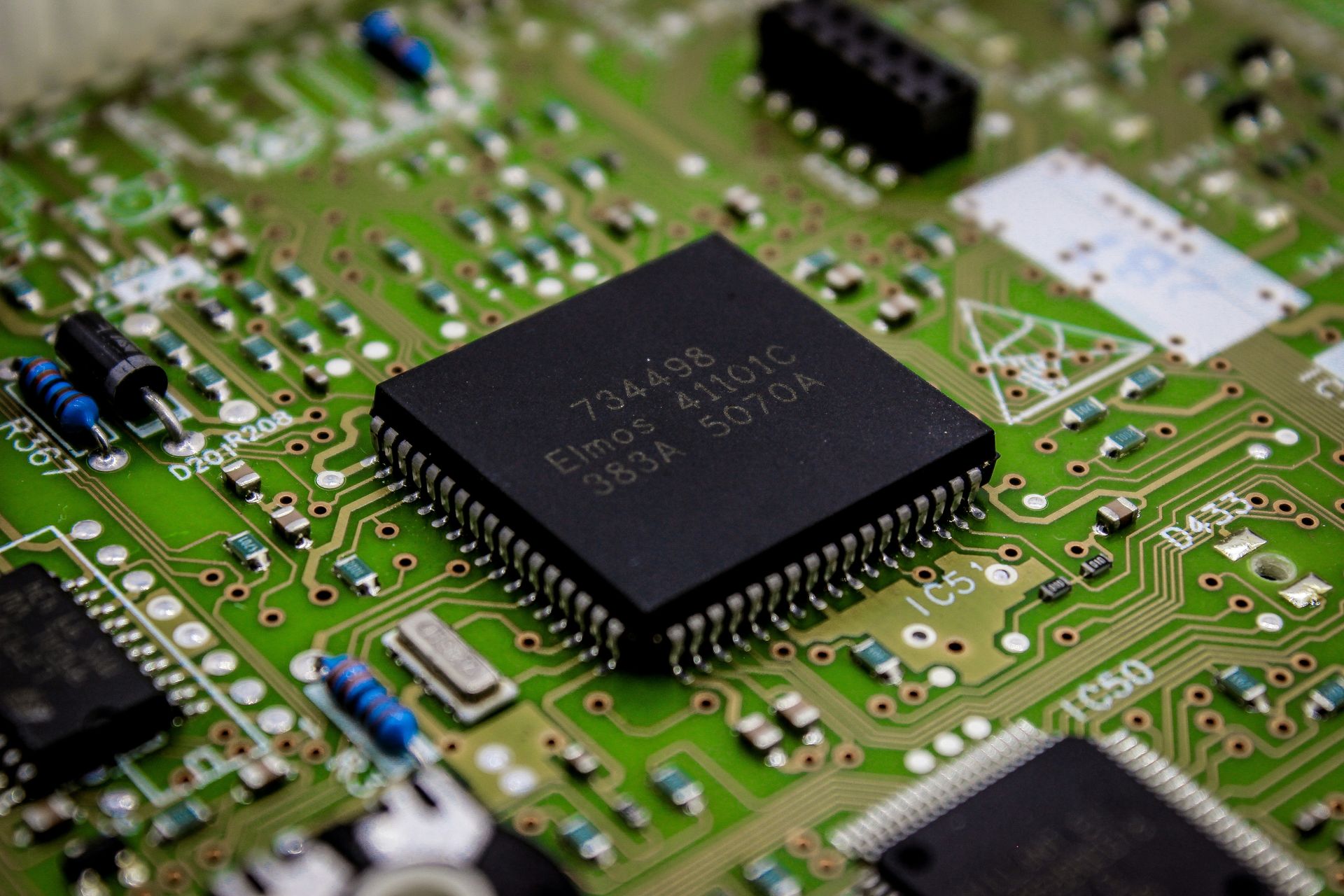
The integrated circuit — the microchip — solved a problem that the transistor had created. Individual transistors were small and reliable, but building complex electronic circuits required connecting thousands of them by hand with wires, a process that was slow, expensive, and introduced its own reliability problems at the connection points. What was needed was a way to manufacture not just individual transistors but entire circuits — transistors, resistors, capacitors, and the connections between them — as a single integrated unit.
Two inventors arrived at the solution independently and almost simultaneously. Jack Kilby of Texas Instruments $TXN demonstrated the first working integrated circuit in September 1958, built on a piece of germanium. Robert Noyce of Fairchild Semiconductor developed a more practical version using silicon and a planar manufacturing process in early 1959. The patent dispute between them lasted years; both are now credited as co-inventors. Kilby received the Nobel Prize in Physics in 2000 — Noyce had died in 1990 and Nobel Prizes are not awarded posthumously.
The microchip made it possible to manufacture electronic circuits at industrial scale, with the number of components per chip doubling roughly every two years as manufacturing processes improved. Gordon Moore, a co-founder of Intel $INTC, observed this pattern in 1965 and predicted it would continue — a prediction that became known as Moore's Law and held with remarkable accuracy for the following five decades.
The consequences of that scaling were not just quantitative. At some point — roughly in the 1970s — the density of components on a chip crossed a threshold at which computers became small enough, cheap enough, and powerful enough to use as personal tools rather than shared institutional resources. The microchip is what made the personal computer possible, and the personal computer is what made the digital age a mass phenomenon rather than a specialist one.
Hardware without software is an expensive paperweight. The operating system — the software layer that manages a computer's hardware resources and provides a platform on which application programs can run — is the invention that bridges the two, and its development in the 1950s and 1960s was as consequential for the practical usability of computers as any hardware advance.
Early computers had no operating systems. Each program was loaded directly onto the hardware, managed its own memory and input/output operations, and left the machine in whatever state it happened to be in when it finished. Running a second program required manually resetting the machine. The inefficiency was enormous — expensive machines sat idle between jobs while operators physically handled the transition.
The first operating systems were batch processing systems that allowed programs to be queued and run sequentially without human intervention between each job. Time-sharing systems, developed in the early 1960s at MIT and elsewhere, went further — allowing multiple users to interact with a single computer simultaneously, each experiencing the illusion of having the machine to themselves. The commercial implementation of time-sharing was the first moment at which computers became interactive tools rather than batch processors, and it changed what computing felt like to use.
The operating systems that shaped the personal computer era — CP/M, MS-DOS, the Macintosh System Software, and eventually Windows and Unix/Linux — translated the hardware capabilities of microchips into environments that non-specialists could navigate. The graphical user interface, the file system, the concept of an application — all of these are properties of operating systems rather than hardware. The decision by IBM $IBM to license MS-DOS from Microsoft $MSFT for its PC, rather than developing a proprietary operating system, gave Microsoft a platform from which it built the most commercially successful software business of the 20th century.
The internet that billions of people use daily grew from a research network called ARPANET, funded by the U.S. Defense Department's Advanced Research Projects Agency and first operated in October 1969. The initial network connected four nodes: the University of California Los Angeles, the Stanford Research Institute, the University of California Santa Barbara, and the University of Utah. The first message transmitted over the network, on October 29, 1969, was "lo" — the beginning of "login," before the system crashed.
ARPANET was built around a concept called packet switching, developed independently by Paul Baran at RAND Corporation and Donald Davies at the National Physical Laboratory in the U.K. in the early 1960s. Instead of establishing a dedicated circuit between sender and receiver — as telephone networks did — packet switching broke messages into discrete chunks, sent each chunk independently through whatever network path was available, and reassembled them at the destination. The approach was more efficient, more resilient, and more scalable than circuit switching, and it became the foundational architecture of the internet.
The strategic rationale for ARPANET was communications resilience — a network that could survive the loss of any individual node, relevant in a Cold War context where nuclear attack on specific communications infrastructure was a genuine concern. Whether that was the primary motivation or a post-hoc justification for a research initiative is debated by historians. What is not debated is that the technical architecture developed for ARPANET — packet switching, distributed routing, open protocols — turned out to be exactly the right foundation for a global communications network that nobody had specifically planned.
ARPANET was decommissioned in 1990, by which point the internet it had seeded had grown far beyond any government network. The transition from ARPANET to the modern internet was not a single event but a gradual transfer of infrastructure, protocol development, and governance from government and academic institutions to commercial operators — a transition whose implications are still being worked through.
ARPANET created a network. TCP/IP — the Transmission Control Protocol and Internet Protocol, developed by Vint Cerf and Bob Kahn and first described in a 1974 paper — created the rules that allowed different networks to communicate with each other, turning a collection of separate networks into a single interconnected whole. TCP/IP is the reason a message sent from a computer in Manila can reach a server in Frankfurt without either end needing to know anything about the intermediate infrastructure through which it passes.
The two protocols divide the work of internet communication between them. IP handles addressing and routing — it gives every device on the network a unique address and determines the path that data packets take from source to destination. TCP handles reliability — it ensures that packets arrive in the correct order, requests retransmission of any that are lost, and manages the flow of data to prevent network congestion. Together, they provide a universal communication layer on which any application — email, file transfer, the web, video streaming — can be built.
The decision to make TCP/IP an open, non-proprietary standard — available for any network to implement without licensing fees — was the single most consequential design choice in the history of the internet. It meant that any network operator, anywhere in the world, could connect to the internet simply by implementing the protocols, with no permission required from any central authority. That openness produced the explosive, decentralized growth of the internet in the 1980s and 1990s, as universities, research institutions, government agencies, and eventually commercial internet service providers all connected to the same protocol layer.
Cerf and Kahn received the Presidential Medal of Freedom in 2005 and the Turing Award — computing's equivalent of the Nobel Prize — in 2004. The protocols they designed in the early 1970s, with modifications, continue to route essentially all internet traffic in the world.
The graphical user interface — windows, icons, menus, a pointer controlled by a mouse — is so familiar that it is difficult to remember that it was invented, that there was a specific moment at which it did not exist and then did, and that the people who invented it understood they were doing something that would change computing permanently.
That moment was the early 1970s at Xerox PARC, the research laboratory that Xerox established in Palo Alto in 1970. The GUI was developed there as part of the Alto project — a research computer that incorporated, for the first time, a bitmap display, a mouse, overlapping windows, and a desktop metaphor in which files and folders were represented as visual objects that could be manipulated directly. The Alto was never commercialized by Xerox, a decision that became one of the most studied examples of a company failing to capitalize on its own research.
Steve Jobs visited Xerox PARC in 1979 and saw a demonstration of the Alto's interface. The visit is sometimes described as the moment Jobs "stole" the GUI for Apple $AAPL — a characterization that Xerox's engineers and historians of the period tend to dispute, noting that Jobs saw a demo of a limited version of the system and that Apple's implementation was substantially different. What is accurate is that the visit confirmed for Jobs that the graphical interface was the right direction for personal computing, and the Apple Lisa and then the Macintosh — released in 1984 — brought the GUI to a mass market for the first time.
Microsoft $MSFT's Windows followed in 1985, initially as a modest addition to MS-DOS, and gradually became the dominant GUI in the world. By the mid-1990s, essentially all personal computing happened within a graphical environment. The command-line interface that had defined early personal computing became a specialist tool. The GUI made computers accessible to people who had no interest in learning a programming language or a set of text commands, and that accessibility was the proximate cause of the personal computer's transformation from a hobbyist device into a universal tool.
William Warby / Unsplash
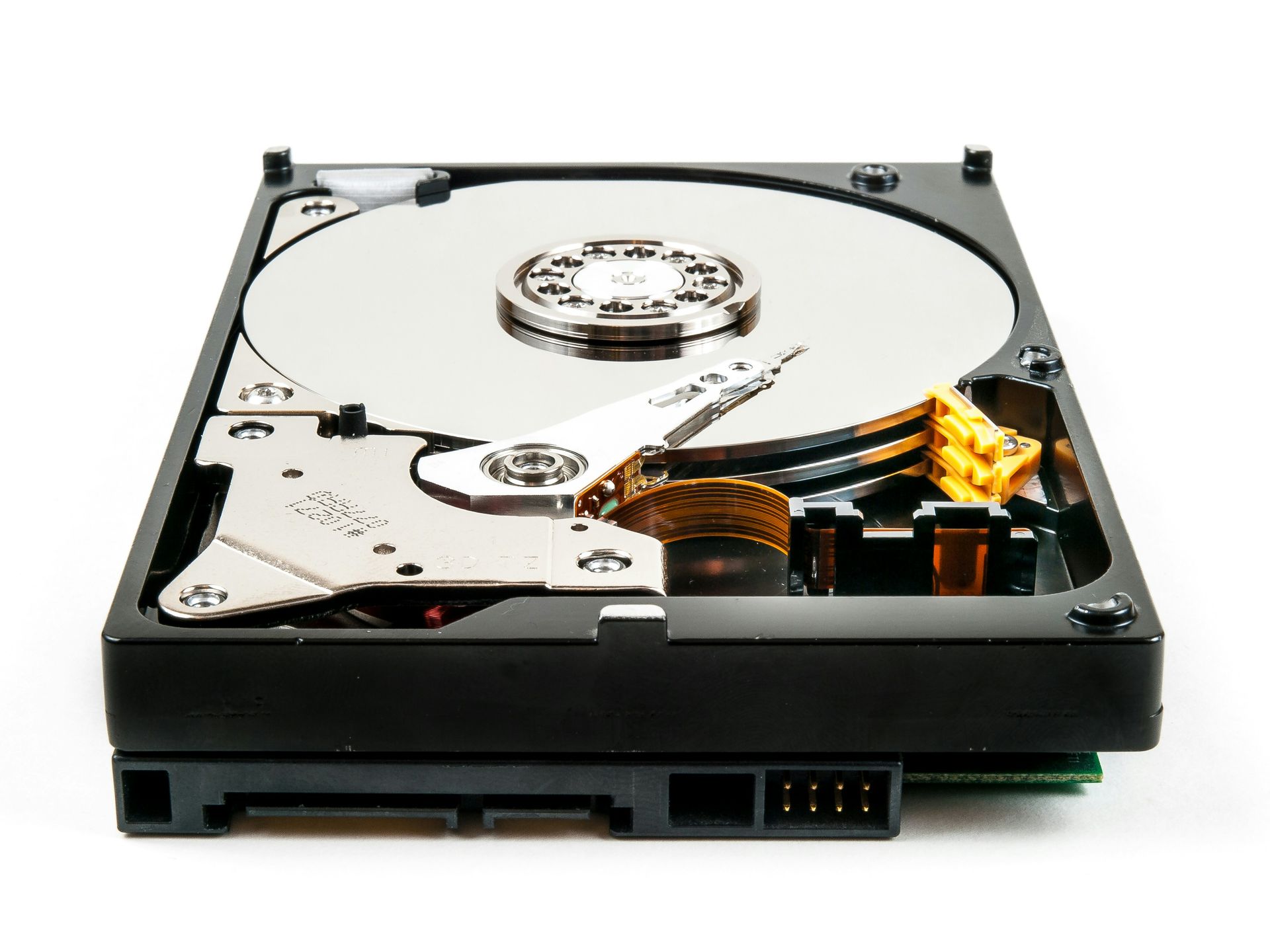
Memory that disappears when the power goes off is useful for computation but useless for storage. The hard disk drive — a device that stores data magnetically on spinning platters and retrieves it through read/write heads that move across the surface — solved the problem of persistent, large-capacity, randomly accessible data storage, and in doing so made the personal computer a genuinely practical tool rather than a computational curiosity.
IBM $IBM introduced the first hard disk drive, the IBM 350, in 1956 as part of the RAMAC 305 system. The 350 stored five megabytes of data on 50 aluminum disks, each 24 inches in diameter, stacked in a unit the size of two large refrigerators. It was leased, not sold, at a rate of around $3,200 per month in contemporary dollars — roughly $35,000 per month in current terms, for five megabytes of storage.
The trajectory of hard drive development over the following six decades is one of the most dramatic improvement curves in the history of technology. Capacity increased by roughly a factor of one million between 1956 and 2010. Cost per gigabyte fell from thousands of dollars to fractions of a cent. Physical size shrank from a room-sized installation to a device small enough to fit in a laptop. The 3.5-inch form factor, introduced in 1983, became the standard for personal computers and remained so for nearly three decades.
The hard drive made possible the applications that define personal computing: word processors that saved documents, spreadsheets that preserved financial models, databases that retained customer records, email clients that stored correspondence. Without persistent storage, a computer is a calculator. With it, it is an office. The hard drive's role has been partly taken over by solid-state drives in the laptop era, but the hard drive remains the dominant storage medium for data centers, where its cost advantage over solid-state storage at scale has kept it central to the infrastructure of the internet.
AS Photography / Pexels
The internet and the World Wide Web are not the same thing, though the terms are used interchangeably in popular language. The internet is the infrastructure — the global network of connected computers, the TCP/IP protocols, the physical cables and wireless links. The World Wide Web is an application built on top of that infrastructure — a system of documents and resources linked by hyperlinks and accessible through a browser, using the HTTP protocol to transfer content and URLs to identify locations.
Tim Berners-Lee, a British physicist working at CERN in Geneva, invented the Web in 1989 and implemented the first web server and browser in 1990. His original proposal was titled "Information Management: A Proposal" and was described by his supervisor as "vague but exciting." The first website, info.cern.ch, went live in August 1991. Berners-Lee made the critical decision to make the Web's protocols and standards available royalty-free, which allowed it to grow without the friction of licensing negotiations.
The Web was not the first attempt to create a hyperlinked information system. Ted Nelson had described "hypertext" — text containing links to other text — in 1963, and various hypertext systems had been built in the following decades. What distinguished Berners-Lee's system was that it was designed for a global network rather than a single machine or local network, and that it used the existing internet infrastructure as its transport layer rather than requiring new infrastructure.
The addition of the Mosaic browser in 1993 — the first browser to display images inline with text, developed at the National Center for Supercomputing Applications by Marc Andreessen and Eric Bina — transformed the Web from a text-based information system into a multimedia environment that non-technical users could navigate. Between 1993 and 1996, the number of websites grew from a few hundred to more than 100,000. The commercial internet era had begun.

cottonbro studio / Pexels
A web with 100,000 pages is navigable. A web with a billion pages is not, without a mechanism for finding what you are looking for. The search engine — and specifically the algorithmic approach to ranking search results by relevance rather than simply indexing them by keyword — is what made the Web usable at scale, and the specific algorithm that made search work well enough to organize the world's information was PageRank, developed by Larry Page and Sergey Brin as doctoral students at Stanford and published in 1998.
Earlier search engines — AltaVista, Excite, Lycos — indexed the web and ranked results primarily by keyword frequency: how often the search term appeared on a page. The approach worked reasonably well on a small web but degraded as the web grew, because keyword frequency could be gamed — pages could be loaded with keywords to rank highly for searches they were not actually relevant to.
Page and Brin's insight was to use the link structure of the web as a proxy for quality. A page that many other pages linked to was likely to be more authoritative than one that few pages linked to. And links from highly linked pages carried more weight than links from obscure ones. The algorithm treated links as votes, and votes from credible sources as more valuable than votes from less credible ones — a recursive logic that required significant computation to resolve but produced search results dramatically better than keyword frequency alone.
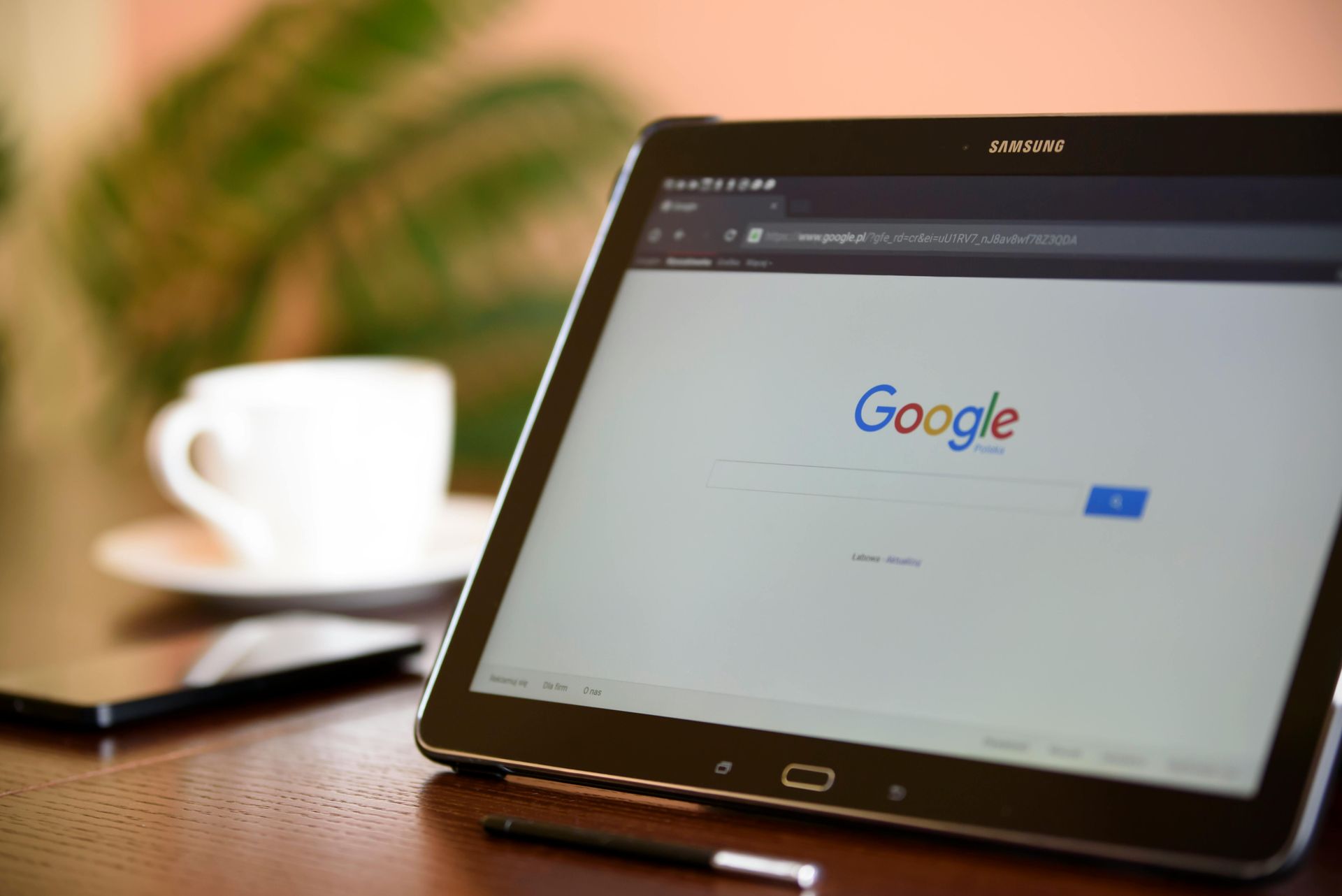
Google $GOOGL, the company Page and Brin founded to commercialize PageRank, launched publicly in 1998 and within a few years had become the dominant search engine globally. Its text-based advertising model — ads displayed alongside search results, priced by auction and relevant to the search query — became the economic foundation of the commercial web, generating revenues that funded the infrastructure, the products, and the acquisitions that define the internet economy.
Behind almost every digital service that stores and retrieves information — which is to say, behind almost every digital service — is a database. And behind most databases is a conceptual model developed by Edgar F. Codd, a British computer scientist working at IBM $IBM, and published in a landmark 1970 paper: the relational model of data.
Before Codd's model, databases were organized hierarchically or as networks — data was stored in tree structures or linked chains, and retrieving it required knowing the physical structure of the storage and navigating it explicitly. The approach worked for specific, predictable queries but was inflexible when the questions changed or the data structure needed to evolve. Changing the database structure could break every application that used it.
Codd proposed organizing data as a series of tables — relations, in mathematical terminology — in which each row represented a record and each column an attribute. Data in different tables could be related through shared key values, and any query that could be expressed in relational algebra could be answered without knowing anything about the physical storage of the data. The query language — eventually standardized as SQL, Structured Query Language — allowed users to ask questions of the data in a form that was independent of how the data was stored.
The relational database transformed what organizations could do with their data. Queries that would previously have required a programmer to write custom navigation code could be expressed in a few lines of SQL. Data from different tables could be combined in ways that the original database designer had not anticipated. The flexibility of the relational model meant that databases could evolve as organizational needs changed without requiring wholesale reconstruction.
Every major internet service — from banking systems to e-commerce platforms to social networks — is built on relational databases or their descendants. The data that defines your relationship with every digital service you use is, in most cases, stored in a form that traces directly to a paper Edgar Codd published in 1970.
JJ Ying / Unsplash
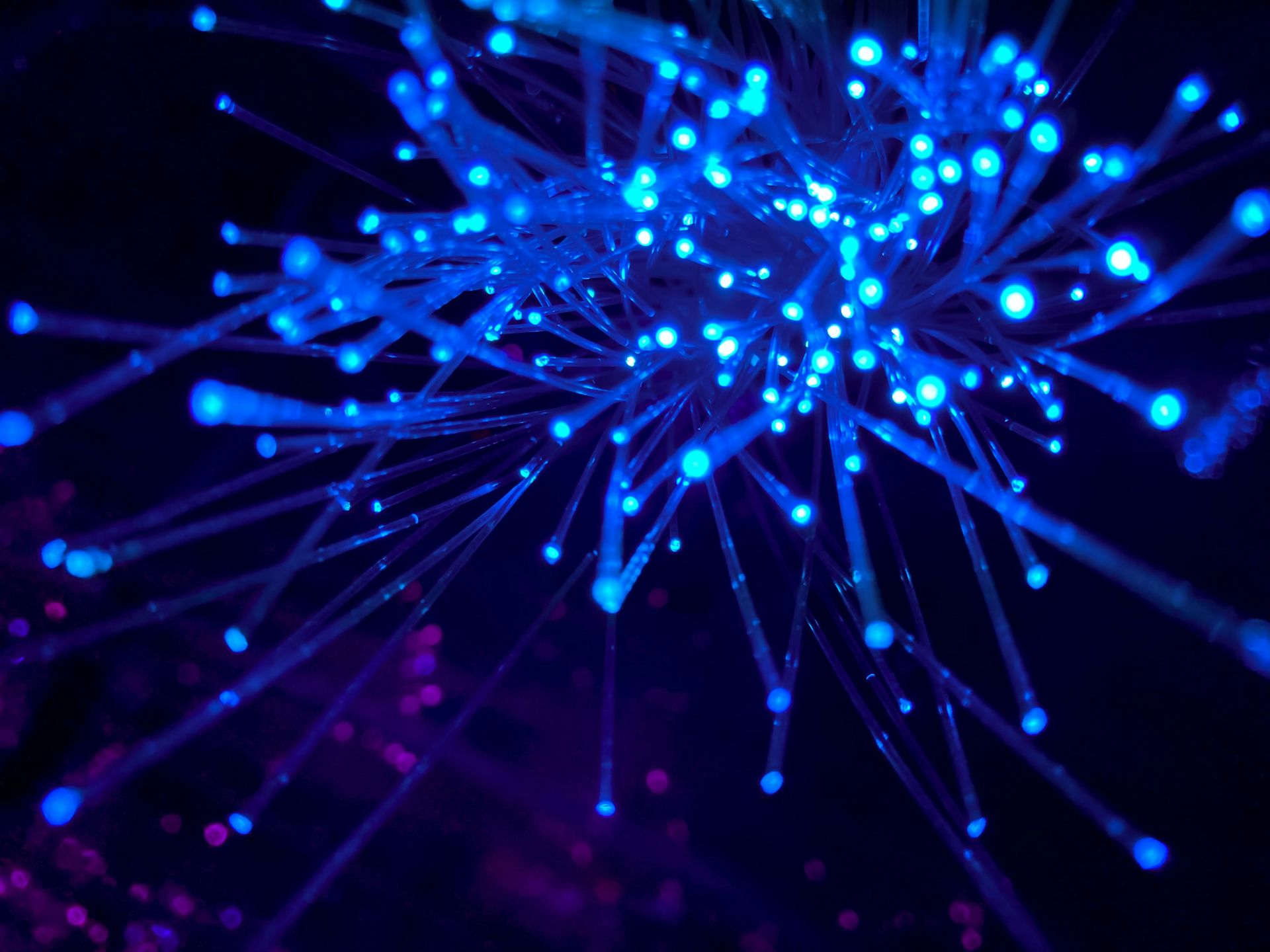
Data moves across the internet through cables — and for the distances that matter at global scale, those cables carry data not as electrical signals but as pulses of light traveling through glass fibers thinner than a human hair. Fiber optic communication, developed through the 1960s and 1970s and deployed at commercial scale beginning in the 1980s, provided the bandwidth and the transmission distances that made the global internet physically possible.
The critical advance was low-loss optical fiber — glass pure enough that light could travel through it for kilometers without becoming too faint to detect. Charles Kao, working at Standard Telecommunication Laboratories in the U.K., published a paper in 1966 arguing that the attenuation losses in existing glass fibers were due to impurities rather than fundamental physical limits, and that fiber sufficiently pure to be practical for communication could be manufactured. Corning Glass Works in the U.S. produced the first fiber meeting Kao's specifications in 1970. Kao received the Nobel Prize in Physics in 2009.
The capacity advantage of fiber over copper wire is enormous. A single fiber optic cable can carry hundreds of terabits of data per second — orders of magnitude more than the copper cables that preceded it. The cost per bit transmitted has fallen steadily as the technology has improved, making high-bandwidth internet access economically viable first for institutions, then for businesses, then for homes.
The physical infrastructure of the internet — the submarine cables that cross oceans, the backbone networks that connect continents, the long-haul links that carry traffic between cities — is almost entirely fiber optic. When you send a message from one continent to another, it travels as light through glass cables laid on the ocean floor, a physical reality that is easy to forget in the age of wireless everything but that underlies every international digital communication.
The smartphone, the laptop, the electric vehicle, and the wireless earphone all share a dependency on a single enabling technology: a battery that stores enough energy to power a device for hours, is light enough to carry, can be recharged thousands of times without significant degradation, and is safe enough to put in a pocket. The lithium-ion battery, developed through the 1970s and 1980s and first commercialized by Sony $SONY in 1991, is that technology.
The key figures in lithium-ion battery development — John Goodenough, M. Stanley Whittingham, and Akira Yoshino — shared the Nobel Prize in Chemistry in 2019, more than four decades after the foundational work was done. Goodenough, who made the critical advance of identifying cobalt oxide as a cathode material that dramatically improved energy density, was 97 years old when he received the prize — the oldest Nobel laureate in history.
The energy density of lithium-ion batteries — the amount of energy they store per unit of weight — is approximately 150 to 200 watt-hours per kilogram, roughly three times that of the nickel-metal hydride batteries that preceded them in consumer electronics. That improvement, combined with the ability to recharge hundreds of times and a relatively flat discharge curve, made lithium-ion the enabling technology for portable computing in a way that no previous battery chemistry had managed.
Without lithium-ion, the laptop is a desk-bound machine tethered to a power outlet. The smartphone does not exist in its current form. Electric vehicles remain a niche curiosity. The portability and untethered mobility that characterize digital life in the 21st century depend on the ability to store electrical energy in a form that is light, dense, and rechargeable — a problem that lithium-ion solved and that researchers are still working to solve better.
Dreamlike Street / Unsplash
The physical infrastructure of the internet runs on fiber and copper. The last connection — between that infrastructure and the device in your hand — runs on radio waves, and the standard that governs how those radio waves carry data between devices and wireless access points is Wi-Fi, a set of protocols based on the IEEE 802.11 standard that has become the universal means of wireless local area networking.
Wi-Fi's origins involve a patent dispute, a scientific coincidence, and an Australian government research agency. The core technology — a technique called orthogonal frequency-division multiplexing, used to transmit data across multiple frequency channels simultaneously — was developed by John O'Sullivan and colleagues at the CSIRO (Commonwealth Scientific and Industrial Research Organisation) in Australia in the late 1980s, originally as part of research into detecting exploding mini black holes. The technique turned out to be exactly what wireless networking needed to deal with the multipath interference that causes signal degradation in indoor environments.
The first Wi-Fi standard was ratified in 1997, and the Wi-Fi Alliance was formed in 1999 to certify interoperability between products from different manufacturers. The decision to require interoperability certification — ensuring that a Wi-Fi device from any manufacturer would work with an access point from any other manufacturer — was the organizational equivalent of making TCP/IP an open standard: it prevented the fragmentation of the wireless networking market into incompatible proprietary systems and allowed Wi-Fi to become a universal infrastructure.
The proliferation of Wi-Fi access points in homes, offices, cafes, airports, and public spaces transformed the economics of internet access and the geography of where digital work could happen. The assumption that internet connectivity is available in any indoor environment — an assumption so embedded in daily life that its absence feels like a failure — is the product of a wireless standard that most people have never heard of and would be hard-pressed to explain.
Christian Wiediger / Unsplash
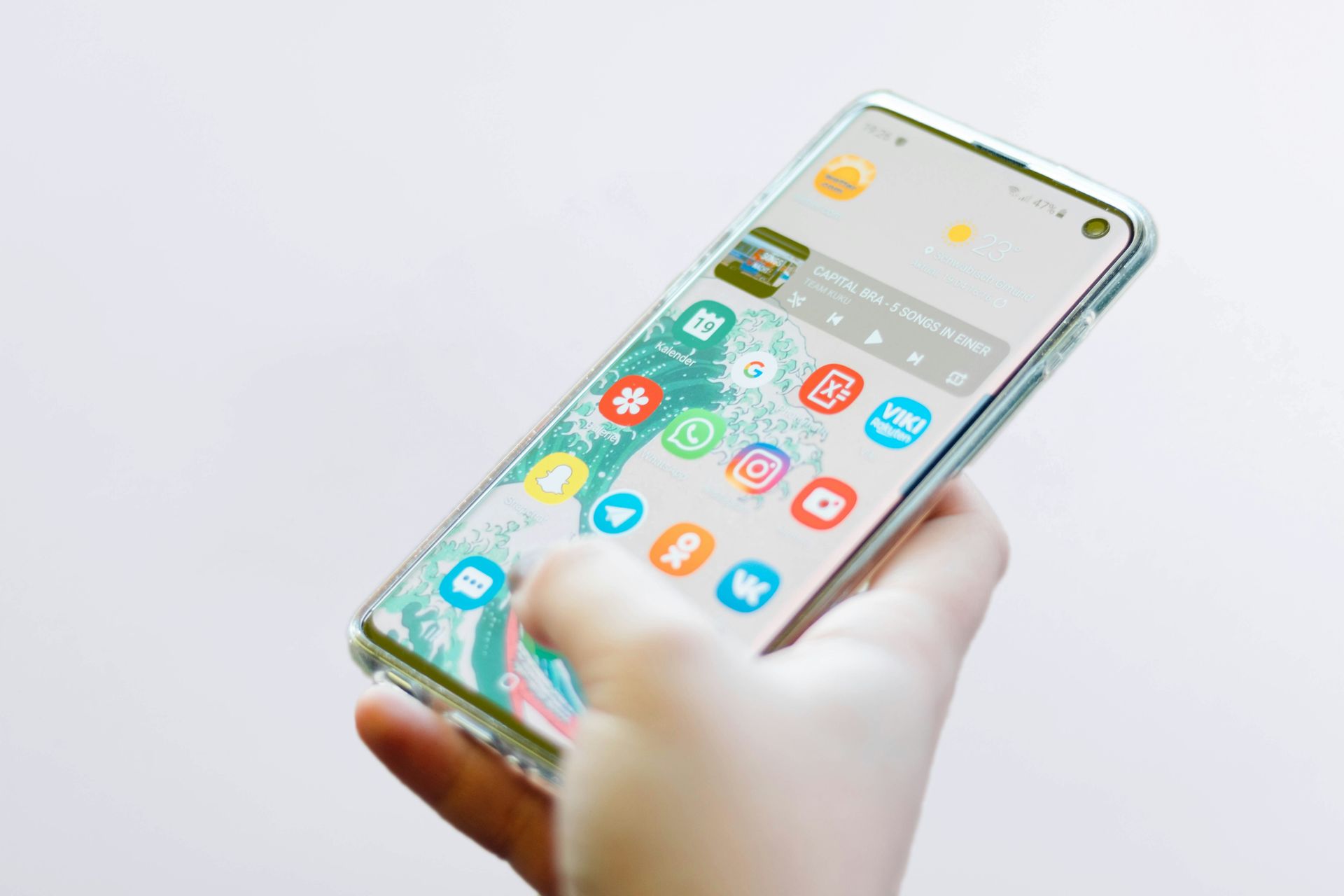
The smartphone is the most consequential consumer device of the early 21st century — a convergence of phone, camera, computer, GPS receiver, music player, and internet terminal into a single object that a majority of the world's adult population carries at all times. Its influence on communication, commerce, navigation, entertainment, social life, and attention is so pervasive that describing it risks understatement.
The iPhone, introduced by Apple $AAPL on January 9, 2007, is the device most associated with the smartphone era, and Steve Jobs's presentation of it — "an iPod, a phone, and an internet communicator" — remains one of the most effective product introductions in technology history. But the iPhone was a synthesis rather than a creation from scratch. It combined technologies that already existed — capacitive touchscreens, mobile internet, GPS, digital cameras, lithium-ion batteries, ARM processors — into a form factor and an interface that made them work together in a way no previous device had.
What Apple contributed was the software — iOS, the App Store model, the gesture-based interface that made a large touchscreen the primary input method — and the industrial design that made the combination feel inevitable rather than provisional. Google $GOOGL's Android, released in 2008, provided an alternative platform that allowed the smartphone to scale to billions of users who were not Apple customers, and the two-platform duopoly that resulted remains the structure of the mobile computing market.
The smartphone changed what proximity means — you are reachable anywhere, at any time, through multiple channels simultaneously. It changed what information access means — any question can be answered in seconds. It changed what navigation means — getting lost requires active effort. It changed what commerce means — purchasing decisions happen in any context, not just in stores. And it changed what attention means — the continuous availability of the device produces behavioral patterns and psychological effects that researchers are still working to understand.
The Global Positioning System — a network of satellites operated by the U.S. Department of Defense that allows any receiver on Earth to determine its location to within a few meters — was designed to guide nuclear submarines and direct ballistic missiles. Its application to consumer navigation, logistics, agriculture, and the infrastructure of the digital economy was not planned. It was a consequence of the decision, made in 1983 following the Soviet shootdown of Korean Air Lines Flight 007, to make GPS signals available to civilian users without charge.
The system reached full operational capability in 1995, with 24 satellites in orbit providing continuous global coverage. The first consumer GPS receivers were large, expensive, and slow to acquire a satellite fix. By the early 2000s, they had become small enough and cheap enough to integrate into smartphones, and the combination of GPS location data with digital maps and mobile internet produced the turn-by-turn navigation systems that have largely replaced paper maps and the specialized knowledge of local geography that drivers once needed.
The economic consequences of GPS extend far beyond navigation. Precision agriculture — the use of GPS to guide planting and harvesting equipment to centimeter accuracy, reducing overlap and waste — has changed the economics of farming. Just-in-time logistics — the ability to track the location of vehicles and shipments in real time — has restructured supply chains. Financial markets use GPS timing signals — accurate to billionths of a second — to timestamp transactions. The internet itself uses GPS timing to synchronize the clocks of servers around the world, a function so fundamental that GPS failure would disrupt the internet in ways most people do not anticipate.
The smartphone made GPS personal. The app economy that GPS enabled — ride-hailing, food delivery, location-based services of every description — is one of the most economically significant sectors of the digital economy, built entirely on the availability of accurate location data from a satellite network originally designed for military navigation.
Photography went digital because of a device called the charge-coupled device — the CCD — invented in 1969 by Willard Boyle and George Smith at Bell Labs. The CCD is an image sensor that converts light into electrical charge, which can then be read out and digitized as pixel values. Along with the later CMOS sensor, the CCD enabled the transition from film to digital photography, fundamentally changing how images are captured, stored, shared, and used.
The practical implications of digital photography extend far beyond the replacement of film with memory cards. The marginal cost of taking a photograph dropped to effectively zero — you could take a thousand photographs at no additional expense and delete the ones you didn't want. That zero marginal cost changed behavior: people photograph more, photograph differently, use photographs in contexts — messaging, social media, documentation — where the cost of film would have made photography impractical.
The smartphone camera, which now accounts for the vast majority of photographs taken globally, is the consumer endpoint of a technology chain that runs from the CCD through digital image processing, compression algorithms, and mobile internet. The ability to take, process, and share a photograph in seconds — from any location with mobile connectivity — has changed journalism, social interaction, personal memory, and surveillance simultaneously.
Boyle and Smith received the Nobel Prize in Physics in 2009 for the invention of the CCD. The citation noted that the device had created entirely new industries and changed how human beings record and share their experience of the world — an assessment that, if anything, understates the scope of the change.
The touchscreen — a display that responds to direct finger contact, allowing users to interact with on-screen elements by touching rather than by manipulating a separate input device — predates the smartphone by four decades. The first touch-sensitive display was developed by E.A. Johnson at the Royal Radar Establishment in the U.K. in the mid-1960s and published in 1965. The first multitouch screen — capable of detecting and responding to multiple simultaneous touch points — was developed at the University of Toronto in 1982.
The resistive touchscreen, which detects touch by the pressure-induced contact between two conductive layers, was the dominant technology for consumer touchscreens through the 1990s and 2000s — used in ATMs, point-of-sale terminals, and early smartphones including the first generation of Windows Mobile devices. Resistive screens required physical pressure to activate and could not accurately detect multiple simultaneous touches, limiting their usefulness as a primary input method.
The capacitive touchscreen, which detects the electrical conductivity of a finger without requiring physical pressure, enabled the multi-touch gestures — pinch to zoom, swipe, two-finger scroll — that define smartphone interaction. Capacitive technology had existed for decades but required the combination of a sufficiently powerful processor and sufficiently sophisticated software to translate raw touch data into gesture recognition in real time. Apple $AAPL's implementation in the original iPhone in 2007 was the first consumer device to use capacitive multitouch at a quality and responsiveness that made it feel natural rather than approximate.
The touchscreen removed the last barrier between the user and the digital interface — the keyboard, the mouse, the stylus — and made computing genuinely direct in a way that no previous input method had achieved. Its adoption as the primary input method for smartphones and tablets changed what computing was, who could do it, and at what age people could begin.
Cloud computing — the delivery of computing resources including storage, processing power, databases, and software over the internet, on demand, without local infrastructure — is the organizational and economic model that underlies most of the digital services people use. It is not a single invention but a convergence of several technologies — virtualization, distributed computing, broadband internet, large-scale data centers — into a service model that made enterprise-grade computing infrastructure accessible to organizations of any size.
Amazon $AMZN Web Services, launched in 2006 with a simple file storage service called S3 and a virtual computing service called EC2, is the organization most responsible for defining cloud computing as a commercial category. The insight behind AWS was that Amazon had built a massive internal computing infrastructure to run its e-commerce operations, and that the excess capacity of that infrastructure could be rented to other organizations at a cost below what those organizations would pay to build their own. The business model — pay only for the computing resources you actually use, with no upfront capital expenditure — was transformative for startups in particular, which could now launch services without the capital investment that server infrastructure previously required.
The cloud changed the economics of starting a digital business. Before AWS and its competitors — Microsoft $MSFT Azure, Google $GOOGL Cloud, and others that followed — building an internet service required purchasing servers, finding a data center, and making capital investments in infrastructure before a single customer had signed up. After the cloud, those capital costs became variable operating costs, payable only as the service scaled. That shift reduced the capital required to start a digital business by orders of magnitude and contributed directly to the explosion of technology startups in the 2010s.
The cloud also changed the economics of data. Storage costs on cloud platforms fell steadily, making it practical to retain and analyze data at scales that would previously have been prohibitively expensive. The data analytics, machine learning, and artificial intelligence applications that define the current frontier of the digital economy all depend on the ability to store and process data at cloud scale.
The algorithm — a defined sequence of steps for solving a problem or accomplishing a task — is not a single invention but a concept so fundamental to computing that it deserves recognition as the underlying intellectual framework of the digital age. Every software program is a collection of algorithms. Every digital system — recommendation engines, search results, fraud detection, GPS routing, autocorrect — is running algorithms. The question of which algorithm is used, and how it is designed, determines the outputs of every digital system in existence.
The word "algorithm" derives from the name of the 9th-century Persian mathematician Muhammad ibn Musa al-Khwarizmi, whose treatise on arithmetic introduced the decimal system to the Islamic world and, eventually, to Europe. The concept of a defined computational procedure predates computing by centuries. What the digital age did was make algorithms executable at scale — capable of processing millions of inputs and producing millions of outputs per second, invisibly, continuously, across every digital surface.
The specific algorithms that shaped the digital age are numerous: the PageRank algorithm that made Google $GOOGL's search useful; the RSA algorithm that made secure internet communication possible; the compression algorithms that made digital audio, video, and images transmissible over the internet; the recommendation algorithms that determine what content billions of people see on social media and streaming platforms; the sorting and searching algorithms that make databases fast enough to be practical.
What unites these is not their technical details but their social consequence: algorithms make decisions, and the decisions they make are not neutral. A recommendation algorithm that optimizes for engagement will recommend whatever produces the most engagement, regardless of whether that content is accurate, healthy, or socially constructive. The design choices embedded in an algorithm — what it optimizes for, what data it uses, what outcomes it treats as equivalent — are consequential in ways that are often invisible to the people affected by them. The algorithm is the most powerful and the least understood technology of the digital age.
The ability to communicate privately over a public network — to send a message that only the intended recipient can read, even though it passes through infrastructure controlled by third parties — is the property that makes the internet safe for banking, commerce, healthcare, and personal communication. That property is provided by encryption, and the specific breakthrough that made encryption practical for internet communication was public-key cryptography, invented by Whitfield Diffie and Martin Hellman in 1976.
Before public-key cryptography, secure communication over a network required that the communicating parties first exchange a secret key through some secure channel — a meeting in person, a courier, a diplomatic pouch. That requirement made secure communication expensive and impractical at scale. You could not establish a secure channel with a bank or a merchant you had never met without first arranging the key exchange through some other secure means, which rather defeated the purpose.
Diffie and Hellman's insight was mathematically elegant: it is possible to design a system in which two parties can establish a shared secret over an insecure channel, in public, without any prior exchange of information. The mathematics depends on computational asymmetry — certain mathematical operations are easy to perform but extremely difficult to reverse. Multiplying two large prime numbers together is straightforward; factoring the result back into its component primes is, for sufficiently large numbers, computationally infeasible with current technology.
RSA encryption, developed by Ron Rivest, Adi Shamir, and Leonard Adleman in 1977 and now used in essentially all secure internet communication, implemented Diffie and Hellman's concept in a practical system. The padlock icon in your browser's address bar — the visual indicator that you are communicating with a website over an encrypted connection — represents a descendant of the mathematics Diffie and Hellman published in 1976. Every online purchase, every banking transaction, every private message sent over the internet is protected by cryptography that traces to that paper.
Olivier Collet / Unsplash
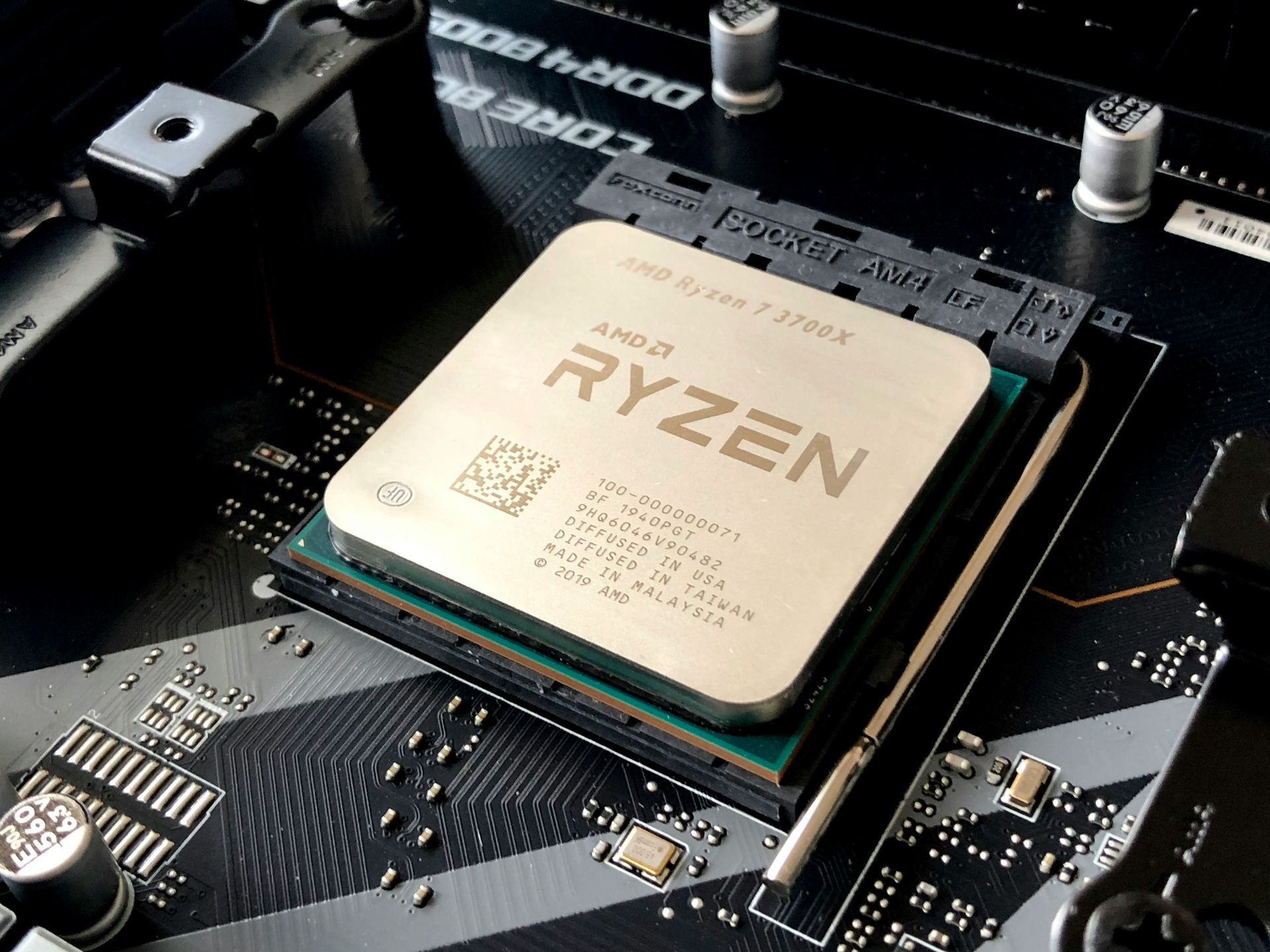
The microprocessor — a complete central processing unit implemented on a single chip — is the direct descendant of the integrated circuit and the immediate ancestor of every computing device in existence. It combined, for the first time, all the logic required to execute a program — the arithmetic unit, the control unit, the registers — onto a single piece of silicon, creating a complete, general-purpose computer on a chip that could be mass-produced and embedded in any device.
Intel $INTC's 4004, released in November 1971, is generally credited as the first commercial microprocessor. It was designed by Federico Faggin, Ted Hoff, and Stanley Mazor for a Japanese calculator company, Busicom, and delivered 2,300 transistors on a chip that measured approximately 12 square millimeters. It ran at 740 kilohertz and could perform approximately 92,000 operations per second — less computing power than a modern digital wristwatch, but a complete CPU in a package previously unimaginable.
The Intel 8008 followed in 1972, the 8080 in 1974, and the 8086 in 1978 — the architecture from which the x86 instruction set that still dominates personal computing descends. The IBM $IBM PC, introduced in 1981, used the Intel 8088. The lineage from the 4004 to the processors in contemporary laptops and servers is direct and unbroken, a continuous development of the same basic architecture across 50 years and billions of transistors.
The microprocessor changed the economics of computing by making the CPU manufacturable at consumer prices. Before the microprocessor, a CPU was a large and expensive assembly of discrete components. After it, the CPU was a mass-produced commodity that could be embedded in a calculator, a game, an appliance, or a car. The intelligence of the digital age — its ability to process, store, and transmit information at scale — runs on microprocessors, and the microprocessor is what made that intelligence manufacturable at the scale the digital age required.
The digital files that represent audio, video, and images are enormous in their uncompressed form. A single minute of uncompressed CD-quality audio occupies roughly ten megabytes. A single frame of uncompressed high-definition video occupies several hundred megabytes. Without compression — algorithms that reduce the size of digital files by removing redundant or perceptually irrelevant information — digital media as it exists would be economically and logistically impossible. Streaming video would require bandwidth that does not exist. Music libraries would require storage that no consumer device could provide. The internet as a medium for media distribution would not function.
Compression algorithms fall into two categories. Lossless compression, used for text, software, and data where exact reconstruction is required, removes statistical redundancy from the file without discarding any information. The ZIP file format and the PNG image format are lossless. Lossy compression, used for audio, video, and photographs, discards information that the human perceptual system is unlikely to notice — quiet sounds masked by louder ones, fine detail in regions of uniform color, subtle color variations that the eye does not distinguish from their neighbors. The discarded information cannot be recovered, but the resulting file is dramatically smaller and the perceptual difference is minimal.
The MP3 audio format, developed at the Fraunhofer Institute in Germany and standardized in 1993, reduced the size of a CD audio file by roughly a factor of ten with minimal perceptible quality loss. The consequences — Napster, the iPod, iTunes, and the restructuring of the entire recorded music industry — followed directly from the existence of a file format small enough to download over a dial-up internet connection in a reasonable amount of time.
The H.264 video codec, standardized in 2003, made high-definition video streaming practical by compressing video by factors of hundreds relative to uncompressed formats. YouTube, Netflix $NFLX, video calling, and the entirety of online video as an industry depend on compression algorithms for their basic feasibility. The compression algorithm is one of the least glamorous and most consequential inventions in the history of the digital age.
The artificial neural network — a computational model loosely inspired by the structure of biological neurons, capable of learning patterns from data — is the technology underlying the current wave of artificial intelligence: the image recognition systems that identify faces in photographs, the language models that generate text and answer questions, the recommendation algorithms that select content on streaming platforms, the systems that flag fraudulent transactions, and dozens of other applications that have become embedded in daily digital life.
The concept of the artificial neural network dates to 1943, when Warren McCulloch and Walter Pitts published a mathematical model of a neuron. The field went through cycles of enthusiasm and disappointment — periods now referred to as "AI winters" — before the combination of larger datasets, more powerful processors, and architectural innovations produced the breakthrough results of the 2010s.
The specific advance that initiated the current era was the demonstration in 2012 by Geoffrey Hinton, Ilya Sutskever, and Alex Krizhevsky that a deep neural network — one with many layers of processing — trained on the ImageNet dataset could recognize objects in photographs with an accuracy dramatically better than any previous approach. The AlexNet architecture they developed won the ImageNet Large Scale Visual Recognition Challenge by a margin so large that it convinced the field that deep learning was the right direction.
Hinton, along with Yann LeCun and Yoshua Bengio — the other researchers who sustained neural network research through the difficult years before the breakthrough — received the Turing Award in 2018. Hinton received the Nobel Prize in Physics in 2024, shared with John Hopfield, for foundational discoveries that enabled machine learning with artificial neural networks.
The consequences of the neural network for the digital age are still accumulating. The large language models that produce human-quality text, the image generators that produce photorealistic images from text descriptions, the protein structure predictors that are transforming drug discovery — all of them are descendants of the architectural ideas that Hinton and his colleagues developed and the training methods that made those architectures work. The neural network may prove to be the most consequential invention on this list, though the distance needed to assess that claim clearly does not yet exist.
Open-source software — software whose source code is publicly available, freely modifiable, and freely distributable — is not a single invention but a movement and a licensing philosophy that produced some of the most widely used software infrastructure in the digital age and established a model of collaborative development that changed how software is built.
The philosophical foundation was laid by Richard Stallman, a programmer at MIT who in 1983 launched the GNU Project — an effort to build a free, open-source operating system — and in 1985 published the GNU Manifesto, articulating the principle that software should be free to use, study, modify, and distribute. Stallman's Free Software Foundation and the GPL (General Public License) it developed created a legal framework for open-source software that protected its openness while allowing it to be used commercially.
Linus Torvalds's creation of the Linux kernel in 1991 — announced in a modest post to a Usenet newsgroup as "just a hobby" — gave the open-source movement its most significant practical contribution: a free, open-source operating system kernel that has since become the foundation of Android, the dominant mobile operating system, and of the vast majority of the world's web servers and supercomputers. The internet runs on Linux in a more literal sense than most people who use the internet appreciate.
The open-source model produced a catalog of software infrastructure — the Apache web server, the MySQL database, the Python and Perl programming languages, the Firefox browser — that the commercial internet was built on. The economics of open-source are distinctive: the software is free to use, the development is distributed across thousands of contributors globally, and the value is captured not by selling the software but by selling services, support, and complementary products built on top of it. That model changed the software industry permanently and gave small startups access to enterprise-grade infrastructure that would previously have cost millions of dollars in licensing fees.
