
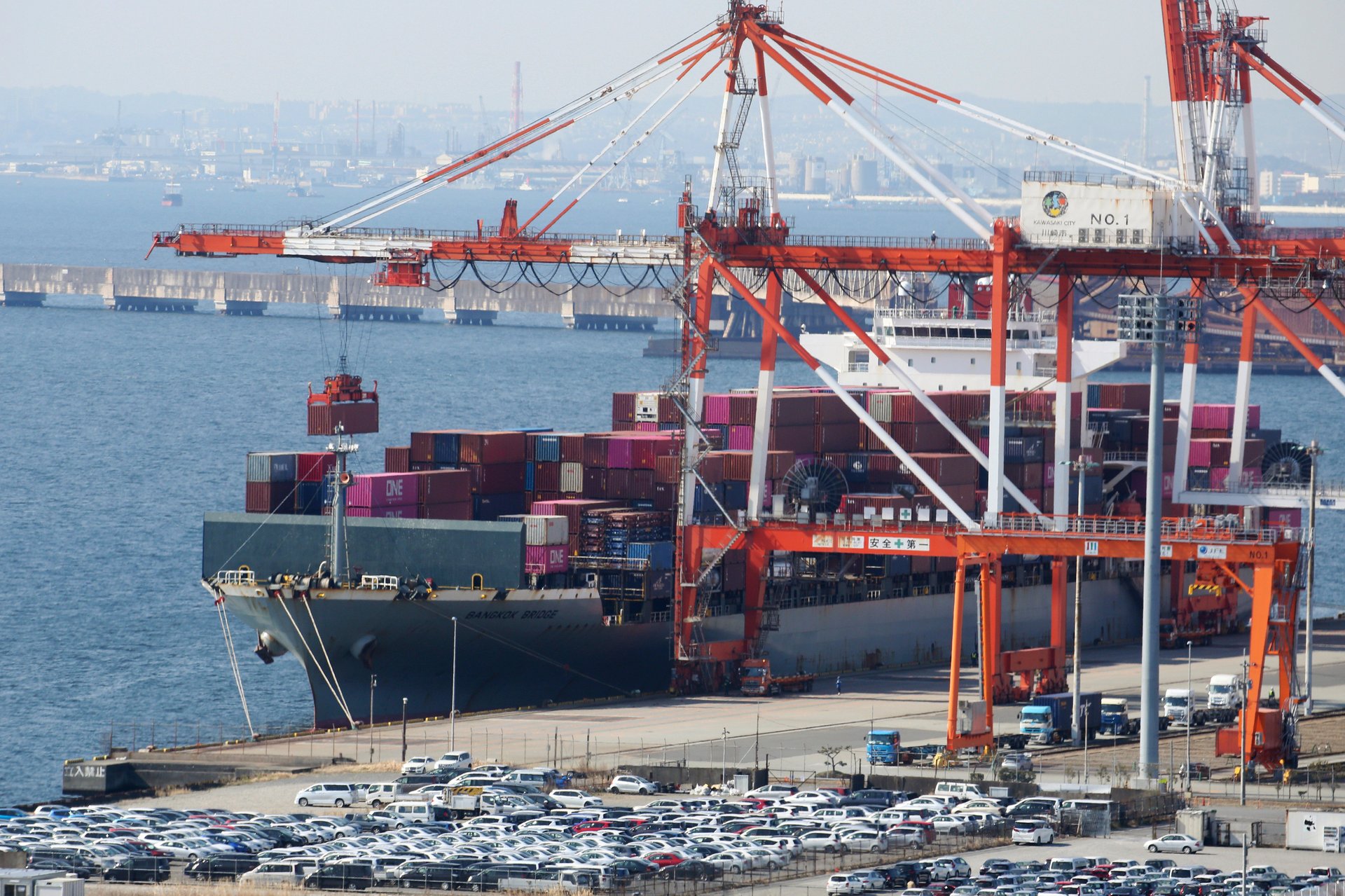
BANGKOK (AP) — Japan's exports surged almost 10% in December from a year earlier, helped by a revival in trade with China and strong demand for vehicles, machinery and computer chips.
Imports fell almost 7%, leaving a trade surprise of 62 billion yen ($410 million), according to preliminary customs data released Wednesday.
A weak Japanese yen has helped export manufacturers like Toyota $TM, Honda $HMC and Sony $SONY, though it increases costs of imports of key commodities like oil and gas needed to fuel the world's third-largest economy.
A decline in oil prices helped reduce the burden of energy imports in December, which fell by 18% from a year earlier.
A recovery in demand in China contributed to a 10% increase in exports, while imports from China were flat.
Another boost came from a surge in tourist arrivals, which are counted as exports in trade statistics.
The improvement late in the year “means that overall net exports should have made a significant contribution to GDP growth in the fourth quarter," Gabriel Ng of Capital Economics said in a report. But he added that “Looking ahead, we expect export growth will be sluggish this year.”
Data from a preliminary survey of factory managers also released Wednesday likewise showed weakness in the export manufacturing sector, with "new export orders” falling to 46.0 from 46.4 on a scale up to 100 where 50 marks the cut-off between expansion and contraction.
Exports to the U.S., Japan's single largest export market, jumped 20% in December from the year before, while imports of U.S. goods fell 7%.
Shipments of cars rose 16% in unit terms, to 1.47 million vehicles, and more than 35% in dollar value. Power generation equipment, construction machines and semiconductors also showed strong growth.
For the full year, Japan’s exports grew 3%, to 100.9 trillion yen ($680 billion) and imports fell 7% to 110.2 trillion yen ($740 billion). The trade deficit was 9.2 trillion yen ($62 billion), down sharply from a deficit of 20.3 trillion yen in 2022.